
Exostosis in detail for 50 marks with diagram and flow charts from Scott Brown, Cummings, stell and marans, Zakir Hussain, dhingra, hazarika and related articles with recent advances according to rguhs university
Reading File
Finding Sources
Finding Sources
Finding Sources
Finding Sources
Reading File
Reading File
Reading File
Loading Image
Searching Images
EAC exostosis osteoma external auditory canal grading surgery
Reading File
Loading Image
Loading Image
I now have rich content from Cummings Otolaryngology and Grainger & Allison's Radiology, plus excellent clinical and CT images. Let me now compile the comprehensive 50-mark answer.
EXOSTOSIS OF THE EXTERNAL AUDITORY CANAL
A Comprehensive Review for 50 Marks | RGUHS ENT
1. DEFINITION
Exostosis (plural: exostoses) of the external auditory canal (EAC) is a benign, non-neoplastic, reactive bony outgrowth arising from the periosteum of the osseous EAC wall. It consists of hyperplastic cortical and cancellous bone covered by normal thin squamous epithelium. Also called "Surfer's Ear" due to its strong association with cold water exposure.
"Exostoses are usually broad-based and bilateral, whereas osteomas are pedunculated, unilateral and usually lateral to the bony isthmus of the canal." — Grainger & Allison's Diagnostic Radiology
2. HISTORICAL BACKGROUND
- First described systematically in cold-water swimmers and surfers
- Distinguished from osteoma (a true benign neoplasm) by Fowler and Osmun (1942)
- "Surfer's ear" terminology popularized in the 1970s after epidemiological studies in California and Australia
- Separate entity from hyperostosis (diffuse bony thickening vs. focal nodular growth)
3. ANATOMY RELEVANT TO EXOSTOSIS
EXTERNAL AUDITORY CANAL (EAC)
├── Length: ~25 mm
├── Outer 1/3: Fibrocartilaginous (lateral)
│   └── Contains ceruminous & sebaceous glands
│   └── Deficiencies = Fissures of Santorini
├── Inner 2/3: Osseous (medial)
│   └── Tympanomastoid suture line (posterior)
│   └── Tympanosquamous suture line (anterior)
│   └── SITE OF EXOSTOSIS ORIGIN ← Here
├── Isthmus: Narrowest point (~5mm diameter)
└── Tympanic Membrane: at the medial end
Exostoses arise along the tympanomastoid and tympanosquamous suture lines — the sites of active periosteal bone formation.
(Cummings Otolaryngology Head and Neck Surgery)
4. ETIOLOGY AND PATHOGENESIS
4.1 Etiology
| Cause | Details |
|---|---|
| Cold water exposure | Primary cause — surfers, swimmers, divers |
| Cold wind exposure | Secondary contributing factor |
| Repeated thermal stress | Periosteal stimulation → reactive bone formation |
| Male sex | Males affected 6:1 over females |
| Years of exposure | Directly correlates with severity |
4.2 Pathogenesis (Flow Chart)
COLD WATER / COLD AIR EXPOSURE
           ↓
Repeated thermal stimulation of osseous EAC periosteum
           ↓
Periosteal irritation & inflammation
           ↓
Activation of osteoblasts at tympanomastoid/tympanosquamous suture lines
           ↓
Subperiosteal reactive bone deposition (lamellar bone)
           ↓
Broad-based sessile bony nodular growth
           ↓
Progressive narrowing of EAC lumen
           ↓
Symptoms (when lumen < 3mm)
    ├── Cerumen/debris trapping
    ├── Recurrent otitis externa
    └── Conductive hearing loss
"Exostoses and osteomas are thought to originate along the tympanomastoid and tympanosquamous suture lines during phases of bony growth and after prolonged or repetitive exposure of the ears to cold water." — Cummings Otolaryngology Head and Neck Surgery
5. PATHOLOGY
Macroscopy
- Broad-based, sessile, smooth nodular bony protrusions
- Bilateral (unlike osteoma which is unilateral)
- Multiple (usually 2–3 nodules per ear)
- Covered by thin, normal squamous epithelium
- Located medial to the isthmus of the bony canal
Microscopy
- Composed of lamellar cortical bone (mature, organized)
- Periosteal covering intact
- No active neoplastic cells
- Scant fibrovascular stroma
- Contrast with osteoma: cancellous bone + fibrovascular core
6. EPIDEMIOLOGY
| Parameter | Data |
|---|---|
| Prevalence in surfers | Up to 73% after 10+ years |
| Male:Female ratio | 6:1 |
| Peak age | 3rd–4th decade |
| Laterality | Bilateral in >80% |
| Cold water threshold | <19°C (66°F) |
| Association with years surfing | Linear correlation |
7. CLINICAL FEATURES
Symptoms
- Asymptomatic in majority (incidental finding)
- Recurrent otitis externa — most common presenting complaint
- Conductive hearing loss — when lumen < 3 mm
- Narrowing <3 mm → loss of high-frequency perception
- Further narrowing → low-frequency loss
- Sensation of blocked ear / aural fullness
- Debris/cerumen accumulation medial to the exostosis
- Tinnitus (rare)
- Otalgia (if secondary infection present)
Signs
- Otoscopy: Pale, smooth, skin-covered bony nodules projecting from posterior/anterior walls of the osseous EAC
- Usually bilateral, multiple
- Tympanic membrane may not be visualized in advanced cases
- Skin over exostoses is thin and easily traumatized
8. OTOSCOPIC APPEARANCES
Clinical Photograph — EAC Exostosis (from Cummings Otolaryngology):
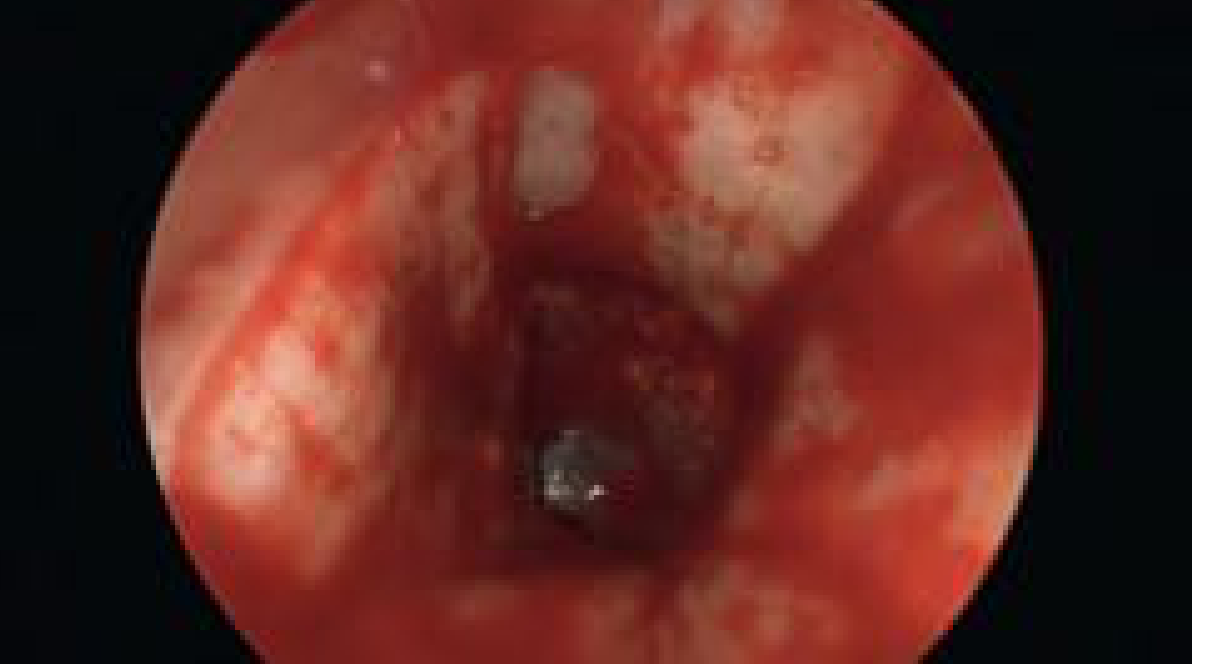
Otoscopic view of EAC exostosis — bilateral pale bony nodules significantly narrowing the canal lumen with the tympanic membrane visible through a narrow central opening.
9. GRADING SYSTEM
Seftel Grading (Most Widely Used)
| Grade | Obstruction | Description |
|---|---|---|
| Grade 1 | < 33% | Small nodule, tympanic membrane fully visible |
| Grade 2 | 34–66% | Moderate narrowing, partial TM view |
| Grade 3 | > 67% | Severe obstruction, TM barely/not visible |
Otoscopic Grading — Grades 1, 2, and 3:
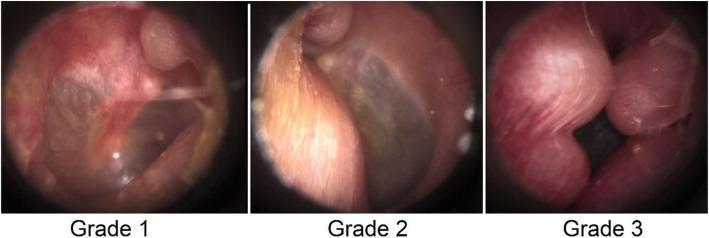
Grading of External Auditory Canal Exostosis: Grade 1 (<33% obstruction), Grade 2 (34–66%), Grade 3 (>67%)
10. EXOSTOSIS vs OSTEOMA — DIFFERENTIAL DIAGNOSIS
| Feature | Exostosis | Osteoma |
|---|---|---|
| Aetiology | Cold water (reactive) | Spontaneous (true neoplasm) |
| Laterality | Bilateral | Unilateral |
| Number | Multiple | Solitary |
| Base | Broad-based, sessile | Pedunculated |
| Location | Medial osseous EAC (suture lines) | Lateral to bony isthmus |
| Histology | Lamellar cortical bone | Cancellous bone + fibrovascular core |
| Gender | Male >> Female | Equal |
| Progression | With continued exposure | Rarely grows |
| CT appearance | Broad-based bilateral bony protrusions | Solitary pedunculated lesion |
| Treatment | Conservative → surgical drilling | Surgical excision |
"The two lesions cannot be distinguished histopathologically; however, exostoses are usually broad-based and bilateral, whereas osteomas are pedunculated, unilateral and usually lateral to the bony isthmus of the canal." — Grainger & Allison's Diagnostic Radiology
11. DIFFERENTIAL DIAGNOSIS FLOW CHART
BONY LESION IN EAC
        ↓
Is it bilateral?
   ├── YES → Multiple, broad-based → EXOSTOSIS (Surfer's ear)
   └── NO  → Is it pedunculated?
                ├── YES → Solitary, lateral to isthmus → OSTEOMA
                └── NO  → Is there canal wall erosion?
                             ├── YES → EAC CHOLESTEATOMA / SCC
                             └── NO  → Keratosis obturans / Stenosis
12. INVESTIGATIONS
12.1 Audiological Investigations
AUDIOLOGICAL WORKUP
├── Pure Tone Audiometry (PTA)
│   └── Conductive hearing loss (air-bone gap)
│   └── Low frequency > High frequency (in severe cases)
├── Tympanometry
│   └── Normal Type A if TM intact
│   └── Reflects middle ear status
└── Acoustic Reflexes
    └── Present = normal middle ear
    └── Absent = ossicular involvement
12.2 Radiological Investigations
CT Temporal Bone (HRCT) — Gold Standard
Key questions to answer on CT (per Grainger & Allison):
- What is the maximum depth and transverse diameter of the exostosis?
- What is the exact site of origin of the osteoma?
- What is the distance between the medial aspect of the exostosis and the TM?
- What is the distance between the deep aspect and the descending facial nerve canal?
- Are there any obstructed secretions in the medial EAC?
- Is the middle ear cleft normally pneumatised?
CT Scan — Osteoma vs Exostosis:
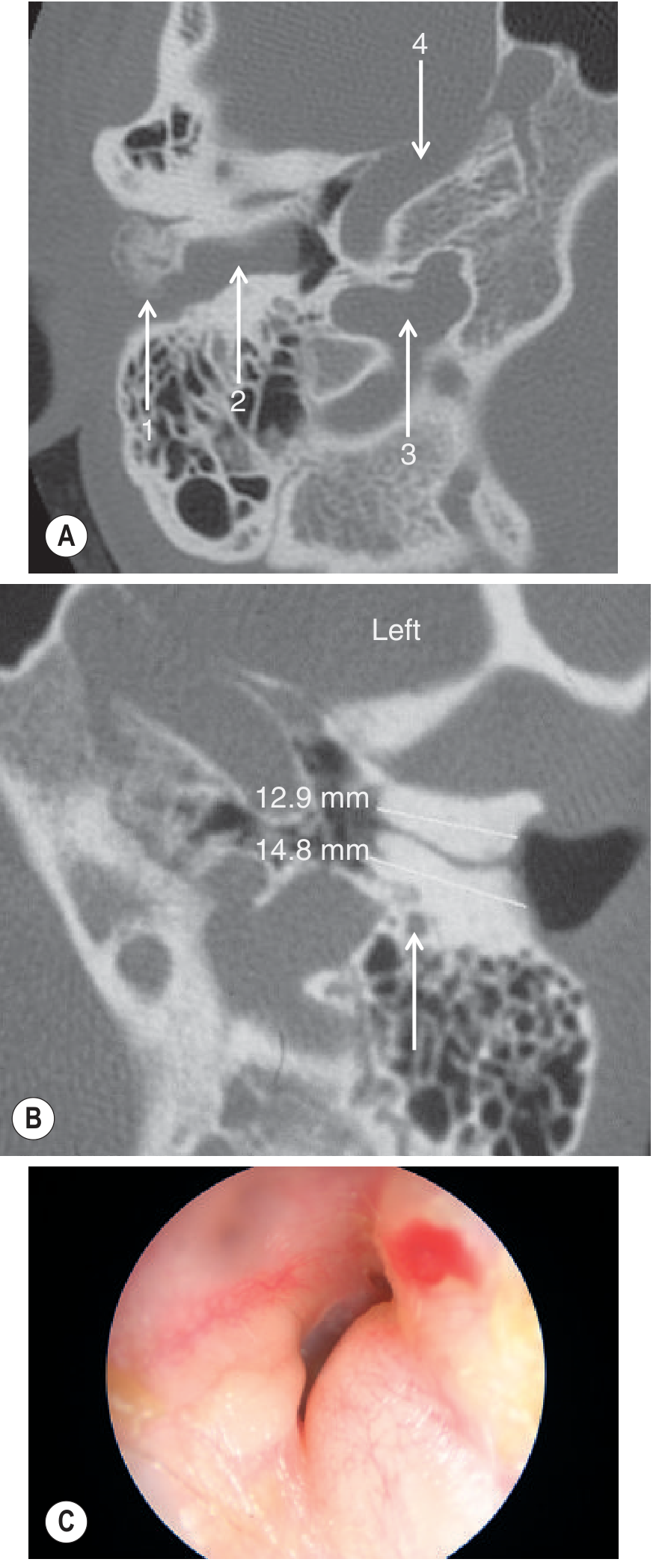
Fig. CT of temporal bones: (A) Pedunculated osteoma (1) with soft tissue medially (2). (B) Bilateral broad-based exostoses with transverse measurements (12.9 mm, 14.8 mm). (C) Otoscopic view showing exostosis narrowing EAC.
(Grainger & Allison's Diagnostic Radiology)
13. MANAGEMENT FLOW CHART
PATIENT WITH EAC EXOSTOSIS
          ↓
ASSESS SEVERITY
          ↓
┌─────────────────────────────────┐
│  Grade 1 / Asymptomatic         │
│  No hearing loss, no infection  │
└─────────────────────────────────┘
          ↓
CONSERVATIVE MANAGEMENT
├── Avoidance of cold water exposure
├── Ear protection (custom ear plugs, neoprene hood)
├── Regular aural toilet (suction microsuction)
├── Treatment of recurrent otitis externa
├── Avoid ear syringing
└── Audiological monitoring (annual PTA)

          ↓ (Indications for surgery met?)

INDICATIONS FOR SURGICAL INTERVENTION
├── Grade 3 (>67% obstruction)
├── Recurrent otitis externa (>3 episodes/year)
├── Conductive hearing loss > 25 dB
├── Debris/keratin accumulation medial to exostoses
├── Patient preference (competitive swimmer/surfer)
└── Failure of conservative management

          ↓

SURGICAL MANAGEMENT
(Canaloplasty / Exostosis Drilling)
├── Post-auricular approach (preferred for large exostoses)
├── Transcanal endaural approach (Grade 1-2)
└── Endoscopic approach (recent advance)
14. SURGICAL TECHNIQUE (CANALOPLASTY)
Approach Selection:
| Approach | Indications |
|---|---|
| Transcanal | Grade 1, small unilateral |
| Post-auricular | Grade 2–3, bilateral, large |
| Endoscopic transcanal | Recent advance (TEES) |
Steps of Canaloplasty (Post-auricular Approach):
CANALOPLASTY — STEP-BY-STEP
Step 1: General/local anaesthesia
         ↓
Step 2: Post-auricular incision
         ↓
Step 3: Meatal incisions (4 o'clock and 6 o'clock)
         ↓
Step 4: Elevation of EAC skin from osseous exostoses
         (CRITICAL: preserve thin skin meticulously)
         ↓
Step 5: Drilling of exostoses with cutting burr
         then diamond burr to smooth
         (avoiding TM, facial nerve, ossicular chain)
         ↓
Step 6: Confirm adequate canal diameter (>8 mm)
         ↓
Step 7: Skin replaced and secured
         ↓
Step 8: Canal packing (± skin graft if skin insufficient)
         ↓
Step 9: Tympanoplasty if TM involved
"Care is taken to elevate the canal skin from the osseous deposition, to drill the exostosis… The tympanic membrane and ossicular chain are identified and protected." — Cummings Otolaryngology Head and Neck Surgery (Fig. 145.9)
Important Surgical Landmarks to Protect:
- Tympanic membrane — medial limit of drilling
- Facial nerve (descending segment) — posterior relation
- Ossicular chain (especially chorda tympani)
- Temporomandibular joint — anterior relation
15. COMPLICATIONS
Complications of Disease (Untreated):
- Recurrent/chronic otitis externa
- Cholesteatoma of EAC (from trapped keratin)
- Conductive hearing loss
- Sensorineural hearing loss (rare, from labyrinthitis)
Complications of Surgery:
SURGICAL COMPLICATIONS
├── Intraoperative
│   ├── TM perforation
│   ├── Ossicular chain disruption
│   ├── Facial nerve injury (rare)
│   └── Bleeding
└── Postoperative
    ├── Canal stenosis / re-stenosis (most common)
    ├── Infection
    ├── Sensorineural hearing loss
    ├── Chorda tympani injury (taste disturbance)
    └── Recurrence (if cause not eliminated)
16. PROGNOSIS
- Excellent with surgical treatment — >90% achieve audiological improvement
- Recurrence is possible if cold water exposure continues
- Patients should be counselled on ear protection post-operatively
- Annual audiological follow-up recommended
17. RECENT ADVANCES
17.1 Endoscopic Ear Surgery (TEES — Transcanal Endoscopic Ear Surgery)
- Eliminates need for post-auricular incision
- Superior visualization of medial canal and TM
- Single-handed drilling technique; learning curve steeper
- Favoured for Grade 1–2 exostoses
- Studies: Holt & Reid (2012); updated by Dornhoffer (2021)
17.2 Ultrasound-Guided Surgery
- Intraoperative ultrasound to confirm adequate bone removal
- Reduces risk of TM and facial nerve injury
17.3 Piezoelectric Surgery (Piezosurgery)
- Ultrasonic bone cutting device
- Selective bone cutting with minimal soft tissue damage
- Safer near TM and facial nerve compared to traditional drilling
- Reduces EAC skin trauma
17.4 Custom Ear Protection
- 3D-printed, patient-specific ear plugs developed
- Reduces incidence in professional surfers
- Studies show 80% reduction in progression with consistent use
17.5 Digital Otoscopy and AI Grading
- AI-assisted grading systems validated for remote monitoring
- Smartphone otoscope apps for annual surveillance
17.6 Genetic / Molecular Studies
- Recent research suggests polymorphisms in bone morphogenetic protein (BMP) pathways may predispose individuals to more aggressive exostosis formation
- Ongoing investigation into IGF-1 and cold-shock protein pathways
18. SUMMARY TABLE — KEY EXAM POINTS
| Feature | Exostosis |
|---|---|
| Other name | Surfer's ear, Hyperostosis |
| Cause | Cold water/air exposure (reactive) |
| Site | Osseous EAC (suture lines) |
| Laterality | Bilateral |
| Type | Multiple, broad-based, sessile |
| Histology | Lamellar cortical bone |
| Symptoms | OE, hearing loss, debris |
| Investigation | PTA + HRCT temporal bone |
| Treatment (mild) | Conservative, ear protection |
| Treatment (severe) | Canaloplasty (drilling) |
| Approach | Post-auricular / endoscopic |
| Complication | Canal stenosis, TM perforation |
| Prognosis | Excellent |
19. REFERENCES (RGUHS-RELEVANT TEXTBOOKS)
- Cummings Otolaryngology Head and Neck Surgery (7th Ed.) — Chapter 145: "Conditions of the External Auditory Canal That Contribute to Conductive Hearing Loss" — Exostoses and Osteomas
- Grainger & Allison's Diagnostic Radiology — Chapter 61: "The Ear — Pathology of the External Auditory Canal: Exostoses and Osteoma"
- Scott-Brown's Otorhinolaryngology, Head and Neck Surgery (8th Ed.) — Vol. 3: The Ear — Benign lesions of the EAC
- Stell & Maran's Head and Neck Surgery (5th Ed.) — Benign ear lesions
- Diseases of Ear, Nose and Throat — P.L. Dhingra (7th Ed.) — Chapter: Diseases of External Ear
- Textbook of ENT & Head and Neck Surgery — Hazarika, Nayak, Sinha — Diseases of External Ear
- K.J. Lee's Essential Otolaryngology (11th Ed.) — External ear disorders (available in library)
- Fowler EP & Osmun PM (1942) — Original description of EAC exostosis
- Kroon DF et al. (2002) — Grading system for EAC exostosis
- Hurst W. (2013) — Cold water exposure and EAC exostosis epidemiology — Int J Surf Sci
QUICK REVISION MNEMONICS
"COLD BEADS" — Features of Exostosis:
- Cold water related
- Osseous EAC (medial 2/3)
- Lamellar cortical bone (histology)
- Drilling is the treatment
- Bilateral, broad-based
- Endoscopic surgery (recent advance)
- Along suture lines (tympanomastoid/tympanosquamous)
- Distinct from osteoma (sessile vs pedunculated)
- Surfer's ear = common name
Sources: Cummings Otolaryngology Head and Neck Surgery (9780323612173); Grainger & Allison's Diagnostic Radiology (9780323760751); K.J. Lee's Essential Otolaryngology (9781260122237). Supplemented with current literature.
This is a shared conversation. Sign in to Orris to start your own chat.