
Dumping syndrome
"dumping syndrome" treatment
dumping syndrome pathophysiology diagram gastric emptying
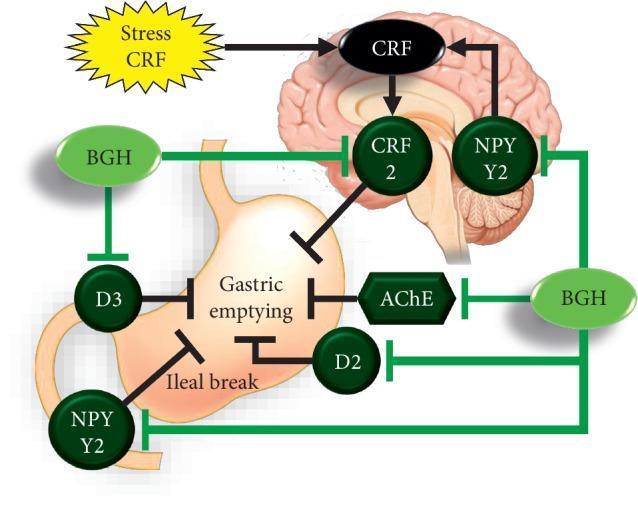
This pathophysiology diagram illustrates the hypothetical mechanism of action for the Kampo medicine bukuryoingohangekobokuto (BGH) on stress-induced gastric dysmotility. The schematic shows a central nervous system component (brain illustration) and a peripheral component (stomach illustration). In the brain, 'Stress CRF' (corticotropin-releasing factor) triggers CRF activity, which activates the CRF2 receptor to inhibit gastric emptying. The diagram highlights how BGH exerts a restorative effect through multi-target antagonism. Key pathways include: 1) Central antagonism of CRF2 and NPY Y2 receptors; 2) Enhancement of gastric emptying via antagonism of the dopamine D2 and D3 receptors; and 3) Inhibition of acetylcholinesterase (AChE), which facilitates acetylcholine-driven gastric motility. The visual uses black arrows to signify activation/stimulation and green T-shaped lines to represent inhibitory or antagonistic effects by BGH. Additional factors such as the 'Ileal break' and peripheral NPY Y2 receptors are shown contributing to the inhibition of gastric emptying, which BGH aims to counter. This educational visual explains the multi-pathway prokinetic properties of BGH in the context of stress-mediated gastrointestinal disorders.
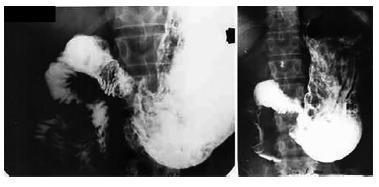
Two side-by-side abdominal fluoroscopic images from a barium swallow or upper gastrointestinal series demonstrating gastric emptying in a postoperative patient. The left image shows the stomach and proximal small intestine filled with radiopaque barium contrast. The stomach is distended with a high-density contrast column, showing clear visualization of the gastric anatomy and initial transit into the duodenum. The right image, taken at a subsequent time interval, displays physiological gastric emptying. The gastric volume is visibly reduced, and the contrast material has transitioned into the distal duodenum and jejunal loops. The vertebral column serves as a midline anatomical landmark. These images are used to assess gastrointestinal motility, transit time, and the patency of surgical anastomoses (such as gastrojejunalduodenostomy) following procedures for peptic ulcer disease, ensuring the absence of dumping syndrome or mechanical obstruction.
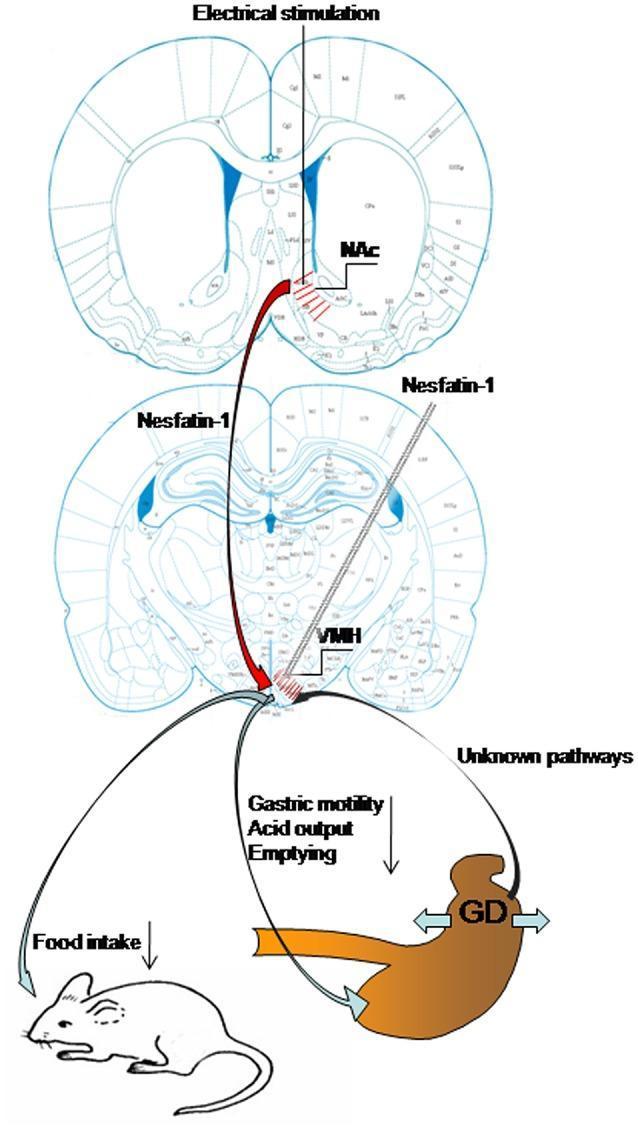
This medical schematic illustrates the neuroanatomical pathways and physiological mechanisms regulating gastric function and food intake. The diagram features two coronal sections of a rat brain, highlighting key neuroanatomical structures in blue (ventricles) and specific nuclei. In the superior section, electrical stimulation is applied to the Nucleus Accumbens (NAc). A nesfatinergic projection (indicated by a red arrow labeled 'Nesfatin-1') extends from the NAc to the Ventromedial Hypothalamus (VMH) shown in the inferior section. The VMH is also targeted via direct Nesfatin-1 injection. The pathway continues from the VMH to peripheral targets: a black line labeled 'Unknown pathways' connects to the stomach, where Gastric Distension (GD) is indicated by bidirectional arrows. Functional outcomes of VMH activation are represented by downward arrows indicating inhibition of gastric motility, acid output, and emptying. Finally, a connection to a whole-animal illustration shows a reduction in food intake. This pathophysiology diagram explains how the NAc-VMH circuit modulates autonomic gastric responses and satiety behavior via nesfatin-1 signaling.
Dumping Syndrome
Definition
Causes / Precipitating Operations
- Partial gastrectomy with Billroth II reconstruction (most common)
- Billroth I or Roux-en-Y reconstruction (less common)
- Vagotomy + drainage procedure (pyloroplasty, gastroenterostomy) - vagotomy abolishes receptive relaxation of the proximal stomach, markedly exacerbating rapid liquid emptying
- Distal esophagectomy, myotomy for achalasia, non-pylorus-sparing Whipple surgery
- Bariatric surgery: Roux-en-Y gastric bypass, one anastomosis gastric bypass (mild and usually transient)
- Nissen fundoplication, hiatal hernia repair
Pathophysiology
- Loss of proximal stomach receptive relaxation (from vagotomy) - prevents accommodation of ingested fluid, raises intragastric pressure, accelerates liquid emptying
- Decreased gastric capacity after gastrectomy
- Loss of controlled pyloric emptying from pylorus bypass or ablation
- Loss of duodenal feedback inhibition - in gastrojejunostomy, the duodenal mucosal receptors (for acid, sugar, fat, osmolality) that normally slow emptying are bypassed - Yamada's Gastroenterology, p. 1521
- Osmotic fluid shift from intravascular space into the intestinal lumen
- Release of vasoactive neurohormones - neurotensin, VIP, GLP-1, insulin, glucagon
- Reactive hyperinsulinemia (key in late dumping)
Clinical Features
Early Dumping (within 10-30 minutes of eating)
- Nausea, bloating, crampy abdominal pain
- Early satiety
- Explosive diarrhea (in some patients - NOT universal)
- Palpitations, tachycardia
- Diaphoresis, flushing
- Lightheadedness, syncope
- A vague feeling of being "unwell"
- Many patients need to lie down for 30-60 minutes post-meal
Important: Diarrhea is NOT an obligate symptom of dumping. The majority of patients do not have prominent diarrhea. - Fischer's, p. 3041
Late Dumping (1-3 hours after eating)
- Rapid carbohydrate delivery → rapid absorption → hyperglycemia
- Exaggerated GLP-1 response → massive insulin release
- Insulin overcompensation → reactive hypoglycemia
- Hypoglycemia → catecholamine release → diaphoresis, tremulousness, lightheadedness, tachycardia, confusion - Sabiston, p. 2286
Diagnosis
| Test | Positive Finding |
|---|---|
| Modified 75 g oral glucose tolerance test | Early dumping: hematocrit rise ≥3% OR heart rate rise ≥10 bpm at 30 min; Late dumping: blood glucose <50 mg/dL at 1-3 h |
| Radionuclide gastric emptying (liquid marker) | Accelerated liquid-phase emptying - must specify liquid marker, as most standard tests measure solid-phase |
| Glucose challenge (50% glucose, 200 mL) | Reproduces symptoms - usually unnecessary in practice |
Treatment
Step 1: Dietary Modification (first-line)
- Small, frequent meals (6 per day), separated from liquids
- Avoid simple sugars and concentrated sweets
- Increase protein and fiber content; reduce simple carbohydrates
- Lie down after meals (reduces orthostatic symptoms)
- Pectin (15 g with each meal) may slow gastric emptying in patients with a residual stomach
Step 2: Pharmacologic Therapy
| Drug | Indication | Dose |
|---|---|---|
| Acarbose (alpha-glucosidase inhibitor) | Late dumping with reactive hypoglycemia | 50-100 mg orally TID with meals |
| Octreotide (somatostatin analogue) | Refractory dumping after dietary failure | 25-200 µg SQ TID, 30 min before meals; or 10-20 mg IM monthly (long-acting depot) |
| Loperamide / tincture of opium | Prominent diarrhea | As needed |
| Meclizine | Prominent nausea | As needed |
| GLP-1 receptor agonists | Symptomatic reactive hypoglycemia | Emerging option |
Step 3: Surgical Revision (last resort)
- Pyloric reconstruction (if pylorus is still present)
- Takedown of gastrojejunostomy (if pyloric function is preserved)
- Conversion of Billroth II to Roux-en-Y reconstruction (most commonly recommended)
- Reversed jejunal interposition segment (slows transit - rarely used, technically demanding)
Special Considerations
- Non-surgical dumping has been described in functional dyspepsia, early type 2 diabetes (rapid emptying in early stages), cyclic vomiting syndrome, and autonomic dysfunction
- Bariatric surgery: After Roux-en-Y gastric bypass, mild early dumping is common and may even serve as behavioral modification (discourages high-calorie foods), but persistent dumping beyond 1-2 months should prompt re-evaluation of the diagnosis
- Postvagotomy diarrhea is a separate entity - diarrhea is not meal-related, and postprandial hypotension/hypoglycemia are absent