
describe cubital fossa
Reading File
Finding Sources
Searching Images
cubital fossa anatomy diagram
Reading File
Reading File
Loading Image
Loading Image
Loading Image
Cubital Fossa
The cubital fossa is a triangular depression located anterior to the elbow joint, serving as the key transition zone between the arm and forearm.
Boundaries
| Boundary | Structure |
|---|---|
| Base (superior) | Imaginary horizontal line connecting the medial and lateral epicondyles of the humerus |
| Lateral border | Brachioradialis muscle (originating from lateral supraepicondylar ridge) |
| Medial border | Pronator teres muscle (originating from medial epicondyle) |
| Apex | Where brachioradialis and pronator teres meet inferiorly |
Walls (Floor & Roof)
- Floor (bed): Formed mainly by the brachialis muscle, with the supinator contributing to the lateral part of the floor.
- Roof: Formed by skin and superficial fascia, reinforced by the bicipital aponeurosis (lacertus fibrosus), which is a flat connective tissue membrane sweeping medially from the biceps brachii tendon into the deep fascia of the forearm. It protects the deeper neurovascular structures.
Contents (lateral → medial)
The mnemonic "TAN" is helpful: Tendon → Artery → Nerve
- Tendon of biceps brachii – easily palpable; runs toward its insertion on the radial tuberosity
- Brachial artery – bifurcates into the radial and ulnar arteries at the apex of the fossa (though this bifurcation can occur higher, even in the axilla)
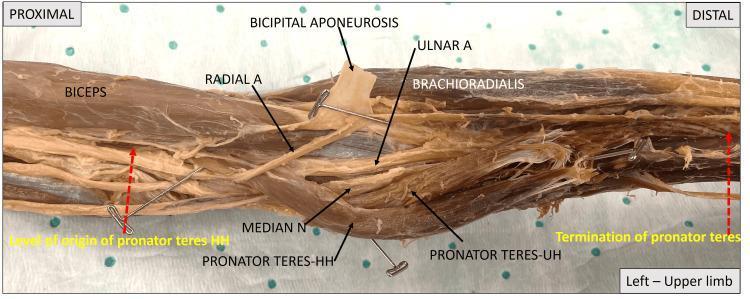
- Median nerve – lies immediately medial to the brachial artery; exits the fossa by passing between the humeral and ulnar heads of pronator teres
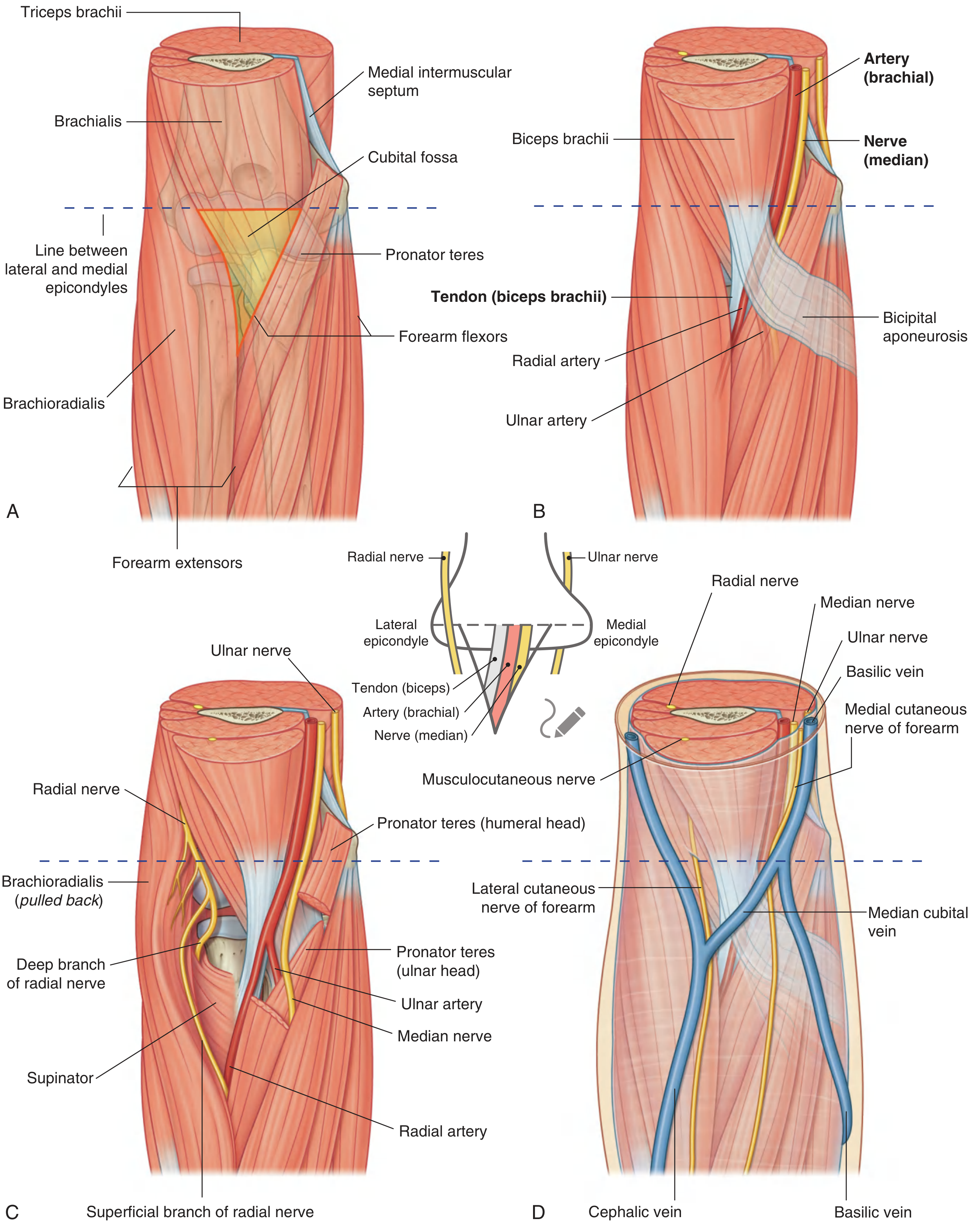
Fig. 7.77 — Cubital Fossa. (A) Margins. (B) Contents. (C) Position of the radial nerve. (D) Superficial structures.
Radial Nerve
The radial nerve is NOT a main content of the fossa — it lies just deep to the lateral lip of the brachioradialis muscle (the lateral border). At this level it divides into:
- Superficial branch → continues into the forearm deep to brachioradialis
- Deep branch (posterior interosseous nerve) → winds around the radius through both heads of the supinator to reach the posterior compartment
Ulnar Nerve
The ulnar nerve does not pass through the cubital fossa. It travels posterior to the medial epicondyle (where it can be "rolled" against bone — the "funny bone" sensation), then enters the anterior forearm by passing between the two heads of flexor carpi ulnaris.
Roof Structures (Superficial)
Within the superficial fascia forming the roof:
- Median cubital vein – passes diagonally across the roof, connecting the cephalic vein (lateral) with the basilic vein (medial). It is separated from the brachial artery below by the bicipital aponeurosis.
- Medial cutaneous nerve of the forearm (medially)
- Lateral cutaneous nerve of the forearm — the terminal branch of the musculocutaneous nerve (laterally)

Cadaveric View
Clinical Relevance
| Application | Detail |
|---|---|
| Venepuncture / IV access | Median cubital vein in the roof is the most common site |
| Blood pressure measurement | Brachial artery is auscultated here with a stethoscope |
| Brachial pulse | Palpated medial to the biceps tendon |
| Dialysis fistula | Cephalic and basilic veins near the fossa are used to create arteriovenous fistulas |
| Median nerve compression | Nerve can be compressed between the two heads of pronator teres just below the fossa (pronator teres syndrome) |
| Brachial artery injury | Supracondylar fractures in children can lacerate or compress the brachial artery in the fossa |
Sources: Gray's Anatomy for Students, pp. 889–890, 944–945
describe cubital fossa
Finding Sources
Searching Images
cubital fossa anatomy diagram
Reading File
Reading File
Loading Image
Loading Image
Loading Image
Cubital Fossa
The cubital fossa is a triangular depression anterior to the elbow joint, forming the key transition zone between the arm and forearm.
Boundaries
| Boundary | Structure |
|---|---|
| Base (superior) | Imaginary horizontal line between the medial and lateral epicondyles of the humerus |
| Lateral border | Brachioradialis (from lateral supraepicondylar ridge) |
| Medial border | Pronator teres (from medial epicondyle) |
| Apex | Where the two muscles meet inferiorly |
Floor and Roof
- Floor (bed): Formed mainly by brachialis, with supinator contributing to the lateral part.
- Roof: Skin and superficial fascia, reinforced in its deeper layer by the bicipital aponeurosis (lacertus fibrosus) — a flat connective tissue sheet that fans medially from the biceps brachii tendon into the deep fascia of the forearm, separating superficial veins from deeper neurovascular structures.
Contents (lateral → medial): "TAN"
| Structure | Notes |
|---|---|
| Tendon of biceps brachii | Easily palpable; inserts on radial tuberosity |
| Artery (brachial) | Bifurcates into radial and ulnar arteries at the apex; bifurcation may occasionally occur higher in the arm or even in the axilla |
| Nerve (median) | Immediately medial to brachial artery; exits by passing between the humeral and ulnar heads of pronator teres |
The brachial artery and median nerve are protected anteriorly by the bicipital aponeurosis in the distal fossa.
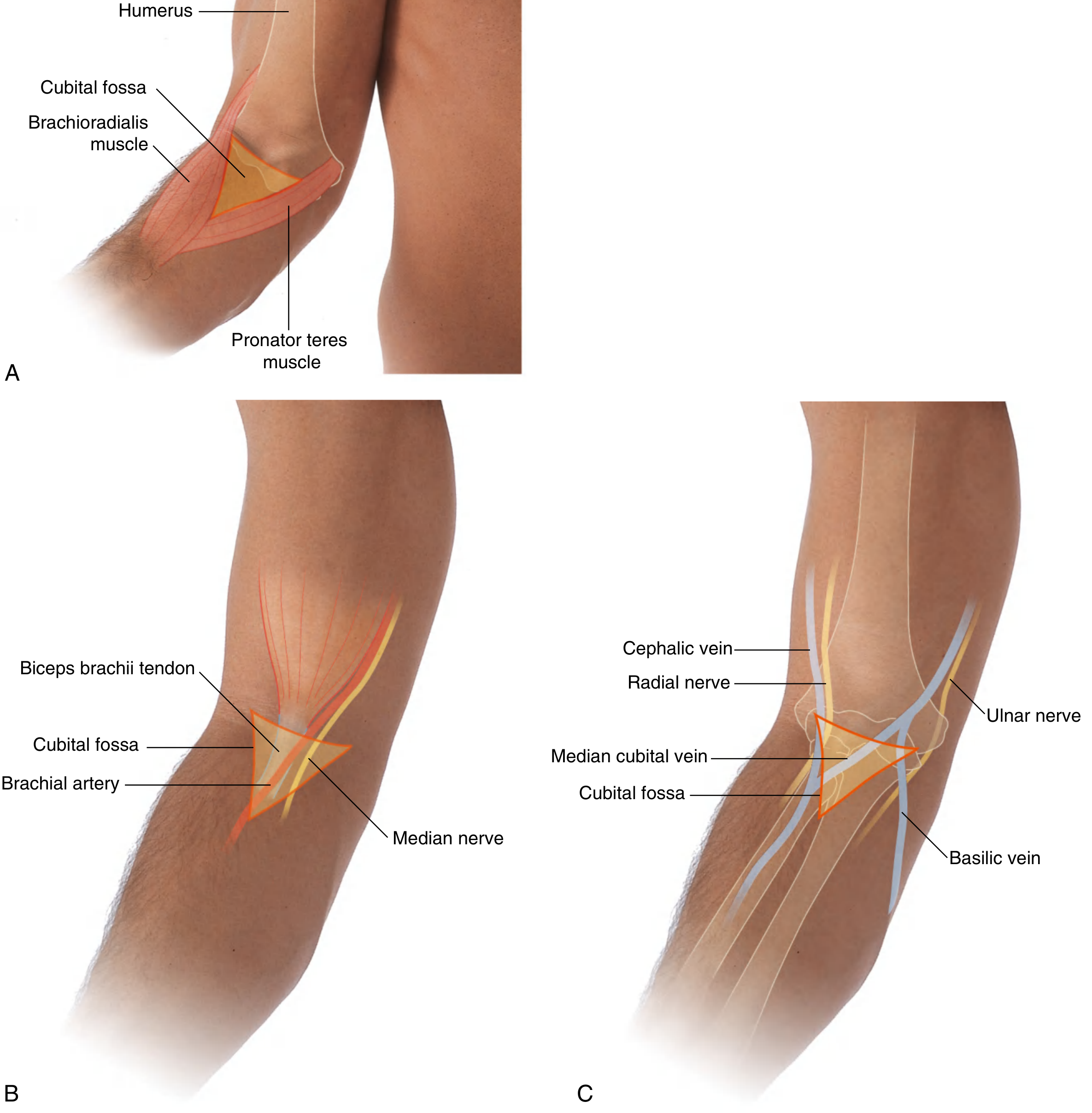
Radial Nerve
The radial nerve is not a main fossa content — it lies just deep to the lateral lip of brachioradialis (the lateral border) and here divides into:
- Superficial branch → continues into the forearm deep to brachioradialis
- Deep branch (posterior interosseous nerve) → winds through both heads of supinator to reach the posterior forearm compartment
Ulnar Nerve
The ulnar nerve does not pass through the cubital fossa. It runs posterior to the medial epicondyle, where it can be palpated and "rolled" against the bone (the "funny bone" sensation), then enters the forearm between the two heads of flexor carpi ulnaris.
Roof Structures (Superficial)
Within the superficial fascia:
| Structure | Detail |
|---|---|
| Median cubital vein | Most important; runs diagonally connecting cephalic vein (lateral) to basilic vein (medial); separated from brachial artery by the bicipital aponeurosis |
| Lateral cutaneous nerve of forearm | Terminal branch of musculocutaneous nerve |
| Medial cutaneous nerve of forearm | Runs along the medial side |
Cadaveric View
Clinical Relevance
| Application | Relevance |
|---|---|
| Venepuncture / IV access | Median cubital vein in the roof is the standard site |
| Blood pressure measurement | Brachial artery is auscultated here with a stethoscope |
| Brachial pulse palpation | Medial to the biceps tendon |
| Dialysis fistula | Cephalic and basilic veins near the fossa are anastomosed with the brachial artery |
| Supracondylar fracture | Can compress or lacerate the brachial artery — a surgical emergency in children |
| Pronator teres syndrome | Median nerve compression between the two heads of pronator teres just distal to the fossa |
Source: Gray's Anatomy for Students, pp. 889–890, 944–945
This is a shared conversation. Sign in to Orris to start your own chat.