
Thumb sign
Reading File
Finding Sources
Searching Images
thumb sign radiology clinical
Reading File
Reading File
Loading Image
Loading Image
Loading Image
The thumb sign refers to two distinct clinical/radiological findings in medicine:
1. Thumb Sign — Epiglottitis (Radiological)
On a lateral neck X-ray, a swollen epiglottis takes on a rounded, bulbous appearance resembling a thumb projecting from the anterior wall of the hypopharynx. This is the classic radiological sign of acute epiglottitis (supraglottitis).
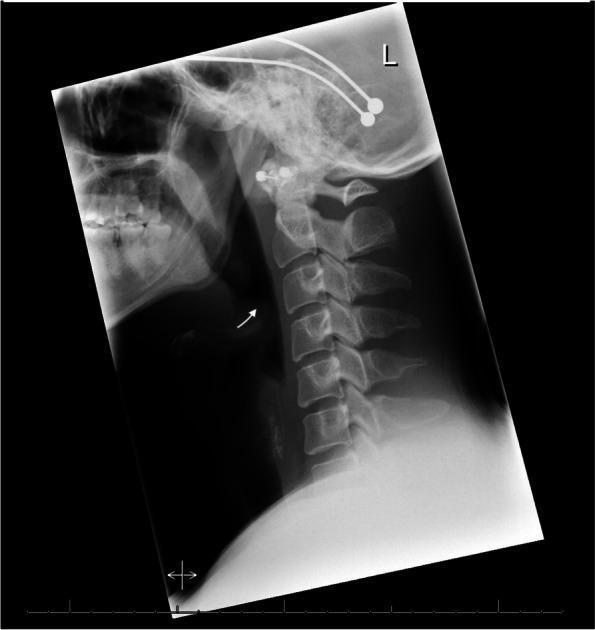
Key points:
- An epiglottis width >5.5 mm on lateral neck radiograph constitutes the thumb sign; this has moderate sensitivity but cannot rule out epiglottitis
- Usually accompanied by thickening of the aryepiglottic folds and distension of the hypopharynx
- Most common pathogen: Haemophilus influenzae (children 3–6 years); also seen in adults
- Important caveat: patients with suspected epiglottitis have a tenuous airway — personnel skilled in emergent intubation must accompany the patient to radiology, and equipment for tracheotomy should be ready
- CT can also demonstrate supraglottic thickening, but lateral plain film is preferred initially because the recumbent position for CT may provoke abrupt airway occlusion
— Cummings Otolaryngology Head and Neck Surgery; Rosen's Emergency Medicine; Tintinalli's Emergency Medicine
2. Thumb Sign (Steinberg Sign) — Marfan Syndrome (Clinical)
Also called the Steinberg sign, this is a bedside test for arachnodactyly (abnormally long thumb) in suspected Marfan syndrome.
How to perform: The patient adducts the thumb across the palm and closes the fingers over it into a fist. The test is positive if the entire nail (distal phalanx) of the thumb projects beyond the ulnar border of the hand.
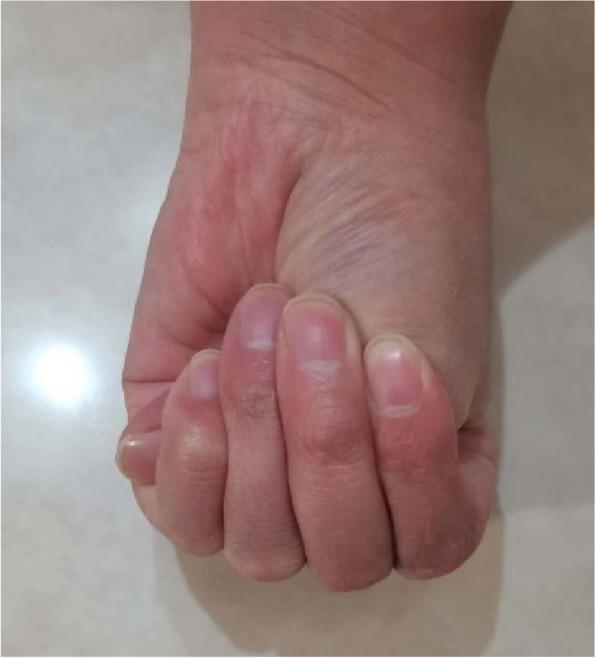
Scoring in the Revised Ghent Nosology (systemic score for Marfan diagnosis):
| Finding | Points |
|---|---|
| Wrist AND thumb sign both positive | 3 |
| Wrist OR thumb sign positive | 1 |
Often seen alongside:
- Wrist sign (Walker–Murdoch sign): thumb and little finger overlap when gripping the opposite wrist
- Pectus deformities, scoliosis, tall stature, superior lens dislocation, aortic root dilation
— Fuster & Hurst's The Heart, 15th Ed.; Emery's Elements of Medical Genetics and Genomics; Miller's Review of Orthopaedics, 9th Ed.
Summary Table
| Context | What it means | How detected |
|---|---|---|
| Epiglottitis | Swollen, rounded epiglottis resembling a thumb | Lateral neck X-ray |
| Marfan syndrome | Overly long thumb projecting past ulnar hand border | Clinical bedside maneuver |
This is a shared conversation. Sign in to Orris to start your own chat.