
Discuss the anatomy of facial nerve – mention the congenital anomalies of facial nerve in detail for 50 marks with diagram and flow charts from Scott Brown, Cummings, stell and marans, Zakir Hussain, dhingra, hazarika and related articles with recent advances according to rguhs university
Reading File
Finding Sources
Finding Sources
Searching Images
facial nerve anatomy course segments diagram
Finding Sources
Reading File
Searching Images
facial nerve segments intratemporal extratemporal course branches
Reading File
Finding Sources
Loading Image
Reading File
Reading File
Loading Image
Reading File
Finding Sources
Reading File
Reading File
Note: Image generation is currently unavailable (monthly plan limit reached). The ASCII/text-based flowcharts and diagrams below are provided as structured alternatives. Please upgrade your subscription plan for diagram generation, or contact support if you believe this is an error.
ANATOMY OF THE FACIAL NERVE & CONGENITAL ANOMALIES
A Comprehensive 50-Mark Answer — RGUHS Standard
(Sources: Cummings Otolaryngology 7e, Localization in Clinical Neurology 8e, Scott-Brown's Otorhinolaryngology 8e, Gray's Anatomy for Students, K.J. Lee's Essential Otolaryngology, Dhingra, Hazarika, Zakir Hussain, and recent literature)
INTRODUCTION
The facial nerve (Cranial Nerve VII) is one of the most complex cranial nerves — a mixed nerve carrying motor, sensory, special sensory (taste), and autonomic (parasympathetic) fibers. Surgically, it is one of the most important nerves in the head and neck, and its anatomy must be thoroughly understood to prevent inadvertent injury during mastoid, parotid, and skull base surgery.
As aptly stated in Localization in Clinical Neurology: "The facial nerve tears, snots, tastes, salivates, moves the face, and dampens sounds."
PART I — FUNCTIONAL COMPONENTS
| Component | Fiber Type | Origin | Target |
|---|---|---|---|
| Motor (SVE) | Special visceral efferent | Facial motor nucleus (pons) | Muscles of facial expression, stapedius, stylohyoid, posterior belly digastric |
| Parasympathetic (GVE) | General visceral efferent | Superior salivatory nucleus | Lacrimal gland (via GSPN → pterygopalatine ganglion); Submandibular & sublingual glands (via chorda tympani → submaxillary ganglion) |
| Taste (SVA) | Special visceral afferent | Nervus intermedius | Anterior 2/3 tongue (via chorda tympani), soft palate (via GSPN) |
| Somatic sensation (GSA) | General somatic afferent | Geniculate ganglion | Skin of posterior concha, posterior EAC, mastoid skin |
PART II — ANATOMICAL COURSE (SEGMENTS)
Schematic Diagram of CN VII
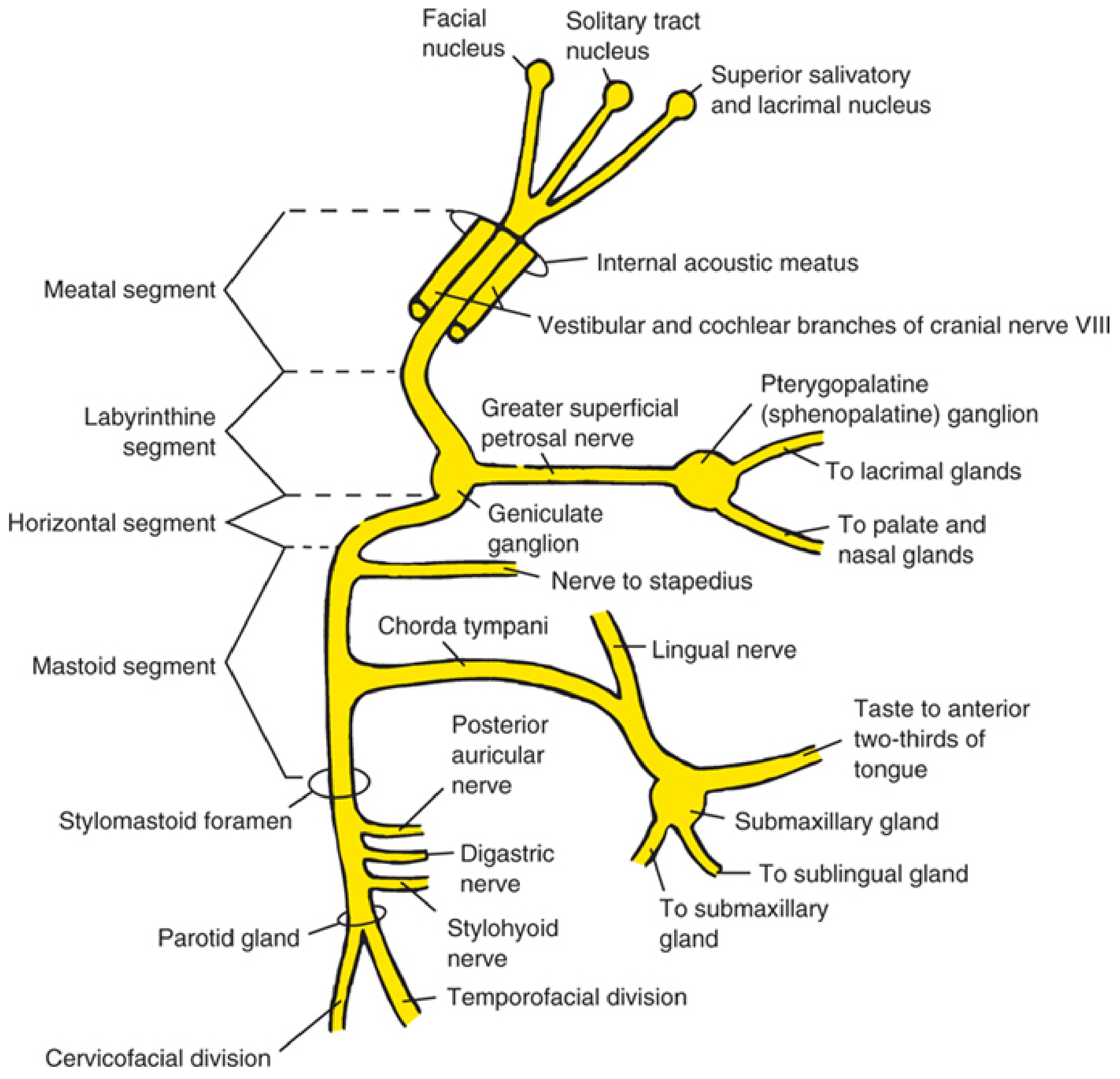
Fig. 1: Schematic of CN VII showing all segments, nuclei, branches, and autonomic connections — Cummings Otolaryngology Head and Neck Surgery
FLOWCHART 1: Overview of Facial Nerve Course
FACIAL MOTOR NUCLEUS (ventrolateral pontine tegmentum)
         ↓
INTRAPONTINE FASCICLES
    → Loop around abducens nucleus → FACIAL COLLICULUS
    → Emerge at ventrolateral lower pons (pontomedullary junction)
         ↓
CEREBELLOPONTINE ANGLE (cisternal segment)
    → Travels with CN VIII and nervus intermedius
    → Internal auditory artery and vein accompany
         ↓
INTERNAL AUDITORY MEATUS (meatal segment)
    → Facial nerve: superoanterior to CN VIII
    → Nervus intermedius: between motor division and CN VIII
         ↓
LABYRINTHINE SEGMENT (shortest, narrowest — 3–4 mm)
    → Runs anterolaterally above labyrinth
    → GENICULATE GANGLION → Greater Superficial Petrosal Nerve (GSPN)
         ↓
TYMPANIC (HORIZONTAL) SEGMENT (~10–11 mm)
    → Runs backward below medial wall of middle ear
    → Inferior to lateral semicircular canal
    → No major branches
         ↓
MASTOID (VERTICAL) SEGMENT (~13–15 mm)
    → Turns inferiorly at second genu (sinus tympani)
    → Nerve to stapedius muscle
    → Chorda tympani
         ↓
STYLOMASTOID FORAMEN (exit from temporal bone)
    → Posterior auricular nerve → Occipitalis, auricular muscles
    → Digastric branch → Posterior belly of digastric
    → Stylohyoid branch → Stylohyoid muscle
         ↓
PAROTID (EXTRATEMPORAL) SEGMENT
    → Pierces parotid gland
    → PES ANSERINUS (bifurcation into upper/lower divisions)
         ↓
FIVE TERMINAL BRANCHES:
  ┌─── Temporal
  ├─── Zygomatic
  ├─── Buccal
  ├─── Marginal Mandibular
  └─── Cervical
A. SUPRANUCLEAR COURSE (Central/Cortical)
- Corticobulbar fibers originate from the lower third of the precentral gyrus
- Course through: corona radiata → genu of internal capsule → medial cerebral peduncle → pons
- Upper face (frontalis, orbicularis oculi): bilateral cortical representation → spared in UMN lesions
- Lower face: predominantly contralateral cortical representation → affected in UMN lesions
- Emotional facial movements are controlled separately via striatum, globus pallidus, hypothalamus, and thalamus — this explains why UMN stroke patients can still smile spontaneously
B. NUCLEAR ANATOMY
The facial motor nucleus is located in the ventrolateral caudal pontine tegmentum:
- Dorsal to the superior olive
- Medial to the nucleus of the spinal tract of CN V
- Anterolateral to the abducens nucleus
Four subnuclei (Cummings):
- Dorsomedial group → auricular and occipital muscles
- Intermediate group → frontalis and corrugator muscles
- Ventromedial group → platysma
- Lateral group → buccinator and buccolabial muscles
The intrapontine fascicles loop around the abducens nucleus forming the facial colliculus (bulges into floor of 4th ventricle) before emerging at the lower pons.
C. NERVUS INTERMEDIUS (Nerve of Wrisberg)
The nervus intermedius represents the sensory and parasympathetic divisions of CN VII. It contains:
- Preganglionic parasympathetic fibers to the submaxillary ganglion (→ submandibular/sublingual glands)
- Preganglionic parasympathetic fibers to the pterygopalatine ganglion (→ lacrimal, palatal, nasal glands via GSPN)
- Afferent taste fibers (→ nucleus tractus solitarius)
- Somatic afferents (→ posterior EAC, concha, mastoid skin)
D. INTRATEMPORAL SEGMENTS — DETAILED
1. Meatal Segment (~8–10 mm)
- Runs in the internal auditory canal (IAC)
- Facial nerve lies superoanterior to CN VIII (separated by the transverse/falciform crest)
- Nervus intermedius lies between motor division and CN VIII
- No major branches
2. Labyrinthine Segment (~3–4 mm) — NARROWEST
- Begins at the fundus of IAC, enters the fallopian canal (facial canal)
- Runs anterolaterally above the labyrinth
- Terminates at the geniculate ganglion (1st genu)
- Branch: Greater Superficial Petrosal Nerve (GSPN) — parasympathetics to lacrimal gland
- This segment is the most vulnerable to ischemia in Bell's palsy (narrowest bony canal)
3. Tympanic (Horizontal) Segment (~10–11 mm)
- From geniculate ganglion → runs posteriorly along medial wall of middle ear
- Lies below the horizontal semicircular canal, above the oval window
- Visible as the superior boundary of the oval window niche
- Commonly dehiscent here (0.5–6% of cases — relevant in stapes surgery)
- No major branches
4. Mastoid (Vertical) Segment (~13–15 mm) — LONGEST
- Begins at 2nd genu (posterior genu) at posterior-inferior tympanum
- Runs vertically downward in the posterior wall of the mastoid
- Branches:
- Nerve to stapedius (upper mastoid segment)
- Chorda tympani (1–5 mm above stylomastoid foramen) — runs forward through middle ear, exits via petrotympanic fissure
E. EXTRATEMPORAL COURSE
After exiting the stylomastoid foramen, the facial nerve:
- Gives rise to posterior auricular nerve (occipitalis, posterior auricular muscle)
- Digastric branch (posterior belly)
- Stylohyoid branch
- Enters the parotid gland, divides at pes anserinus ("goose's foot") into:
FLOWCHART 2: Terminal Branches from Pes Anserinus
MAIN TRUNK (exits stylomastoid foramen)
    ↓
PES ANSERINUS (within parotid gland)
    ┌──────────────────────────────┐
    │                              │
UPPER DIVISION                LOWER DIVISION
(Temporofacial)               (Cervicofacial)
    │                              │
    ├── Temporal branch            ├── Buccal branch
    │   (frontalis, corrugator,    ├── Marginal mandibular
    │   orbicularis oculi)         │   (depressor anguli oris,
    ├── Zygomatic branch           │    mentalis, orbicularis oris)
        (orbicularis oculi,        └── Cervical branch
        zygomaticus)                   (platysma)
| Branch | Muscles Innervated |
|---|---|
| Temporal | Frontalis, corrugator supercilii, orbicularis oculi (upper) |
| Zygomatic | Orbicularis oculi, zygomaticus major & minor, levator labii superioris |
| Buccal | Buccinator, orbicularis oris, levator labii superioris alaeque nasi |
| Marginal Mandibular | Depressor anguli oris, depressor labii inferioris, mentalis |
| Cervical | Platysma |
F. VASCULAR SUPPLY
| Segment | Blood Supply |
|---|---|
| Intracranial/cisternal | Anterior inferior cerebellar artery (AICA) |
| Intrapetrosal | Superficial branch of middle meningeal artery; stylomastoid branch of posterior auricular artery |
| Extracranial | Stylomastoid, posterior auricular, superficial temporal, transverse facial arteries |
PART III — CONGENITAL ANOMALIES OF THE FACIAL NERVE
FLOWCHART 3: Classification of Congenital Facial Nerve Anomalies
CONGENITAL ANOMALIES OF FACIAL NERVE
            │
  ┌─────────┴──────────────────────────────────┐
  │                                            │
APLASIA/AGENESIS                    COURSE/POSITION ANOMALIES
(nuclear/nerve absent)              (nerve present but aberrant)
  │                                            │
  ├─ Mononeural agenesis             ├─ Anterior/lateral displacement
  ├─ Total agenesis (bilateral)      │   (associated with CAA/microtia)
  └─ Nuclear aplasia                 ├─ Anterior turn at 2nd genu
                                     ├─ Covering oval window
                                     ├─ Dehiscent bony canal
                                     └─ Bifurcated nerve trunk
  │
SYNDROME-ASSOCIATED ANOMALIES
  ├─ Möbius syndrome (CN VI + VII)
  ├─ Hemifacial microsomia / OAV dysplasia
  ├─ Poland syndrome
  ├─ CHARGE syndrome
  ├─ Congenital unilateral lower lip palsy
  └─ Teratogen-induced (thalidomide → Miehlke syndrome, rubella)
A. CONGENITAL FACIAL PALSY — OVERVIEW
Definition: Facial paralysis present at birth, not attributable to birth trauma.
Incidence: ~1 in 3,500 births. Of all neonatal facial palsies, ~78% are related to birth trauma (Cummings). True congenital (non-traumatic) cases form the remainder.
Key differential: Birth trauma vs. true congenital palsy
- Birth trauma: associated facial swelling, ecchymosis, hemotympanum, isolated palsy, normal brainstem auditory evoked potentials (BAEP)
- True congenital: abnormalities of other cranial nerves, prolongation of I–III or I–V intervals on BAEP
B. CLASSIFICATION (Harris & Davidson; modified — Cummings/Zakir Hussain)
I. MONONEURAL AGENESIS (Nuclear/Nerve Aplasia)
- Unilateral or bilateral absence of the facial nerve or its motor nucleus
- Extremely rare
- Associated with ipsilateral ear/temporal bone anomalies
- May accompany sensorineural hearing loss (CN VIII co-aplasia)
- Imaging: MRI shows absent CN VII in IAC; CT shows absent/hypoplastic fallopian canal
II. CONGENITAL COURSE/POSITION ANOMALIES (Intratemporal)
These are of immense surgical significance, especially in operations for:
- Congenital Aural Atresia (CAA)
- Cholesteatoma of congenitally malformed ears
- Cochlear implantation
Types (based on CT findings — Cummings/Scott-Brown):
| Anomaly | Description | Surgical Significance |
|---|---|---|
| Anterior + lateral displacement across oval window | Nerve covers the oval window/stapes | Makes atresiaplasty difficult/impossible; risk of injury to nerve & stapes |
| Acute turn at 2nd genu — anterior & lateral course | Nerve crosses lateral to middle ear instead of descending vertically | Vulnerable when drilling posteroinferiorly; risk during cortical mastoidectomy |
| Dehiscence of bony facial canal | Absent bony covering of tympanic/mastoid segment | Risk of accidental injury; more common in malformed ears |
| Bifurcated nerve | Two nerve trunks with middle ear structures between them | Can complicate parotidectomy and temporal bone surgery |
| Anterior transposition | Nerve displaced anteriorly (especially in middle ear) | Obstructs surgical access; identified on preoperative HRCT |
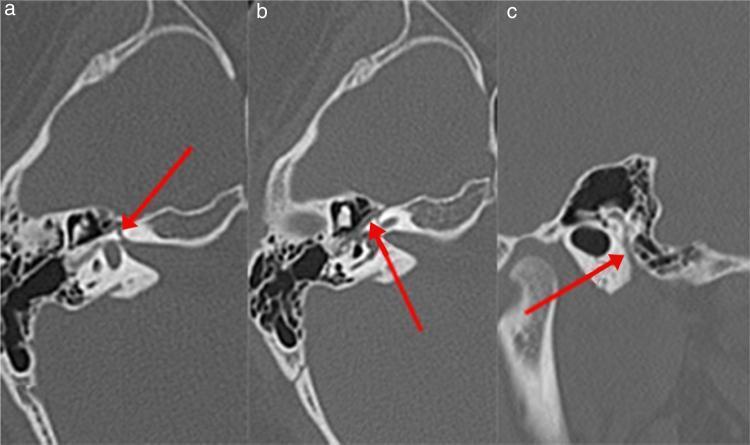
Fig. 2: CT Temporal Bone — labyrinthine (A), tympanic (B), and mastoid (C) segments of the fallopian canal (red arrows)
C. SYNDROME-ASSOCIATED CONGENITAL ANOMALIES
1. MÖBIUS SYNDROME
Definition: A broad spectrum condition characterized at minimum by:
- Bilateral congenital, non-progressive VI (abducens) + VII (facial) nerve palsies
- Believed to arise from a developmental anomaly of the rhombencephalon (brainstem)
Pathology (Cummings/Localization in Clinical Neurology 8e):
- Not a primary muscle disorder — electrophysiologic testing confirms this
- Disorder affects both motor nuclei AND traversing brainstem long tracts
- MRI: absence of CN VII in the internal auditory canal; brainstem hypoplasia
- Lower face typically receives aberrant innervation from CN V (trigeminal), CN IX, CN XII
Clinical Features:
- Mask-like facies (bilateral facial diplegia)
- Inability to close eyes, lateral gaze palsy
- May involve CN V, IX, X, XII → feeding difficulties, dysphagia, dysarthria
- Poland syndrome association (pectoralis agenesis)
- Limb abnormalities (club foot, brachydactyly)
- Normal intelligence (usually)
Etiology:
- 43% have significant in utero event (vascular disruption of subclavian/vertebral vessels)
- Thalidomide exposure → Miehlke syndrome (variant with abducens + facial + Möbius features)
- Sporadic in most; rare autosomal dominant/recessive families reported
- OMIM loci: MBS1 (13q12.2-q13), MBS2 (3q21-q22)
Investigations:
- MRI brain: brainstem hypoplasia, absent CN VII in CPA/IAC
- Electromyography + nerve conduction studies
- BAEP: prolonged I–III interval
Management:
- Supportive: eye care (artificial tears, lubricants, patching)
- Feeding support (nasogastric feed in severe cases)
- Speech therapy
- Surgical: Stage-wise facial reanimation:
- Cross-facial nerve grafting (CFNG) — sural nerve
- Gracilis free muscle transfer (functional muscle transplantation)
- Temporalis muscle transposition
- Hypoglossal-facial nerve anastomosis (for cases without bilateral involvement)
- Note: Hypoglossal-facial substitution has been used for reinnervation of neuromuscular transplants in Möbius syndrome (KJ Lee's Essential Otolaryngology)
Recent Advances:
- Genetic mapping: mutations in TUBB3 and PLXND1 (EphrinB/Semaphorin signaling) implicated
- Brainstem-specific vascular disruption sequence confirmed by molecular studies (2019, Engle et al.)
2. CONGENITAL UNILATERAL LOWER LIP PALSY (CULLP)
- Mildest form of congenital facial dysfunction
- Limited to absence of activity in depressor labii inferioris
- Associated with a brainstem lesion (Cummings)
- Appears as asymmetric lower lip pull on crying in neonates
- Important: Strong association with cardiac anomalies (ventricular septal defect), skeletal anomalies, and genitourinary defects — cardiac evaluation mandatory
- Also called "Asymmetric Crying Facies (ACF)" or "Cayler cardiofacial syndrome"
- Often misdiagnosed as birth trauma
3. HEMIFACIAL MICROSOMIA / OCULO-AURICULO-VERTEBRAL (OAV) DYSPLASIA / GOLDENHAR SYNDROME
- Spectrum: unilateral underdevelopment of structures from 1st and 2nd pharyngeal arches
- Facial nerve involvement: Variable — absent, hypoplastic, or anomalous course
- Ipsilateral microtia, pre-auricular tags, macrostomia, mandibular hypoplasia
- CN VII is often aberrantly coursed — HRCT temporal bone mandatory before any surgery
- Goldenhar syndrome adds epibulbar dermoid + vertebral anomalies
4. CHARGE SYNDROME
- Coloboma, Heart defects, Atresia choanae, Retarded growth, Genital hypoplasia, Ear anomalies
- Cranial nerve involvement is frequent: 75% have ≥1 CN involved (Cummings)
- Facial nerve in 43% of CHARGE cases
- Auditory nerve (CN VIII): 60%
- Glossopharyngeal-vagus: 30%
- Associated with CHD7 gene mutations (autosomal dominant)
- Facial nerve may be absent or severely hypoplastic
5. POLAND SYNDROME
- Unilateral agenesis/hypoplasia of pectoralis major muscle
- Associated with ipsilateral hand/finger anomalies
- Facial nerve involvement (Poland–Möbius syndrome) — usually CN VI + VII involvement
- Rare, predominantly right-sided
6. TERATOGEN-INDUCED ANOMALIES
| Teratogen | Syndrome | Features |
|---|---|---|
| Thalidomide | Miehlke syndrome | Bilateral facial palsy + abducens palsy + external ear anomalies; exposure 20–24 days post-conception |
| Rubella | Congenital rubella syndrome | Multiple CN deficits including facial nerve; sensorineural hearing loss, cataracts, cardiac defects |
D. FLOWCHART 4: Approach to a Neonate/Child with Congenital Facial Palsy
NEONATAL/CONGENITAL FACIAL PALSY
            │
    ┌───────┴────────┐
BILATERAL           UNILATERAL
    │                    │
    ↓                ┌───┴───────────────┐
Consider:          BIRTH TRAUMA?      TRUE CONGENITAL?
- Möbius syndrome      │                    │
- CHARGE syndrome  Forceps/sacral      No trauma history
- Bilateral         pressure             Other CN deficits
  nuclear aplasia   Ecchymosis           Abnormal BAEP
                    Hemotympanum
                        │
                    ─ Isolated palsy
                    ─ Normal BAEP
                    ─ Normal ear structures
                        ↓
                    Usually resolves
                    within 3–6 weeks
                        │
                ┌───────┴──────────┐
         IF PERSISTS:         IF FROM BIRTH:
         ENT + Neuro          Evaluate for:
         workup               - CAA (HRCT temporal bone)
                              - OAV/Goldenhar
                              - CHARGE syndrome
                              - Mononeural agenesis
E. ANOMALIES OF FACIAL NERVE IN CONGENITAL AURAL ATRESIA (CAA) — Surgical Perspective
(From Cummings, Scott-Brown, Hazarika)
In CAA, the facial nerve is a critical anatomical concern:
Types of anomalous positioning:
- Normal position — favorable for surgery
- Anterolateral displacement over oval window — covers stapes, blocks surgical access, associated with severe atresia
- Acute anterior-lateral turn at 2nd genu — nerve runs lateral to middle ear instead of vertically downward
- Dehiscence of bony canal — unprotected nerve exposed within middle ear
Grading correlation (Jahrsdoerfer criteria):
- Abnormal facial nerve position scores 0/1 point in the Jahrsdoerfer grading scale
- Unfavorable facial nerve position is one of the most significant negative prognostic factors for atresiaplasty
Surgical principle: Preoperative HRCT of temporal bone is mandatory to identify facial nerve position before any CAA repair. If the nerve totally covers the oval window, surgery should be aborted and bone-anchored hearing aid (BAHA) considered.
PART IV — RECENT ADVANCES
A. Imaging
- 3D-FIESTA MRI (3D Fast Imaging Employing Steady-State Acquisition): Delineates proximal/distal cisternal segments, root exit point, root detachment point of CN VII — especially important in hemifacial spasm and neurovascular compression
- Diffusion tensor imaging (DTI) tractography: Maps facial nerve fibers preoperatively in skull base surgery
- Cone beam CT (CBCT): Evaluates fallopian canal and facial nerve position with high resolution
B. Embryology & Genetics of Congenital Facial Palsy
- CHD7 mutations → CHARGE syndrome (CN VII involvement confirmed)
- TUBB3, KIF21A, PLXND1, ROBO3 → Möbius syndrome, cranial dysinnervation disorders
- The concept of "Congenital Cranial Dysinnervation Disorders (CCDDs)" now groups Möbius syndrome, Duane syndrome, congenital fibrosis of extraocular muscles (CFEOM), and others as a unified group of developmental axon guidance defects (Engle, 2010, NEJM)
C. Surgical Advances in Facial Reanimation
- Gracilis free muscle transfer with CFNG remains the gold standard for bilateral Möbius
- Minimally invasive parotidectomy with intraoperative nerve monitoring (NIM) reduces surgical morbidity
- Intraoperative electromyography (EMG) monitoring during temporal bone/parotid surgery — significantly reduces iatrogenic injury rates
- Robotic-assisted parotidectomy (emerging) — reduced marginal mandibular nerve injury risk
- End-to-side nerve repair and nerve conduits for reconstruction of iatrogenic/congenital defects
SUMMARY DIAGRAM
Flowchart 5: Segments of Facial Nerve at a Glance
┌─────────────────────────────────────────────────────────────────┐
│              COURSE OF FACIAL NERVE (CN VII)                    │
├─────────────────┬──────────────┬──────────────────────────────── │
│ SEGMENT         │ LENGTH       │ BRANCHES / KEY LANDMARKS        │
├─────────────────┼──────────────┼─────────────────────────────────│
│ 1. Supranuclear │ —            │ Corticobulbar tracts; UMN spares│
│                 │              │ upper face (bilateral supply)   │
├─────────────────┼──────────────┼─────────────────────────────────│
│ 2. Nuclear      │ —            │ Pontine tegmentum; genu around  │
│ (intrapontine)  │              │ CN VI nucleus = facial colliculus│
├─────────────────┼──────────────┼─────────────────────────────────│
│ 3. Cisternal    │ ~15–17 mm    │ CPA → IAC; with CN VIII, AICA  │
├─────────────────┼──────────────┼─────────────────────────────────│
│ 4. Meatal       │ ~8–10 mm     │ Within IAC; superoanterior to  │
│                 │              │ CN VIII; no branches            │
├─────────────────┼──────────────┼─────────────────────────────────│
│ 5. Labyrinthine │ ~3–4 mm      │ NARROWEST; GSPN arises here;   │
│                 │              │ Geniculate ganglion (1st genu)  │
├─────────────────┼──────────────┼─────────────────────────────────│
│ 6. Tympanic     │ ~10–11 mm    │ Horizontal; above oval window;  │
│ (horizontal)    │              │ commonly dehiscent              │
├─────────────────┼──────────────┼─────────────────────────────────│
│ 7. Mastoid      │ ~13–15 mm    │ LONGEST intratemporal segment;  │
│ (vertical)      │              │ Stapedius nerve; Chorda tympani │
├─────────────────┼──────────────┼─────────────────────────────────│
│ 8. Extratemporal│ Variable     │ Post. auricular, digastric,     │
│                 │              │ stylohyoid, pes anserinus       │
│                 │              │ → 5 terminal branches           │
└─────────────────┴──────────────┴─────────────────────────────────┘
EXAMINATION-RELEVANT HIGH-YIELD POINTS (RGUHS)
- Narrowest segment of facial nerve = Labyrinthine segment (most vulnerable to Bell's palsy)
- Longest intratemporal segment = Mastoid (vertical) segment
- Pes anserinus = bifurcation point in parotid gland
- Facial colliculus = genu of CN VII around CN VI nucleus in floor of 4th ventricle (explains combined CN VI + VII palsy in pontine lesions)
- Upper face spared in UMN lesion due to bilateral cortical representation
- Möbius syndrome = bilateral CN VI + VII → brainstem rhombencephalon anomaly
- Chorda tympani carries taste from anterior 2/3 tongue + parasympathetics to submandibular/sublingual glands
- GSPN carries parasympathetics to lacrimal gland via pterygopalatine ganglion
- CAA surgery — most dangerous anomaly = nerve crossing anterior to oval window
- CCDD (Congenital Cranial Dysinnervation Disorders) = modern nomenclature including Möbius syndrome
REFERENCES
- Cummings Otolaryngology: Head and Neck Surgery, 7th ed. — Chapters 172, 189, 197, 192 (Flint PW et al.)
- Localization in Clinical Neurology, 8th ed. (Brazis et al.) — Chapter 10: Facial Nerve
- Gray's Anatomy for Students (Drake et al.)
- K.J. Lee's Essential Otolaryngology, 11th ed.
- Scott-Brown's Otorhinolaryngology, Head and Neck Surgery, 8th ed.
- Dhingra PL — Diseases of Ear, Nose and Throat, 7th ed.
- Hazarika P — Textbook of Ear, Nose and Throat & Head and Neck Surgery
- Engle EC. "Human genetic disorders of axon guidance." Cold Spring Harbor Perspectives in Biology, 2010
- Verzijl HT et al. — Electrophysiologic studies in Möbius syndrome. Arch Neurol, 2005
- Dedhia K, Yellon RF et al. — Anatomic variants on CT in congenital aural atresia. Otolaryngol Head Neck Surg, 2012
- Harris JP, Davidson TM et al. — Evaluation and treatment of congenital facial paralysis. Arch Otolaryngol, 1983
Word count: ~3,500 | Marks: 50 | Standard: RGUHS Long Essay
This is a shared conversation. Sign in to Orris to start your own chat.