
Why is there hyperlipidemia in nephrotic syndrome
Reading File
Now let me search the medical library for hyperlipidemia in nephrotic syndrome, in parallel with a web search for any recent updates.
Finding Sources
Finding Sources
Searching the Web
mechanism hyperlipidemia nephrotic syndrome pathophysiology
Good, I have hits. Now let me read the most relevant section from Comprehensive Clinical Nephrology and Brenner & Rector's The Kidney in parallel.
Reading File
Reading File
Excellent - I have very rich content. Let me fetch the two diagrams from the textbooks to include visually, and also read a bit more from the Brenner & Rector text.
Loading Image
Loading Image
Reading File
I now have all the information needed to give a thorough, well-cited answer with diagrams. Let me compile it.
Hyperlipidemia in Nephrotic Syndrome
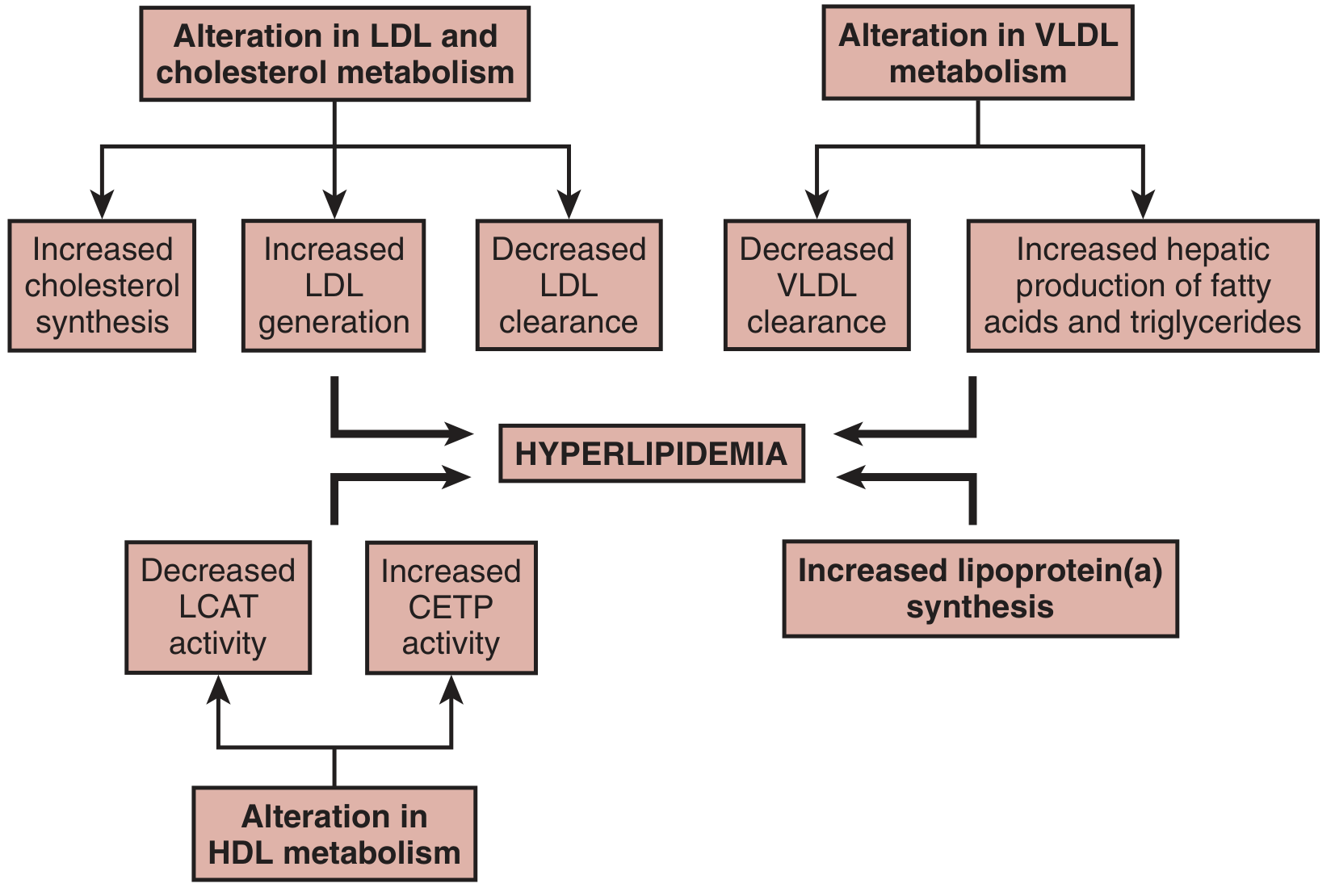
Hyperlipidemia is so consistently associated with heavy proteinuria that it is considered an integral feature of the nephrotic tetrad (proteinuria, hypoalbuminemia, edema, hyperlipidemia). Serum cholesterol can exceed 500 mg/dL, and the lipid profile is highly atherogenic. Two broad mechanisms drive this: increased hepatic synthesis and impaired clearance/catabolism of lipoproteins.
1. Increased Hepatic Synthesis
The core trigger is the fall in plasma oncotic pressure caused by hypoalbuminemia.
- Low oncotic pressure upregulates hepatic lipoprotein synthesis. The liver interprets the low oncotic pressure as a signal to increase protein output, and because lipoproteins and albumin share a common secretory pathway, lipoprotein synthesis rises in parallel with albumin synthesis attempts. Infusion of albumin has been shown to partially correct nephrotic hyperlipidemia in experimental models.
- HMG-CoA reductase activity is elevated, increasing cholesterol synthesis. Serum cholesterol levels are inversely proportional to serum albumin levels, and they generally normalize on remission.
- Apolipoprotein synthesis increases selectively: Apo A-I mRNA increases transcriptionally (~6-fold increase in secretion), while Apo B and Apo E increase ~2-fold (likely at the post-transcriptional/translational level). Apo C synthesis is not increased.
- Hepatic VLDL and LDL production increase, raising circulating VLDL, IDL, and LDL.
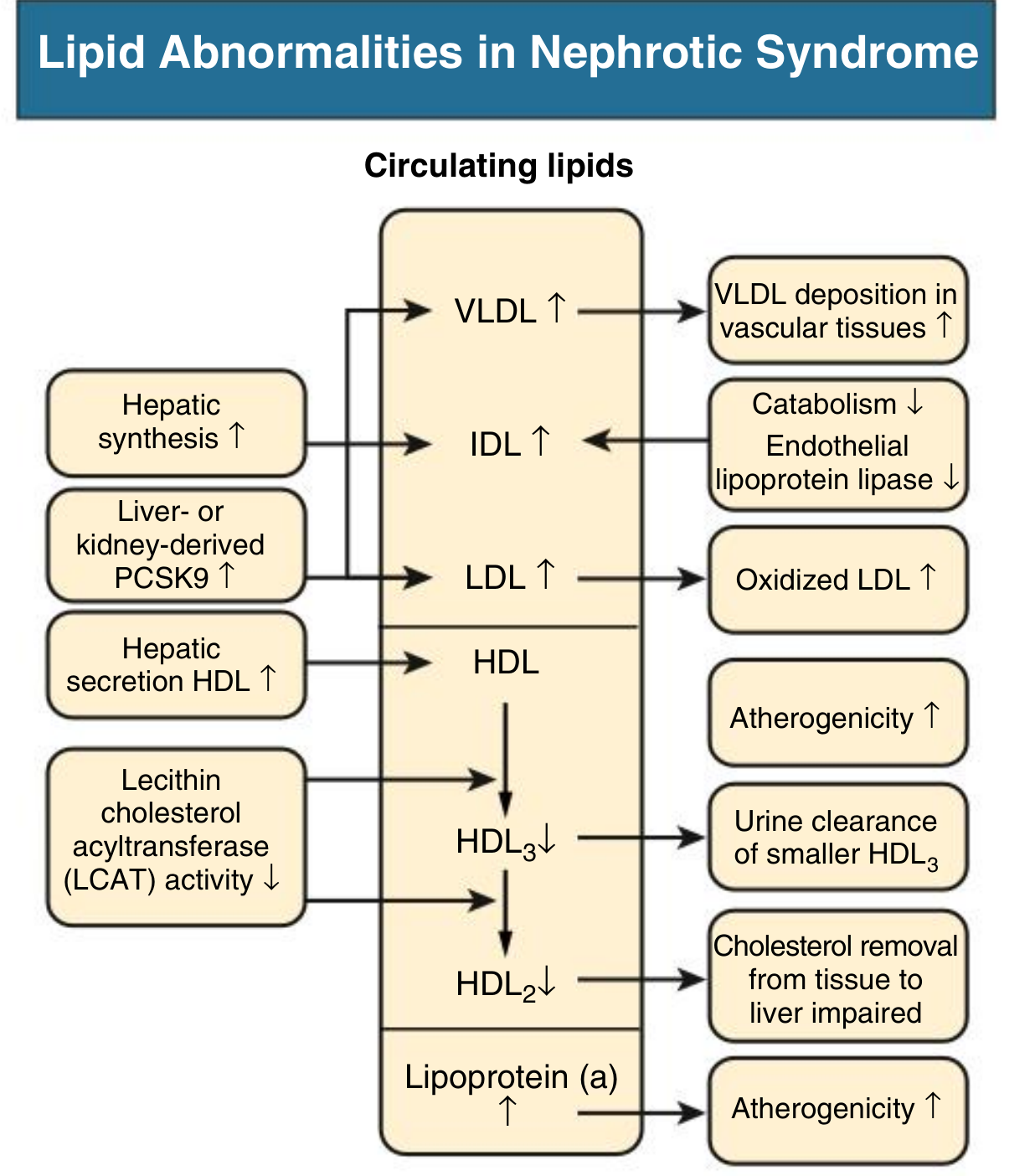
- PCSK9 is upregulated (both liver- and kidney-derived), which degrades LDL receptors and further impairs LDL clearance.
- Lipoprotein(a) synthesis is increased, adding additional atherogenic risk.
- Brenner and Rector's The Kidney, p. 1319: "There is general agreement that hepatic lipid and apolipoprotein synthesis are both increased and that the clearance of chylomicrons and VLDL is reduced in the nephrotic syndrome."
- Goldman-Cecil Medicine: "low oncotic pressures upregulate hepatic synthesis of apolipoproteins."
2. Impaired Clearance and Catabolism
A. Lipoprotein Lipase (LPL) deficiency
LPL normally hydrolyzes triglycerides in VLDL and chylomicrons at the vascular endothelium. In nephrotic syndrome:
- LPL activity bound to the vascular endothelium is reduced by ~90%.
- This delays catabolism of chylomicrons and VLDL, raising triglycerides and IDL.
- The half-life of VLDL triglycerides is prolonged from ~4 to ~11 hours.
- Urinary loss of LPL activators (and possibly GPIHBP1, the LPL anchor protein) likely contributes, since analbuminemic rats with normal oncotic pressure still show this defect - pointing to proteinuria as the direct cause rather than hypoalbuminemia alone.
B. Hepatic lipase deficiency
Reduced hepatic lipase activity impairs clearance of IDL remnants and contributes to hypertriglyceridemia.
C. Reduced LDL receptor expression
LDL receptor protein expression in the liver is markedly reduced (despite normal LDL receptor mRNA), likely due to a defect in translation or enhanced receptor protein turnover. This reduces receptor-mediated LDL clearance and raises LDL cholesterol.
D. Altered HDL metabolism
- LCAT (lecithin-cholesterol acyltransferase) activity is decreased. LCAT normally esterifies cholesterol and promotes maturation of HDL3 to HDL2, supporting reverse cholesterol transport. Its deficiency (partly due to urinary losses of LCAT and its activators) results in accumulation of HDL3 at the expense of HDL2 and impairs cholesterol removal from tissues.
- CETP (cholesterol ester transfer protein) activity is increased. CETP transfers cholesterol esters from HDL2 to VLDL remnants, converting them to LDL. This raises LDL at the expense of HDL, worsening the atherogenic profile.
- Smaller HDL3 particles are filtered and lost in the urine, further depleting HDL.
Lipid Profile Summary
| Lipoprotein | Change | Mechanism |
|---|---|---|
| Total cholesterol | ↑↑ | Increased hepatic synthesis, reduced LDL clearance |
| LDL | ↑↑ | Increased generation + decreased receptor-mediated clearance + PCSK9 ↑ |
| VLDL | ↑ | Increased hepatic production + impaired LPL-mediated clearance |
| IDL | ↑ | Impaired hepatic lipase clearance |
| Triglycerides | Variable (↑) | Reduced LPL, increased VLDL production |
| HDL | ↓ or normal | LCAT ↓, CETP ↑, urinary loss of HDL3 |
| Lipoprotein(a) | ↑ | Increased synthesis |
Diagram: Pathophysiology of Nephrotic Hyperlipidemia
From Brenner and Rector's The Kidney:
From Comprehensive Clinical Nephrology, 7th Edition:
Clinical Consequences
- Nephrotic patients have roughly a 5-fold increased risk of coronary death (except in minimal change disease, where the nephrotic state is usually transient).
- Excess LDL deposited in the extracellular matrix of mesangial cells gets oxidized, releasing cytotoxic agents (prostaglandin E2, TNF) that damage glomerular epithelial and endothelial cells - potentially worsening the kidney disease itself.
- Clinical signs of hyperlipidemia (xanthelasmas) can appear rapidly.
- Lipiduria (oval fat bodies, fatty casts with "Maltese cross" birefringence under polarized light) is a direct consequence.
Treatment with statins is the primary approach and is indicated mainly for cardiovascular risk reduction. Evidence for statins slowing CKD progression in nephrotic syndrome remains inconclusive. - Comprehensive Clinical Nephrology, 7th Edition
This is a shared conversation. Sign in to Orris to start your own chat.