
Write a note on jaundice mention typescauses and explain findings in urine and blood 10 marks mbbs first year
Your credits are exhausted. You can purchase a top-up or subscribe to a plan to continue using Orris. If you're already subscribed, your daily credits will reset tomorrow.
Write a note on jaundice mention typescauses and explain findings in urine and blood 10 marks mbbs first year
Jaundice is yellowish discoloration of skin, sclerae, and mucous membranes due to elevated serum bilirubin (>2 mg/dL). It results from disturbances in bilirubin metabolism. There are three main types based on the site of the defect, each with distinct causes and lab findings.
Searching sources...
Reading File
Finding Sources
Finding Sources
Reading File
Reading File
Reading File
Finding Sources
Reading File
Finding Sources
Reading File
Loading Image
Excellent - I now have comprehensive information from multiple authoritative textbooks. Here is the complete, exam-ready note:
JAUNDICE
Definition
Jaundice (icterus) is the yellowish discoloration of the skin, sclerae (whites of the eyes), and mucous membranes caused by an elevated plasma bilirubin level exceeding 2-2.5 mg/dL (normal: 0.5-1 mg/dL). It is not a disease itself, but a sign of an underlying disorder of bilirubin metabolism.
(Harper's Illustrated Biochemistry, 32nd Ed; Guyton & Hall Textbook of Medical Physiology)
Bilirubin Metabolism (Brief Review)
Understanding jaundice requires knowing normal bilirubin handling:
- Senescent RBCs are broken down by macrophages (reticuloendothelial system) - Heme → Biliverdin → Unconjugated (indirect) bilirubin
- Unconjugated bilirubin binds albumin in plasma and is transported to the liver
- In hepatocytes, it is conjugated with glucuronic acid to form conjugated (direct) bilirubin - water soluble
- Conjugated bilirubin is excreted into bile → intestines → bacterial action → urobilinogen
- Urobilinogen: partly excreted in feces (as stercobilin), partly reabsorbed and excreted in urine (as urobilin)
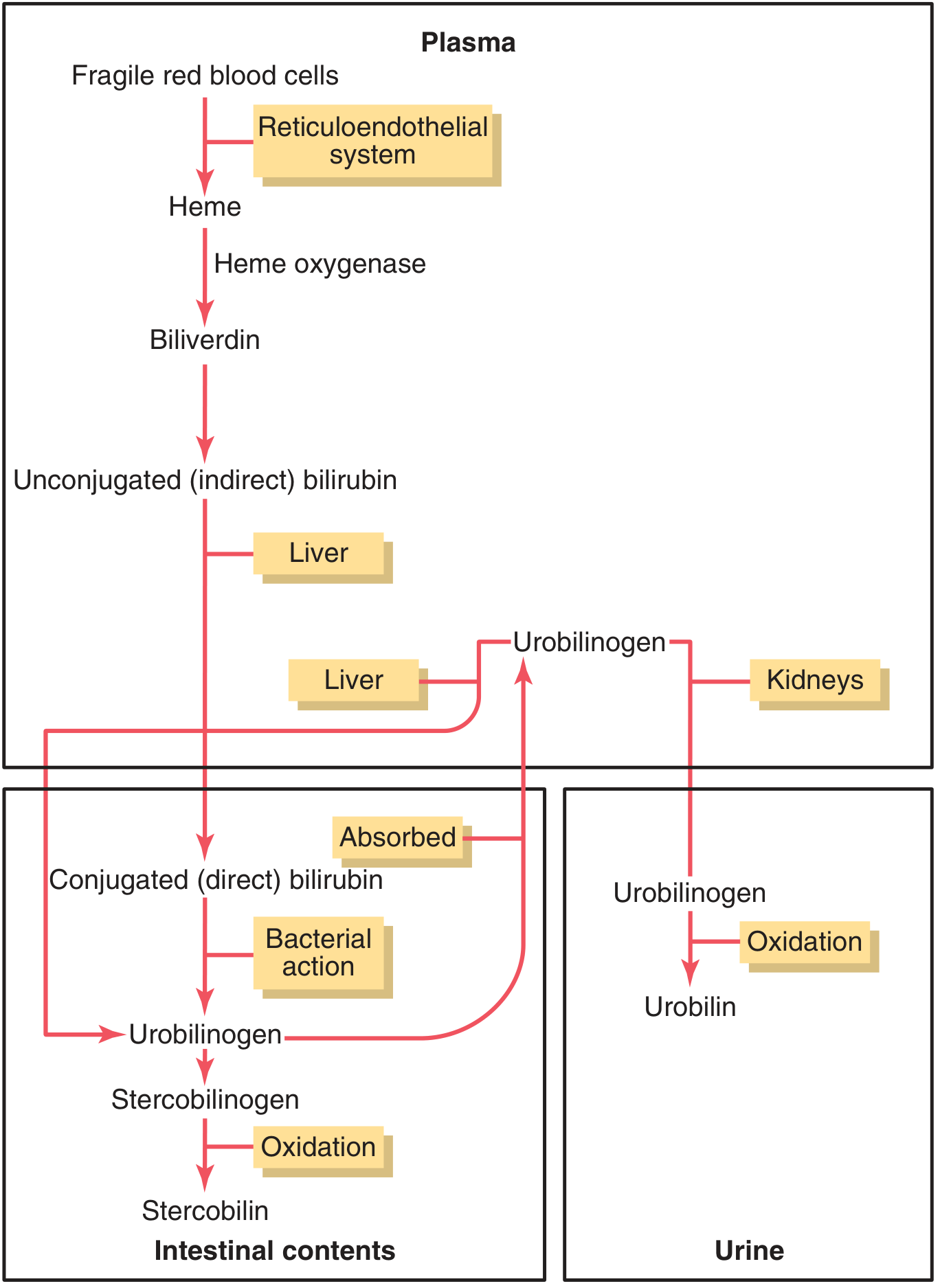
Types and Causes of Jaundice
Jaundice is classically divided into three types based on the site of the defect:
1. Pre-Hepatic (Hemolytic) Jaundice
Site of defect: Before the liver - excessive production of bilirubin
Mechanism: RBCs are destroyed so rapidly that the liver cannot conjugate bilirubin fast enough, leading to accumulation of unconjugated bilirubin in the blood.
Causes:
- Hemolytic anemias (sickle cell disease, thalassemia, G6PD deficiency, autoimmune hemolysis)
- Resorption of large internal hemorrhage or hematoma
- Ineffective erythropoiesis (pernicious anemia, thalassemia)
- Malaria
- Mismatched blood transfusion
2. Hepatic (Hepatocellular) Jaundice
Site of defect: Within the liver - failure of hepatocytes to take up, conjugate, or excrete bilirubin
Mechanism: Damaged liver cells impair all steps - uptake, conjugation, and excretion - leading to a mixed (both unconjugated and conjugated) hyperbilirubinemia.
Causes:
- Viral hepatitis (A, B, C)
- Drug-induced liver injury
- Cirrhosis of the liver
- Alcoholic hepatitis
- Liver cell carcinoma
- Leptospirosis
- Hereditary disorders:
- Gilbert syndrome (reduced UDP-glucuronosyltransferase activity) - unconjugated
- Crigler-Najjar syndrome Types I & II - unconjugated
- Dubin-Johnson syndrome - conjugated
- Rotor syndrome - conjugated
- Physiologic jaundice of the newborn (decreased conjugating capacity)
3. Post-Hepatic (Obstructive/Cholestatic) Jaundice
Site of defect: After the liver - obstruction of bile flow from the bile ducts
Mechanism: Conjugated bilirubin is formed normally in the liver but cannot be excreted into the intestines. It regurgitates back into the blood (regurgitation hyperbilirubinemia), producing predominantly conjugated hyperbilirubinemia.
Causes:
- Intraluminal: Gallstones blocking the common bile duct
- Mural: Strictures, cholangiocarcinoma, primary sclerosing cholangitis (PSC), primary biliary cholangitis (PBC)
- External compression: Carcinoma of the head of the pancreas, enlarged lymph nodes
Laboratory Findings in Jaundice
A. Findings in Blood (Serum)
| Parameter | Pre-hepatic | Hepatic | Post-hepatic |
|---|---|---|---|
| Total bilirubin | Raised | Raised | Raised |
| Unconjugated bilirubin | Markedly raised | Raised | Normal / slightly raised |
| Conjugated bilirubin | Normal | Raised | Markedly raised |
| Van den Bergh reaction | Indirect positive | Biphasic (both) | Direct positive |
| Serum ALT/AST (transaminases) | Normal | Markedly raised | Mildly raised |
| Alkaline Phosphatase (ALP) | Normal | Mildly raised | Markedly raised |
| Serum albumin | Normal | Reduced (in chronic) | Normal |
| Prothrombin time (PT) | Normal | Prolonged | Prolonged (corrects with Vit K) |
| Serum proteins | Normal | Abnormal | Normal |
Key points:
- Van den Bergh test distinguishes conjugated from unconjugated bilirubin colorimetrically using diazotized sulfanilic acid. "Direct" = conjugated reacts directly without methanol; "Indirect" = unconjugated requires methanol addition.
- In hemolytic jaundice, indirect (unconjugated) bilirubin is raised because the liver is healthy but overwhelmed.
- In obstructive jaundice, direct (conjugated) bilirubin is raised, ALP is markedly elevated due to bile duct damage.
- In hepatic jaundice, both fractions are raised - liver cells cannot properly take up OR excrete bilirubin.
B. Findings in Urine
| Parameter | Pre-hepatic | Hepatic | Post-hepatic |
|---|---|---|---|
| Bile pigments (Bilirubin) | Absent (acholuric) | Present | Present |
| Urobilinogen | Markedly increased | Increased (early) / Decreased (late) | Absent |
| Colour of urine | Normal / pale yellow | Dark (bile-stained) | Very dark (tea/cola-coloured) |
| Bile salts | Absent | Present | Present |
Explanation of urine findings:
-
Bile pigments in urine (Choluria): Only conjugated bilirubin is water-soluble and can appear in urine. In pre-hepatic jaundice, bilirubin is unconjugated (bound to albumin) and cannot pass the glomerular filter - so urine is bile-free (acholuric jaundice). In hepatic and post-hepatic jaundice, conjugated bilirubin spills into blood and appears in urine (choluric jaundice).
-
Urobilinogen in urine:
- Pre-hepatic: Increased urobilinogen - large amounts of bilirubin reach the gut, producing excess urobilinogen; the liver (which normally removes reabsorbed urobilinogen) cannot handle it all, so excess is excreted in urine.
- Hepatic: Initially increased, then decreased as liver disease progresses and less conjugated bilirubin reaches the gut.
- Post-hepatic: Completely absent (zero) - no bilirubin reaches the gut, so no urobilinogen is formed. Stools become pale/clay-colored (no stercobilin) and urine becomes dark (bile pigments but no urobilinogen).
-
Bile salts (Hay's test): Present in urine in hepatic and post-hepatic jaundice; their presence causes pruritis (itching) and also reduces surface tension (Hay's sulfur powder test).
C. Findings in Stool
| Stool | Pre-hepatic | Hepatic | Post-hepatic |
|---|---|---|---|
| Colour | Dark (excess stercobilin) | Pale/normal | Clay/pale (acholic stools) |
| Stercobilinogen | Markedly increased | Decreased | Absent |
Summary Table
| Feature | Pre-hepatic | Hepatic | Post-hepatic |
|---|---|---|---|
| Bilirubin type | Unconjugated | Mixed | Conjugated |
| Urine bilirubin | Absent | Present | Present |
| Urine urobilinogen | Increased | Variable | Absent |
| Stool colour | Dark | Pale | Clay/white |
| ALT/AST | Normal | Very high | Mildly high |
| ALP | Normal | Mildly high | Very high |
| Pruritis | Absent | Mild | Severe |
Clinical Importance
- Kernicterus: accumulation of unconjugated bilirubin in the basal ganglia of neonates (crosses blood-brain barrier) - causes brain damage
- Only unconjugated bilirubin crosses the blood-brain barrier (due to lipid solubility)
- Only conjugated bilirubin appears in urine (due to water solubility)
- These two facts explain many of the clinical and laboratory differences between types
(Robbins & Kumar Basic Pathology; Harper's Illustrated Biochemistry, 32nd Ed; Guyton & Hall Medical Physiology)
This is a shared conversation. Sign in to Orris to start your own chat.