
Approach to hematuria history wise
Reading File
Now let me search the library for hematuria history content in parallel.
Finding Sources
Finding Sources
Excellent results. Let me now read the key sections in parallel - Campbell Walsh Urology block 1 (main hematuria chapter), Tintinalli's, and NKF Primer.
Reading File
Reading File
Reading File
Let me also read the Rosen's emergency medicine section and the Family Medicine content for additional breadth, and fetch that NKF flowchart image.
Reading File
Reading File
Loading Image
I now have comprehensive content from Campbell-Walsh Urology, Tintinalli's, NKF Primer, and Rosen's. Here is a thorough, well-structured answer.
Approach to Hematuria: History
Hematuria (blood in the urine) may signal pathology anywhere from the glomerulus to the urethra. A structured history is the cornerstone of evaluation - it often localizes the source and stratifies malignancy risk before any test is ordered.
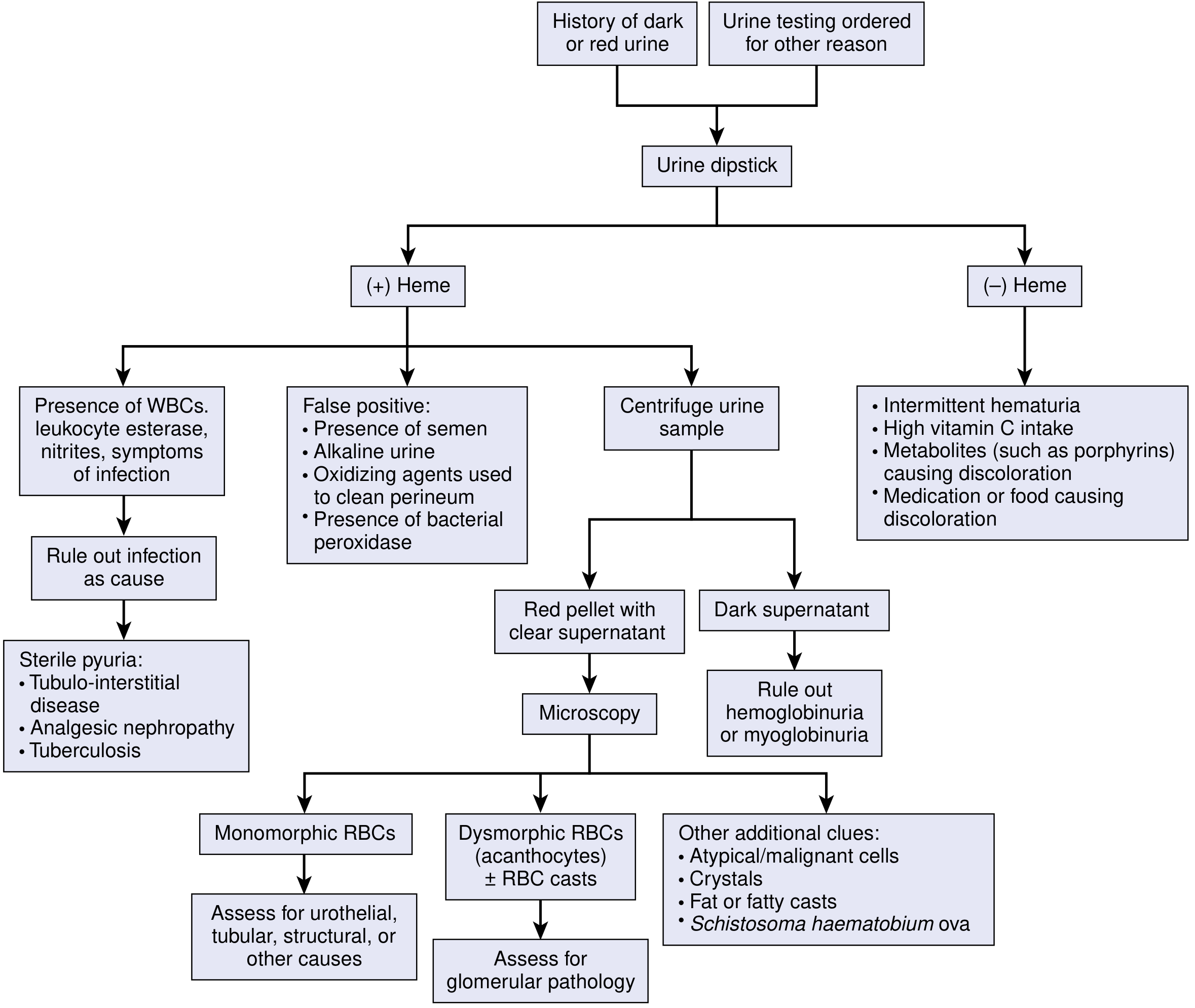
1. First - Confirm It Is True Hematuria
Before taking a detailed history, establish that the patient has true hematuria. Several conditions mimic it (pseudohematuria):
- Foods: beets, rhubarb, blackberries
- Drugs: rifampicin, nitrofurantoin, metronidazole, chloroquine, isoniazid, chlorpromazine
- Other: myoglobinuria (rhabdomyolysis), hemoglobinuria (intravascular hemolysis), porphyrins, high vitamin C intake
A urine dipstick positive for blood must always be followed by microscopy - dipstick alone is insufficient to confirm true hematuria. - Campbell-Walsh Urology
2. Characterize the Hematuria
Gross vs. Microscopic
- Gross hematuria is visible to the patient and is alarming; in patients >50 years, the most common cause is bladder cancer.
- Microscopic hematuria = >5 RBCs/high-power field on two or more samples - found incidentally.
Timing in the Urinary Stream
This is a highly localizing question:
| Timing | Source |
|---|---|
| Initial stream only | Urethra or prostate (anterior urethral bleed expressed at stream onset) |
| Throughout entire stream | Bladder or upper urinary tract (above bladder neck) |
| Terminal (end of stream) | Bladder neck, posterior urethra, prostate (expressed on bladder neck contraction) |
Clot Characteristics
- Vermiform (worm-shaped) clots - formed in the upper tract (ureter/renal pelvis)
- Cuboid/amorphous clots - formed within the bladder
- Clots obstructing the upper tract cause colicky renal pain; clots in the bladder can cause urinary retention.
Transient vs. Persistent vs. Recurrent
- Transient: trauma, exercise, menstruation, catheterization
- Persistent: more likely structural pathology, infection, or malignancy
- Recurrent: consider IgA nephropathy, thin basement membrane disease, urolithiasis
3. Associated Symptoms (Pain vs. Painless)
Painless hematuria is the classic presentation of urothelial malignancy (bladder, ureteral, renal pelvis cancer) - this is an oncologic emergency until proved otherwise.
Painful hematuria - ask about:
- Colicky flank/loin pain radiating to groin - nephrolithiasis/ureterolithiasis
- Dysuria + frequency + urgency + fever - UTI or cystitis; pyelonephritis if febrile with flank pain
- Dull loin ache - renal parenchymal pathology (glomerulonephritis, hydronephrosis)
- Joint pain and skin rash - HSP (IgA vasculitis), SLE, other systemic vasculitis
- Abdominal/pelvic pain - trauma, mass lesion
4. Temporal Relationship to Other Events
- Preceded by pharyngitis or skin infection (1-2 weeks prior): post-streptococcal glomerulonephritis
- Concurrent with upper respiratory infection / same day as illness: IgA nephropathy (synpharyngitic hematuria - onset within 24-48 hours of URTI, unlike PSGN's 1-2 week lag)
- Recent vigorous exercise (>10 km running): exercise-induced hematuria - typically resolves with rest, can be of renal or bladder origin
- Recent trauma or catheterization: urothelial injury
- Recent pelvic radiation: radiation cystitis
5. Risk Factors for Urothelial Malignancy
These are the most important cancer-screening questions:
| Risk Factor | Clinical note |
|---|---|
| Age >50 | Strongest demographic risk for bladder cancer |
| Smoking history | Single biggest modifiable risk factor for bladder cancer |
| Industrial/occupational chemical exposure | Aromatic amines (dye, rubber, leather, paint industries) |
| Alkylating chemotherapy (cyclophosphamide, ifosfamide) | Hemorrhagic cystitis; increases transitional cell carcinoma risk |
| Analgesic abuse (phenacetin, NSAIDs) | Papillary necrosis, analgesic nephropathy |
| Chronic foreign body in urinary tract (chronic indwelling catheter) | Squamous cell carcinoma risk |
| Pelvic radiation | Radiation cystitis, secondary malignancy |
| Schistosomiasis (travel to endemic areas) | Squamous cell carcinoma of bladder |
6. Past Medical History
- Prior episodes of hematuria - when, evaluated, any diagnosis?
- Known nephrolithiasis or passage of gravel
- Renal disease (glomerulonephritis, polycystic kidney disease, chronic kidney disease)
- Diabetes - risk of papillary necrosis
- Sickle cell disease or trait - papillary necrosis (sickling in renal medulla)
- Coagulopathy or bleeding disorders - note: anticoagulation at therapeutic levels does NOT cause hematuria; finding hematuria in an anticoagulated patient still requires full workup
- Hypertension - renal parenchymal disease
- Autoimmune disease (SLE, vasculitis)
- Recurrent UTIs
7. Drug History
Drugs that can cause hematuria or mimic it:
- NSAIDs - papillary necrosis, interstitial nephritis
- Anticoagulants (warfarin, heparin, DOACs) - hematuria in these patients is NOT benign and still requires workup
- Penicillin, diuretics, anticonvulsants - interstitial nephritis
- Cyclophosphamide - hemorrhagic cystitis
- Chlorpromazine - urinary discoloration
- Rifampicin, nitrofurantoin, isoniazid - red-brown urine discoloration (pseudohematuria)
8. Family History
This is particularly important and often overlooked:
| Family history | Suggests |
|---|---|
| Hematuria | Thin basement membrane disease, Alport syndrome, IgA nephropathy |
| Sensorineural deafness + hematuria | Alport syndrome (X-linked COL4A5 mutation) |
| Ocular disorders | Alport syndrome |
| Progressive renal failure / dialysis / transplant | Hereditary nephropathy |
| Nephrolithiasis | Inherited stone disease (hypercalciuria, cystinuria, hyperuricosuria) |
| Hemoglobinopathy (sickle cell) | Papillary necrosis |
| Coagulopathy, bleeding tendency | Blood dyscrasia |
| Polycystic kidney disease | ADPKD |
| Hypertension and renal failure | Alport syndrome, ADPKD |
9. Social and Travel History
- Occupation: dye/rubber/paint/leather industries (aromatic amine exposure)
- Travel to Sub-Saharan Africa, Middle East, South America: Schistosoma haematobium - causes terminal painless hematuria
- Exercise habits: long-distance running - exercise hematuria
- Menstrual history (females): rule out contamination of urine specimen with menstrual blood
10. Review of Systems
Ask specifically about:
- Fever, weight loss, night sweats (malignancy, TB, endocarditis)
- Skin rash - purpuric in HSP, butterfly rash in SLE
- Joint pain/swelling - SLE, HSP, vasculitis
- Hearing loss, visual problems - Alport syndrome
- Edema (periorbital, lower limb) - nephrotic/nephritic syndrome
- Hypertension, headache - glomerulonephritis
- Symptoms of prostatism (older males) - BPH, prostate cancer
Summary: Key Diagnostic Clues from History
| History feature | Most likely cause |
|---|---|
| Painless gross hematuria, age >50, smoker | Bladder cancer (urothelial) |
| Colicky flank pain, prior stones | Nephrolithiasis |
| Post-URTI (same day), young male | IgA nephropathy |
| Post-strep infection (1-2 wk delay) | Post-streptococcal GN |
| Deafness + hematuria + family history | Alport syndrome |
| Travel to Africa, terminal hematuria | Schistosomiasis |
| Exercise, resolves with rest | Exercise-induced hematuria |
| Dysuria + frequency + fever | UTI/pyelonephritis |
| Rash + arthralgia | HSP, SLE, vasculitis |
| Sickle cell disease / analgesic abuse / diabetes | Papillary necrosis |
| Cyclophosphamide use | Hemorrhagic cystitis |
Sources:
- Campbell-Walsh-Wein Urology, 12e, Ch. 2 (Evaluation of the Urologic Patient)
- NKF Primer on Kidney Diseases, 8e, Ch. 5
- Tintinalli's Emergency Medicine, 9e, Ch. 89
- Rosen's Emergency Medicine, 9e, Ch. 168
This is a shared conversation. Sign in to Orris to start your own chat.