
Mexhanism of penicillin
Penicillin works by inhibiting bacterial cell wall synthesis. It binds to penicillin-binding proteins (PBPs) and blocks the transpeptidation step that cross-links peptidoglycan strands, causing the cell wall to weaken and the bacterium to lyse. It is bactericidal and most effective against gram-positive organisms.
Searching sources...
Reading File
Finding Sources
Finding Sources
Finding Sources
Finding Sources
Now let me read the most pharmacology-focused sources - Katzung and Goodman & Gilman:
Reading File
Reading File
Reading File
Loading Image
Loading Image
Reading File
I now have excellent textbook content and diagrams. Here is a thorough answer:
Mechanism of Action of Penicillin
Penicillin belongs to the beta-lactam class of antibiotics. Its action targets the bacterial cell wall - a structure that has no equivalent in human cells, making it a highly selective antibiotic.
1. The Target: Peptidoglycan and the Cell Wall
The bacterial cell wall is a rigid, cross-linked polymer called peptidoglycan. It is composed of repeating units of two amino sugars:
- N-acetylglucosamine (NAG/G)
- N-acetylmuramic acid (NAM/M)
These form long polysaccharide chains. A pentapeptide side chain hangs off each NAM unit, and these side chains must be cross-linked to each other to give the wall its mechanical strength. The cross-linking is what penicillin attacks.
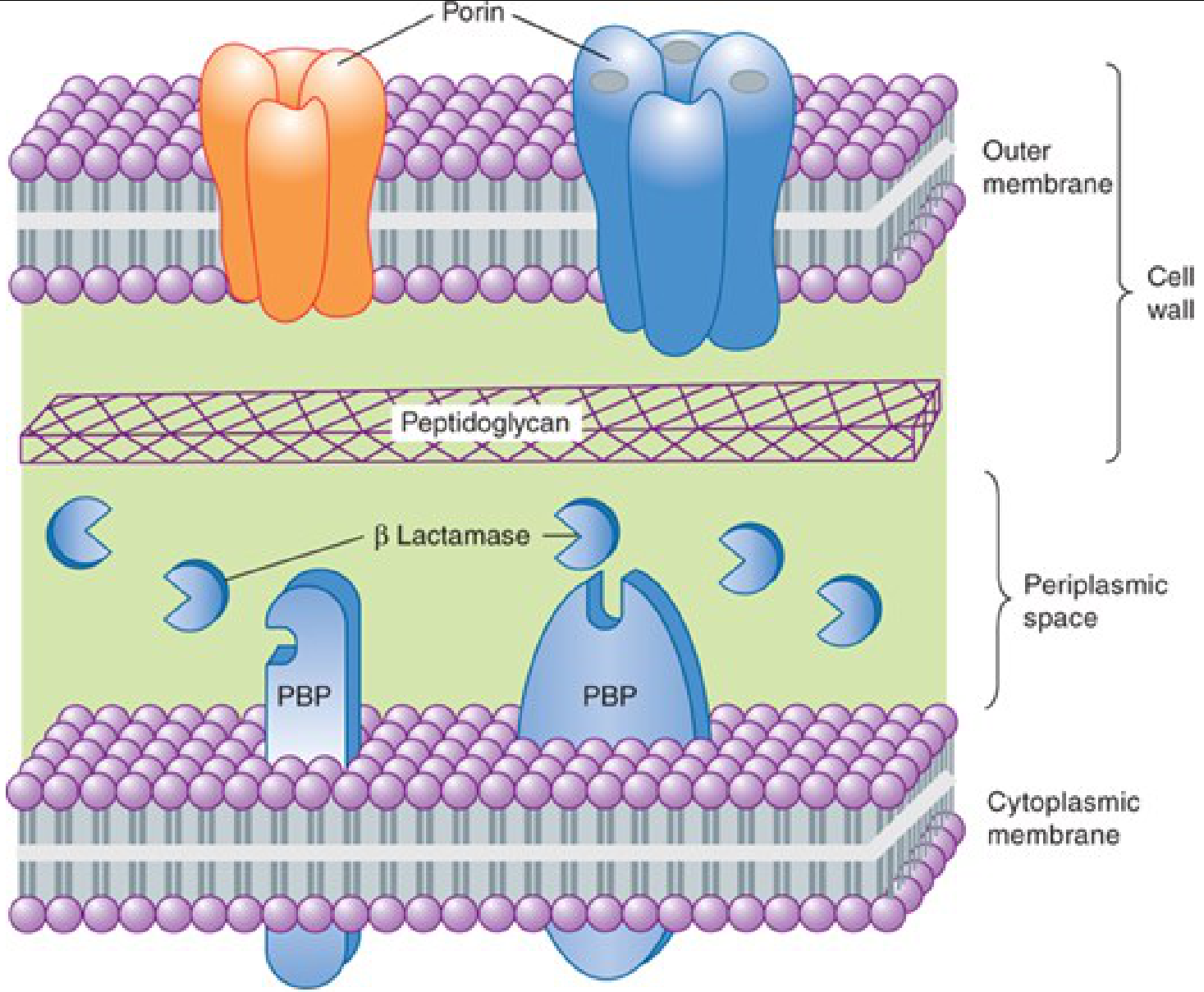
Gram-negative cell wall: note the outer membrane (absent in gram-positives), the peptidoglycan layer, PBPs on the cytoplasmic membrane, and beta-lactamases in the periplasmic space. - Katzung's Basic & Clinical Pharmacology, 16th Ed.
2. The Transpeptidation Reaction (Normal)
The final step in cell wall synthesis is transpeptidation - an enzyme (transpeptidase / PBP) removes the terminal D-alanine from the pentapeptide and forms a covalent cross-link between adjacent peptide chains. These cross-links give the peptidoglycan its rigidity and integrity.
3. How Penicillin Blocks This
Penicillin (and all beta-lactams) is a structural analog of the natural substrate D-Ala-D-Ala (the end of the pentapeptide). Because of this mimicry:
- Penicillin binds to the active site of PBPs (penicillin-binding proteins) - these are the transpeptidase enzymes located on the inner surface of the cytoplasmic membrane.
- The beta-lactam ring opens and covalently and irreversibly acylates the active serine residue of the PBP.
- This permanently blocks the transpeptidation reaction, preventing new cross-links from forming.
- Peptidoglycan synthesis halts; the cell wall cannot be completed or repaired.
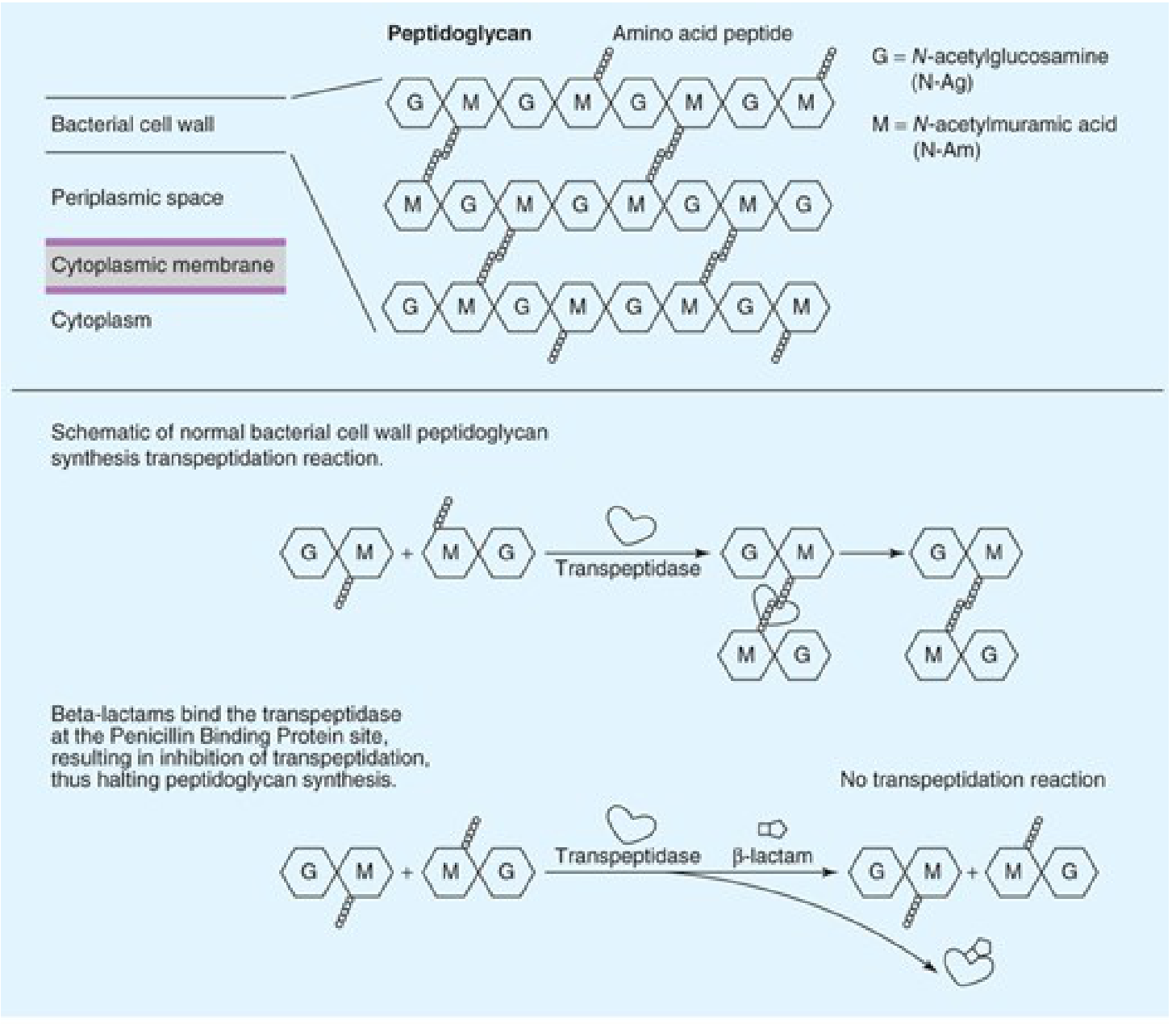
Top: Normal transpeptidation cross-links peptidoglycan chains. Bottom: Beta-lactam binds transpeptidase at the PBP site, no cross-linking occurs. - Katzung's Basic & Clinical Pharmacology, 16th Ed.
4. Bactericidal Action: Autolysins
Inhibiting transpeptidation alone produces bacteriostasis in some organisms. The bactericidal effect comes from an additional event:
"A final bactericidal event is the removal or inactivation of an inhibitor of autolytic enzymes in the cell wall. This activates the autolytic enzymes and results in cell lysis."
- Jawetz Medical Microbiology, 28th Ed.
- Autolysins are enzymes bacteria use normally to remodel their cell wall during growth.
- Penicillin triggers or disinhibits autolysins, which then degrade the existing peptidoglycan.
- The weakened cell wall cannot withstand the high internal osmotic pressure, leading to cell swelling and lysis.
- Organisms with defective autolysins are inhibited but not killed - they are called "tolerant".
5. Key Points
| Feature | Detail |
|---|---|
| Drug class | Beta-lactam antibiotic |
| Target | Penicillin-binding proteins (PBPs = transpeptidases) |
| Reaction inhibited | Transpeptidation (cross-linking of peptidoglycan) |
| Effect | Bactericidal |
| Mechanism of killing | Autolysin activation + loss of cell wall integrity -> lysis |
| Selectivity | Active only against growing bacteria (requires active cell wall synthesis) |
| Gram-positive vs negative | More potent vs gram-positives (thicker peptidoglycan, no outer membrane barrier) |
6. Resistance Mechanisms
From Katzung's Basic & Clinical Pharmacology, 16th Ed.:
- Beta-lactamase production - enzymes hydrolyze the beta-lactam ring (most common; e.g., S. aureus, H. influenzae, E. coli)
- Altered PBPs - reduced affinity for penicillin (e.g., MRSA has PBP2a; penicillin-resistant S. pneumoniae has altered PBPs)
- Impaired penetration - gram-negative outer membrane acts as a barrier; porin loss limits drug entry
- Efflux pumps - active transport removes drug from the periplasmic space before it can bind PBPs
Sources: Katzung's Basic & Clinical Pharmacology, 16th Ed. | Jawetz Melnick & Adelberg's Medical Microbiology, 28th Ed. | Medical Microbiology 9th Ed.
This is a shared conversation. Sign in to Orris to start your own chat.