
Sciatic nerve plsy assessment and management
Reading File
Searching across assessment, management, and anatomical aspects of sciatic nerve palsy in parallel.
search_medical_text
sciatic nerve palsy assessment clinical features diagnosis
search_medical_text
sciatic nerve palsy management treatment rehabilitation
search_medical_image
sciatic nerve anatomy distribution motor sensory
Hugging Face pmc clinical VQA raw
Page 0
GradeResponse
GradeResponse
GradeResponse
The database didn't return relevant text results, so I'll provide a comprehensive answer from clinical knowledge.
Sciatic Nerve Palsy: Assessment & Management
Anatomy Recap
The sciatic nerve (L4–S3) is the largest peripheral nerve in the body. It exits the pelvis via the greater sciatic foramen (below piriformis, usually) and divides into:
| Branch | Level | Key muscles innervated |
|---|---|---|
| Common peroneal (fibular) | ~Popliteal fossa | Tibialis anterior, peroneals, toe extensors |
| Tibial | ~Popliteal fossa | Gastrocnemius, soleus, flexor hallucis longus, intrinsics |
Etiology / Causes
Traumatic:
- Hip dislocation or fracture (posterior > anterior)
- Total hip arthroplasty (THA) — most common iatrogenic cause; 0.1–2% incidence
- Pelvic/acetabular fractures
- Penetrating injuries, gunshot wounds
Compressive/Positional:
- Piriformis syndrome
- Prolonged lithotomy or lateral decubitus positioning
- Gluteal compartment syndrome
- Space-occupying lesion (tumour, haematoma, abscess)
Vascular:
- Gluteal artery aneurysm / pseudoaneurysm
Other:
- Diabetic neuropathy (rarely isolated sciatic)
- Injection injury (intramuscular injection — upper outer quadrant misplacement)
Assessment
History
- Onset (acute vs insidious), mechanism (trauma, surgery, injection)
- Pain distribution: buttock radiating to posterior thigh, leg, foot
- Functional deficits: difficulty walking, foot drop, inability to plantarflex
- Bladder/bowel involvement (raises concern for cauda equina — urgent)
- Diabetes, prior malignancy, anticoagulation use
Clinical Examination
Motor Testing
| Muscle | Action tested | Root | Branch |
|---|---|---|---|
| Biceps femoris (short head) | Knee flexion | L5–S2 | Common peroneal |
| Biceps femoris (long head), semimembranosus, semitendinosus | Knee flexion | L5–S2 | Tibial |
| Tibialis anterior | Ankle dorsiflexion | L4–L5 | Deep peroneal |
| Extensor hallucis longus | Great toe extension | L5 | Deep peroneal |
| Peroneus longus/brevis | Ankle eversion | L5–S1 | Superficial peroneal |
| Gastrocnemius/soleus | Ankle plantarflexion | S1–S2 | Tibial |
| Intrinsic foot muscles | Toe flexion/abduction | S1–S3 | Tibial |
Key point: Testing short head of biceps femoris (common peroneal component) helps distinguish sciatic nerve palsy from isolated common peroneal nerve palsy at the fibular head.
Sensory Testing
| Area | Branch |
|---|---|
| Dorsum of foot, lateral leg | Common peroneal |
| Sole, posterior leg | Tibial |
| Posterior thigh | Posterior cutaneous nerve of thigh (not sciatic proper) |
Reflexes
- Ankle jerk (S1): absent/reduced — tibial component
- Knee jerk: spared (femoral nerve, not sciatic)
Special Tests
- Straight leg raise (SLR): positive at <60° suggests sciatic nerve tension; sensitivity ~80%, specificity ~40% for disc herniation
- FAIR test: hip flexion, adduction, internal rotation — for piriformis syndrome
- Pace sign: weakness/pain with resisted hip abduction/external rotation — piriformis syndrome
Severity Grading (Seddon / Sunderland)
| Grade | Seddon | Pathology | Prognosis |
|---|---|---|---|
| I | Neurapraxia | Focal demyelination, axon intact | Full recovery weeks–months |
| II | Axonotmesis | Axon disruption, endoneurium intact | Recovery at 1 mm/day (Tinel progression) |
| III | Axonotmesis | Endo/perineurium disrupted | Incomplete, variable |
| IV | Axonotmesis | Only epineurium intact | Poor without surgery |
| V | Neurotmesis | Complete transection | No recovery without surgery |
Investigations
Electrodiagnostic Studies (EDX)
- Timing: optimally performed 3–4 weeks post-injury (allows Wallerian degeneration to complete)
- Nerve conduction studies (NCS):
- Reduced/absent compound muscle action potential (CMAP) amplitude
- Reduced/absent sensory nerve action potential (SNAP)
- Sural, superficial peroneal, tibial responses
- Electromyography (EMG):
- Fibrillations + positive sharp waves: denervation (appears at 2–4 weeks)
- Motor unit analysis: polyphasic MUAPs on recovery
- Test short head of biceps femoris, tibialis anterior, gastrocnemius, gluteal muscles (to localise lesion level)
- Paraspinal muscles normal (excludes radiculopathy)
- Key distinction:
- Sciatic palsy: abnormal EMG in short head biceps femoris + distal muscles
- Common peroneal palsy at fibular head: normal biceps femoris (short head), normal tibial-territory muscles
Imaging
- MRI: modality of choice for soft-tissue causes (tumour, haematoma, piriformis, nerve sheath tumour); can show nerve signal change, muscle denervation oedema
- Ultrasound: dynamic assessment, especially useful for piriformis syndrome, and identifying compressive masses or nerve continuity after trauma
- X-ray / CT pelvis: for bony pathology (hip dislocation, acetabular fracture)
- MR neurography: high-resolution nerve imaging for complex cases
Management
Acute / General Principles
- Identify and treat the underlying cause (reduce hip dislocation urgently, evacuate haematoma, stop offending injection, relieve compression)
- Prompt reduction of traumatic hip dislocation within 6 hours significantly improves prognosis
Conservative Management
| Intervention | Details |
|---|---|
| Foot drop orthosis (AFO) | Ankle-foot orthosis for foot drop — improves gait immediately |
| Physiotherapy | Strengthening, range of motion, gait re-education, proprioception training |
| Pain management | Neuropathic agents: gabapentin, pregabalin; TCAs; SNRIs (duloxetine) |
| Nerve protection | Avoid pressure on nerve, padding at risk sites |
| Occupational therapy | ADL adaptation, footwear modification |
Surgical Management
Indications:
- Open/penetrating injuries (explore early, within days–weeks)
- Complete lesion with no EDX evidence of recovery at 3–6 months
- Identifiable compressive lesion (tumour, haematoma, pseudoaneurysm)
- Iatrogenic transection (THA, injection) — early exploration if suspected
Surgical options:
- Neurolysis: external or internal; for scar compression
- Primary neurorrhaphy: end-to-end repair if tension-free
- Nerve grafting: sural nerve most common donor; for gaps >2–3 cm
- Nerve transfers: for proximal/severe injuries to reinnervate critical distal targets (e.g., obturator to femoral for knee stability, or tibial branch transfers)
- Tendon transfers: for established foot drop (e.g., tibialis posterior transfer through interosseous membrane) when nerve recovery is unlikely or maximal
Monitoring Recovery
- Serial clinical examination monthly
- Tinel's sign progression: advancing Tinel indicates axon regrowth (~1 mm/day)
- Repeat EDX at 3–6 months: nascent MUAPs = early reinnervation
- Upper limit for meaningful reinnervation: ~18–24 months (muscle fibrosis beyond this limits functional return)
Prognosis
| Factor | Better prognosis | Worse prognosis |
|---|---|---|
| Injury grade | Neurapraxia (I) | Neurotmesis (V) |
| Mechanism | Stretch/contusion | Transection, injection |
| Completeness | Incomplete palsy | Complete palsy |
| Time to treatment | Rapid decompression | Delayed |
| Age | Younger | Older |
| Tibial vs peroneal | Tibial recovers better | Common peroneal recovers poorly |
The tibial division recovers better than the common peroneal division — attributed to the straighter fascicular path of the tibial nerve and greater distance to target muscles for the common peroneal.
Common Peroneal vs Sciatic Palsy: Key Differentiators
| Feature | Sciatic palsy | Common peroneal palsy |
|---|---|---|
| Plantarflexion | Weak | Normal |
| Ankle jerk | Absent | Normal |
| Short head biceps femoris EMG | Abnormal | Normal |
| Tibial sensory (sole) | Affected | Spared |
| Typical cause | Hip trauma, surgery | Fibular head compression |
Post-THA Sciatic Nerve Palsy (Special Consideration)
- Incidence ~0.1–2%; higher in revision THA, DDH, or leg lengthening >2.5–4 cm
- Most commonly involves the common peroneal division
- Management: flex hip and knee to reduce nerve tension; if hardware or haematoma implicated, explore early
- Prognosis: ~50% regain functional recovery; tibial division recovers better than peroneal
Physiotherpay assessment and management
search_medical_text
physiotherapy assessment sciatic nerve palsy neurological examination
search_medical_text
physiotherapy rehabilitation management foot drop sciatic nerve peripheral nerve injury
Bailey and Love's Short Practice of Surgery 28th Edition
Page 520
search_medical_image
sciatic nerve palsy physiotherapy exercise foot drop rehabilitation
Hugging Face pmc clinical VQA raw
Page 0
GradeResponse
GradeResponse
GradeResponse
Physiotherapy Assessment & Management: Sciatic Nerve Palsy
PART 1 — PHYSIOTHERAPY ASSESSMENT
1. Subjective Assessment (History)
Presenting complaint:
- Location, nature, and distribution of pain (burning, shooting, aching)
- Onset, mechanism (trauma, surgery, prolonged positioning, injection)
- Functional limitations: walking, stair climbing, rising from chair, dressing
Relevant history:
- Prior hip pathology or surgery (THA, ORIF), lumbar spine history
- Diabetes, malignancy, peripheral vascular disease
- Bladder/bowel function (cauda equina red flag)
- Medications (neuropathic agents already trialled)
Outcome measures (baseline):
- Visual Analogue Scale (VAS) / Numeric Pain Rating Scale (NPRS)
- Oswestry Disability Index or Lower Extremity Functional Scale (LEFS)
- Neuropathic pain: DN4 questionnaire or PainDETECT
2. Objective Assessment
Observation / Posture
- Antalgic gait, steppage gait (foot drop compensation)
- Gluteal wasting, limb length discrepancy
- Foot posture: equinovarus tendency, clawing of toes
Gait Analysis
| Gait Deviation | Underlying Deficit |
|---|---|
| Steppage gait (exaggerated hip/knee flexion) | Foot drop (tibialis anterior weakness) |
| Trendelenburg lurch | Gluteus medius weakness (hip abductors — superior gluteal nerve; assess to rule in/out co-existing pathology) |
| Reduced push-off | Gastrocnemius/soleus weakness (tibial division) |
| Circumduction | Combined weakness, compensation |
Active & Passive Range of Motion (ROM)
- Hip: flexion, extension, abduction, IR/ER
- Knee: flexion/extension
- Ankle: dorsiflexion (key), plantarflexion, inversion, eversion
- Note contracture vs weakness limitation
Manual Muscle Testing (MMT — MRC Scale 0–5)
| Muscle | Action | Root | Division |
|---|---|---|---|
| Biceps femoris (short head) | Knee flexion | L5–S2 | Common peroneal |
| Biceps femoris (long head) | Knee flexion | L5–S2 | Tibial |
| Semimembranosus/tendinosus | Knee flexion | L5–S2 | Tibial |
| Tibialis anterior | Ankle dorsiflexion | L4–L5 | Deep peroneal |
| Extensor hallucis longus | Great toe extension | L5 | Deep peroneal |
| Extensor digitorum longus | Toe extension | L5 | Deep peroneal |
| Peroneus longus/brevis | Ankle eversion | L5–S1 | Superficial peroneal |
| Gastrocnemius/soleus | Plantarflexion | S1–S2 | Tibial |
| Flexor digitorum longus | Toe flexion | S2–S3 | Tibial |
| Intrinsic foot muscles | Toe abduction/flexion | S1–S3 | Tibial |
MRC Scale:
- 0 = No contraction
- 1 = Flicker/trace
- 2 = Movement with gravity eliminated
- 3 = Movement against gravity
- 4 = Movement against resistance (reduced)
- 5 = Normal
Sensory Assessment
| Modality | Tool | Area tested |
|---|---|---|
| Light touch | Cotton wool / monofilament (Semmes-Weinstein) | Dorsum foot, lateral leg, sole, posterior thigh |
| Pin-prick | Neurotip | Same distribution |
| Vibration sense | 128 Hz tuning fork | Medial/lateral malleolus, metatarsal heads |
| Proprioception/JPSS | Passive toe/ankle positioning | Hallux, ankle |
| Two-point discrimination | Caliper | Plantar surface (normally 4–8 mm) |
Reflexes
- Ankle jerk (S1): graded 0–4+ (absent/reduced in sciatic palsy — tibial division)
- Knee jerk: expected normal (femoral nerve — useful comparison)
- Plantar response: assess for upper motor neuron signs (rule out cord involvement)
Neural Tension / Provocation Tests
| Test | Technique | Positive sign | Implication |
|---|---|---|---|
| Straight Leg Raise (SLR) | Supine, hip flexion with knee extended | Radicular pain <60°, reproduced with dorsiflexion | Sciatic nerve tension, disc herniation |
| Slump test | Seated slump + knee extension + ankle DF | Reproduces symptoms, relieved by cervical extension | Neural mechanosensitivity |
| FAIR test | Hip flex 60°, adduction, IR in sidelying | Buttock/sciatic pain | Piriformis syndrome |
| Pace test | Resisted hip abduction/ER seated | Pain/weakness | Piriformis syndrome |
Functional Tests
- Single leg stance (Romberg and dynamic)
- Timed Up and Go (TUG) test
- 10-Metre Walk Test / 6-Minute Walk Test
- Step-up/step-down test
- Heel walk (tests dorsiflexion, L4–L5) and toe walk (tests plantarflexion, S1–S2)
Palpation
- Sciatic nerve at sciatic notch, posterior thigh
- Piriformis (medial buttock between PSIS and greater trochanter)
- Tender/thickened nerve trunk
- Advancing Tinel's sign (percussion along nerve — tingling distally = axon regeneration front)
3. Physiotherapy Problem List (Example)
- Foot drop — risk of falls, tripping
- Ankle dorsiflexion weakness (MRC 2/5)
- Reduced sensation — dorsum foot and sole
- Proprioceptive deficit — ankle and hallux
- Reduced ankle ROM — tight Achilles/posterior capsule
- Impaired balance — single leg stance <5 seconds
- Altered gait — steppage pattern
- Neuropathic pain — VAS 6/10
- Fear of falling — reduced confidence (assess with Falls Efficacy Scale)
PART 2 — PHYSIOTHERAPY MANAGEMENT
Management is staged according to nerve injury severity (neurapraxia → neurotmesis) and phase of recovery.
Phase 1 — Acute / Early (0–6 weeks)
Goals: Protect nerve, prevent secondary complications, manage pain, maintain joint mobility
| Intervention | Rationale |
|---|---|
| Patient education | Nerve healing timeline (1 mm/day), expected recovery, positioning advice, fall prevention |
| Ankle-Foot Orthosis (AFO) | Corrects foot drop immediately; prevents equinus contracture; improves gait safety |
| Passive ROM exercises | Prevent contracture at ankle, subtalar joint; maintain tissue extensibility |
| Positioning | Avoid prolonged hip flexion >90° (post-THA); avoid leg crossing; pressure relief over fibular head |
| Gentle neural mobilisation | Slider techniques (nerve gliding) — mobilise nerve without excessive tension; reduce intraneural oedema and adhesions |
| Oedema management | Elevation, compression if limb oedema present |
| Electrical stimulation | NMES/FES to denervated muscles — reduces atrophy, may maintain muscle morphology (evidence: modest) |
| TENS | Neuropathic pain modulation |
| Cryotherapy/heat | Comfort, pain modulation — caution with sensory loss (avoid burns) |
Phase 2 — Subacute / Re-innervation (6 weeks – 6 months)
Goals: Facilitate motor re-education, restore strength and sensory function, improve gait
Motor Re-education
| Exercise | Technique | Target |
|---|---|---|
| Ankle dorsiflexion | Sitting, gravity-eliminated → against resistance band; biofeedback EMG-assisted | Tibialis anterior (L4–L5) |
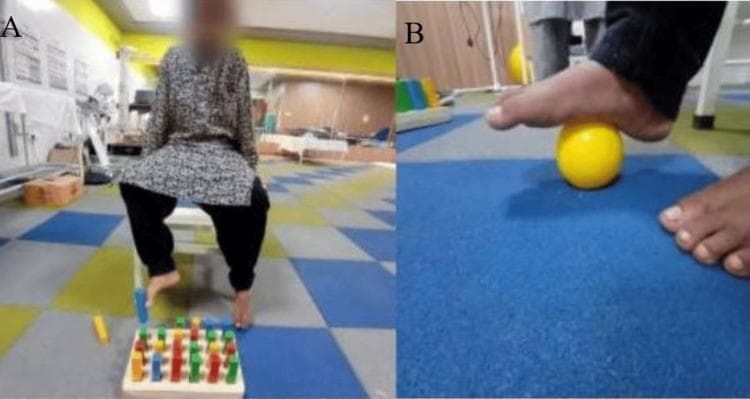
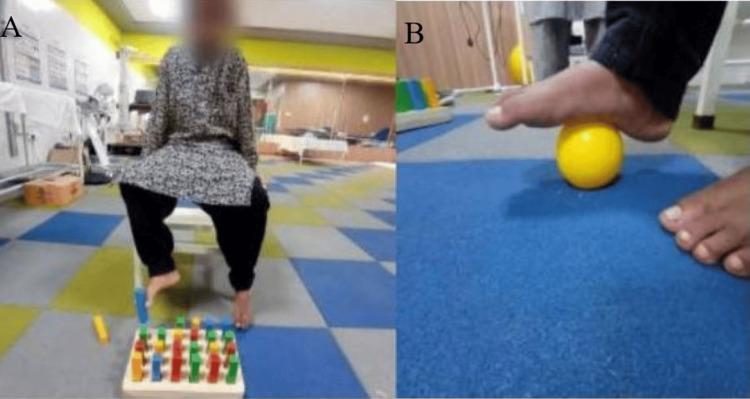
| Toe extension | Marble/peg picking with toes; towel scrunching | Extensor digitorum, EHL |
| Ankle eversion | Resistance band in sidelying; wobble board | Peroneals (L5–S1) |
| Ankle plantarflexion | Calf raises: bilateral → unilateral; seated → standing | Gastrocnemius, soleus (S1–S2) |
| Knee flexion (hamstrings) | Prone knee curls; nordic hamstring curl progression | All hamstrings (short head — peroneal) |
| Hip extension | Bridging, prone hip extension, Romanian deadlift progression | Gluteus maximus, hamstrings |
| Intrinsic foot muscles | Toe curls, short foot exercise, peg board (see image below) | Lumbricals, interossei (S1–S3) |
Sensory Re-education
- Early phase: graded sensory stimulation — cotton, brush, textures; vibration (tuning fork, vibrating tool)
- Late phase: texture discrimination, object identification (stereognosis), balance on varied surfaces
- Mirror therapy: useful adjunct for cortical remapping in chronic cases
- Proprioceptive retraining: wobble board, foam pad, BOSU ball progressions
Neural Mobilisation (Progression)
- Sliders: hip flexion with knee extension alternated with hip extension with knee flexion — moves nerve without tension
- Tensioners: used cautiously once acute inflammation subsides; SLR with ankle dorsiflexion
- Frequency: daily, within symptom-free range; avoid aggravating neurogenic pain
Phase 3 — Functional / Late Rehabilitation (6 months+)
Goals: Restore functional gait, strength, balance, return to occupation/sport
Gait Retraining
- AFO weaning: as dorsiflexion recovers (MRC ≥3), trial dynamic AFO → no AFO with supervision
- Treadmill training: visual and verbal feedback; body-weight support treadmill (BWSTT) if significant weakness
- Obstacle course training, stair training, ramp walking
- Address compensatory strategies (steppage, circumduction) with mirror/video feedback
Progressive Strengthening
- Resistance progression: gravity-eliminated → against gravity → resistance bands → free weights → functional
- Eccentric loading for hamstrings (Nordic curls, Romanian deadlift)
- Single-leg press, single-leg calf raise
- Sport/occupation-specific loading
Balance & Proprioception
- Single leg stance: firm → foam → eyes closed progressions
- Perturbation training
- Functional reach test — target improvement
- Dual-task balance training (balance + cognitive task)
Hydrotherapy
- Buoyancy reduces weight-bearing demands
- Warm water facilitates muscle relaxation and pain reduction
- Walking in water: earlier active gait training pre-land ambulation
- Resistance of water for strengthening as function improves
Pain Management (Across All Phases)
| Modality | Notes |
|---|---|
| TENS | High-frequency (conventional) for acute pain; low-frequency for chronic |
| Therapeutic ultrasound | Phonophoresis; deep tissue heating; evidence limited but clinically used |
| Laser therapy (LLLT) | Emerging evidence for peripheral nerve regeneration and pain reduction |
| Dry needling / acupuncture | Trigger points in piriformis, gluteal muscles; neuropathic pain modulation |
| Manual therapy | Soft tissue mobilisation of piriformis, gluteals; lumbar/hip joint mobilisation if restricted |
| Cryotherapy/thermotherapy | Caution with sensory deficit — use towel barrier; check skin response |
Orthotic & Assistive Devices
| Device | Indication |
|---|---|
| Static AFO | Severe foot drop, early phase; night splinting to prevent equinus |
| Dynamic AFO (e.g. Dictus band, carbon fibre) | Partial recovery; allows some dorsiflexion movement |
| Functional Electrical Stimulation (FES) walkaid | Active foot drop correction during gait; also provides sensory input |
| Walking aids | Crutches/stick initially for safety; wean as strength returns |
| Heel raise | If leg length discrepancy |
Functional Electrical Stimulation (FES)
- NMES (Neuromuscular Electrical Stimulation): denervated muscle — direct muscle stimulation (low frequency, longer pulse width 200–1000 µs)
- FES: stimulates intact nerve to trigger dorsiflexion during swing phase (e.g. WalkAide, Bioness L300)
- Best evidence for incomplete lesions where some neural continuity remains
- Maintains muscle bulk, prevents fibrotic change, re-educates motor pattern
- Electrode placement: tibialis anterior (peroneal nerve at fibular head)
Psychological & Holistic Considerations
- Address fear-avoidance beliefs (Tampa Scale of Kinesiophobia)
- Goal-setting using SMART goals; patient-centred approach
- Vocational rehabilitation: modified duties, workplace ergonomic assessment
- Falls prevention programme for high-risk patients (elderly, bilateral involvement)
- Support groups / peer connection for long-term neurological conditions
Monitoring Progress — Outcome Measures Summary
| Domain | Measure |
|---|---|
| Pain | NPRS / VAS, DN4 |
| Muscle strength | MRC scale, hand-held dynamometry |
| ROM | Goniometry (ankle DF key) |
| Sensation | Semmes-Weinstein monofilament, 2-point discrimination |
| Balance | Single leg stance time, Berg Balance Scale, TUG |
| Gait | 10MWT, 6MWT, GAITRite if available |
| Function | LEFS, Oswestry |
| Quality of life | SF-36 |
Red Flags During Physiotherapy — Refer / Escalate
| Flag | Action |
|---|---|
| Bladder/bowel dysfunction | Urgent surgical review (cauda equina) |
| Progressive worsening despite treatment | Re-refer for EDX / MRI |
| No Tinel progression at 3–4 months | Consider surgical exploration |
| Spreading neurological deficit | Neurology/neurosurgery referral |
| Signs of complex regional pain syndrome (CRPS) | Multidisciplinary pain team |
Summary: Physiotherapy Goal Progression
Phase 1 (0–6 wks):   Protect → prevent contracture → pain control → patient education
Phase 2 (6wk–6mo):   Motor re-education → sensory retraining → neural mobilisation → gait training
Phase 3 (6mo+):      Functional strength → balance → gait normalisation → return to activity
This is a shared conversation. Sign in to Orris to start your own chat.