
Lung hilar anatomy
Reading File
This is a visual anatomy topic. I'll search both headings and paragraphs in parallel, plus look for images.
Searching sources...
Finding Sources
Finding Sources
Finding Sources
Finding Sources
I found the key sources. Let me read them in parallel - Gray's Anatomy "Root and hilum" section and the Scott-Brown's "hilum of the lung" section, plus search for hilar structures more specifically.
Reading File
Reading File
Finding Sources
Excellent. Let me fetch the hilar diagram image from Scott-Brown's, read the Fischer's Surgery section on left lung hilum, and get more Gray's content on pulmonary vessels.
Loading Image
Reading File
Reading File
Let me fetch the key hilar diagrams and read more on right hilum from Fischer's:
Loading Image
Loading Image
Reading File
I now have comprehensive, well-sourced content and two excellent diagrams. Here is the full response:
Lung Hilar Anatomy
The hilum (plural: hila) is the region on the medial (mediastinal) surface of each lung where structures enter and leave. The root of the lung is the short tubular collection of these structures, wrapped in a sleeve of mediastinal pleura that reflects onto the lung surface as visceral pleura.
Contents of the Hilum
Each hilum contains the following structures:
| Structure | Notes |
|---|---|
| Pulmonary artery (x1) | Carries deoxygenated blood to the lung |
| Pulmonary veins (x2) | Carry oxygenated blood back to the heart |
| Main bronchus | Conducts air |
| Bronchial vessels | Nutritive supply to lung parenchyma and bronchi, closely associated with the bronchial tree |
| Lymphatics | Abundant lymph nodes in loose connective tissue |
| Nerves | Autonomic fibers (pulmonary plexuses) |
Loose connective tissue and lymph nodes surround all major tubular structures throughout the hilum. - Fischer's Mastery of Surgery, p. 2213
Anterior-to-Posterior Arrangement
The key rule from anterior to posterior:
Pulmonary veins (anterior) → Pulmonary artery (middle) → Bronchus (posterior)
More precisely, from front to back: anterior pulmonary plexus, pulmonary vessels (artery superior, two veins inferior), bronchi and bronchial vessels, posterior pulmonary plexus. - Scott-Brown's Otorhinolaryngology, p. 939
Right vs. Left Hilum
Right Hilum
Right hilum diagram (a) - medial view:
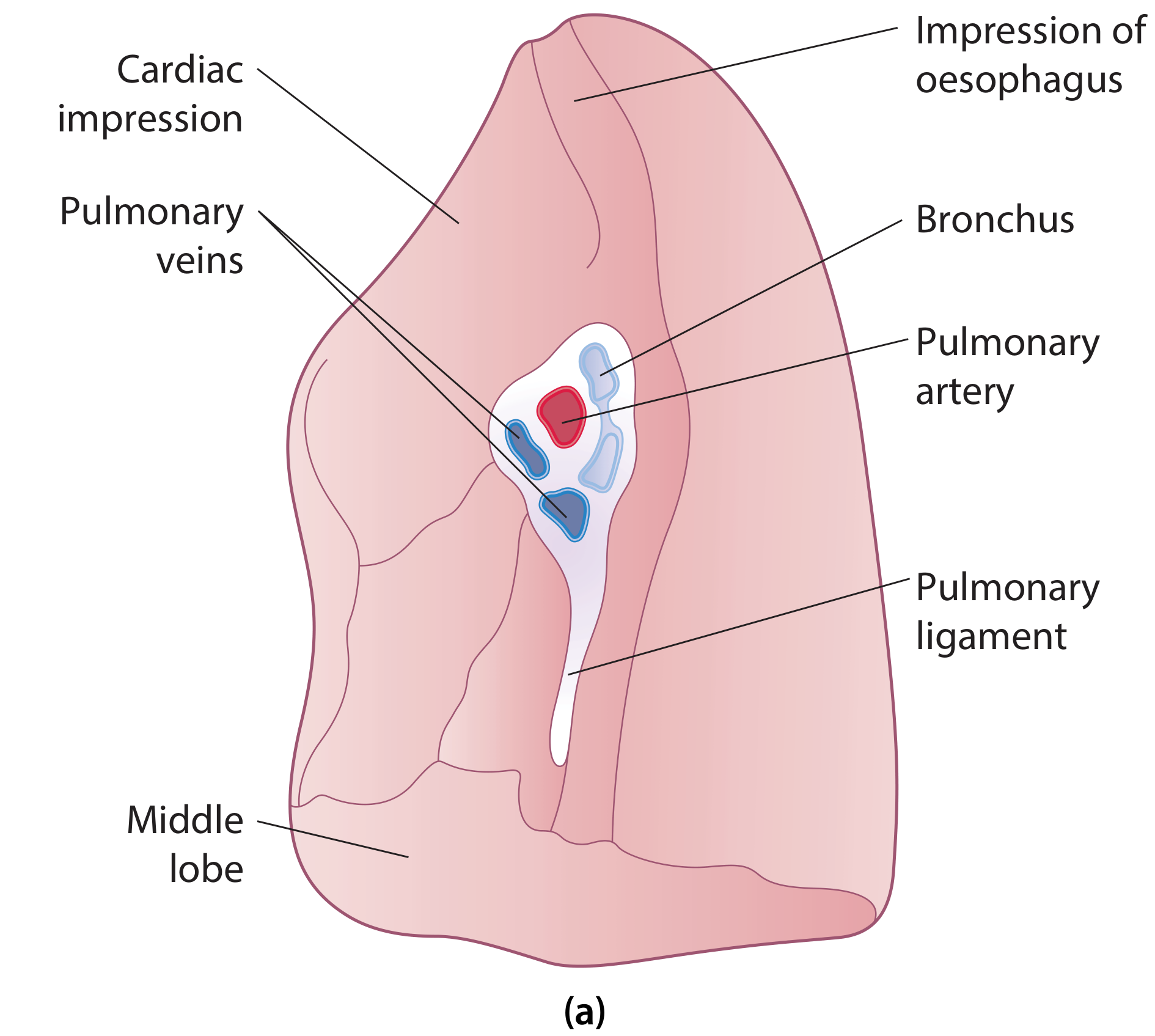
- Pulmonary veins are most anterior; their course is predominantly inferomedial
- The pulmonary artery runs predominantly transversely (intermediate position)
- The bronchus is most posterior, with a superolateral course
- Key right-sided feature: the right upper lobe bronchus branches from the main bronchus within the root (before entering the lung), and it lies superior to the pulmonary artery - this is the "eparterial bronchus" - Gray's Anatomy for Students
- Superior relation: the azygos vein arches anteriorly over the root to join the SVC
- Anterior: the right phrenic nerve and pericardiophrenic artery pass in front of the root (within mediastinal adventitia of the SVC/pericardium)
- Posterior: the right vagus nerve and esophagus lie behind the hilum
Left Hilum
Left hilum diagram (b) - medial view:
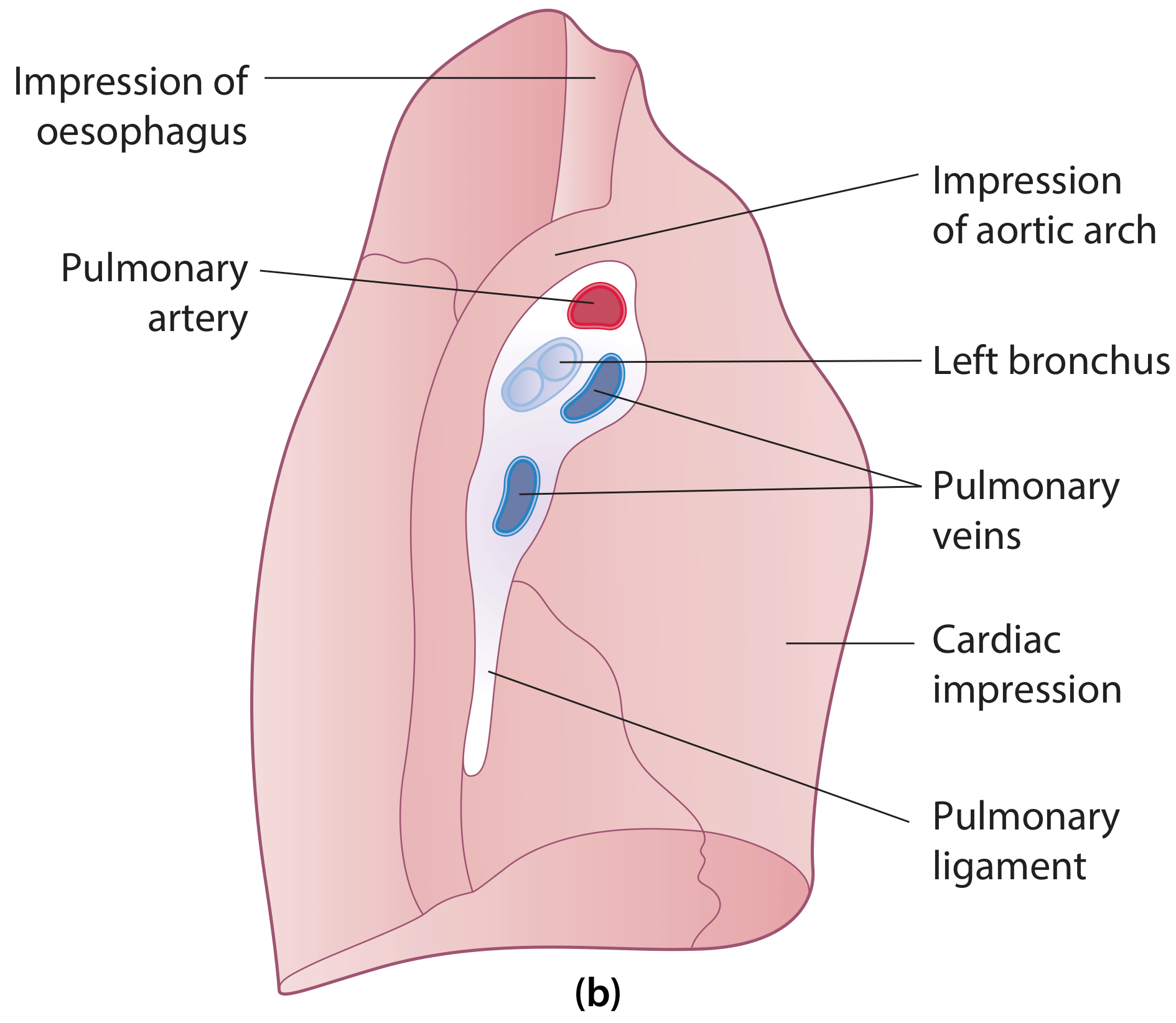
- The pulmonary artery is superior to the bronchus and initially anterior, then curves over the bronchus before dividing
- Pulmonary veins are anterior and inferior, the bronchus is posterior - same general pattern as right
- The left upper lobe bronchus branches within the lung (not in the root), so there is no eparterial bronchus on the left
- Superior relation: the aortic arch (not the azygos vein) arches over the left hilum
- Anterior: the left phrenic nerve passes in front of the root
- Posterior: the left vagus nerve and descending aorta cross posterior to the left hilum; the recurrent laryngeal branch loops under the aortic arch near the ligamentum arteriosum
Summary Table: Right vs. Left Differences
| Feature | Right | Left |
|---|---|---|
| Superior relation | Azygos vein | Aortic arch |
| Anterior relation | Right phrenic nerve + SVC | Left phrenic nerve |
| Posterior relation | Right vagus + esophagus | Left vagus + descending aorta |
| Upper lobe bronchus | Branches in root, above PA ("eparterial") | Branches within lung |
| Pulmonary artery position | Superior/transverse | Superior, arches over bronchus |
| Recurrent laryngeal nerve | Loops under subclavian (in neck) | Loops under aortic arch (in thorax) |
The Pulmonary Ligament
A blade-like fold of pleura projects inferiorly from the root of each lung, extending from the hilum to the mediastinum. This is the pulmonary ligament. It stabilizes the position of the inferior lobe and accommodates the translocation of hilar structures during breathing. It must be incised during surgical procedures (e.g. lobectomy, esophageal surgery) to allow lung retraction. - Gray's Anatomy for Students, p. 204
Nerve Relations to the Root
- The vagus nerves pass posterior to the roots of both lungs in the mediastinum
- The phrenic nerves pass anterior to the roots of both lungs - they are the only longitudinal structures anterior to the lung root, and lie in a different tissue plane from the lung adventitia
- Practical point: careless retraction of the lung at the start of thoracic surgery can tent or injure the vagus through its contributions to the pulmonary plexuses
Sources: Gray's Anatomy for Students (9780323934237); Scott-Brown's Otorhinolaryngology Head & Neck Surgery (9781138094642); Fischer's Mastery of Surgery 8th ed. (9781975176433)
Lung hilar anatomy
Reading File
This is a visual anatomy topic. Searching headings and paragraphs in parallel.
Searching sources...
Finding Sources
Finding Sources
Reading File
Reading File
Finding Sources
Now let me fetch the hilar diagrams and read the Gray's Anatomy section on root and hilum in parallel.
Loading Image
Loading Image
Finding Sources
Reading File
I have everything needed for a thorough, well-illustrated answer.
Lung Hilar Anatomy
Definition
The hilum is the region on the medial (mediastinal) surface of each lung where structures enter and leave, outlined by the pleural reflection. The root of the lung is the short tubular collection of all these structures connecting the lung to the mediastinum - it is wrapped in a sleeve of mediastinal pleura that continues as visceral pleura over the lung surface.
- Gray's Anatomy for Students
Contents of Each Hilum
Every hilum contains:
| Structure | Details |
|---|---|
| Pulmonary artery (×1) | Deoxygenated blood to the lung; generally superior |
| Pulmonary veins (×2) | Oxygenated blood back to the heart; generally inferior |
| Main bronchus | Posterior in position |
| Bronchial vessels | Nutritive supply; closely associated with the bronchial tree |
| Lymphatics & lymph nodes | Abundant, in loose connective tissue |
| Autonomic nerve fibers | Forming pulmonary plexuses (anterior and posterior) |
The anterior-to-posterior order is: anterior pulmonary plexus → pulmonary vessels (artery superior, veins inferior) → bronchi + bronchial vessels → posterior pulmonary plexus.
Right Hilum
Figure (a): Medial view of the right lung hilum - Scott-Brown's Otorhinolaryngology
- Pulmonary veins - most anterior; course is predominantly inferomedial
- Pulmonary artery - intermediate position; course predominantly transverse
- Bronchus - most posterior; course is superolateral
- Key right-side feature: the right upper lobe (eparterial) bronchus branches from the main bronchus within the root itself, before entering the lung. It sits above the pulmonary artery - this is why the right is called "eparterial" (above the artery)
- Superior: the azygos vein arches anteriorly over the root to join the SVC
- Anterior: the right phrenic nerve + pericardiophrenic artery, running in mediastinal adventitia adherent to the SVC and pericardium - the only longitudinal structure anterior to the root, in a separate tissue plane
- Posterior: the right vagus nerve and esophagus; the pulmonary ligament is immediately anterior to the esophagus inferiorly
Left Hilum
Figure (b): Medial view of the left lung hilum - Scott-Brown's Otorhinolaryngology
- Pulmonary artery - superior to the bronchus; initially anterior, then curves over the bronchus before dividing
- Pulmonary veins - anterior and inferior (same as right)
- Bronchus - posterior (same as right)
- No eparterial bronchus on the left - the upper lobe bronchus branches within the lung, not in the root
- Superior: the aortic arch (not the azygos) arches over the left hilum
- Anterior: the left phrenic nerve - again the only longitudinal structure anterior to the root
- Posterior: the left vagus nerve and descending aorta; the recurrent laryngeal branch of the left vagus loops under the aortic arch near the ligamentum arteriosum - at risk during left pneumonectomy
Right vs. Left: Key Differences at a Glance
| Feature | Right | Left |
|---|---|---|
| Superior relation | Azygos vein | Aortic arch |
| Anterior relation | Phrenic nerve + SVC | Phrenic nerve only |
| Posterior relation | Vagus nerve + esophagus | Vagus nerve + descending aorta |
| Upper lobe bronchus | In the root, above PA ("eparterial") | Within the lung, below PA |
| Pulmonary artery position | Superior, transverse | Superior, arches over bronchus |
| Recurrent laryngeal nerve loop | Under right subclavian (in neck) | Under aortic arch (in thorax) |
The Pulmonary Ligament
A blade-like fold of pleura projects inferiorly from the root of each lung, from the hilum down to the mediastinum. It stabilizes the inferior lobe and accommodates the up-and-down movement of hilar structures during breathing. Surgically, it must be incised to allow lung retraction (e.g. lobectomy, esophageal procedures) - care must be taken not to injure the phrenic nerve or the inferior pulmonary vein. - Gray's Anatomy for Students
Nerve Relations - Clinical Summary
- Vagus nerves pass posterior to both lung roots
- Phrenic nerves pass anterior to both lung roots - they are the only longitudinal structures anterior, and lie in a different tissue plane from the lung adventitia (important during lung retraction in surgery)
- Lung retraction at the start of thoracic surgery can "tent" the vagus nerve via its pulmonary plexus contributions
Sources: Gray's Anatomy for Students (9780323934237) | Scott-Brown's Otorhinolaryngology Head & Neck Surgery (9781138094642) | Fischer's Mastery of Surgery 8th ed. (9781975176433)
Images
The two diagrams from my previous answer are already rendered above. Here they are again clearly labelled:
Figure (a) — Right Lung Hilum (medial view)
Figure (b) — Left Lung Hilum (medial view)
Both images are from Scott-Brown's Otorhinolaryngology Head & Neck Surgery, Figure 58.16. They show the medial surface of each lung with the hilar structures labelled - pulmonary artery (red, superior), bronchus (blue outline, posterior), pulmonary veins (blue, anteroinferior), and the pulmonary ligament projecting inferiorly. Let me know if you'd like additional images, such as axial CT views or surgical anatomy diagrams.
This is a shared conversation. Sign in to Orris to start your own chat.