
Malaria
Reading File
The query "Malaria" is broad. Let me clarify what you need before diving in.
Asking for Preferences
What aspect of malaria are you looking for?
Finding Sources
Finding Sources
Good. I have strong hits from Robbins Pathology, Sherris Microbiology, Lippincott Pharmacology, and Rosen's Emergency Medicine. Let me pull the most comprehensive sections in parallel.
Reading File
Reading File
Reading File
I have rich, detailed content from three major textbooks. Let me also fetch the key lifecycle diagram from Robbins Pathology and the antimalarial drug lifecycle diagram.
Loading Image
Loading Image
Excellent — both diagrams are clear and highly informative. I now have everything needed for a comprehensive overview. Here is the full synthesis:
Malaria
Overview
Malaria is a potentially life-threatening parasitic disease caused by protozoa of the genus Plasmodium, transmitted exclusively by the bite of female Anopheles mosquitoes. The WHO estimated >200 million cases and >600,000 deaths in 2020, with the greatest burden in sub-Saharan Africa and parts of Asia. With widespread jet travel, cases now appear worldwide.
Five species infect humans:
| Species | Disease | Notes |
|---|---|---|
| P. falciparum | Falciparum (tertian) malaria | Most dangerous; high fatality; no hypnozoite |
| P. vivax | Benign tertian malaria | Dormant hypnozoite → relapse |
| P. ovale | Ovale malaria | Dormant hypnozoite → relapse |
| P. malariae | Quartan malaria | Mild; long latency |
| P. knowlesi | Knowlesi malaria | Zoonosis (primates); can be severe; SE Asia |
Life Cycle
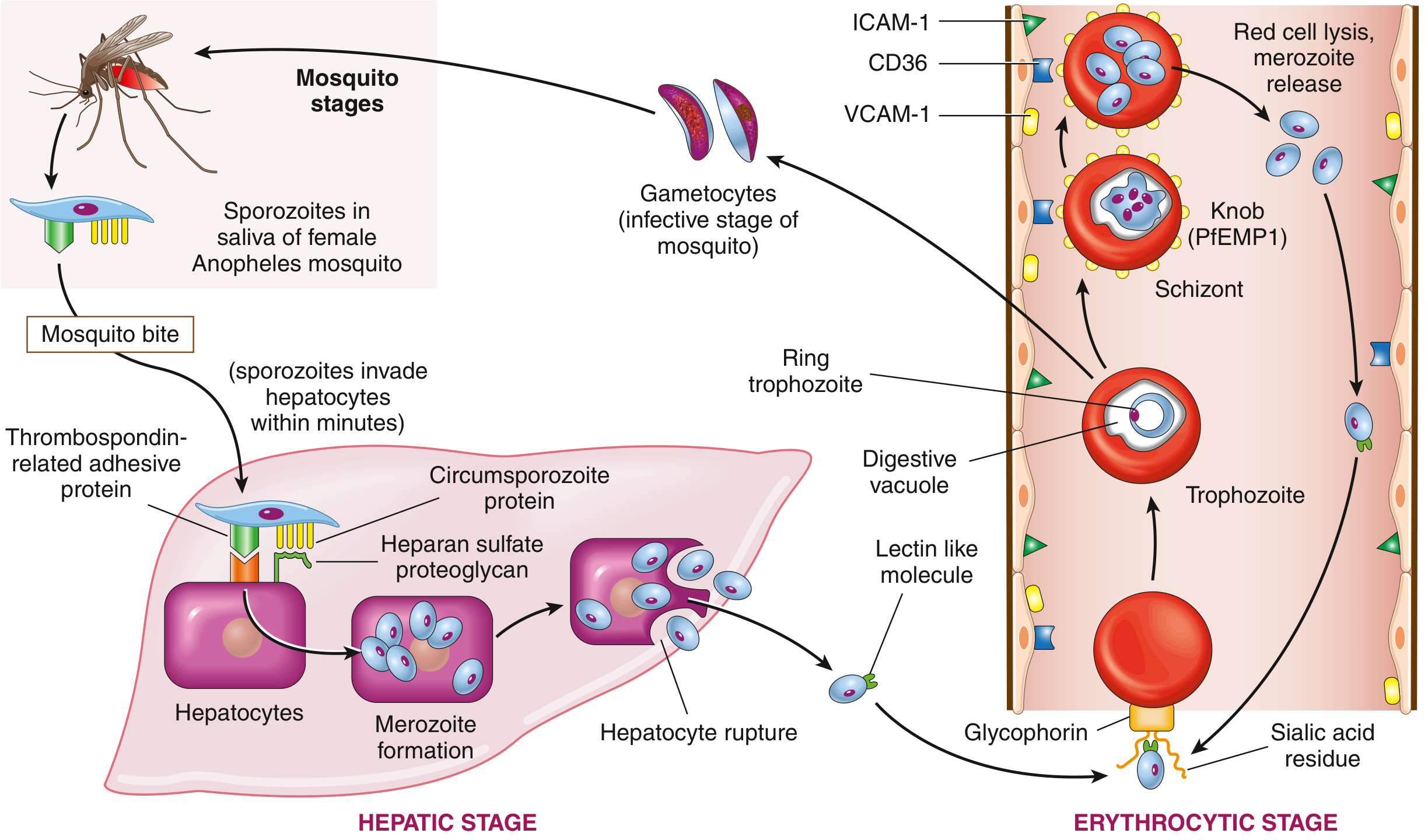
Hepatic (pre-erythrocytic) stage:
- An infected Anopheles mosquito injects sporozoites into the bloodstream.
- Sporozoites travel to the liver within minutes, using thrombospondin-related adhesive protein and circumsporozoite protein to bind hepatocyte heparan sulfate proteoglycans.
- Inside hepatocytes, sporozoites differentiate into merozoites (incubation 1–4 weeks), then hepatocytes rupture and merozoites are released.
- In P. vivax and P. ovale, some parasites enter a dormant hypnozoite stage in the liver — the basis for relapses months to years later.
Erythrocytic stage:
- A lectin-like molecule on merozoites binds sialylated glycophorin on red blood cells (RBCs), allowing invasion into a "digestive" vacuole.
- Merozoites differentiate into ring trophozoites, then mature trophozoites.
- Trophozoites either become gametocytes (sexual forms; restart cycle in mosquito) or differentiate into schizonts.
- P. falciparum schizonts express PfEMP1 on knob-like extensions on the RBC surface, which binds endothelial adhesion molecules (ICAM-1, VCAM-1, CD36), causing sequestration in capillary beds — the key pathogenic mechanism of severe disease.
- Schizonts lyse the RBC, releasing new merozoites → repeat cycle every 48–72 hours.
— Robbins & Kumar Basic Pathology, p. 392
Pathogenesis of Severe Disease (P. falciparum)
The capillary sequestration caused by PfEMP1 drives most severe complications, which typically appear at parasitemia >100,000 organisms/mm³:
- Cerebral malaria: delirium, seizures, coma, paralysis; ~80% mortality when combined with pulmonary insufficiency
- Acute respiratory distress (pulmonary malaria)
- Splanchnic involvement: vomiting, abdominal pain, bloody diarrhea
- Acute kidney injury
- Jaundice (haemolysis + hepatic involvement)
- Severe anaemia (haemolysis from repeated RBC lysis)
Most deaths in falciparum malaria occur within 3 days.
— Sherris & Ryan's Medical Microbiology, p. 1701–1705
Clinical Features
Classic presentation: headache and fatigue → fever, chills, sweats in paroxysms. The periodicity reflects synchronised RBC lysis:
- Every 48 hours — P. falciparum, P. vivax, P. ovale
- Every 72 hours — P. malariae
P. falciparum typically causes persistent high fever without clear paroxysms, hyperparasitemia, and rapid multiorgan dysfunction.
Diagnosis
- Peripheral blood smear (gold standard): thick and thin smears stained with Giemsa or Wright stain. Thick smear concentrates parasites; thin smear allows species identification. Multiple specimens may be needed.
- Acridine orange / QBC tubes: faster, requires fluorescence microscope; poor speciation.
- Rapid antigen tests:
- ParaSight F: detects HRP2 protein of P. falciparum; >95% sensitivity
- OptiMAL: detects parasite lactate dehydrogenase; distinguishes P. falciparum from P. vivax
- PCR assays: high sensitivity and speciation; used in reference labs
- Serology: epidemiological use; occasionally helpful for speciation
— Sherris & Ryan's Medical Microbiology, p. 1705
Treatment
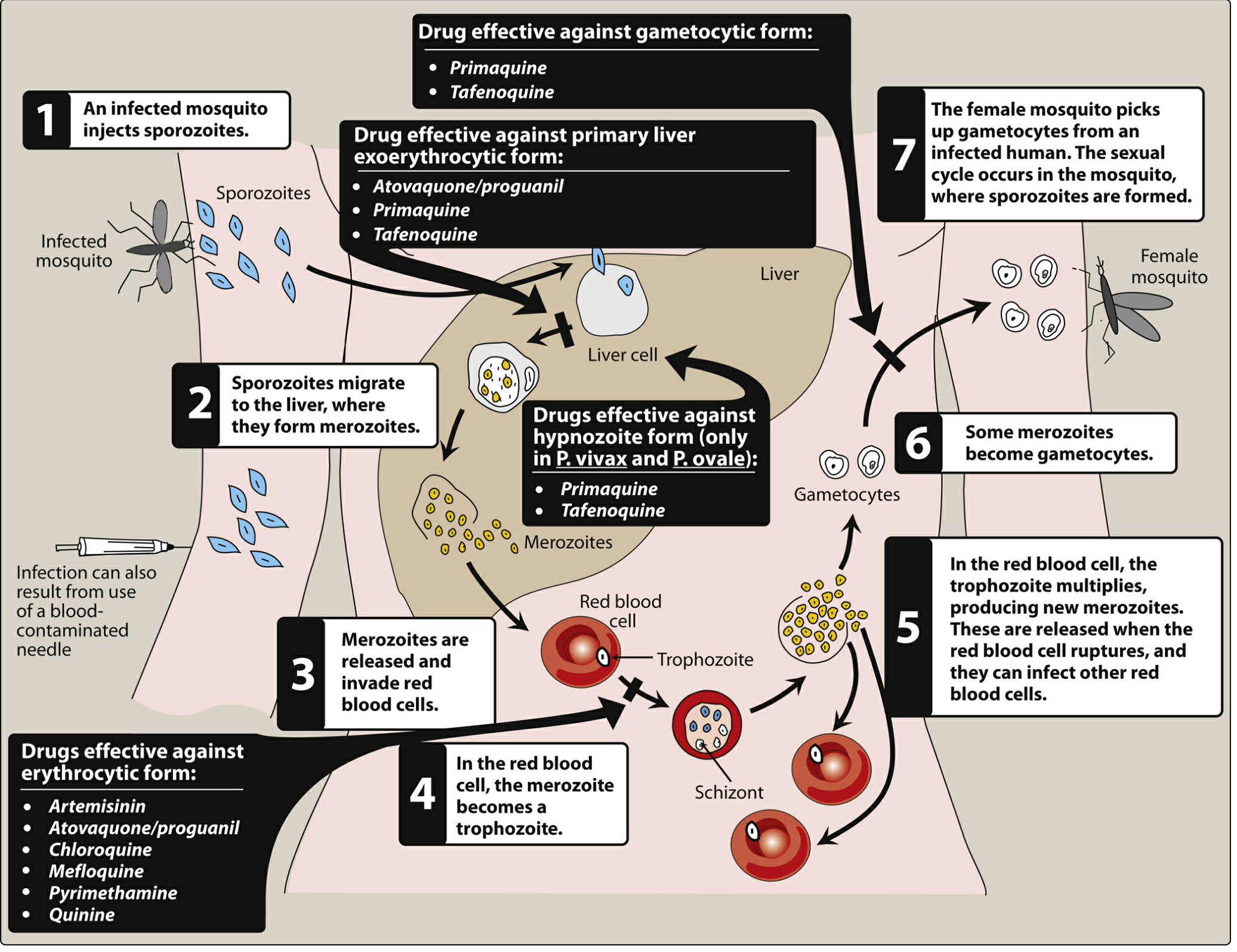
Complete treatment requires eliminating parasites at three levels:
- Erythrocytic schizonts → ends the clinical attack
- Hepatic schizonts / hypnozoites → prevents relapse
- Gametocytes → prevents transmission
No single drug does all three. The diagram below maps drugs to life cycle stages:
Key Antimalarial Drugs
| Drug | Stage targeted | Notes |
|---|---|---|
| Chloroquine | Erythrocytic | Drug of choice for P. vivax, P. malariae, P. ovale (where sensitive); widespread P. falciparum resistance |
| Artemisinin / artemisinins | Erythrocytic | Rapidly acting; backbone of artemisinin-based combination therapy (ACT) for P. falciparum |
| Atovaquone/proguanil (Malarone) | Erythrocytic + primary liver stage | Used for treatment and prophylaxis |
| Mefloquine | Erythrocytic | Used where chloroquine-resistant P. falciparum |
| Quinine | Erythrocytic | IV for severe P. falciparum |
| Pyrimethamine | Erythrocytic | Antifolate; used in combination |
| Primaquine | Hypnozoites (liver) + gametocytes | Mandatory to prevent relapse in P. vivax and P. ovale; contraindicated in G6PD deficiency (causes haemolytic anaemia) |
| Tafenoquine | Hypnozoites + gametocytes + primary liver stage | Single-dose alternative to primaquine for P. vivax radical cure; also contraindicated in G6PD deficiency |
Resistance is the major challenge, particularly multi-drug-resistant P. falciparum. Artemisinin partial resistance has emerged in Southeast Asia and Africa.
— Lippincott Illustrated Reviews: Pharmacology, p. 1167–1170
Prevention
- Vector control: insecticide-treated bed nets, indoor residual spraying
- Chemoprophylaxis (for travellers):
- Atovaquone/proguanil, mefloquine, or doxycycline — choice depends on destination resistance patterns
- Chloroquine for travel to chloroquine-sensitive areas
- Vaccine: RTS,S/AS01 (Mosquirix) — first approved malaria vaccine, targets P. falciparum sporozoites; moderate efficacy (~50%)
Key Points Summary
- P. falciparum is the deadliest species due to capillary sequestration via PfEMP1
- P. vivax and P. ovale have hypnozoites requiring primaquine/tafenoquine for radical cure (G6PD screen first)
- Diagnosis: Giemsa-stained blood smear ± rapid antigen test ± PCR
- Severe malaria is a medical emergency requiring IV artesunate
- Drug resistance, especially in P. falciparum, shapes treatment selection by geographic region
This is a shared conversation. Sign in to Orris to start your own chat.