
Trauma of liver abdomen and management and anaesthestic considerations
Reading File
Finding Sources
Finding Sources
Finding Sources
Reading File
Finding Sources
Finding Sources
Reading File
Reading File
Reading File
Finding Sources
Finding Sources
Reading File
Finding Sources
Reading File
Reading File
Reading File
Searching PubMed
liver trauma management
Liver Trauma: Presentation, Management, and Anaesthetic Considerations
Epidemiology and Mechanism
The liver is the second most commonly injured intra-abdominal organ after the spleen. Blunt trauma (road traffic accidents, crush injuries with rib fractures) causes contusion, laceration, and avulsion, and is often accompanied by splenic, mesenteric, or renal injury. Penetrating trauma (stab/gunshot wounds) is frequently associated with thoracic or pericardial involvement. Blunt injury is more common but carries higher overall mortality (10-30%, rising to 60% for severe/high-velocity injury; 50-100% for hepatic vein or retrohepatic IVC injury) - Bailey and Love's Short Practice of Surgery, 28th ed.
Diagnosis and Grading
- FAST (Focused Assessment with Sonography for Trauma) identifies free intraperitoneal fluid at the bedside.
- Haemodynamically unstable patients with penetrating injury go straight to laparotomy/thoracotomy while resuscitation and blood products are mobilised.
- Haemodynamically stable patients get contrast-enhanced CT chest/abdomen (dual arterial/portal-venous phase) to grade injury and detect pseudoaneurysm or AV fistula.
- The AAST liver injury scale (revised 2018) grades I (subcapsular haematoma <10% surface area, capsular tear <1 cm) through to VI (hepatic avulsion) - Bailey and Love's Short Practice of Surgery, 28th ed.
Surgical Management
Non-operative management is standard for haemodynamically stable patients regardless of grade, with angioembolisation for active bleeding/pseudoaneurysm on CT.
Operative management (unstable patients):
- Rooftop or midline incision with xiphisternal extension for exposure.
- Perihepatic packing against the diaphragmatic contour is the first-line technique - effective for most injuries, but overzealous packing risks pressure necrosis or abdominal compartment syndrome.
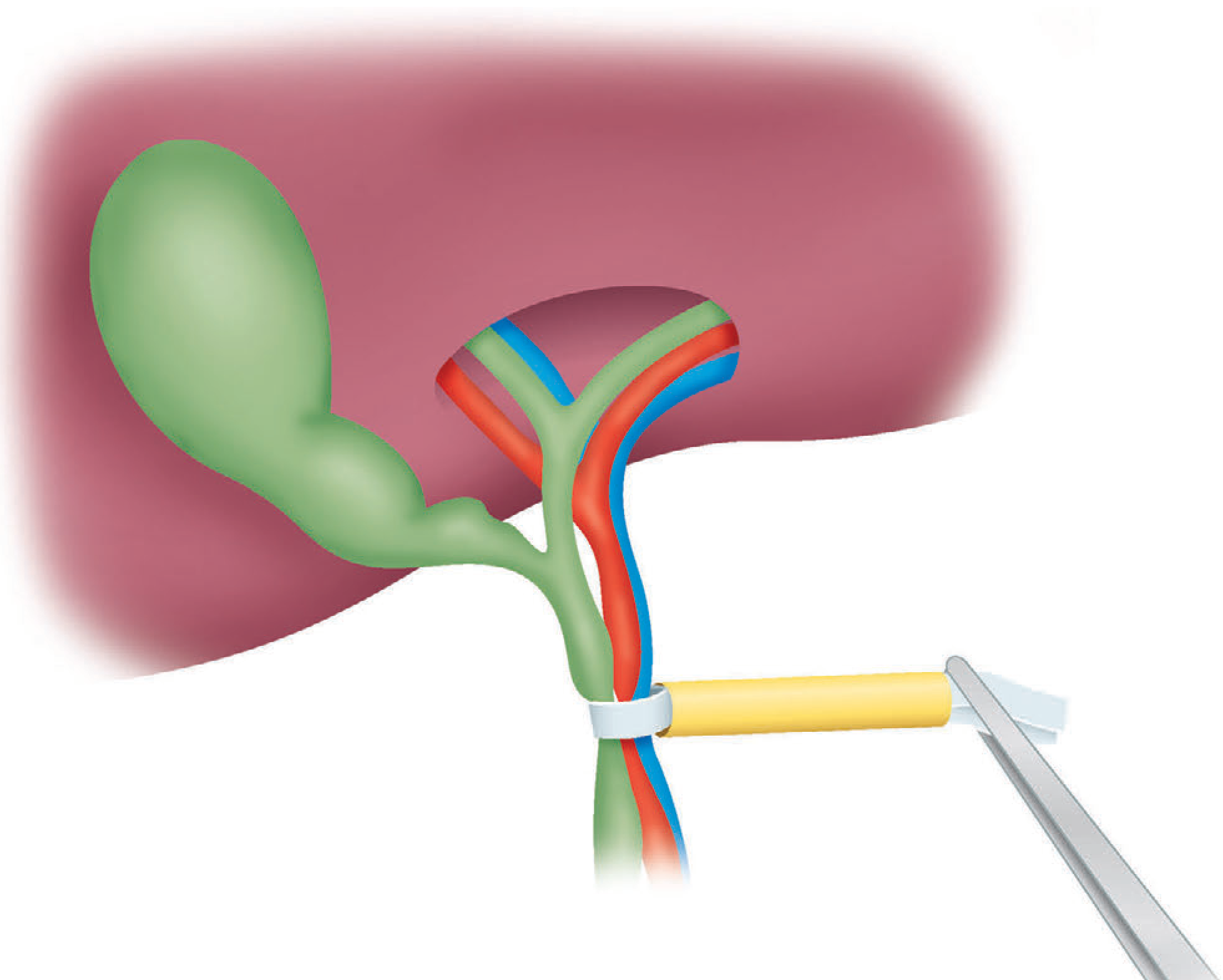
- Pringle manoeuvre (occlusion of the hepatoduodenal ligament - hepatic artery and portal vein) if packing fails to control bleeding; warm ischaemia tolerated up to ~45 minutes.
- Suture ligation, hepatotomy, resectional debridement; anatomical resection and venovenous bypass reserved for tertiary centres with major hepatic vein/IVC injury.
- Packs are removed at 48-72 hours once coagulopathy, temperature, and acidosis are corrected.
- Major complications: recurrent haemorrhage, sepsis, bile leak, and (long-term) biliary stricture or hepatic abscess.
Damage Control Surgery (DCS) is used when physiology (hypothermia, coagulopathy, acidosis - "the lethal triad") precludes definitive repair:
- Phase 1 - recognition, rapid-sequence induction, rewarming, transfer to theatre.
- Phase 2 - abbreviated laparotomy: control bleeding/contamination, pack, temporary closure.
- Phase 3 - ICU resuscitation to normalise physiology.
- Phase 4 - planned re-look and definitive repair, sometimes over multiple trips.
A 2025 systematic review/guideline update on surgical management of abdominal injury in multi-trauma patients (PMID: 40237811) reinforces this damage-control-first approach for haemodynamically unstable patients - worth checking if very current protocol nuances are needed.
Anaesthetic Considerations
Preoperative/induction:
- Assume full stomach and aspiration risk in all trauma patients - rapid-sequence induction with cricoid pressure.
- Presume cervical spine injury until cleared; use manual in-line stabilisation for laryngoscopy.
- Choose induction agents that preserve haemodynamic stability - ketamine or etomidate are preferred over propofol in hypovolaemic patients; reduce doses in shock.
- Avoid nitrous oxide (bowel distension, risk of pneumothorax expansion if occult).
Monitoring and access:
- Large-bore IV access (x2) plus consideration of rapid infusion devices; arterial line for continuous BP and blood gas/coagulation monitoring; central access often needed for vasopressors and CVP trends.
- Continuous core temperature monitoring - hypothermia worsens coagulopathy and bleeding, so warm all fluids/blood and use forced-air warming; keep the theatre warm.
Haemorrhage/damage control resuscitation (DCR):
- Up to 25% of trauma patients have trauma-induced coagulopathy (TIC) before resuscitation even begins.
- Give red cells, FFP, and platelets in a balanced 1:1:1 ratio (massive transfusion protocol) rather than large-volume crystalloid, which dilutes clotting factors and worsens acidosis - Morgan and Mikhail's Clinical Anesthesiology, 7e.
- Tranexamic acid within 3 hours of injury improves survival in bleeding trauma patients (CRASH-2 trial data).
- Permissive hypotension (target systolic ~80-90 mmHg or a palpable radial pulse, in patients without head injury) until surgical haemorrhage control is achieved, to avoid "popping the clot."
- Correct the lethal triad aggressively: hypothermia, coagulopathy, and metabolic acidosis potentiate each other and drive mortality.
- Monitor for TACO (transfusion-associated circulatory overload) as the main risk of DCR; TRALI risk is reduced by male/never-pregnant plasma donors.
Intraoperative considerations specific to liver injury/Pringle manoeuvre:
- Anticipate abrupt haemodynamic swings during Pringle manoeuvre (portal vein/hepatic artery occlusion) and IVC clamping - sudden preload drop and hypotension; communicate closely with the surgical team about clamp/unclamp timing.
- Watch for air embolism or reperfusion hypotension/hyperkalaemia on unclamping, especially after prolonged warm ischaemia.
- Elevated intra-abdominal pressure from packing can cause abdominal compartment syndrome - monitor ventilatory pressures, oxygenation, and urine output; consider intra-abdominal pressure measurement.
- Ventilation: expect reduced compliance from packing/distension; use lung-protective settings and be alert to tension pneumothorax if chest trauma coexists.
- Renal protection: maintain perfusion pressure, avoid nephrotoxins, monitor urine output closely given risk of hypoperfusion and rhabdomyolysis/haemoglobinuria.
Postoperative/ICU handover (Phase 3 of DCS):
- Continue rewarming, correction of coagulopathy/acidosis, and ventilatory support.
- Plan for return to theatre (Phase 4) for pack removal and definitive repair once physiology normalises (usually 24-72 hours).
- Antibiotic cover is advisable given contamination risk and necrotic tissue.
Below is the Pringle manoeuvre illustrated, which anaesthetists should recognise for its haemodynamic implications:
Key sources
- Liver trauma pathophysiology, grading, and surgical technique - Bailey and Love's Short Practice of Surgery, 28th ed.
- Damage control surgery phases - Bailey and Love's Short Practice of Surgery, 28th ed.
- Trauma anaesthesia, damage control resuscitation, massive transfusion, tranexamic acid - Morgan and Mikhail's Clinical Anesthesiology, 7e.
- Permissive hypotension and DCR components - Mulholland and Greenfield's Surgery, 7e.
- Recent evidence: Güsgen et al. 2025 systematic review/guideline update on surgical management of abdominal trauma (PMID: 40237811); Duncan et al. 2023 meta-analysis on hepatic pseudoaneurysm risk after liver trauma (PMID: 36690777) - both consistent with the damage-control approach above.
This is a shared conversation. Sign in to Orris to start your own chat.