
Lateral plate mesoderm
Reading File
Finding Sources
Finding Sources
Reading File
Reading File
Loading Image
Reading File
Here is a comprehensive overview of the lateral plate mesoderm (LPM) based on authoritative embryology textbooks.
Lateral Plate Mesoderm
Origin and Position
The lateral plate mesoderm is one of three subdivisions of the intraembryonic mesoderm that differentiates by the end of the third week of development. It lies lateral to the intermediate mesoderm and extends toward the sides of the embryo. The three mesodermal subdivisions are:
| Region | Derivatives |
|---|---|
| Paraxial | Somites → vertebrae, ribs, skeletal muscle, dermis of back |
| Intermediate | Urogenital system |
| Lateral plate | Body cavities, cardiovascular system, limb skeleton, body wall |
BMP4 signaling ventralizes the mesoderm to form intermediate and lateral plate mesoderm; in its absence, BMP4 is antagonized by Chordin/Noggin/Follistatin (secreted by the notochord and neural plate) and mesoderm becomes paraxial.
Splitting: Parietal vs. Visceral Layers
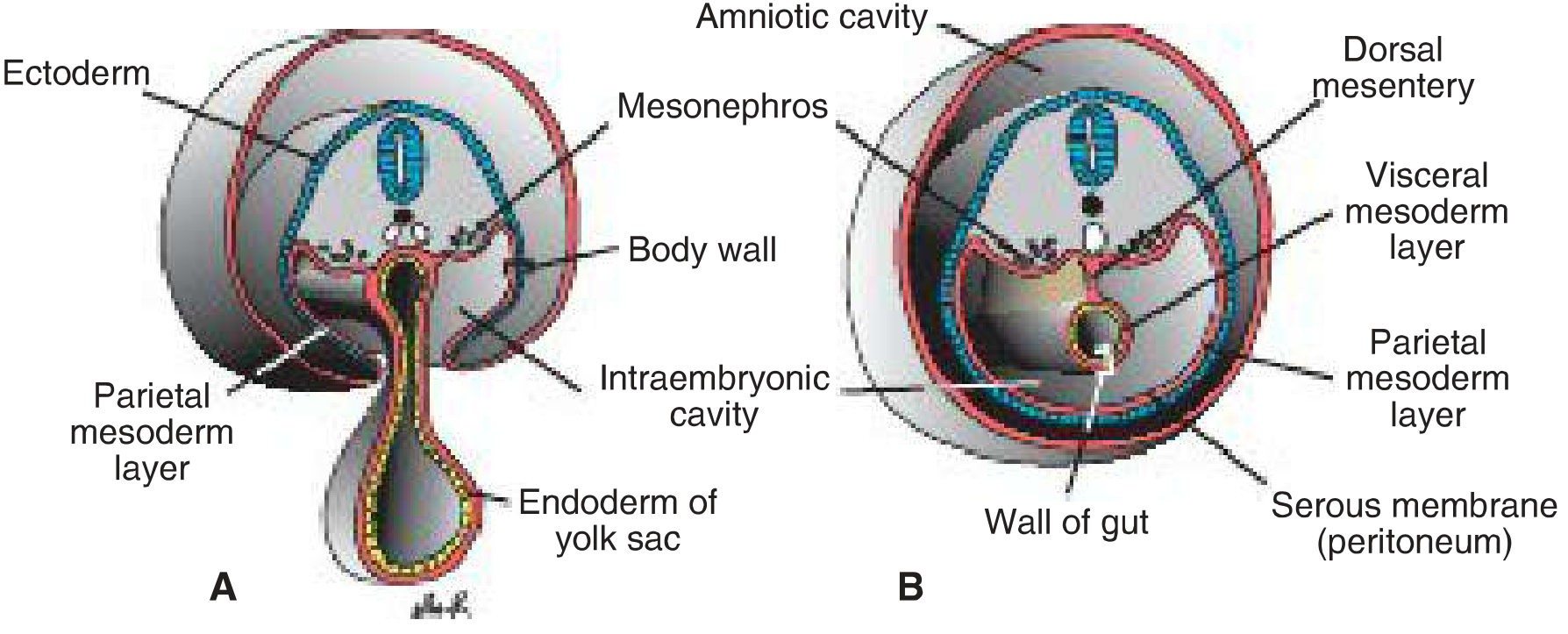
Shortly after it forms as a solid sheet, clefts appear within the lateral plate mesoderm and coalesce to divide it into two layers, creating the intraembryonic (primitive) body cavity between them:
-
Parietal (somatic) layer — adjacent to surface ectoderm; continuous with extraembryonic parietal mesoderm of the amnion
- Together with overlying ectoderm → somatopleure
-
Visceral (splanchnic) layer — adjacent to endoderm of the gut tube; continuous with extraembryonic visceral mesoderm over the yolk sac
- Together with underlying endoderm → splanchnopleure
Derivatives of the Parietal Layer
- Lateral body wall folds — parietal LPM + overlying ectoderm fold ventrally and fuse in the midline, closing the ventral body wall by the end of week 4
- Dermis of skin in the body wall and limbs
- Bones and connective tissue of the limbs
- Sternum — develops independently in the parietal layer from two sternal bands, one on each side of the midline, which later fuse
- Costal cartilages, limb muscles, and most body wall muscles — from sclerotome and muscle precursor cells that migrate across the lateral somitic frontier into the parietal LPM
- Serous (mesothelial) membranes — lining the peritoneal, pleural, and pericardial cavities
Derivatives of the Visceral Layer
- Wall of the gut tube — visceral LPM + embryonic endoderm
- Smooth muscle of the dorsal aorta and large vessels (along with neural crest cells)
- Thin serous membrane around each organ
- Heart — the LPM is the source of both the primary and secondary heart fields
- Hematopoietic cells and vasculature — blood islands appear in LPM at ~3 weeks, giving rise to hemangioblasts → endothelial cells + blood cells (vasculogenesis)
Intraembryonic Body Cavity
The space between the two LPM layers is the primitive body cavity, which initially is a single continuous cavity communicating with the extraembryonic chorionic cavity. During the fourth week it is progressively subdivided into:
- Pericardial cavity
- Pleural cavities
- Abdominopelvic (peritoneal) cavity
The Lateral Somitic Frontier
A key boundary exists between each somite and the parietal LPM called the lateral somitic frontier. This frontier separates:
- Primaxial domain — somite-derived tissues only
- Abaxial domain — parietal LPM and somite-derived cells that have migrated across the frontier
This boundary also defines:
- Dermis from dermatomes (back) vs. dermis from LPM (body wall and limbs)
- The extent of rib development
Summary Table of Key Derivatives
| Structure | Layer | Notes |
|---|---|---|
| Serous membranes (peritoneum, pleura, pericardium) | Parietal | Line body cavities |
| Limb skeleton | Parietal | Bones + connective tissue |
| Sternum | Parietal | Two sternal bands fuse |
| Dermis (body wall & limbs) | Parietal | |
| Heart (primary & secondary fields) | Visceral | |
| Blood vessels / vasculature | Visceral | Via vasculogenesis from hemangioblasts |
| Gut wall smooth muscle | Visceral | With endoderm |
| Dorsal aorta smooth muscle | Visceral | + neural crest cells |
— Langman's Medical Embryology; Creasy & Resnik's Maternal-Fetal Medicine
This is a shared conversation. Sign in to Orris to start your own chat.