
Difference in boy and girl usg in pregnancy
Reading File
Finding Sources
Finding Sources
Finding Sources
Finding Sources
Searching Images
fetal sex determination ultrasound male female genitalia
Loading Image
Loading Image
Loading Image
Here is a comprehensive overview of how male (boy) and female (girl) fetuses appear differently on ultrasound during pregnancy.
Fetal Sex Determination on Ultrasound
When Can It Be Done?
| Trimester | Method | Reliability |
|---|---|---|
| 1st (11–14 weeks) | Genital tubercle angle | ~75–90% (operator-dependent) |
| 2nd (18–20 weeks) | Direct genitalia visualization | ~95–99% |
| 3rd (>28 weeks) | Direct genitalia visualization | Very high |
First Trimester (11–14 Weeks) — Genital Tubercle Method
At this stage, external genitalia are not yet fully differentiated. The genital tubercle (nub) is assessed:
- Male (boy): Tubercle points upward at an angle >30° relative to the spine
- Female (girl): Tubercle is horizontal or pointing downward (<30° angle, parallel to spine)
This is less reliable than second-trimester assessment.
Second Trimester Onwards (≥18 Weeks) — Classic Signs
This is the standard time for sex determination during the anomaly scan.
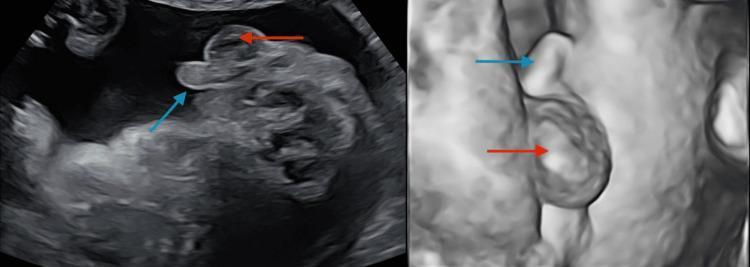
🔵 Male Fetus (Boy)
The scrotum and penis are visualized:
- "Turtle sign" / "Donut sign": The penis appears as a rounded or elongated echogenic projection with the scrotum visible beneath it
- Three lines: In cross-section, the penis can show a central echogenic line
- Scrotum: Appears as a rounded, lobulated, hypoechoic structure inferior to the penis
- Testes may be seen descending into the scrotum by the 3rd trimester
2D and 3D ultrasound of male fetus (20 weeks):
🔴 Female Fetus (Girl)
The labia are visualized in the perineal/transverse plane:
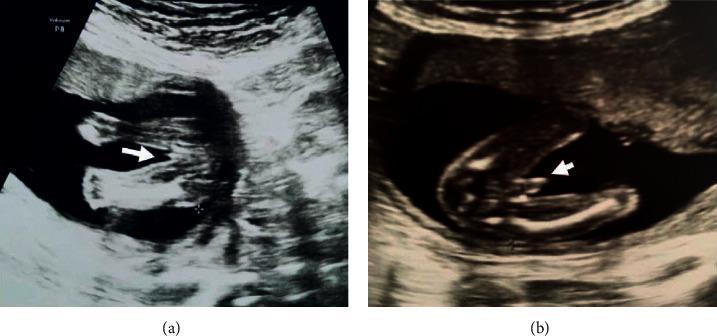
- "Hamburger sign" (Three-line sign): Three parallel hyperechoic lines — the two outer lines represent the labia majora, and the central echogenic dot/line represents the clitoris between the labia minora
- No protruding phallus or scrotum
- Uterus may occasionally be seen later in pregnancy
Ultrasound comparison — Female (a: hamburger sign) vs. Male (b: dome/phallus sign):
Side-by-Side Summary
| Feature | Male (Boy) | Female (Girl) |
|---|---|---|
| Sign name | Turtle sign / Donut sign | Hamburger sign / Three-line sign |
| Appearance | Echogenic protruding phallus + rounded scrotum | 3 parallel lines (labia + clitoris) |
| Structure seen | Penis + scrotum | Labia majora + labia minora + clitoris |
| Angle of tubercle (1st trimester) | >30° (pointing up) | <30° (horizontal/down) |
| Color Doppler | Urethral flow may be seen | — |
| 3D USG | Surface rendering clearly shows phallus | Flat perineum with labial folds |
Key Points
- Legal note (India): Under the PCPNDT Act, sex determination for the purpose of sex selection is prohibited in India. Ultrasound for sex determination is only performed clinically when there is suspicion of a sex-linked genetic disorder.
- Accuracy depends heavily on gestational age, fetal position, amniotic fluid volume, and sonographer skill.
- A fetus in a breech or awkward position, or with the legs closed, may make determination difficult.
- Ambiguous findings should not be reported as a definite sex.
This is a shared conversation. Sign in to Orris to start your own chat.