
Arteries and it's branches of upper limb for medical student in detailed notes
Your credits are exhausted. Your daily credits reset tomorrow, or you can purchase a top-up for more.
Arteries and it's branches of upper limb for medical student in detailed notes
Reading File
Finding Sources
Finding Sources
Reading File
Reading File
Finding Sources
Reading File
Reading File
Finding Sources
Finding Sources
Finding Sources
Reading File
Finding Sources
Reading File
Reading File
Reading File
Finding Sources
Finding Sources
Finding Sources
Reading File
Searching Images
arteries of upper limb subclavian axillary brachial radial ulnar
Loading Image
Loading Image
Loading Image
Loading Image
Now I have comprehensive material from the textbooks. Let me compile the full detailed notes.
Arteries of the Upper Limb — Detailed Medical Student Notes
Sources: Gray's Anatomy for Students; THIEME Atlas of Anatomy — General Anatomy and Musculoskeletal System
Overview: The Arterial Chain
The arterial supply of the upper limb flows as a continuous axial channel:
Aorta → Subclavian → Axillary → Brachial → Radial + Ulnar → Palmar Arches → Digital Arteries
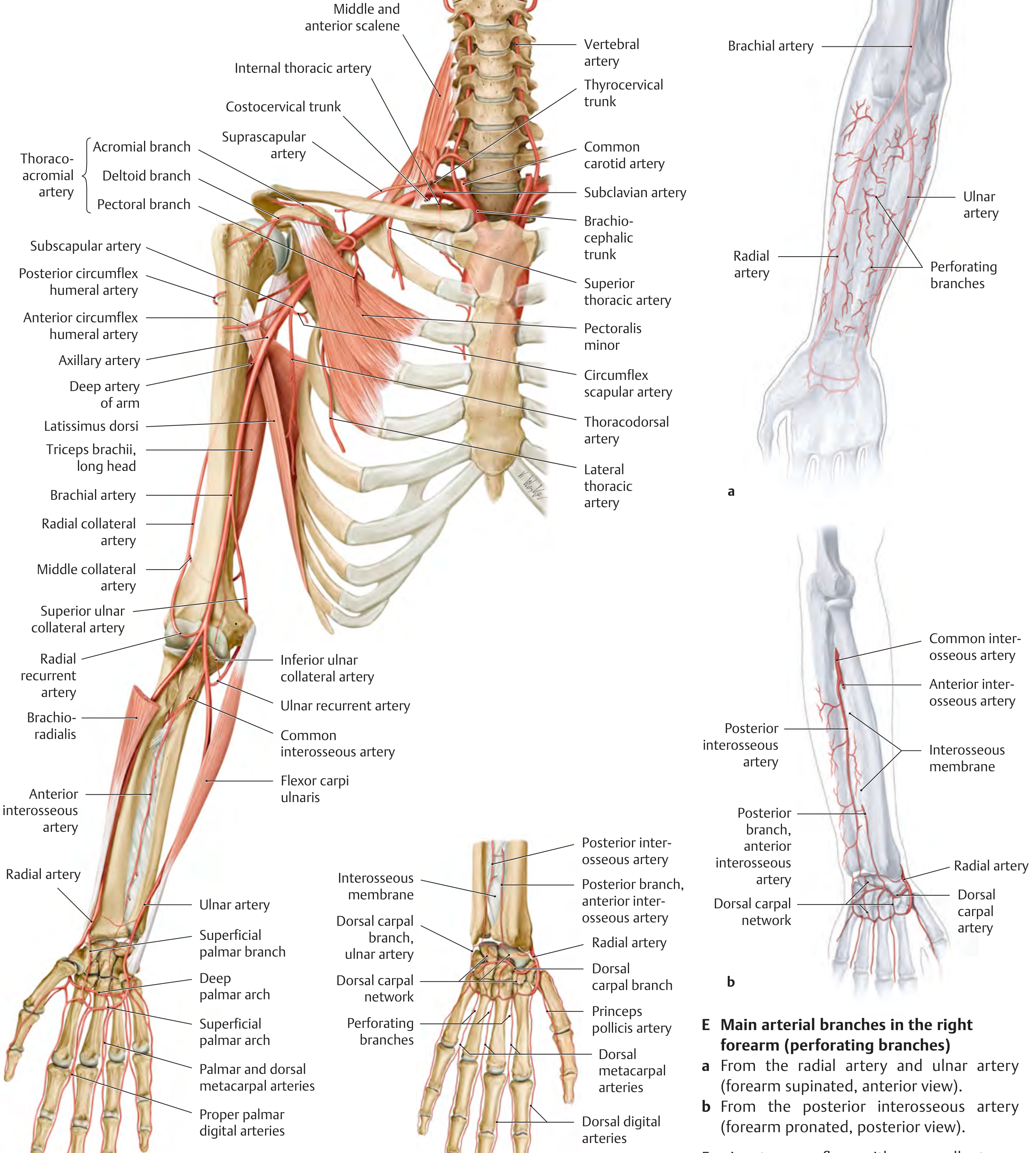
1. SUBCLAVIAN ARTERY
Origin
| Side | Origin |
|---|---|
| Right | Brachiocephalic trunk |
| Left | Directly from arch of aorta |
Parts (relative to anterior scalene muscle)
The subclavian artery is divided into three parts by the anterior scalene (scalenus anterior) muscle:
| Part | Location |
|---|---|
| 1st part | Medial to anterior scalene — from origin to medial border of scalene |
| 2nd part | Posterior to anterior scalene (between anterior and middle scalene) |
| 3rd part | Lateral to anterior scalene — from lateral border to lateral border of rib I (where it becomes axillary artery) |
Branches (mnemonic: VIT C D)
| Branch | From Part | Course & Supply |
|---|---|---|
| Vertebral artery | 1st part | Ascends through foramina transversaria C6→C1; supplies brain and cervical spinal cord |
| Internal thoracic artery (internal mammary) | 1st part | Descends posterior to costal cartilages; supplies breast, anterior chest wall, pericardium |
| Thyrocervical trunk | 1st part | Short trunk giving rise to: |
| — Inferior thyroid artery | Supplies thyroid, parathyroids, pharynx | |
| — Ascending cervical artery | Supplies deep neck muscles | |
| — Suprascapular artery | Crosses base of posterior triangle; passes over superior transverse scapular ligament → infraspinous fossa; anastomoses around scapula | |
| — Transverse cervical artery | Crosses posterior triangle → deep surface of trapezius; superficial branch on trapezius deep surface; deep branch (dorsal scapular a.) along medial scapular border behind rhomboids | |
| Costocervical trunk | 2nd part | Gives rise to: |
| — Deep cervical artery | Supplies deep posterior neck muscles | |
| — Supreme (highest) intercostal artery | Supplies 1st and 2nd posterior intercostal spaces | |
| Dorsal scapular artery | 3rd part (variable) | Passes to superior angle of scapula → descends along medial border posterior to rhomboids |
Clinical note — Rib I fracture: The subclavian artery is fixed to the superior surface of rib I by surrounding muscles. Rapid deceleration injuries causing first rib fracture can compromise the distal subclavian or proximal axillary artery. Anastomotic connections around the scapula usually prevent complete ischemia.
2. AXILLARY ARTERY
Boundaries
- Begins: Lateral border of rib I (continuation of subclavian)
- Ends: Lower border of teres major muscle (continues as brachial artery)
Parts (divided by pectoralis minor muscle)
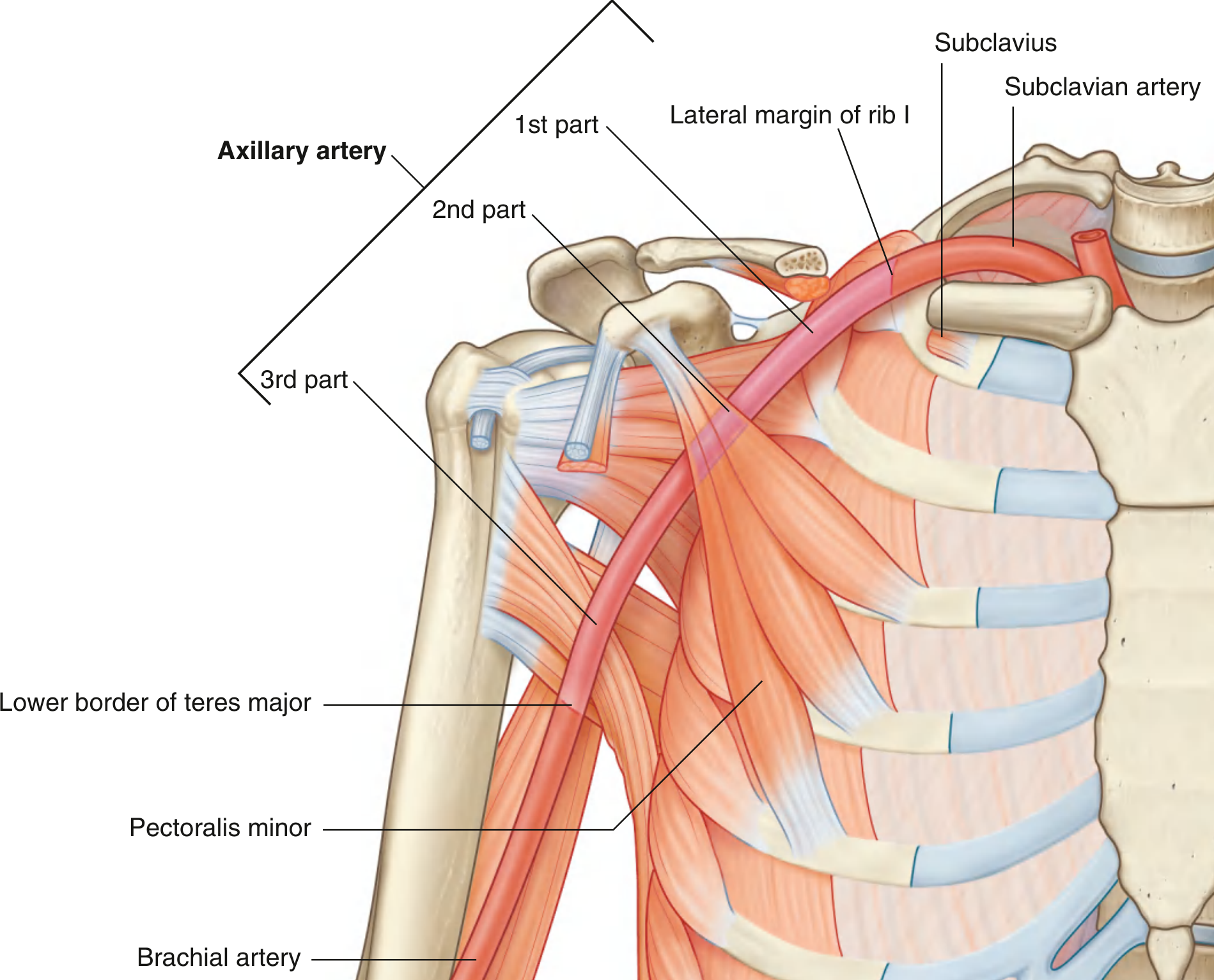
| Part | Location | Branches | Mnemonic |
|---|---|---|---|
| 1st part | Proximal to pectoralis minor | 1 branch | "1 branch from part 1" |
| 2nd part | Posterior to pectoralis minor | 2 branches | "2 branches from part 2" |
| 3rd part | Distal to pectoralis minor | 3 branches | "3 branches from part 3" |
Branches in Detail
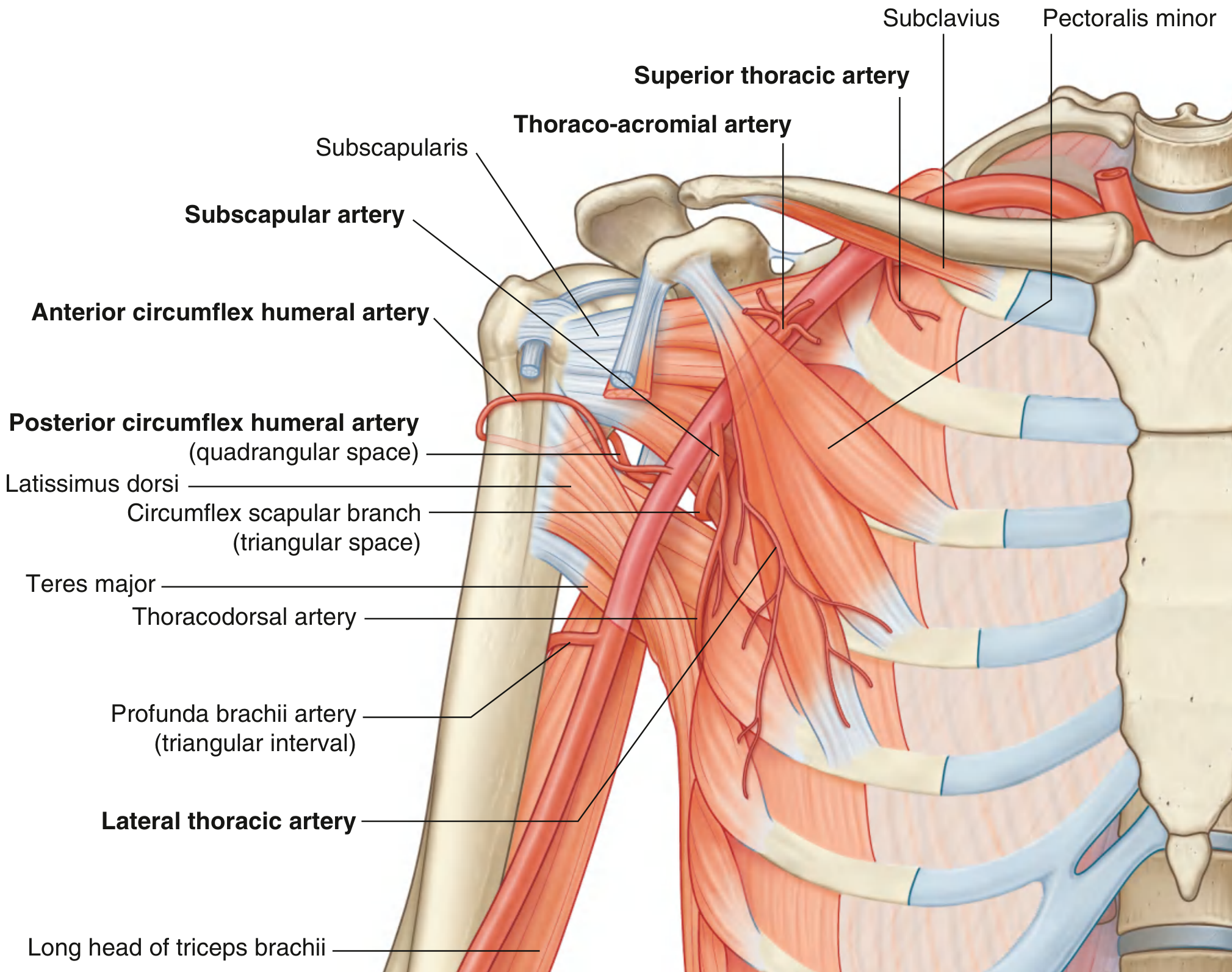
1st Part — 1 branch
Superior (Supreme) Thoracic Artery
- Small vessel from anterior surface of 1st part
- Supplies upper medial and anterior axillary walls (1st and 2nd intercostal spaces)
2nd Part — 2 branches
Thoraco-acromial Artery
- Short trunk from anterior surface of 2nd part, just posterior to medial margin of pectoralis minor
- Curves around the superior margin of pectoralis minor, pierces clavipectoral fascia
- Divides into 4 branches:
- Pectoral branch — pectoralis major/minor muscles + breast supply
- Deltoid branch — enters clavipectoral triangle alongside cephalic vein; supplies deltoid
- Clavicular branch — sternoclavicular joint and subclavius muscle
- Acromial branch — acromion; contributes to acromial arterial network
Lateral Thoracic Artery
- Arises from anterior surface of 2nd part, posterior to lateral margin of pectoralis minor
- Follows margin of pectoralis minor to thoracic wall
- Supplies medial and anterior axillary walls
- In women: contributes branches to breast (around inferior margin of pectoralis major)
3rd Part — 3 branches
Subscapular Artery (largest branch of axillary artery)
- Arises from posterior surface of 3rd part
- Follows inferior margin of subscapularis → divides into:
- Circumflex scapular artery — passes through triangular space (bounded by subscapularis, teres major, and long head of triceps); curves to infraspinous fossa; anastomoses with suprascapular and dorsal scapular arteries → scapular anastomotic ring
- Thoracodorsal artery — follows lateral border of scapula to inferior angle; supplies posterior axillary wall (latissimus dorsi, serratus anterior)
Anterior Circumflex Humeral Artery (smaller)
- From lateral side of 3rd part
- Passes anterior to surgical neck of humerus
- Supplies glenohumeral joint capsule, head of humerus (via anterolateral ascending branch — important for avascular necrosis risk)
- Anastomoses with posterior circumflex humeral artery
Posterior Circumflex Humeral Artery (larger)
- From lateral surface of 3rd part, just posterior to anterior circumflex humeral artery
- Exits axilla through quadrangular space with the axillary nerve
- Quadrangular space: bounded by teres major (below), teres minor (above), long head of triceps (medially), surgical neck of humerus (laterally)
- Curves around surgical neck of humerus
- Supplies: deltoid, teres minor, glenohumeral joint
- Anastomoses with anterior circumflex humeral, profunda brachii, suprascapular, and thoraco-acromial arteries
Clinical notes:
- Anterior dislocation of shoulder: The humeral head may compress the axillary artery and/or stretch the brachial plexus. Surgical reconstruction of the axillary artery may be needed.
- Axillary/subclavian venous access: Central venous catheters are best inserted lateral to the midclavicular line to avoid subclavius muscle causing catheter kinking or fatigue fracture.
3. BRACHIAL ARTERY
Course
- Begins: Lower border of teres major (continuation of axillary artery)
- Course: Descends in anterior compartment of arm
- Proximally — lies on medial side of arm
- Distally — moves laterally to lie midway between medial and lateral epicondyles
- Ends: Just distal to the elbow joint (cubital fossa), divides into radial and ulnar arteries
- Crosses anteriorly to elbow joint, immediately medial to tendon of biceps brachii
- Palpable throughout its length; can be compressed against medial humerus in proximal arm
Relations in cubital fossa (lateral → medial: TAN)
- Tendon of biceps
- Brachial Artery
- Median Nerve
Branches
| Branch | Notes |
|---|---|
| Profunda brachii (deep brachial) artery | Largest branch; leaves brachial artery early; passes through triangular interval with the radial nerve; travels in the radial (spiral) groove; supplies posterior compartment of arm (triceps, anconeus); terminates as radial collateral and middle collateral arteries (contribute to cubital anastomosis) |
| Nutrient artery to humerus | Enters anteromedial surface of humeral shaft |
| Superior ulnar collateral artery | Accompanies ulnar nerve through posterior compartment; contributes to cubital anastomosis |
| Inferior ulnar collateral artery | Arises just above elbow; contributes to cubital anastomosis |
| Muscular branches | Supply biceps brachii, brachialis, coracobrachialis |
Cubital (Periarticular) Anastomosis
A rich network around the elbow joint ensures blood flow despite position changes. Contributions:
- Radial collateral + middle collateral (from profunda brachii)
- Superior + inferior ulnar collateral (from brachial)
- Radial recurrent (from radial artery)
- Anterior + posterior ulnar recurrent (from ulnar artery)
- Interosseous recurrent (from posterior interosseous artery)
Clinical significance of brachial artery:
- Site of blood pressure measurement (sphygmomanometer cuff compresses it against humerus; stethoscope detects Korotkoff sounds in cubital fossa)
- Midshaft humeral fracture may damage the radial nerve in the radial groove (wrist drop + sensory loss on dorsum of hand)
- Brachial artery is the standard site for arterial blood sampling in neonates
4. RADIAL ARTERY
Course
- Arises at the neck of the radius in the cubital fossa
- Descends laterally in the forearm between brachioradialis (laterally) and flexor carpi radialis (medially)
- At the wrist: lies on anterior surface of distal radius — pulse palpable lateral to flexor carpi radialis tendon
- Passes under the abductor pollicis longus and extensor pollicis brevis tendons onto the dorsum of the hand
- Passes through the anatomical snuffbox (between extensor pollicis longus and abductor pollicis longus/extensor pollicis brevis)
- Enters the palm between the two heads of the first dorsal interosseous muscle to form the deep palmar arch
Branches
| Branch | Supply |
|---|---|
| Radial recurrent artery | Ascends lateral to elbow; contributes to cubital anastomosis |
| Palmar carpal branch | Joins palmar carpal network (anastomosis with ulnar palmar carpal branch) |
| Superficial palmar branch | Passes over or through thenar muscles; contributes to superficial palmar arch |
| Dorsal carpal branch | Contributes to dorsal carpal network |
| → Dorsal metacarpal arteries | Supply dorsum of 2nd–4th web spaces |
| → Dorsal digital arteries | Supply dorsal aspects of fingers |
| Princeps pollicis artery | Supplies both sides of thumb |
| Radialis indicis artery | Supplies radial side of index finger |
| Deep palmar arch | Main terminal branch — forms arch with deep palmar branch of ulnar artery |
| → Palmar metacarpal arteries | Supply deep palm; anastomose with common palmar digital arteries |
| → Perforating branches | Connect dorsal and palmar arches |
5. ULNAR ARTERY
Course
- Also begins at the cubital fossa (larger terminal branch of brachial artery)
- Passes deep (underneath pronator teres and flexor digitorum superficialis) to reach the medial forearm
- Descends between flexor carpi ulnaris (medially) and flexor digitorum superficialis (laterally)
- At the wrist: passes lateral to the pisiform bone through Guyon's canal (ulnar canal) alongside the ulnar nerve
- Enters the palm and forms the superficial palmar arch
Branches
| Branch | Supply |
|---|---|
| Ulnar recurrent artery | Anterior and posterior branches contributing to cubital anastomosis |
| Common interosseous artery | Short trunk that immediately divides into: |
| → Anterior interosseous artery | Descends on anterior interosseous membrane; supplies deep flexors, pronator quadratus; terminates in dorsal carpal network |
| → Posterior interosseous artery | Passes over the interosseous membrane to posterior forearm; supplies extensor muscles |
| → Recurrent interosseous artery | Contributes to cubital anastomosis |
| Palmar carpal branch | Joins palmar carpal network |
| Dorsal carpal branch | Joins dorsal carpal network |
| Deep palmar branch | Passes deep to complete the deep palmar arch (with radial artery) |
| Superficial palmar arch | Main terminal branch (see below) |
6. PALMAR ARCHES
Superficial Palmar Arch
- Formed mainly by the ulnar artery + superficial palmar branch of radial artery
- Lies superficial to the long flexor tendons, beneath the palmar aponeurosis
- Level: approximately at the distal border of the outstretched thumb
- Gives rise to:
- 3 common palmar digital arteries → each divides into 2 proper palmar digital arteries (supplying adjacent sides of fingers 2–5)
- 1 proper palmar digital artery to ulnar side of little finger
Deep Palmar Arch
- Formed mainly by the radial artery + deep palmar branch of ulnar artery
- Lies deep to the long flexor tendons, on the bases of the metacarpals
- Approximately 1 cm proximal to superficial arch
- Gives rise to:
- 3 palmar metacarpal arteries → join the common palmar digital arteries from superficial arch
- Perforating branches → connect with dorsal metacarpal arteries
- Recurrent branches → contribute to carpal anastomosis
7. SCAPULAR ANASTOMOSIS (Clinically Important)
A rich network around the scapula provides collateral circulation:
| Artery | Source |
|---|---|
| Suprascapular artery | Thyrocervical trunk → subclavian |
| Circumflex scapular artery | Subscapular → axillary |
| Dorsal scapular artery | Subclavian (3rd part) or transverse cervical artery |
This anastomosis means that even with complete occlusion of the subclavian or proximal axillary artery, the distal arm rarely becomes completely ischemic.
Quick Summary Table
| Artery | From | Key Landmark | Main Branches |
|---|---|---|---|
| Subclavian | Brachiocephalic trunk (R) / Aortic arch (L) | Divided by anterior scalene | Vertebral, internal thoracic, thyrocervical trunk, costocervical trunk, dorsal scapular |
| Axillary | Subclavian (at lat. border rib I) | Divided by pectoralis minor (3 parts) | Superior thoracic; thoraco-acromial, lateral thoracic; subscapular, ant. & post. circumflex humeral |
| Brachial | Axillary (at lower border teres major) | Anterior compartment arm; ends in cubital fossa | Profunda brachii, superior & inferior ulnar collateral |
| Radial | Brachial (cubital fossa) | Lateral forearm → anatomical snuffbox → deep palm | Radial recurrent, princeps pollicis, deep palmar arch |
| Ulnar | Brachial (cubital fossa) | Medial forearm → Guyon's canal → superficial palm | Ulnar recurrent, common interosseous, superficial palmar arch |
Key Clinical Correlations
| Scenario | Artery at Risk | Consequence |
|---|---|---|
| Fracture of rib I | Subclavian / 1st part axillary | Usually compensated by scapular anastomosis |
| Anterior shoulder dislocation | Axillary artery (+ brachial plexus) | Possible vessel occlusion; axillary nerve injury |
| Midshaft humeral fracture | Profunda brachii → radial nerve in radial groove | Wrist drop |
| Supracondylar humeral fracture (children) | Brachial artery | Ischemic contracture (Volkmann's) |
| Colles' / radial fracture | Radial artery | Usually minor; check radial pulse |
| Carpal tunnel / Guyon's canal | Ulnar artery (in Guyon's) | Ulnar-sided ischemia + nerve deficit |
| Blood pressure measurement | Brachial artery (compressed against humerus) | Korotkoff sounds heard in cubital fossa |
| CABG graft harvesting | Radial artery (Allen's test first) | Check ulnar artery competence before harvest |
Sources: Gray's Anatomy for Students (9780323934237) · THIEME Atlas of Anatomy: General Anatomy & Musculoskeletal System (9781626237186)
This is a shared conversation. Sign in to Orris to start your own chat.