
Explain heart murmurs in detail (easily)
Reading File
Now let me search the medical library for heart murmurs content in parallel:
Finding Sources
Finding Sources
Searching Images
heart murmur auscultation cardiac cycle diagram
Now let me read the key sections from Harrison's and the other sources in parallel:
Reading File
Reading File
Loading Image
Loading Image
Now let me read the detailed content on murmur grading and specific murmur types from Harrison's:
Reading File
Reading File
I now have comprehensive information from Harrison's and Braunwald's. Let me compile the complete, easy-to-understand explanation.
Heart Murmurs — A Complete, Easy Guide
What Is a Heart Murmur?
A heart murmur is simply an extra sound heard between the normal "lub-dub" heartbeats when a doctor listens with a stethoscope. Normal heart sounds (S1 = "lub", S2 = "dub") are made by heart valves snapping shut. A murmur is the sound of turbulent blood flow — like the sound of water rushing through a narrow pipe.
Murmurs are caused by:
- Accelerated blood flow through a normal or abnormal opening (e.g., fever, anemia, pregnancy)
- Flow through a narrowed/irregular orifice into a wider chamber — like aortic stenosis
- Backward (regurgitant) flow through a leaky valve or defect — like mitral regurgitation
Are All Murmurs Dangerous?
No! Murmurs are divided into two main categories:
| Type | Meaning | Action Needed? |
|---|---|---|
| Innocent (Functional) | No structural heart problem; common in children, athletes, pregnancy, fever, anemia | Usually none |
| Pathological | Caused by a valve defect, hole in the heart, or structural disease | Further workup required |
A soft midsystolic murmur in an asymptomatic child or young adult is almost always innocent and does not require an echocardiogram. — Harrison's Principles of Internal Medicine (2025)
How Are Murmurs Described?
1. Timing — When in the Heartbeat?
This is the most important feature. The cardiac cycle has two phases:
- Systole = when the heart squeezes (pumps blood out) → between S1 and S2
- Diastole = when the heart relaxes (fills with blood) → between S2 and the next S1
Types by timing:
| Timing | When Heard | Classic Causes |
|---|---|---|
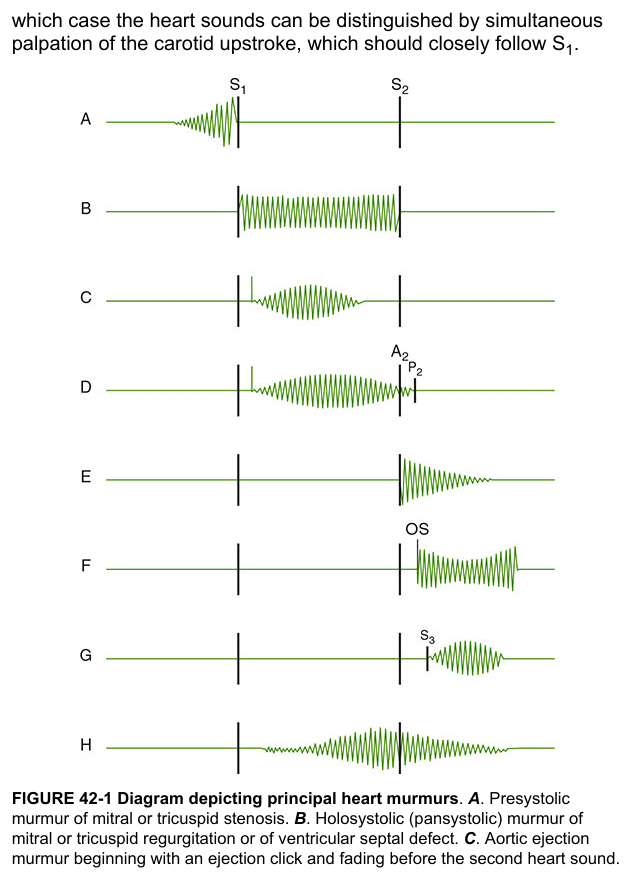
| Early systolic | Starts at S1, fades before S2 | Acute mitral regurgitation, small VSD |
| Midsystolic (ejection) | Starts after S1, peaks in mid-systole, fades before S2 | Aortic stenosis, pulmonic stenosis |
| Holosystolic (pansystolic) | Spans entire systole from S1 to S2, plateau-shaped | Mitral regurgitation, tricuspid regurgitation, VSD |
| Late systolic | Starts mid-systole, ends at S2 | Mitral valve prolapse |
| Early diastolic | Starts at S2, decrescendo | Aortic regurgitation, pulmonary regurgitation |
| Mid-diastolic | Starts after S2, low rumbling sound | Mitral stenosis, tricuspid stenosis |
| Presystolic | Just before S1, in sinus rhythm | Mitral/tricuspid stenosis |
| Continuous | Runs through both S1 and S2 | Patent ductus arteriosus (PDA) — "machinery murmur" |
Here is a visual reference showing exactly when each murmur type occurs in the cardiac cycle:
2. Intensity (Loudness) — Graded I to VI
| Grade | Description |
|---|---|
| I/VI | Very soft; heard only with great effort |
| II/VI | Easily heard, but not loud |
| III/VI | Loud, no thrill felt |
| IV/VI | Loud + palpable thrill (vibration felt on chest) |
| V/VI | Heard with only the edge of the stethoscope touching the chest |
| VI/VI | Heard with stethoscope slightly off the chest |
Clinical rule: Grade ≥ III usually signals important structural heart disease and warrants echocardiography. — Harrison's, 2025
A thrill = a grade IV+ murmur. You can actually feel it vibrating with your hand.
3. Shape / Configuration
| Shape | What It Sounds Like | Example |
|---|---|---|
| Crescendo | Gets louder → | Presystolic murmur of mitral stenosis |
| Decrescendo | Gets softer ← | Aortic regurgitation |
| Crescendo-decrescendo | Builds then fades (diamond shape) | Aortic stenosis |
| Plateau (flat) | Steady throughout | Mitral regurgitation |
4. Location & Radiation — Where on the Chest?
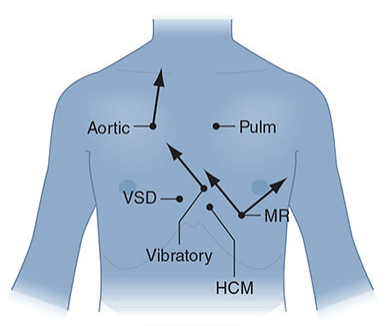
Each murmur is loudest in a specific area and may radiate:
| Murmur | Best Heard At | Radiates To |
|---|---|---|
| Aortic stenosis | Right upper sternal border (2nd R intercostal space) | Neck/carotids |
| Mitral regurgitation (MR) | Apex (left midclavicular line) | Left axilla |
| Pulmonic stenosis | Left upper sternal border (2nd L intercostal space) | Left shoulder |
| VSD | Left lower sternal border | Across entire precordium |
| HCM | Left lower sternal border to apex | — |
5. Quality (Sound Character)
| Quality | Example |
|---|---|
| Blowing, high-pitched | Aortic regurgitation, mitral regurgitation |
| Harsh, rough | Aortic stenosis, VSD |
| Low rumbling | Mitral stenosis (best heard with bell of stethoscope) |
| Machinery-like | Patent ductus arteriosus (PDA) |
Common Specific Murmurs — Quick Reference
🔴 Aortic Stenosis (AS)
- Midsystolic, crescendo-decrescendo (diamond shape)
- Harsh, heard at right upper sternal border, radiates to carotids
- Due to: calcified/narrowed aortic valve → LV has to push hard
- Signs of severity: parvus et tardus pulse (weak, slow carotid upstroke), soft A2
🔴 Mitral Regurgitation (MR)
- Holosystolic (pansystolic), plateau
- Blowing, best at apex, radiates to left axilla
- Due to: leaky mitral valve → blood flows backward into left atrium during systole
🔴 Aortic Regurgitation (AR)
- Early diastolic, decrescendo
- Blowing, high-pitched, heard at left sternal border leaning forward
- Due to: incompetent aortic valve → blood leaks back into LV during diastole
🔴 Mitral Stenosis (MS)
- Mid-diastolic rumble, follows opening snap (OS)
- Low-pitched, heard at apex with bell of stethoscope
- Due to: thickened/fused mitral leaflets (often from rheumatic fever) → LA-LV gradient
🔴 VSD (Ventricular Septal Defect)
- Holosystolic, harsh, loud (Grade IV+)
- Left lower sternal border
- Small VSD = louder murmur (high-velocity jet through tiny hole)
🔴 PDA (Patent Ductus Arteriosus)
- Continuous "machinery" murmur (runs through S2)
- Left upper sternal border
- Due to: persistent connection between aorta and pulmonary artery after birth
🟡 HCM (Hypertrophic Obstructive Cardiomyopathy)
- Midsystolic, between lower left sternal border and apex
- Unique behavior: gets louder with Valsalva or standing (decreased preload); gets softer with squatting (increased preload)
Bedside Maneuvers — How to Identify Murmurs
| Maneuver | Effect on HCM | Effect on AS/MR |
|---|---|---|
| Valsalva (strain) | Louder ↑ | Softer ↓ |
| Standing quickly | Louder ↑ | Softer ↓ |
| Squatting | Softer ↓ | Louder ↑ |
| Passive leg raise | Softer ↓ | Louder ↑ |
The rule: less blood in the heart (↓ preload) → HCM murmur worsens; more blood → HCM murmur improves. All other outflow murmurs do the opposite.
When to Get an Echo?
| Situation | Recommendation |
|---|---|
| Soft midsystolic (I-II/VI), asymptomatic child/young adult | Echo usually not needed |
| Loud systolic ≥ Grade III/VI | Echo indicated |
| Holosystolic or late systolic murmur | Echo indicated |
| Any diastolic murmur | Echo indicated |
| Continuous murmur | Echo indicated |
Summary
Think of a heart murmur as the sound of turbulence — like hearing water rush through a narrowed pipe. The key questions when evaluating any murmur:
- When does it occur? (systolic vs. diastolic vs. continuous)
- How loud? (Grade I–VI)
- What shape? (crescendo, decrescendo, plateau)
- Where is it heard, and where does it radiate?
- What does it sound like? (blowing, harsh, rumbling)
- How does it respond to maneuvers?
Answering these questions systematically almost always leads to the correct diagnosis — even before doing an echocardiogram.
Sources: Harrison's Principles of Internal Medicine 22E (2025), Braunwald's Heart Disease, The Harriet Lane Handbook 23rd Ed.
This is a shared conversation. Sign in to Orris to start your own chat.