
Boundaries and contents of posterior traingle for 5 marks
Reading File
Now searching the medical library for posterior triangle anatomy:
Finding Sources
Finding Sources
Excellent - found the key sections. Now reading the detailed content:
Reading File
Reading File
Now let me read the contents section (nerves, vessels, lymph nodes):
Reading File
Reading File
Loading Image
Reading File
Reading File
Reading File
I now have comprehensive information. Here is a thorough 5-mark answer:
Posterior Triangle of the Neck
Boundaries
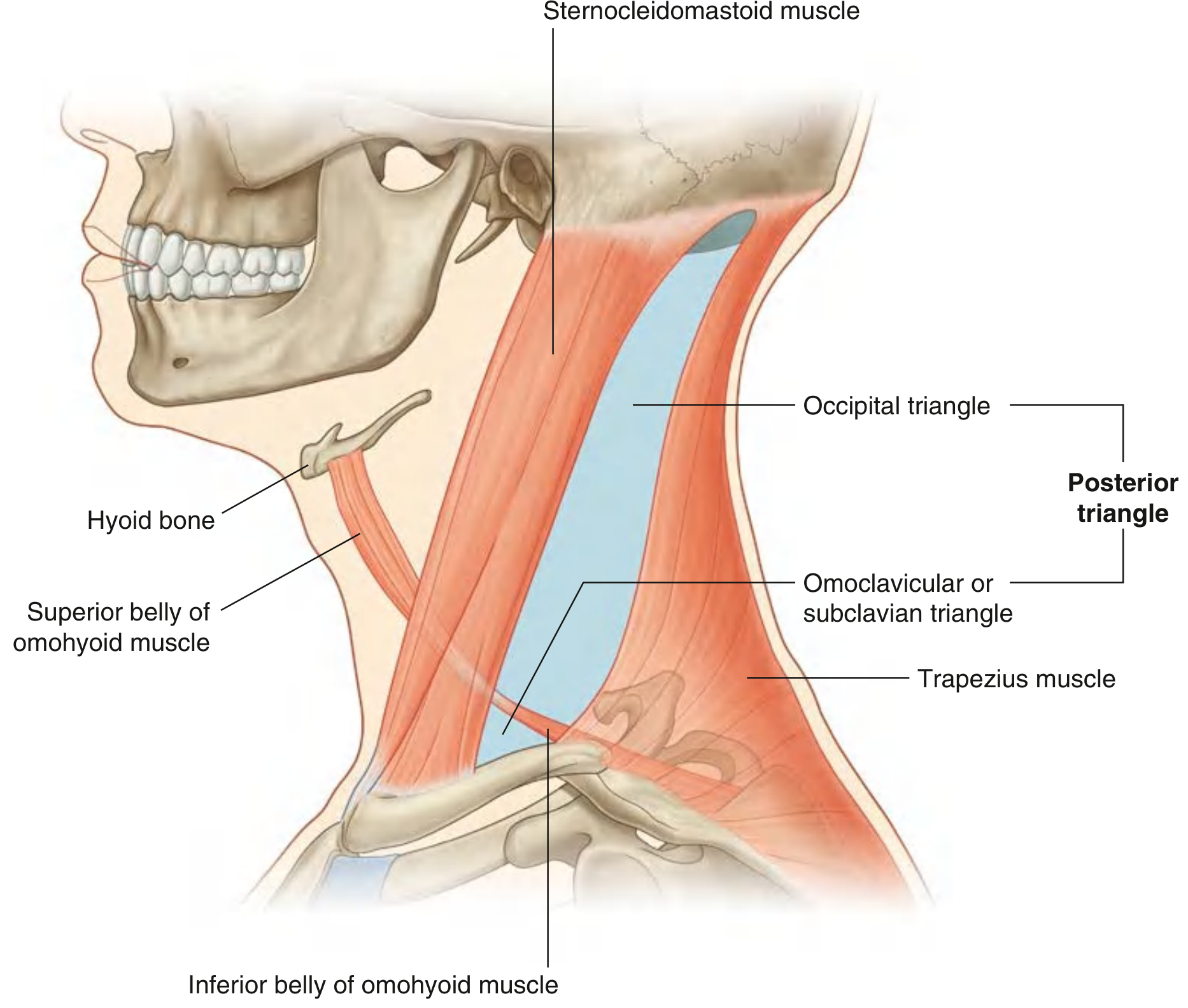
The posterior triangle is situated on the lateral aspect of the neck and has the following boundaries:
| Wall | Structure |
|---|---|
| Anterior | Posterior border of the sternocleidomastoid (SCM) muscle |
| Posterior | Anterior border of the trapezius muscle |
| Base (inferior) | Middle one-third of the clavicle |
| Apex (superior) | Occipital bone just posterior to the mastoid process - where the attachments of trapezius and SCM converge |
| Roof | Investing layer of cervical fascia, which covers and surrounds both the SCM and trapezius as it passes across the region |
| Floor | Covered by the prevertebral layer of cervical fascia; from superior to inferior: splenius capitis, levator scapulae, posterior scalene, middle scalene, and anterior scalene muscles |
Subdivision
The inferior belly of the omohyoid muscle crosses the lower part of the posterior triangle, dividing it into two smaller triangles:
- Occipital triangle (upper, larger) - above the omohyoid
- Omoclavicular (subclavian) triangle (lower, smaller) - below the omohyoid, overlying the subclavian vessels
Contents
1. Muscles
- Omohyoid (inferior belly) - crosses from lateral to medial; the only muscle that actually traverses the triangle
2. Vessels
Arteries:
- Third part of the subclavian artery - crosses the base of the triangle from the lateral border of the anterior scalene to the lateral border of rib I (where it becomes the axillary artery)
- Transverse cervical artery - branch of thyrocervical trunk; crosses the base anteriorly to supply the trapezius
- Suprascapular artery - also from thyrocervical trunk; crosses the lowest part of the triangle heading for the scapula
- Dorsal scapular artery - may arise from the third part of the subclavian artery
Veins:
- External jugular vein - most superficial structure; descends vertically through the triangle in the superficial fascia before draining into the subclavian vein
- Subclavian vein - crosses the base (receives the external jugular, suprascapular, and transverse cervical veins)
- Transverse cervical and suprascapular veins (travel with their respective arteries)
3. Nerves
Accessory nerve [CN XI]:
- Exits the cranial cavity via the jugular foramen, passes through or deep to the SCM (which it innervates), enters the posterior triangle, and crosses obliquely within the investing fascia to reach and innervate the trapezius.
- Superficially located - susceptible to injury.
Cutaneous branches of the cervical plexus (C1-C4) - emerge from the posterior border of the SCM (Erb's point):
- Lesser occipital nerve (C2) - skin of neck and scalp posterior to the ear
- Great auricular nerve (C2, C3) - skin over parotid, ear, and mastoid
- Transverse cervical nerve (C2, C3) - skin over lateral and anterior neck
- Supraclavicular nerves (C3, C4) - skin over clavicle and shoulder down to rib II
Brachial plexus (trunks):
- The roots (anterior rami C5-T1) emerge between anterior and middle scalene muscles and form three trunks: upper (C5, C6), middle (C7), lower (C8, T1)
- The trunks cross the base of the posterior triangle heading into the upper limb
- Branches visible in the triangle include the dorsal scapular nerve, long thoracic nerve, nerve to subclavius, and suprascapular nerve
Phrenic nerve (C3-C5):
- Runs on the anterior surface of the anterior scalene muscle, "pinned" there by the transverse cervical and suprascapular arteries before entering the thorax
4. Lymph nodes
- The posterior triangle contains Level V cervical lymph nodes (posterior triangle group), which drain the posterior scalp, neck, and upper trunk.
- Gray's Anatomy for Students, pp. 1163-1168
This is a shared conversation. Sign in to Orris to start your own chat.