
Mid dilated pupils ….semi reactive….. Giddiness Headache Bradycardia D/d
Differential Diagnosis: Mid-Dilated Semi-Reactive Pupils + Giddiness + Headache + Bradycardia
PRIORITY 1 - Neurological Emergencies (Most Urgent)
1. Raised Intracranial Pressure (RICP) / Tentorial Herniation
- Bradycardia + hypertension + altered pupils = Cushing's response (triad: bradycardia, hypertension, irregular breathing)
- Uncal herniation compresses CN III → initially sluggish/semi-reactive, then fixed dilated pupil
- Headache is severe, progressive; giddiness from posterior fossa pressure
- Mid-dilated, poorly reactive is the classic early herniation pupil
- Source: Rosen's Emergency Medicine - "sudden onset of a dilated, nonreactive pupil, along with bradycardia and hypertension, is indicative of acute brain herniation from raised intracranial pressure"
- Causes to look for: Subdural/epidural hematoma, SAH, hypertensive ICH, brain tumor, cerebral edema
2. Dorsal Midbrain (Parinaud) Syndrome
- Bilateral mid-dilated pupils, poorly reactive to light but constrict with convergence
- Associated with eyelid retraction (Collier sign), upgaze palsy, convergence-retraction nystagmus
- Headache and giddiness from the underlying lesion
- Causes: Pinealoma, obstructive hydrocephalus, dorsal midbrain infarct, AVM
- Source: Wills Eye Manual - "Parinaud syndrome/dorsal midbrain lesion: Bilateral mid-dilated pupils that react poorly to light"
3. Subarachnoid Hemorrhage (SAH)
- "Thunderclap" worst headache of life
- Can cause bradycardia via vagal activation and raised ICP
- Pupils may be unequally dilated or semi-reactive if there is blood tracking near CN III
PRIORITY 2 - Toxic/Pharmacological Causes
4. Acute Angle-Closure Glaucoma
- Classic mid-dilated, fixed (or semi-reactive) pupil - the most textbook ophthalmic cause
- Severe headache (often periorbital), nausea/vomiting, blurred vision with halos
- Bradycardia can occur via oculo-cardiac reflex (vagal stimulation from acute IOP rise)
- Giddiness from the acute pain response and vagal activation
- Source: Kanski's Clinical Ophthalmology - "A non-reactive mid-dilated vertically oval pupil is classic"
- Source: Rosen's - listed under "headache + bradycardia" differentials
5. Cardiac Glycoside (Digoxin) Toxicity
- Bradycardia is a hallmark
- Headache, fatigue, visual disturbances (altered color perception, halos, photophobia)
- Giddiness/vertigo is common
- Pupils can be mid-dilated due to CNS effects
- Source: Goodman & Gilman's - "Headache, fatigue, and sleeplessness can be early symptoms of CG toxicity... visual effects: altered color perception and coronas"
6. Beta-Blocker Toxicity
- Bradycardia is the dominant feature
- Headache, giddiness, and fatigue
- Pupils may be mid-position (beta-2 blockade affects some pupillomotor tone)
7. Calcium Channel Blocker Toxicity
- Bradycardia, hypotension, headache, dizziness
- Pupils variable but can appear mid-dilated
PRIORITY 3 - Specific Toxidromes
8. Sympathomimetic Withdrawal / Clonidine Effect
- Clonidine (central alpha-2 agonist): bradycardia + hypotension + miosis initially, but mid-dilated if mixed sympathetic effect
- Giddiness from hypotension
9. Myasthenic Crisis (vs. Cholinergic Crisis)
- In cholinergic crisis (e.g., AChE inhibitor overdose): typically miosis + bradycardia
- However, in myasthenic crisis, paradoxical mydriasis (mid-dilated) can be seen alongside bradycardia from vagal effects
- Source: Rosen's - "mydriasis is much more likely to be seen in myasthenic crisis"
Systematic Summary Table
| Diagnosis | Pupil | Bradycardia | Headache | Giddiness | Key Differentiator |
|---|---|---|---|---|---|
| Raised ICP / Herniation | Mid-dilated, semi-reactive | Yes (Cushing) | Severe | Yes | Altered GCS, BP high |
| Dorsal Midbrain Syndrome | Bilateral mid-dilated, light-near dissociation | Possible | Yes | Yes | Upgaze palsy, Collier sign |
| SAH | Variable, can be semi-reactive | Yes | Thunderclap | Yes | CT head: blood |
| Acute Angle-Closure Glaucoma | Mid-dilated, fixed | Oculocardiac reflex | Periorbital | Yes | Red eye, corneal haze, IOP high |
| Digoxin Toxicity | Variable | Yes | Yes | Yes | Drug history, ECG changes |
| Beta/CCB Toxicity | Variable | Yes | Yes | Yes | Drug history |
Immediate Workup
- CT head (non-contrast) - rule out ICH, herniation, SAH
- ECG - bradycardia type (sinus? AV block? digoxin pattern?)
- IOP measurement - if red eye or periorbital pain, rule out acute glaucoma
- Drug history - digoxin, beta-blockers, CCBs, organophosphates, opioids
- Serum digoxin level, electrolytes, renal function
- MRI brain with contrast if dorsal midbrain syndrome suspected
Red Flag: Mid-dilated semi-reactive pupils + bradycardia + headache = treat as increased ICP/herniation until proven otherwise. Stabilize airway, get CT head urgently.
Generate a diagnostic algorithm for bradycardia with abnormal pupils
A clean, professional medical diagnostic algorithm flowchart titled "Bradycardia + Abnormal Pupils: Diagnostic Algorithm". The flowchart starts at the top with a dark blue box: "BRADYCARDIA + ABNORMAL PUPILS" with subtext "Assess: Pupil size, reactivity, symmetry, GCS, BP, drug history" Below, a diamond decision box: "Is the patient conscious / GCS altered?" LEFT branch (YES - altered GCS / unconscious), orange color: - Box: "Check BP" - Sub-branch 1 (Hypertension + Bradycardia): Red box "Cushing's Triad → RAISED ICP / Cerebral Herniation" with bullet points: "Uncal: ipsilateral fixed dilated pupil | Tonsillar: bilateral pinpoint or mid-dilated | URGENT CT Head | Mannitol / Hyperventilation" - Sub-branch 2 (Normal/low BP): Yellow box "Toxicological Cause" RIGHT branch (NO - conscious), green color: Split into "PUPIL SIZE" with 3 arms: ARM 1 - PINPOINT (miosis, <2mm), teal box: "Opioid Toxidrome: Miosis + Bradycardia + Resp Depression → Naloxone" "Cholinergic Toxidrome (OP/Nerve agents): SLUDGE + Killer Bs → Atropine + Pralidoxime" "Clonidine OD: Opioid-like picture → Naloxone trial" "Pontine Hemorrhage: Bilateral pinpoint → CT head" ARM 2 - MID-DILATED (semi-reactive, 4-6mm), blue box: "Acute Angle-Closure Glaucoma: Red eye, periorbital headache, high IOP → Urgent ophthalmology" "Dorsal Midbrain / Parinaud Syndrome: Light-near dissociation, upgaze palsy → MRI Brain" "Early Herniation: Progressive, asymmetric → CT Head" "Digoxin Toxicity: Headache, visual halos → ECG, serum levels" ARM 3 - FIXED DILATED (mydriasis, >6mm), red box: "Anticholinergic Toxidrome: Dry, flushed, hyperthermia, urinary retention → Physostigmine" "CCB / Beta-blocker OD: Hypotension + Bradycardia → Calcium / Glucagon" "Post-ictal / Hypoxia" At the bottom, a dark footer box: "ALL CASES: 12-lead ECG | CT Head | Drug screen | Electrolytes | Serum drug levels | Pupils reassessed every 15 min" Use clean medical infographic style with color-coded branches, clear arrows, white background, professional font, clinical detail.
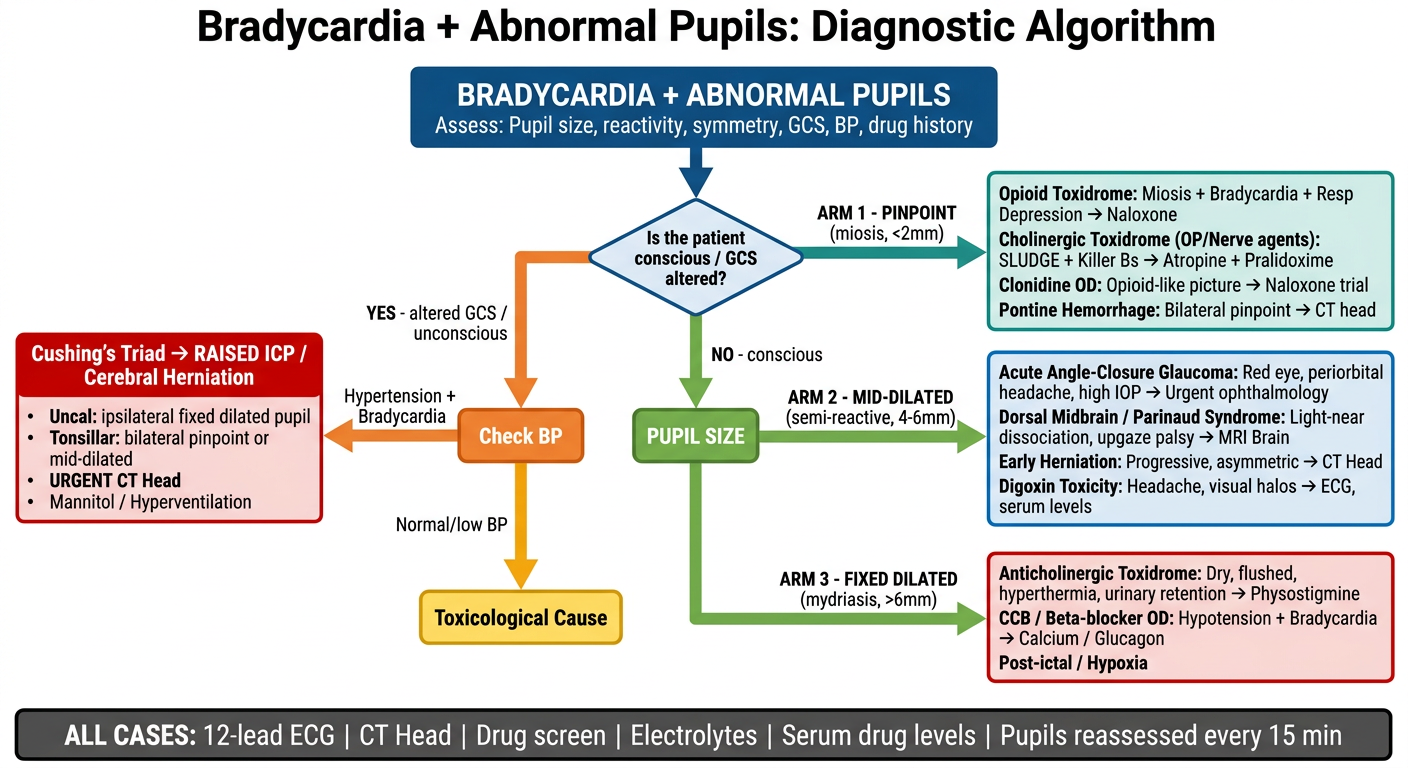
Diagnostic Algorithm: Bradycardia + Abnormal Pupils
STEP 1 - First Assessment (Simultaneous)
- Airway, Breathing, Circulation
- GCS score
- Blood pressure (critical branch point)
- Pupil size + reactivity + symmetry
- Drug/medication history
- 12-lead ECG immediately
STEP 2 - Branch by Consciousness
BRANCH A: GCS Altered / Unconscious
| BP Finding | Interpretation | Action |
|---|---|---|
| Hypertension + Bradycardia + Irregular breathing | Cushing's Triad = Raised ICP | Urgent CT Head, Mannitol 1g/kg, Hyperventilate to EtCO2 30-35 mmHg |
| Hypotension + Bradycardia | Toxicological / cardiogenic | Toxicology screen, ECG, consider opioid/clonidine |
- Uncal herniation → ipsilateral fixed dilated pupil + contralateral hemiplegia
- Tonsillar/cerebellar herniation → bilateral pinpoint or mid-sized unreactive pupils
- Bilateral fixed dilated → catastrophic brainstem failure
- (Source: Goldman-Cecil Medicine)
BRANCH B: Conscious Patient - Stratify by Pupil Size
🔵 PINPOINT PUPILS (<2 mm) + Bradycardia
| Diagnosis | Key Additional Features | Treatment |
|---|---|---|
| Opioid Toxidrome | Classic triad: miosis + bradycardia + respiratory depression (<12/min) | Naloxone 0.4-2mg IV/IM/IN, repeat q2-3 min |
| Cholinergic Toxidrome (Organophosphate, Nerve agent, Carbamate) | SLUDGE: Salivation, Lacrimation, Urination, Defecation, GI cramps, Emesis + "Killer Bs": Bradycardia, Bronchospasm, Bronchorrhea | Atropine 2-4mg IV (titrate to secretions, NOT pupil size) + Pralidoxime |
| Clonidine Overdose | Opioid-like picture, profound hypotension, hypothermia | Naloxone trial (partial response), supportive care |
| Pontine Hemorrhage | Bilateral pinpoint, hyperthermia, quadriplegia, "locked-in" state | Urgent CT/MRI head, neurosurgery |
| Organochlorine / Pilocarpine toxicity | Seizures + miosis | Supportive, benzodiazepines |
(Sources: Tintinalli's EM, Forensic Medicine & Toxicology 2026, Harriet Lane Handbook)
🟡 MID-DILATED PUPILS (4-6 mm), Semi-Reactive + Bradycardia
| Diagnosis | Key Additional Features | Treatment |
|---|---|---|
| Acute Angle-Closure Glaucoma | Red eye, periorbital/frontal headache, nausea/vomiting, corneal haze, halos; bradycardia via oculo-cardiac reflex | Urgent IOP, Topical timolol + pilocarpine, IV acetazolamide, ophthalmology consult |
| Dorsal Midbrain (Parinaud) Syndrome | Light-near dissociation (pupils react to convergence, not light), upgaze palsy, Collier sign, convergence-retraction nystagmus | MRI Brain (rule out pinealoma, hydrocephalus) |
| Early Uncal Herniation | Asymmetric, progressive, GCS deteriorating | CT Head emergent |
| Digoxin Toxicity | Headache, visual halos/color change, nausea, ECG: AV block, scooped ST | Serum digoxin level, Digibind (Fab fragments) if severe |
| Beta-blocker Overdose | Hypotension, bronchospasm, hypoglycemia | IV Glucagon, High-dose insulin, calcium |
(Sources: Wills Eye Manual, Kanski's Ophthalmology, Rosen's EM, Goodman & Gilman's)
🔴 FIXED/FULLY DILATED PUPILS (>6 mm), Non-reactive + Bradycardia
| Diagnosis | Key Additional Features | Treatment |
|---|---|---|
| Anticholinergic Toxidrome | "Dry as a bone, blind as a bat, red as a beet, hot as Hades, mad as a hatter"; urinary retention, tachycardia (note: paradoxical bradycardia at high doses via central vagal effect) | Physostigmine 1-2mg IV slow push (if no contraindications) |
| Calcium Channel Blocker OD | Hypotension + bradycardia + dilated pupils (vasodilation) | IV calcium gluconate, high-dose insulin-euglycemia therapy |
| Severe Hypoxia / Post-ictal | History, postictal confusion, O2 sat low | Oxygen, airway management |
| Bilateral Cerebral Herniation / Brain death | No other reflexes, apnea | Neurology/neurosurgery |
STEP 3 - Mandatory Workup for ALL Cases
| Investigation | Rationale |
|---|---|
| 12-lead ECG | AV blocks (digoxin/BB/CCB), prolonged QT, conduction defects |
| CT Head (non-contrast) | ICH, SAH, herniation, hydrocephalus |
| Serum drug levels | Digoxin, paracetamol, salicylate |
| Urine drug screen | Opioids, organophosphates |
| Serum electrolytes + renal function | Hyperkalemia → bradycardia |
| Blood glucose | Hypoglycemia mimics CNS depression |
| Intraocular pressure | If mid-dilated + headache → rule out ACG |
| Repeat pupil exam q15 min | Track progression or regression |
Key Mnemonic Summary
| Pupil | Toxidrome | Mnemonic |
|---|---|---|
| Pinpoint | Opioid | "3 Ms" - Miosis, Mute (CNS depression), Moaning (resp depression) |
| Pinpoint | Cholinergic | SLUDGE + Killer Bs |
| Mid-dilated | Glaucoma / Dorsal midbrain | "Mid = Midbrain or Mid-pressure (IOP)" |
| Dilated | Anticholinergic | "Dry, Blind, Red, Hot, Mad" |
Bottom line: Pupil size is your fastest non-invasive clue to the anatomical level or toxicological class of the problem. Bradycardia narrows it further - it rules out pure sympathomimetic toxidromes and points toward opioid/cholinergic/structural CNS causes.The algorithm above is organized as a 3-step clinical decision pathway:
- Altered GCS → focus on BP to separate Cushing's triad (raised ICP/herniation) from toxicological causes
- Conscious → branch entirely by pupil size into three arms:
- Pinpoint → Opioid, Cholinergic (OP poisoning), Clonidine, Pontine bleed
- Mid-dilated, semi-reactive → Acute angle-closure glaucoma, Dorsal midbrain/Parinaud, early herniation, Digoxin toxicity
- Fixed/fully dilated → Anticholinergic, CCB/Beta-blocker OD, severe hypoxia