
Explain giardiasis pathogenecity in detail
Reading File
Now I'll search the medical library and PubMed simultaneously for comprehensive coverage on giardiasis pathogenicity.
Finding Sources
Finding Sources
Searching PubMed
giardia pathogenesis virulence mechanisms
Excellent sources found. Now I'll read the key sections in parallel — the most comprehensive ones from Sleisenger & Fordtran's GI/Liver Disease, Sherris Medical Microbiology, Goldman-Cecil Medicine, and Robbins Pathology.
Reading File
Reading File
Reading File
Reading File
Now let me get the detailed pathogenesis section from Sleisenger & Fordtran's, which is the most authoritative GI reference, and also get the Sherris microbiology Giardia section and the image.
Finding Sources
Reading File
Loading Image
Now let me read the detailed pathogenesis sections from Goldman-Cecil and Harrison's, and more of the Sherris Giardia section.
Reading File
Reading File
Reading File
Now let me get the full pathogenesis section from Sleisenger & Fordtran's (the most authoritative GI text) and search for more on the ventral disc mechanism and VSP immune evasion.
Finding Sources
Finding Sources
I now have comprehensive content from multiple authoritative sources. Let me also retrieve the detailed pathogenesis from Sleisenger & Fordtran's dedicated block 28.
Finding Sources
Searching the Web
giardia pathogenicity mechanisms 2024 ventral disc VSP antigenic variation tight junction
I now have comprehensive, multi-source content to compile an authoritative answer. Let me also grab the Yamada's Gastroenterology pathogenesis section on the T-lymphocyte angle and the image reference from it.
Reading File
I now have thorough content from six authoritative sources. Here is the comprehensive synthesis:
Giardiasis: Pathogenicity in Detail
1. The Organism
Giardia duodenalis (synonyms: G. lamblia, G. intestinalis) is a binucleate, pear-shaped flagellated protozoan that exists in two forms:
| Form | Morphology | Function |
|---|---|---|
| Cyst | Oval, 8–12 µm, 4 nuclei, rigid outer wall | Environmentally stable infective form; survives cold water for weeks; resistant to chlorination |
| Trophozoite | Pear/stingray-shaped, 10–20 µm, 2 nuclei, 8 flagella, ventral adhesive disc | Colonizing, pathogenic form; replicates by binary fission |
Ingestion of as few as 10–25 cysts is sufficient for infection. Excystation is triggered by gastric acid and intestinal proteases, yielding 2 trophozoites per cyst.
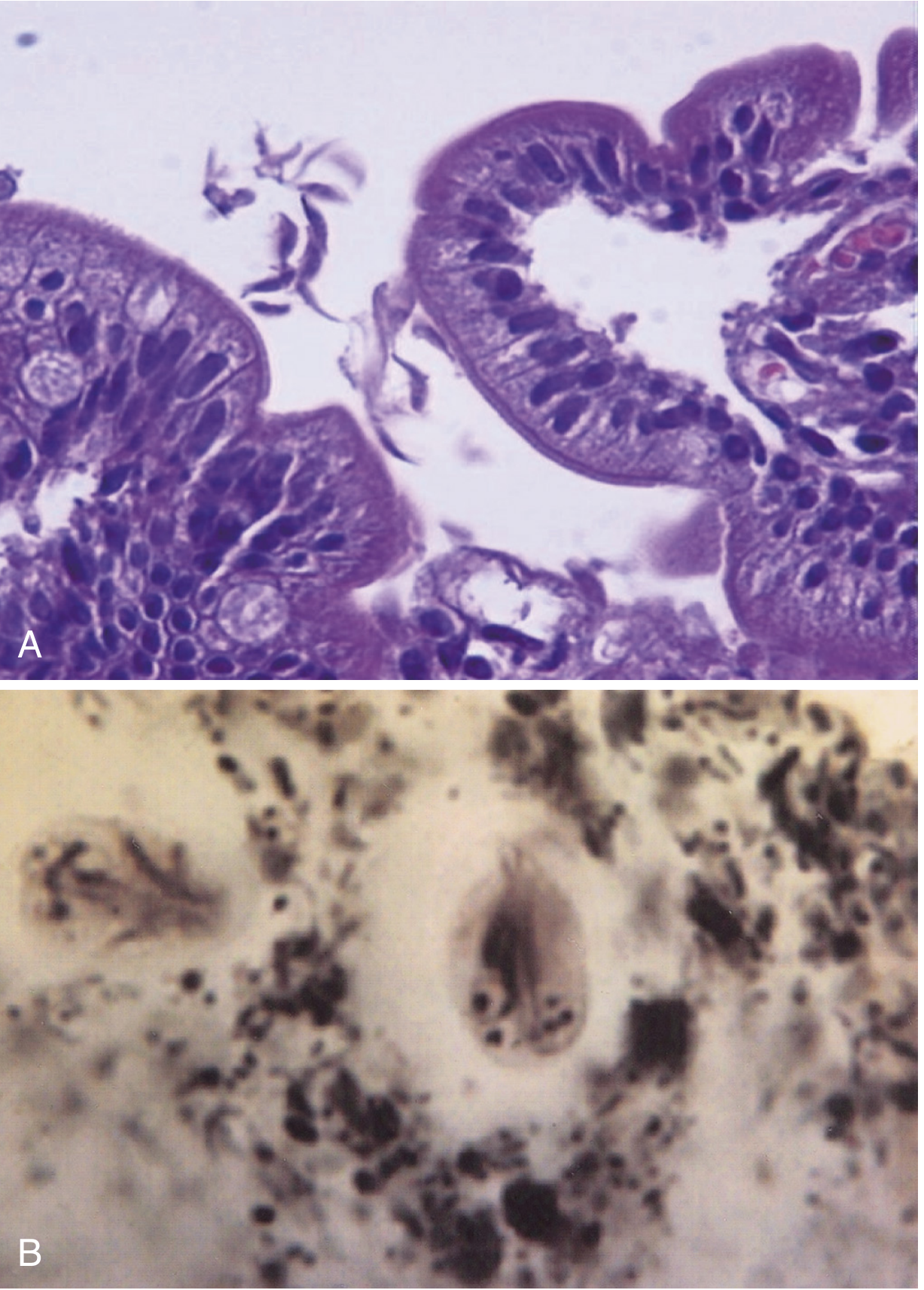
2. Life Cycle and Colonization Site
After excystation in the duodenum, trophozoites colonize the proximal small intestine (duodenum and jejunum), where they live in the lumen and adhere tightly to enterocytes. They do not invade the mucosa (or do so only very rarely). Encystment occurs when exposed to alkaline conditions or bile salts, and cysts are excreted in stool to restart the cycle.
3. Virulence Factors and Pathogenic Mechanisms
Giardia pathogenicity is multifactorial — no single dominant mechanism explains all clinical manifestations. Multiple overlapping processes operate simultaneously:
3a. Ventral Adhesive Disc — Mechanical Attachment
The trophozoite's concave ventral disc (a cytoskeletal structure composed of microtubules and microribbons) acts as a suction/adhesive organ, enabling firm attachment to the brush border of intestinal epithelial cells. This:
- Physically displaces and compresses microvilli
- Causes direct mechanical damage to the brush border
- Initiates downstream signaling disruption in enterocytes
Surface lectins also contribute to adherence, and secretory IgA can block this interaction by targeting these lectins.
3b. Brush-Border Enzyme Loss → Malabsorption
Coverage of the intestinal surface by large numbers of trophozoites interferes with brush-border disaccharidase activity (e.g., lactase, sucrase). This leads to:
- Lactose intolerance — the most consistent finding
- Reduced levels of intestinal peptidases
- Impaired vitamin B12 absorption
- Fat malabsorption (steatorrhea with greasy, floating stools)
Importantly, microvillous injury is not observed in athymic (T-cell-deficient) mice infected with Giardia — demonstrating that this mucosal damage requires T-cell participation, not just mechanical attachment alone (Yamada's Textbook of Gastroenterology).
3c. Cysteine Proteases — Epithelial Barrier Disruption
Giardia secretes cysteine proteases (notably cathepsin B-like proteases, and Giardipain-1):
- Disrupt tight junctions between epithelial cells → increased intestinal permeability
- Induce apoptosis of small intestinal epithelial cells (caspase-3-dependent)
- Break down intestinal mucus, exposing the epithelium
- Degrade host immune factors including secretory IgA
There is no evidence of a classic secretory enterotoxin analogous to cholera toxin. However, a 58 kD enterotoxin-like protein has been implicated in stimulating chloride secretion, contributing to secretory diarrhea.
3d. Arginine Depletion and Nitric Oxide Suppression
Giardia produces arginine deiminase, which consumes host-derived L-arginine, the substrate for nitric oxide synthase. By depleting local arginine:
- Epithelial production of nitric oxide (NO) is downregulated
- NO is an important innate defense molecule with anti-parasitic and immunomodulatory effects
- This creates a permissive environment for sustained colonization
3e. Bile Salt Deconjugation
Giardia causes deconjugation of bile salts in the small intestine lumen, which:
- Impairs fat emulsification and absorption
- Contributes to steatorrhea and fat-soluble vitamin deficiencies
- May alter the local microenvironment to favor Giardia persistence
3f. Altered Intestinal Motility and Microbiome Disruption
- Intestinal hypermotility reduces contact time for nutrient absorption
- Disruption of the intestinal microbiome has been demonstrated; changes in gut flora may both predispose to infection and worsen malabsorption
- Synergistic co-infections (e.g., co-infection with enteroaggregative E. coli) can amplify weight loss
3g. Epithelial Cell Apoptosis (T-Cell Mediated)
A critical pathogenic mechanism — not caused solely by parasite virulence factors but requiring host CD4+ T-cell responses:
- Trophozoites induce epithelial apoptosis, accelerating mucosal cell turnover
- The resulting immature, crypt-derived enterocytes lack full brush-border enzyme complement
- In heavy/chronic infections: villous blunting, crypt hyperplasia, increased intraepithelial lymphocytes, and mixed lamina propria inflammatory infiltrates (resembling tropical sprue or celiac disease)
4. Immune Evasion: Antigenic Variation via VSPs
A central pathogenic feature is Giardia's ability to persist for months to years despite an active immune response:
Variant Surface Proteins (VSPs):
- VSPs are cysteine-rich, type-I integral membrane proteins densely coating the entire trophozoite surface (including the flagella)
- Each parasite expresses only one VSP at a time, regulated by the RNAi pathway (stabilizes one vsp mRNA while degrading all others)
- VSP switching occurs once every 6–13 generations (approximately every 6–16 cell cycles in vivo)
- Over 200 VSP genes have been identified in the Giardia genome
- As host IgA accumulates against the currently expressed VSP, the parasite "switches" to a different VSP, evading antibody-mediated clearance
- VSPs also protect the parasite from luminal proteases, oxygen radicals, and intestinal enzymes
This mechanism of mutually exclusive, stochastic antigenic variation is analogous to VSG switching in African trypanosomes and is the primary reason Giardia can cause chronic infections despite an intact immune system.
5. Host Immune Response
Innate Immunity
- Nitric oxide (countered by Giardia's arginine deiminase)
- Defensins from Paneth cells
- Mast cells and dendritic cells — activated early in infection
- Phagocytic cells in the lamina propria
Adaptive Immunity
- Secretory IgA (sIgA): The most important humoral defense. Anti-trophozoite sIgA inhibits attachment by blocking parasite surface lectins. Patients with hypogammaglobulinemia or agammaglobulinemia suffer severe, prolonged, treatment-resistant giardiasis — confirming the central role of antibodies
- IgM/IgG + complement: Can directly kill trophozoites
- CD4+ T-helper cells: Essential for clearance; IL-17 plays a role in mucosal defense (animal models)
- Breast milk IgA: Provides infants partial protection against symptomatic disease (does not prevent infection but reduces symptoms)
HIV and Giardia
Interestingly, the clinical course of giardiasis is not significantly altered in HIV-positive patients, suggesting that CD4+ T-cell depletion alone does not fully predispose to severe disease — humoral immunity appears more critical.
6. Host Factors Affecting Pathogenicity
| Factor | Effect |
|---|---|
| Achlorhydria / hypochlorhydria | Reduces gastric killing of cysts → increased susceptibility; excystation of cysts requires acid exposure |
| Inoculum size | Uniform infection with ≥100 cysts in challenge studies |
| Parasite assemblage (A vs. B) | Assemblage A may be more virulent; different VSP repertoires between assemblages |
| Nutritional status | Malnutrition increases severity; high glucose counteracts apoptosis experimentally |
| Microbiome composition | Altered flora affects both susceptibility and resistance |
| Age | Children and immunocompromised patients at higher risk for severe disease |
7. Histopathological Spectrum
Mucosal appearances range widely:
- Normal morphology: Even with dense trophozoite colonization, the small intestinal architecture may appear normal
- Moderate disease: Villous blunting, shortened microvilli, increased intraepithelial lymphocytes, mixed lamina propria infiltrate
- Severe/chronic disease: Near-total villous atrophy, crypt hyperplasia (resembling celiac disease or tropical sprue)
- No invasion: Occasional rare trophozoites in the submucosa may reflect T-lymphocyte-mediated damage rather than true invasion
8. Summary of Pathogenic Mechanisms
Cyst ingestion → Excystation in duodenum
        ↓
Trophozoite attachment (ventral disc + lectins)
        ↓
┌─────────────────────────────────────────────────────┐
│  Direct mechanisms:                                  │
│  • Brush border disaccharidase loss → malabsorption  │
│  • Cysteine proteases → tight junction disruption    │
│  • Bile salt deconjugation → steatorrhea             │
│  • Arginine depletion → ↓NO → colonization↑         │
│  • Chloride secretion (enterotoxin-like) → diarrhea  │
│                                                       │
│  T-cell mediated:                                    │
│  • Epithelial apoptosis → villous atrophy            │
│  • Accelerated mucosal turnover → enzyme deficiency  │
│                                                       │
│  Immune evasion:                                     │
│  • VSP switching (RNAi-regulated, ~200 genes)        │
│  • Arginine deiminase → ↓nitric oxide immunity       │
│  • Anti-inflammatory trophozoite products            │
└─────────────────────────────────────────────────────┘
        ↓
Diarrhea, malabsorption, weight loss (or asymptomatic)
Sources: Sleisenger and Fordtran's Gastrointestinal and Liver Disease; Goldman-Cecil Medicine; Harrison's Principles of Internal Medicine 22E (2025); Robbins, Cotran & Kumar Pathologic Basis of Disease; Sherris & Ryan's Medical Microbiology, 8th ed.; Yamada's Textbook of Gastroenterology, 7th ed.
This is a shared conversation. Sign in to Orris to start your own chat.