
The bell majendy law of neurophysiology
The Bell-Magendie Law states that the dorsal (posterior) roots of the spinal cord carry sensory (afferent) signals, while the ventral (anterior) roots carry motor (efferent) signals. This functional separation of spinal nerve roots was discovered independently by Charles Bell (~1811) and François Magendie (1822).
Searching sources...
Reading File
Searching the Web
Bell-Magendie law neurophysiology dorsal ventral roots spinal cord
Finding Sources
Finding Sources
Reading File
Reading File
Loading Image
Loading Image
The Bell-Magendie Law
The Core Statement
The Bell-Magendie Law states that:
The ventral (anterior) roots of the spinal cord contain only motor (efferent) fibers, and the dorsal (posterior) roots contain only sensory (afferent) fibers.
Each spinal nerve, as it courses through the body to muscles and skin, actually carries a mixture of both types of fibers bundled together. They are anatomically segregated only where they attach to the spinal cord.
Historical Discovery
The law was worked out around 1810-1822 by two scientists working independently:
- Charles Bell (Scottish physician, ~1810-1811) - tested by selectively cutting each spinal root in experimental animals. He found that cutting only the ventral roots caused muscle paralysis, establishing the ventral root as the motor pathway. He also proposed that motor fibers originate from the cerebellum and sensory fibers terminate in the cerebrum.
- François Magendie (French physiologist, 1822) - demonstrated that the dorsal roots carry sensory information into the spinal cord (e.g., signals from pain, touch, proprioception).
Together they concluded: within each peripheral nerve is a mixture of many axons, some bringing signals into the CNS and others sending commands out to muscles - one-way transmission in each individual fiber.
Anatomy of the Law
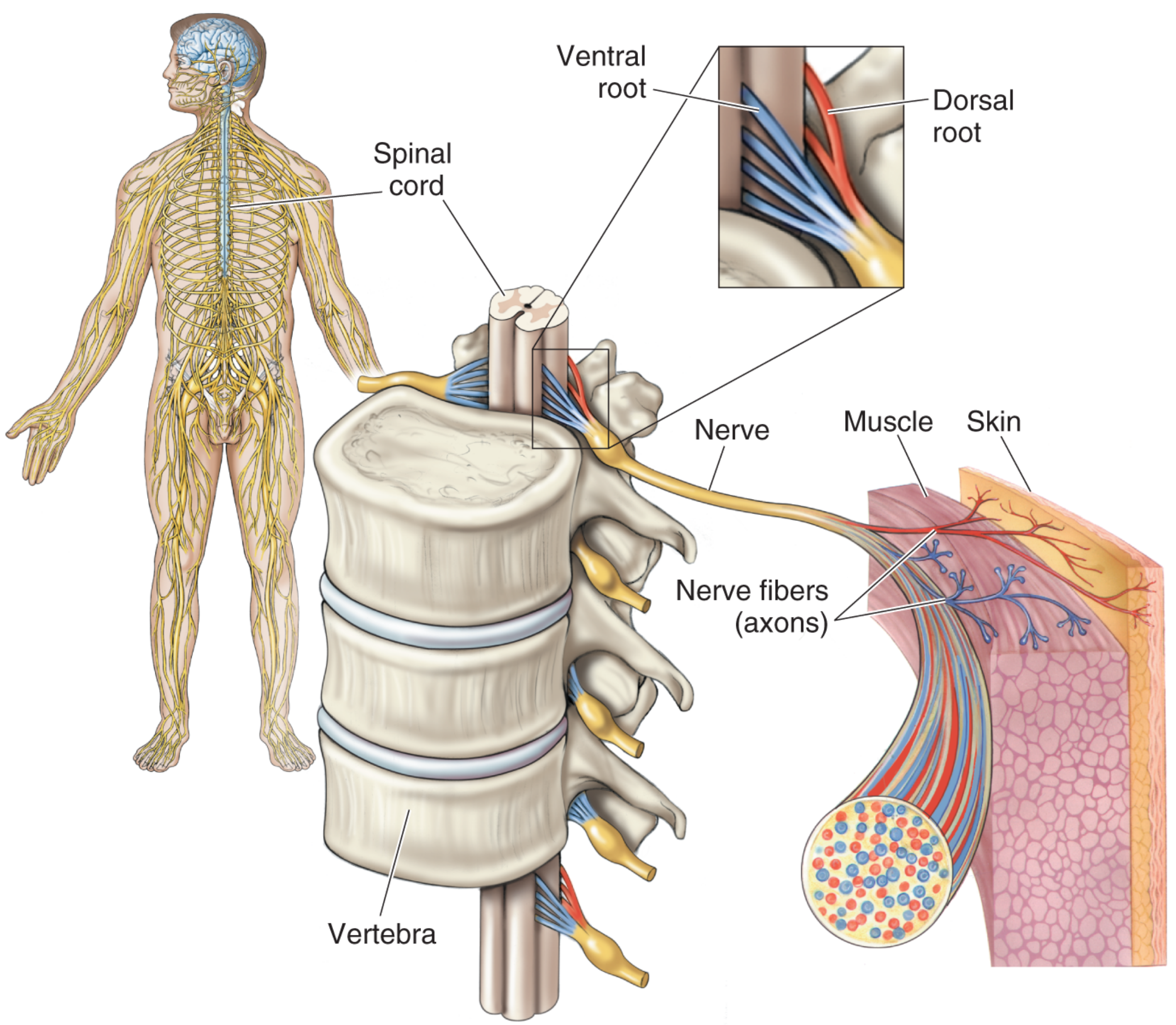
Fig. 1.9 - Spinal nerves and roots. Red = sensory (afferent) fibers entering via dorsal roots; Blue = motor (efferent) fibers exiting via ventral roots. The two root types merge into a single spinal nerve just beyond the vertebra.
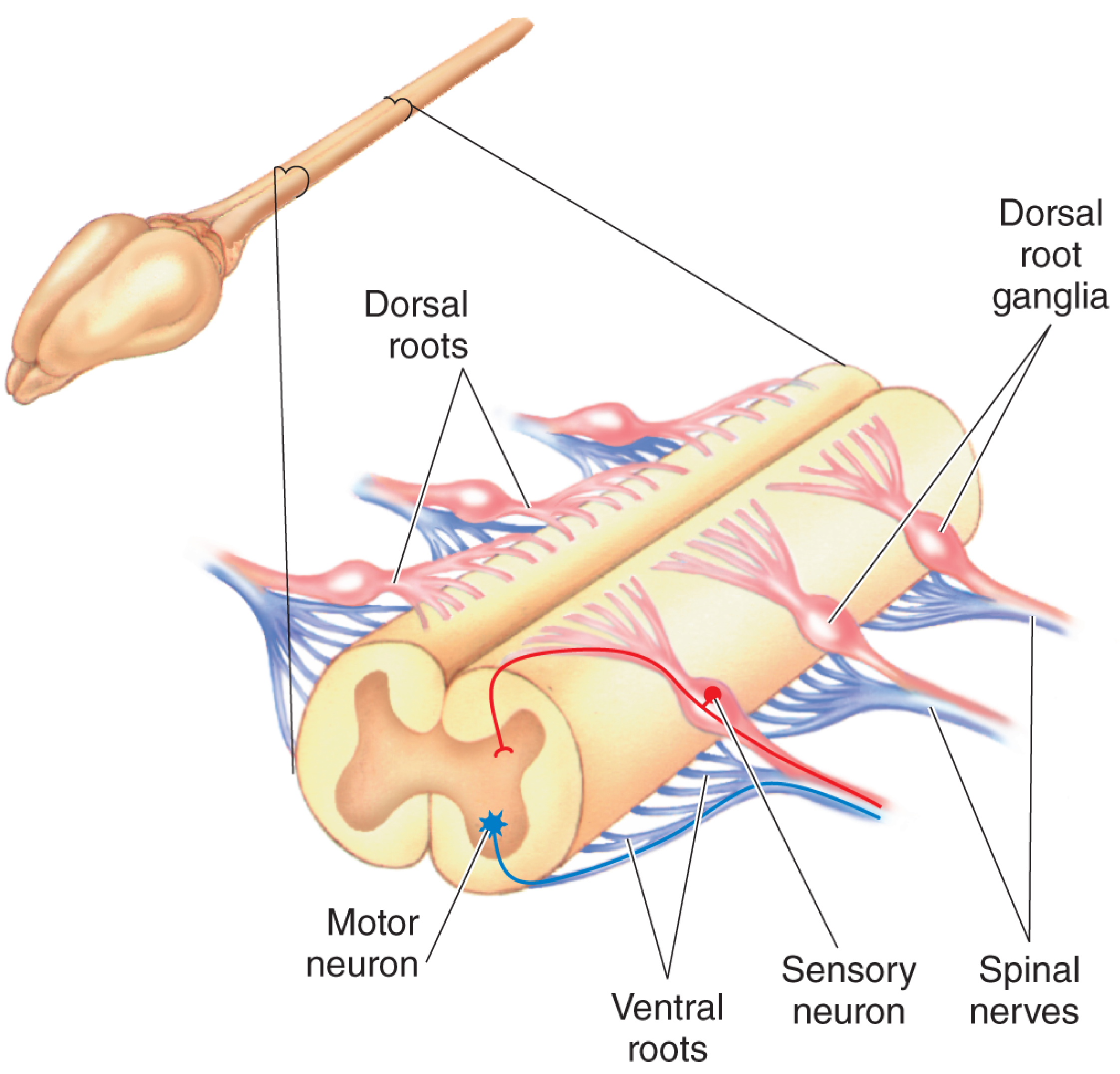
Fig. 7.5 - The spinal cord. Sensory neurons (red) enter via dorsal roots; their cell bodies sit in the dorsal root ganglia. Motor neurons (blue) originate in the anterior horn and exit via ventral roots.
Key Anatomical Points
| Feature | Dorsal (Posterior) Root | Ventral (Anterior) Root |
|---|---|---|
| Signal direction | Afferent (into CNS) | Efferent (out of CNS) |
| Fiber type | Sensory | Motor |
| Cell body location | Dorsal root ganglion (DRG) | Anterior horn of spinal cord |
| Targets sensory input from | Skin, joints, muscles (proprioception) | Skeletal muscle |
| Effect of cutting | Loss of sensation | Paralysis |
| Relative thickness | Thicker (~2x) | Thinner |
- The two roots join just distal to the dorsal root ganglion to form the spinal nerve, which then splits into dorsal and ventral primary rami - both of which carry mixed sensory and motor fibers.
- There are 31 pairs of spinal nerves (8 cervical, 12 thoracic, 5 lumbar, 5 sacral, 1 coccygeal), each with corresponding dorsal and ventral roots.
Clinical Significance
- Dorsal root lesion (e.g., tabes dorsalis in neurosyphilis, diabetic radiculopathy): loss of sensation, loss of proprioception, sensory ataxia - with motor power preserved.
- Ventral root lesion (e.g., poliomyelitis, motor neuron disease): flaccid paralysis with preserved sensation.
- Combined root damage (e.g., disc herniation compressing the nerve root at the foramen): both sensory loss and motor weakness in the affected dermatomal/myotomal distribution.
- The law also guided brain localization research - if different functions are in different spinal roots, perhaps different functions are also localized to different brain regions, laying groundwork for modern cortical mapping.
Important Nuance
Transmission along each individual nerve fiber is strictly one-way (afferent OR efferent). The mixing of both fiber types occurs only in the peripheral nerve trunk after the roots converge. This was a conceptual breakthrough - it resolved the 18th-century debate about whether the same "wire" could carry signals in both directions.
- Neuroscience: Exploring the Brain, 5th ed., pp. 117-118 (Fig. 1.9), p. 577 (Fig. 7.5)
- Langman's Medical Embryology - Spinal Nerves section
- Goldman-Cecil Medicine, Spinal Nerve Anatomy section
discuss from physiology textbook only
Searching sources...
Finding Sources
Finding Sources
Finding Sources
Finding Sources
Finding Sources
Good - I have hits in Guyton & Hall, Medical Physiology (Boron & Boulpaep), Ganong's, and Costanzo. Let me read the relevant sections from each.
Reading File
Reading File
Reading File
Now let me look for Guyton's treatment of dorsal/ventral roots and spinal organization:
Finding Sources
Finding Sources
Reading File
Reading File
Loading Image
Finding Sources
which chapter or page no. in gyton I can find it? 14 edition
Finding Sources
Reading File
In Guyton and Hall Textbook of Medical Physiology (14th edition), the Bell-Magendie Law content is found in:
Chapter 55 - "Spinal Cord Motor Functions; The Cord Reflexes"
Page 675 (start of chapter) and Page 676 onward.
Specifically, the relevant section is titled:
"ORGANIZATION OF THE SPINAL CORD FOR MOTOR FUNCTIONS"
Key passage from that section (p. 675-676):
"Sensory signals enter the cord almost entirely through the sensory roots, also known as the posterior or dorsal roots... Anterior motor neurons... give rise to the nerve fibers that leave the cord by way of the anterior roots and directly innervate the skeletal muscle fibers."
This is where Guyton explains the Bell-Magendie principle - dorsal/posterior roots = sensory (afferent) input, ventral/anterior roots = motor (efferent) output - alongside Figure 55.1 showing the spinal cord cross-section with sensory root entering dorsally and motor root exiting ventrally.
Quick reference summary for Guyton 14th ed:
| What to look for | Location |
|---|---|
| Chapter number | Chapter 55 |
| Chapter title | Spinal Cord Motor Functions; The Cord Reflexes |
| Key section | Organization of the Spinal Cord for Motor Functions |
| Page | 675-676 |
| Key figure | Figure 55.1 (cord gray matter organization, sensory root vs motor root) |
Tip: For the sensory side (dorsal roots carrying afferent signals), also cross-reference Chapters 48-49 (somatic sensations) where Guyton discusses dorsal root ganglia and afferent signal entry in detail.
This is a shared conversation. Sign in to Orris to start your own chat.