
Screening in community medicine
Reading File
Screening is a key preventive medicine tool used to detect disease early in apparently healthy populations. It applies secondary prevention principles.
Searching sources...
Finding Sources
Finding Sources
Finding Sources
Finding Sources
Reading File
Reading File
Finding Sources
Reading File
Finding Sources
Finding Sources
Reading File
Reading File
Finding Sources
Reading File
Reading File
Searching Images
screening test lead time bias length bias diagram community medicine
Loading Image
Finding Sources
Excellent - I found the key community medicine (Park's) source. Let me read those sections now.
Reading File
Reading File
Reading File
Reading File
I now have comprehensive data from Park's Textbook of Preventive and Social Medicine, Harrison's Principles of Internal Medicine, and Textbook of Family Medicine. Let me compile the full answer.
Screening in Community Medicine
Definition
Screening is the presumptive identification of unrecognized disease or defect by means of tests, examinations, or other procedures that can be applied rapidly to apparently healthy persons in the community. It sorts out from a large group of apparently healthy persons those who are "apparently abnormal" (likely to have disease or at increased risk), so that they can be brought under medical supervision and treatment.
- Park's Textbook of Preventive and Social Medicine defines it as testing for infection or disease in populations who are not seeking health care (e.g., serological testing for AIDS virus in blood donors, neonatal screening).
Key distinction from diagnosis: Screening is a presumptive test applied to healthy populations. A positive screen is not a diagnosis - it requires confirmatory diagnostic testing.
Screening vs. Case-Finding vs. Diagnosis
| Term | Description | Example |
|---|---|---|
| Screening | Testing asymptomatic people not seeking care | Neonatal PKU testing |
| Case-finding | Testing patients seeking care for other reasons | VDRL in pregnant women |
| Diagnostic test | Confirming/refuting disease in symptomatic patients | Endocervical culture for gonorrhoea |
Level of Prevention
Screening falls under secondary prevention - it does not prevent disease onset but detects it early (in the latent/preclinical phase), enabling earlier and more effective treatment to improve outcomes.
Types of Screening
| Type | Description |
|---|---|
| Mass screening | Applied to entire populations without selection |
| Selective (high-risk) screening | Targeted at groups with higher risk (e.g., smokers for lung cancer) |
| Multiphasic screening | Application of multiple tests to the same population simultaneously |
| Opportunistic screening | Screening offered to patients attending for other reasons |
| Prescriptive screening (case detection) | Initiated by health personnel for individual benefit (e.g., neonatal screening) |
| Prospective screening (control of disease) | For the benefit of others (e.g., screening immigrants for TB) |
WHO Criteria for an Ideal Screening Program (Wilson & Jungner, 1968)
These 10 criteria, reproduced from Harrison's Principles of Internal Medicine and the WHO 1968 publication, remain the standard:
- The condition should be an important health problem
- There should be an accepted treatment for the condition
- Facilities for diagnosis and treatment should be available
- There should be a latent or early symptomatic stage
- There should be a suitable test or examination
- The test should be acceptable to the population
- The natural history of the disease should be adequately understood
- There should be an agreed policy on whom to treat
- The cost of case-finding should be economically balanced against overall medical expenditure
- Case-finding should be a continuing process, not a "once and for all" project
Properties of an Ideal Screening Test
A good screening test should have three key attributes (Park's):
1. Simplicity and Acceptability
The test should be simple enough for paramedical personnel to perform, quick, safe, and acceptable to the target population.
2. Repeatability (Reliability/Precision)
The test must give consistent results when repeated under the same conditions. Repeatability depends on:
- Intra-observer variation - same observer gets different results on repeat testing
- Inter-observer variation - different observers get different results on the same sample
- Biological variation in the subject
- Technical/laboratory errors
3. Validity (Accuracy)
Validity expresses the test's ability to correctly distinguish diseased from non-diseased individuals. It has two components:
Sensitivity
The ability of a test to correctly identify those who have the disease (true positives).
Sensitivity = a / (a + c) × 100
Where a = true positives, c = false negatives.
A high sensitivity means few false negatives - important when missing a case has serious consequences (e.g., HIV, TB).
Specificity
The ability of a test to correctly identify those who do not have the disease (true negatives).
Specificity = d / (b + d) × 100
Where d = true negatives, b = false positives.
A high specificity means few false positives - important when a false positive causes serious harm (unnecessary treatment, anxiety).
2x2 Table
| Diseased | Not Diseased | |
|---|---|---|
| Test Positive | a (True +ve) | b (False +ve) |
| Test Negative | c (False -ve) | d (True -ve) |
Predictive Values
| Measure | Formula | Meaning |
|---|---|---|
| Positive Predictive Value (PPV) | a/(a+b) × 100 | Probability that a positive test = true disease |
| Negative Predictive Value (NPV) | d/(c+d) × 100 | Probability that a negative test = truly disease-free |
| False-negative rate | c/(a+c) × 100 | — |
| False-positive rate | b/(b+d) × 100 | — |
PPV is heavily dependent on disease prevalence. When prevalence is low (as in most population-level screening), PPV falls dramatically even with high sensitivity and specificity - Tietz Textbook of Laboratory Medicine.
Biases in Screening
These biases can create the false appearance of benefit from screening even when there is none.
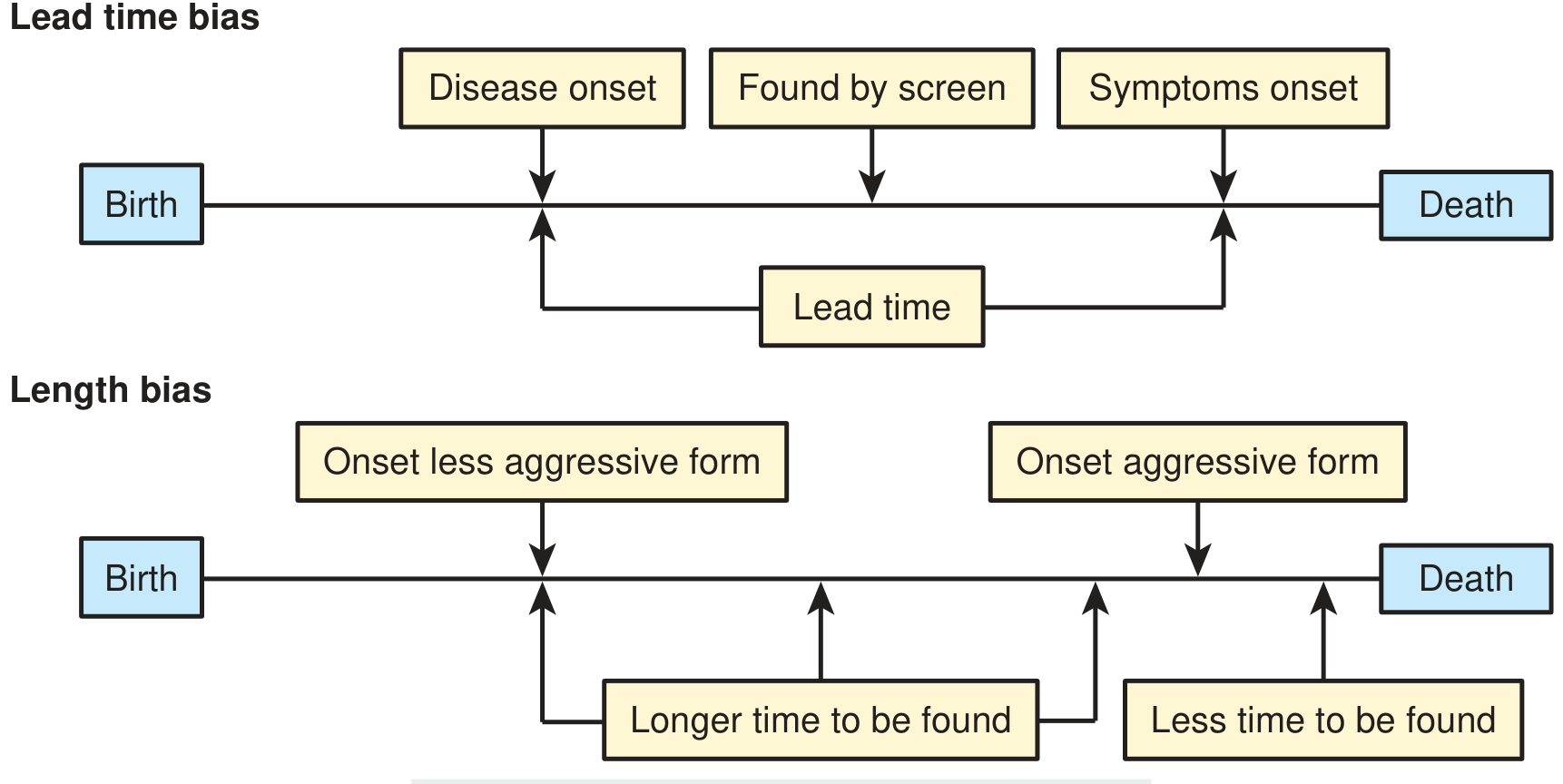
1. Lead Time Bias
Screening detects disease earlier, but does not change the actual date of death. Because the diagnosis date is moved earlier, survival appears longer without any real benefit. This is the period between detection by screening and detection by clinical symptoms - the "lead time."
2. Length (Time) Bias
Screening preferentially detects slower-progressing (less aggressive) disease because these have a longer asymptomatic/preclinical phase during which screening can find them. Faster-progressing cancers are more likely to present symptomatically between screening rounds. This creates the false impression that screened cases have better prognosis.
3. Volunteer (Healthy Worker) Bias
People who volunteer for screening are generally healthier, more health-conscious, and of higher socioeconomic status than non-participants, so screened groups appear to have better outcomes regardless of screening benefit.
"Lead Time" Concept
"Lead time" is the advantage gained by screening - the period between diagnosis by early detection and the time it would have been diagnosed by symptoms. As illustrated in Park's Textbook:
- A = usual outcome without screening
- B = outcome when disease detected at earliest possible moment
- Benefit of the program = B - A
Detection only has real value if it occurs before the "critical point" - beyond which treatment becomes ineffective or irreversible damage is done.
Evaluation of a Screening Program
Beyond test properties, evaluating a program requires assessing whether it actually reduces mortality from the target condition - not just survival time (which is subject to biases above). The gold standard is an RCT with mortality as the endpoint (Harrison's Principles of Internal Medicine).
Common Screening Examples
| Disease | Screening Test |
|---|---|
| Cervical cancer | Pap smear / HPV testing |
| Breast cancer | Mammography |
| Colorectal cancer | Colonoscopy / fecal occult blood test |
| Hypertension | Blood pressure measurement |
| Diabetes | Fasting blood glucose / HbA1c |
| Neonatal hypothyroidism | TSH (heel-prick) |
| PKU | Guthrie test |
| TB | Mantoux test / chest X-ray |
| HIV | ELISA (confirmed by Western blot) |
| Syphilis | VDRL (confirmed by TPHA) |
Summary
| Feature | Ideal Screening |
|---|---|
| Disease | Common, serious, with known natural history |
| Test | Simple, safe, acceptable, valid, reliable |
| Latent stage | Must exist |
| Treatment | Must be available and effective when applied early |
| Benefit | Must outweigh harm and cost |
| Program | Continuous, with follow-up diagnostic services |
Sources: Park's Textbook of Preventive and Social Medicine; Harrison's Principles of Internal Medicine 22e; Textbook of Family Medicine 9e; Tietz Textbook of Laboratory Medicine 7e
This is a shared conversation. Sign in to Orris to start your own chat.