
Tell me the functions of Na+ K+ pump. Like maintain the cell volume, acts as an electrogenic pump. Use the reference and write in details about the functions from guyton ar ganon book
Reading File
Now let me search both Guyton and Ganong for Na+/K+ pump functions in parallel.
Finding Sources
Finding Sources
Now let me read the Guyton section on the Na+/K+ pump and also search Ganong (Medical Physiology by Boron) in parallel:
Reading File
Finding Sources
Finding Sources
Reading File
Finding Sources
Finding Sources
Now let me read the Guyton electrogenic section and search Ganong in parallel:
Reading File
Finding Sources
Finding Sources
I can see that Guyton has the key sections. Let me read the full cell volume and electrogenic sections from Guyton, and also look for Ganong's content:
Reading File
Finding Sources
Finding Sources
Reading File
Now let me read the Ganong sections on cell volume and membrane permeability/Na,K ATPase:
Reading File
Reading File
Reading File
I now have comprehensive content from both Guyton and Ganong. Let me also fetch the diagram image from Guyton for visual support:
Loading Image
I now have all the information needed from both Guyton and Ganong. Let me compile a detailed, well-referenced answer.
Functions of the Na⁺/K⁺ Pump (Na⁺-K⁺-ATPase)
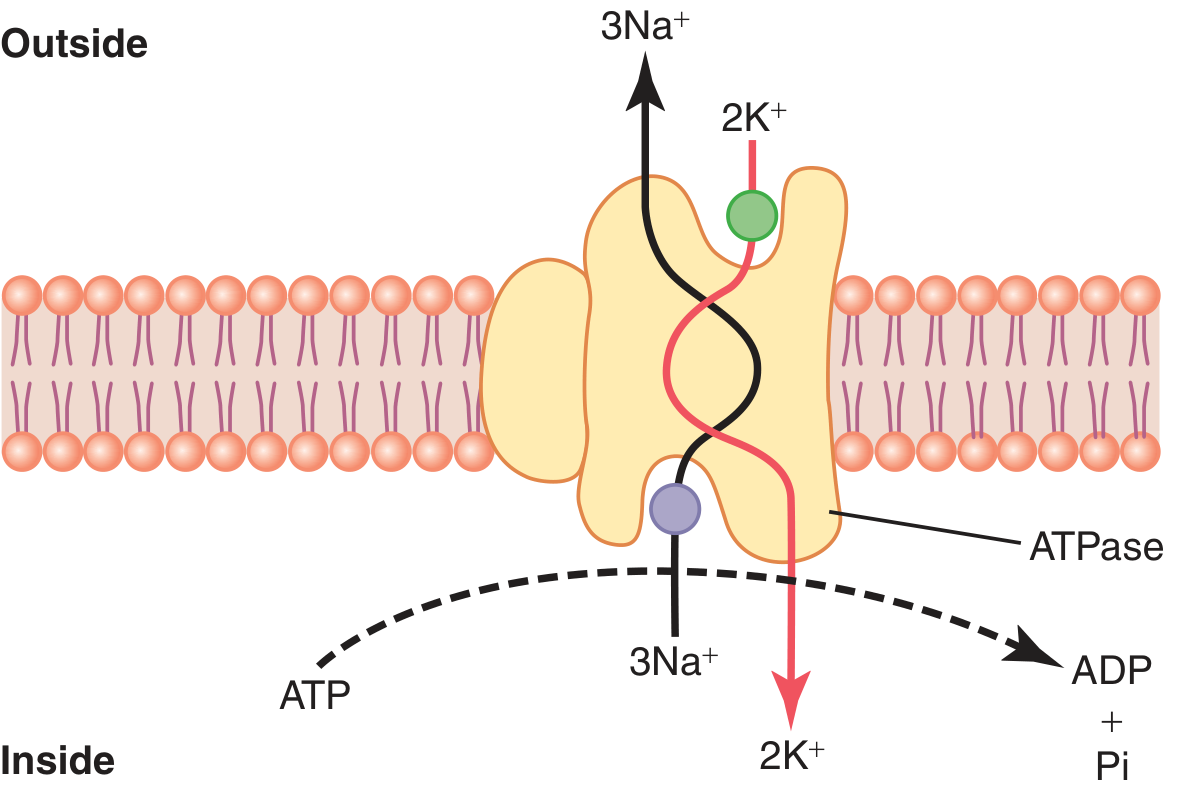
Basic Mechanism (Structure)
The Na⁺/K⁺ pump is a carrier protein complex made of two subunits:
- α subunit (molecular weight ~100,000) - the functional unit
- β subunit (molecular weight ~55,000) - likely anchors the complex in the membrane
The α subunit has three key features:
- Three binding sites for Na⁺ on the intracellular portion
- Two binding sites for K⁺ on the extracellular portion
- ATPase activity on the inside near the Na⁺ binding sites
When 3 Na⁺ bind on the inside and 2 K⁺ bind on the outside, ATPase is activated. One ATP molecule is cleaved to ADP + phosphate, releasing energy that causes a conformational change - extruding 3 Na⁺ out and bringing 2 K⁺ in per cycle.
Guyton and Hall Textbook of Medical Physiology, Chapter 4 (block1, line 1790-1809)
Functions in Detail
1. Maintenance of Intracellular Na⁺ and K⁺ Concentrations
The pump is responsible for maintaining the characteristic ion concentration differences across the cell membrane:
| Ion | Outside (ECF) | Inside (ICF) |
|---|---|---|
| Na⁺ | 142 mEq/L | 14 mEq/L |
| K⁺ | 4 mEq/L | 140 mEq/L |
Without this pump, Na⁺ would gradually accumulate inside the cell (driven by its chemical and electrical gradients inward), and K⁺ would leak out. Ganong explains this directly:
"The intracellular concentrations of Na⁺ and K⁺ remain constant because of selective permeability of the membrane to different ions and the action of the Na,K ATPase that actively transports Na⁺ out of the cell and K⁺ into the cell (against their respective electrochemical gradients)."Ganong's Review of Medical Physiology, 26th Ed., Chapter 1 (block1, line 383)
2. Control of Cell Volume (Prevents Cell Swelling and Lysis)
This is described by Guyton as one of the most important functions of the pump.
Inside the cell, large numbers of proteins and other organic molecules (mostly negatively charged) cannot escape. These non-diffusible anions attract Na⁺, K⁺, and other positive ions by the Gibbs-Donnan effect. All these particles together exert osmotic pressure, drawing water into the cell by osmosis. If unchecked, the cell would swell indefinitely and burst.
The Na⁺/K⁺ pump prevents this because:
- It pumps 3 Na⁺ out for every 2 K⁺ in - a net loss of one cation per cycle
- Na⁺ pumped out has a strong tendency to stay outside (membrane is far less permeable to Na⁺ than K⁺)
- This net outward movement of ions causes osmosis of water out of the cell
If a cell begins to swell for any reason, the pump is automatically activated, moving more ions outward and pulling water with them:
"If a cell begins to swell for any reason, the Na⁺-K⁺ pump is automatically activated, moving still more ions to the exterior and carrying water with them. Therefore, the Na⁺-K⁺ pump performs a continual surveillance role in maintaining normal cell volume."Guyton and Hall Textbook of Medical Physiology, Chapter 4 (block1, lines 1813-1821)
Ganong reinforces this through the Gibbs-Donnan framework:
"Because of charged proteins (Prot⁻) in cells, there are more osmotically active particles in cells than in interstitial fluid, and because animal cells have flexible walls, osmosis would make them swell and eventually rupture if it were not for the sodium-potassium adenosine triphosphate (Na,K ATPase) pumping ions back out of cells. Thus, normal cell volume and pressure largely depend on Na,K ATPase, also known as the Na⁺/K⁺ pump."Ganong's Review of Medical Physiology, 26th Ed., Chapter 1 (block1, lines 312)
3. Electrogenic Pump - Contributes to Resting Membrane Potential
Because the pump moves 3 Na⁺ out but only 2 K⁺ in, there is a net transfer of one positive charge to the outside per cycle. This creates:
- Positivity on the outside
- Negativity on the inside
This is why the pump is called electrogenic - it directly generates an electrical potential across the cell membrane.
From Guyton:
"The Na⁺-K⁺ pump is electrogenic. Because the Na⁺-K⁺ pump moves three Na⁺ ions to the exterior for every two K⁺ ions that are moved to the interior, one net positive charge is moved from the interior of the cell to the exterior of the cell for each cycle of the pump. This creates positivity outside the cell and negativity on the inside. Therefore, the Na⁺-K⁺ pump is said to be electrogenic because it creates an electrical potential across the cell membrane. This electrical potential is a basic requirement in nerve and muscle fibers for transmitting nerve and muscle signals."Guyton and Hall Textbook of Medical Physiology, Chapter 4 (block1, lines 1822-1825)
Quantitatively, Guyton explains that diffusion potentials alone (K⁺ and Na⁺) give a membrane potential of about -86 mV, and the continuously acting electrogenic Na⁺-K⁺ pump adds an additional -4 mV, bringing the net resting membrane potential to approximately -90 mV in nerve fibers.
Guyton and Hall Textbook of Medical Physiology, Chapter 5 (block1, lines 2120-2124)
From Ganong:
"Because the Na,K ATPase moves three Na⁺ out of the cell for every two K⁺ moved in, it also contributes to the membrane potential, and thus is termed an electrogenic pump."Ganong's Review of Medical Physiology, 26th Ed., Chapter 1 (block1, line 388)
4. Maintenance of Resting Membrane Potential (via Ion Gradients)
Beyond the direct electrogenic contribution, the pump is the foundation for maintaining the ion gradients that drive diffusion potentials. The steep K⁺ gradient (140 mEq/L inside vs. 4 mEq/L outside) established by the pump allows K⁺ to diffuse outward through leak channels, generating the large negative resting potential of approximately -94 mV (Nernst potential for K⁺). This is central to the excitability of nerve and muscle cells.
"This condition is maintained by Na,K ATPase, which uses the energy of ATP to pump K⁺ back into the cell and keeps the intracellular concentration of Na⁺ low."Ganong's Review of Medical Physiology, 26th Ed., Chapter 1 (block1, lines 386-388)
5. Energy Source for Secondary Active Transport
The Na⁺ concentration gradient created by the Na⁺/K⁺ pump (high Na⁺ outside, low inside) serves as the driving force for secondary active transport of many other molecules across cell membranes. This is called co-transport or counter-transport:
- Symports (co-transport): Glucose, amino acids, and other nutrients are transported into cells by riding along with Na⁺ flowing down its gradient (e.g., Na⁺-glucose cotransporter in the intestine and renal tubules).
- Antiports (counter-transport): Na⁺ flowing into the cell drives substances in the opposite direction (e.g., Na⁺-Ca²⁺ exchanger).
Since the Na⁺/K⁺ pump creates and sustains this gradient, it indirectly powers all these secondary active transporters. In nerve cells, 60-70% of the cell's total energy may be consumed by this pump alone.
Guyton and Hall Textbook of Medical Physiology, Chapter 4 (block1, line 1811)
6. Basis of Nerve and Muscle Signal Transmission
The pump is directly responsible for the ability of nerve and muscle cells to generate and conduct action potentials. It:
- Maintains the resting membrane potential (prerequisite for excitability)
- Restores ion gradients after each action potential (during the refractory period)
- Ensures sustained signaling capacity in electrically active tissues
"This pump is responsible for maintaining the sodium and potassium concentration differences across the cell membrane, as well as for establishing a negative electrical voltage inside the cells... this pump is also the basis of nerve function, transmitting nerve signals throughout the nervous system."Guyton and Hall Textbook of Medical Physiology, Chapter 4 (block1, line 1790)
7. Reversibility - ATP Synthesis
Under special experimental conditions, if the electrochemical gradients for Na⁺ and K⁺ are made very large (greater than the energy of ATP hydrolysis), the pump can run in reverse - ions flow down their gradients and the pump synthesizes ATP from ADP and phosphate. This demonstrates the thermodynamic coupling between ion gradients and chemical energy.
"The Na⁺-K⁺ ATPase pump can run in reverse. If the electrochemical gradients for Na⁺ and K⁺ are experimentally increased to the degree that the energy stored in their gradients is greater than the chemical energy of ATP hydrolysis, these ions will move down their concentration gradients, and the Na⁺-K⁺ pump will synthesize ATP from ADP and phosphate."Guyton and Hall Textbook of Medical Physiology, Chapter 4 (block1, line 1811)
Summary Table
| Function | Mechanism | Significance |
|---|---|---|
| Maintains Na⁺/K⁺ gradients | Pumps 3 Na⁺ out, 2 K⁺ in per cycle against concentration gradients | Foundation of all cellular electrochemical activity |
| Controls cell volume | Net cation loss prevents osmotic swelling; "surveillance" role | Prevents cell lysis; essential for all cells |
| Electrogenic pump | 3:2 transport ratio creates net outward positive charge movement | Directly contributes ~-4 mV to resting membrane potential |
| Establishes resting membrane potential | Creates K⁺/Na⁺ gradients that drive diffusion potentials | RMP of ~-70 to -90 mV in nerve/muscle |
| Powers secondary active transport | Na⁺ gradient drives co-transport of glucose, amino acids, Ca²⁺ | Nutrient absorption, ion homeostasis |
| Nerve/muscle excitability | Maintains and restores gradients for action potentials | Signal transmission throughout the nervous system |
| Reversible (ATP synthesis) | Runs in reverse under extreme gradient conditions | Demonstrates bioenergetic coupling |
References:
- Guyton AC, Hall JE. Guyton and Hall Textbook of Medical Physiology, 14th Ed. Chapter 4 (Active Transport; Na⁺-K⁺ Pump) and Chapter 5 (Resting Membrane Potential of Neurons).
- Barrett KE, Barman SM, Brooks HL, Yuan JX. Ganong's Review of Medical Physiology, 26th Ed. Chapter 1 (Forces Acting on Ions; Establishment of the Membrane Potential; Plasma Osmolarity & Disease).
This is a shared conversation. Sign in to Orris to start your own chat.