
Per op note for vaginal hysterectomy
Reading File
Finding Sources
Reading File
Reading File
Reading File
Reading File
Reading File
Reading File
I now have comprehensive operative details. Let me compile the full per-op note.
Operative Note: Vaginal Hysterectomy
PREOPERATIVE DETAILS
Procedure: Vaginal Hysterectomy ± Bilateral Salpingo-Oophorectomy (BSO)
Indications: [e.g., uterine prolapse, symptomatic fibroids, abnormal uterine bleeding, cervical/uterine pathology]
Surgeon: ________________________________
Assistant(s): ________________________________
Anesthesia: General / Regional (specify)
Date/Time: ________________________________
EBL: ________ mL | Urine Output: ________ mL
Specimens: Uterus ± cervix ± bilateral tubes and ovaries
PATIENT PREPARATION
The patient was brought to the operating room, placed in the dorsal high lithotomy position with the buttocks positioned just over the table edge. Padded stirrups were applied; hip flexion was maintained >60° and knee flexion 90–120° to avoid nerve and vascular injury. A Trendelenburg tilt of 10–15° was used to aid intravaginal visualization.
Examination under anesthesia was performed, confirming uterine mobility, uterine descent, and size. Pubic hair was clipped from the labia majora. The vagina, vulva, mons, inner thighs, perineum, and anal area were prepped with dilute 4% chlorhexidine-alcohol. The patient was draped in standard sterile fashion. A Foley catheter was inserted to drain the bladder.
PROCEDURE
1. Setup and Cervical Grasping
A short weighted speculum was placed in the vagina. Sidewall retractors were positioned lateral to the cervix. The anterior and posterior lips of the cervix were grasped with a single/double-toothed tenaculum. Downward traction was applied. The vaginal epithelium at the planned incision site was injected with dilute lidocaine with epinephrine (1:200,000) for hemostasis and hydrodissection.
2. Circumferential Incision
A circumferential incision was made in the vaginal epithelium at the cervicovaginal junction, at least 1 cm distal to the bladder, with the aim of preserving vaginal length. The incision was angled posteriorly to facilitate cul-de-sac entry. Using curved Mayo scissors, the vaginal epithelium was dissected circumferentially from the underlying cervical stroma.
3. Posterior Cul-de-Sac Entry
The posterior vaginal epithelium was placed on traction. The posterior peritoneum (cul-de-sac of Douglas) was identified, elevated with forceps, and entered sharply with scissors. Entry was confirmed by digital examination. The posterior peritoneum was secured to the posterior vaginal epithelium with a figure-of-eight delayed absorbable suture for hemostasis and orientation. The posterior pelvic cavity was inspected. A long-weighted (Auvard) speculum was placed into the peritoneal cavity.
4. Uterosacral Ligament Ligation
With lateral retraction and counter-traction on the cervix, the uterosacral ligaments were clamped bilaterally with a curved Heaney clamp, tips incorporating the lower portion of the cardinal ligaments. The clamp was placed perpendicular to the uterine axis, tips touching the cervix. The pedicle was transected and suture-ligated with 0-gauge delayed absorbable suture (transfixion stitch). Suture ends were tagged with hemostats for the most inferior pedicle.
5. Anterior Dissection / Vesicouterine Space Entry
Downward traction was placed on the cervix. Using Mayo scissors directed toward the uterus, the vesicouterine space was developed, separating the bladder from the anterior lower uterine segment. A Heaney retractor was placed in the midline to protect the bladder. The vesicouterine peritoneal fold was identified, elevated with forceps, and entered sharply. Digital confirmation of peritoneal entry was made. The retractor was repositioned into the anterior cul-de-sac to maintain bladder elevation throughout the remainder of the procedure.
6. Cardinal Ligament Ligation
The cardinal ligaments were clamped bilaterally (sequentially or in combination with uterosacral ligaments depending on size) using curved Heaney clamps, transected, and suture-ligated with 0-gauge delayed absorbable suture. This was repeated in sequential bites as needed until the uterine vessels were reached. Suture ends were tagged with hemostats.
7. Uterine Artery Ligation
The cervix was placed on outward and lateral traction. The uterine artery was identified on each side, clamped with a curved Heaney clamp, transected, and doubly ligated with 0-gauge delayed absorbable suture (suture-tie followed by a medial transfixion ligature). The contralateral uterine artery was secured in the same manner.
8. Uterine Fundus Delivery and Upper Pedicles
The uterine fundus was grasped and delivered posteriorly (posterior morcellation technique as needed). Traction was placed inferiorly. The surgeon's finger was placed behind the utero-ovarian ligament complex to guide clamp placement. The utero-ovarian ligaments and round ligament complexes were clamped bilaterally with Heaney clamps, transected, and double-ligated (suture tie + medial transfixion ligature with 0-gauge delayed absorbable suture). Hemostats were placed on the upper pedicle sutures for identification.
9. Specimen Removal
The uterus was removed and sent to pathology. (If enlarged: morcellation was performed after securing uterine artery pedicles.)
9a. Bilateral Salpingo-Oophorectomy (if performed)
The round ligaments were separated from the adnexal pedicles. The ovary was drawn medially with a Babcock clamp. A Heaney clamp was placed across the infundibulopelvic ligament (ovarian vessels). The tube and ovary were excised. A transfixion tie and suture ligature were placed. Bilateral adnexal specimens were sent to pathology.
9b. Opportunistic Salpingectomy (if performed)
The round ligament was isolated. The ovary was retracted medially and the fimbria identified. With the entire fallopian tube in view, a clamp was placed across the mesosalpinx lateral to the fallopian tube, excluding the infundibulopelvic ligament. This pedicle was cut and suture-ligated bilaterally.
10. Hemostasis Inspection
All pedicles were inspected: the most inferior pedicle (uterosacral) through to the most superior pedicle (utero-ovarian ligament). Hemostasis was confirmed at each pedicle. Any bleeding points were addressed with suture ligation.
11. Vault Closure and Cuff Repair
The vaginal cuff was closed with interrupted or running delayed absorbable suture. The uterosacral ligaments were incorporated into the lateral angles of the vault for apical support (McCall culdoplasty performed if indicated — see addendum).
The peritoneum was reapproximated, or left open per surgeon preference. Final inspection of the cuff and pedicles confirmed hemostasis.
12. Foley Catheter
The Foley catheter was confirmed in place and draining clear urine. (Note any cystotomy and repair if occurred.)
CLOSURE
The vaginal cuff was closed without complication. Instruments, sponge, and needle counts were correct × [number]. The patient tolerated the procedure well and was transferred to the PACU in stable condition.
OPERATIVE FINDINGS
- Uterine size: _______ weeks / _______ grams
- Adnexa: Normal / Abnormal (specify) / Removed bilaterally
- Cul-de-sac: Clear / Adhesions noted (specify)
- Estimated blood loss: _______ mL
- Complications: None / (specify)
SPECIMENS SENT TO PATHOLOGY
- Uterus with cervix
- Right tube and ovary
- Left tube and ovary
- Right fallopian tube (salpingectomy)
- Left fallopian tube (salpingectomy)
Source: Berek & Novak's Gynecology, Chapter 27; Campbell-Walsh-Wein Urology, Chapter 68
Search for clinical images of vaginal hysterectomy surgical anatomy
Searching Images
vaginal hysterectomy surgical anatomy
Searching Images
vaginal hysterectomy operative steps cervix uterosacral ligament
Loading Image
Loading Image
Loading Image
Loading Image
Loading Image
Loading Image
Searching Images
vaginal hysterectomy colpotomy incision bladder dissection anterior cul de sac
Loading Image
Loading Image
Loading Image
Here is a curated gallery of clinical intraoperative images covering the key anatomical steps of vaginal hysterectomy:
Vaginal Hysterectomy — Surgical Anatomy in Clinical Images
1. Initial Exposure: Cervix Visualisation & Anterior Colpotomy
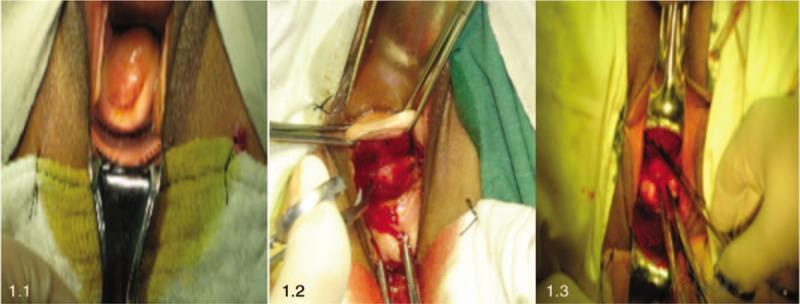
Panel 1.1 — Cervix exposed with weighted speculum; the cervical os and portio vaginalis are visible.
Panel 1.2 — Semi-annular anterior vaginal fornix incision below the bladder sulcus, with forceps and active minor bleeding at the colpotomy site.
Panel 1.3 — Deep dissection exposing the uterovesical peritoneal reflection, separating the vesicocervical space.
2. Vesicouterine Space Dissection (Bladder Mobilisation)
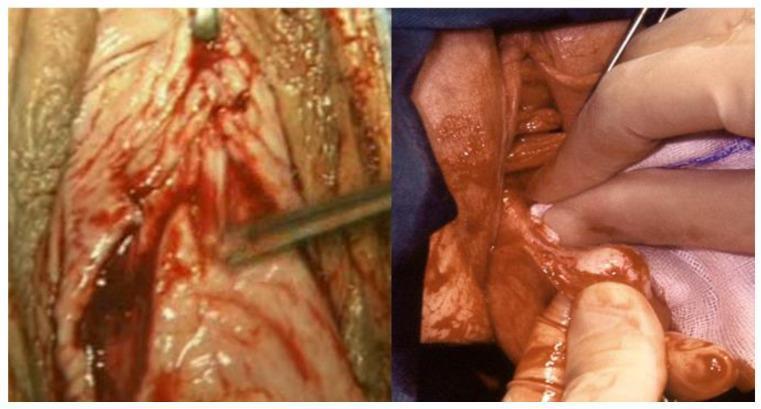
Left — Sharp dissection defining the avascular cleavage plane between bladder and cervix.
Right — Blunt dissection with surgical gauze separating the bladder base from the uterine cervix, revealing the vesicouterine space before anterior peritoneal entry.
3. Posterior Cul-de-Sac Entry & Uterosacral Ligament Exposure
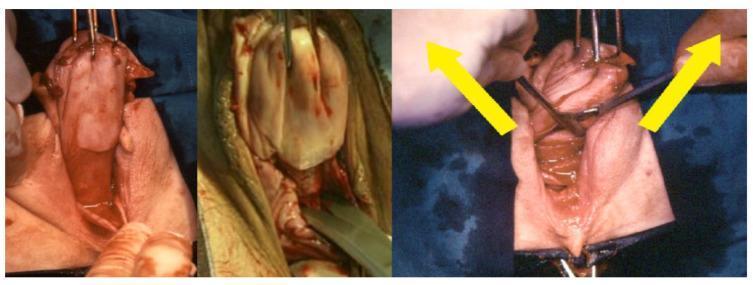
Left — Exposure of the pouch of Douglas (rectouterine pouch) peritoneum; vaginal wall retracted with probes.
Center — Sharp transverse incision through the posterior peritoneum with scissors.
Right — Scissors spread (yellow arrows) to bluntly expand the opening, exposing the uterosacral ligaments and paracervical tissues laterally.
4. Uterosacral Ligament Clamping & Uterine Rotation
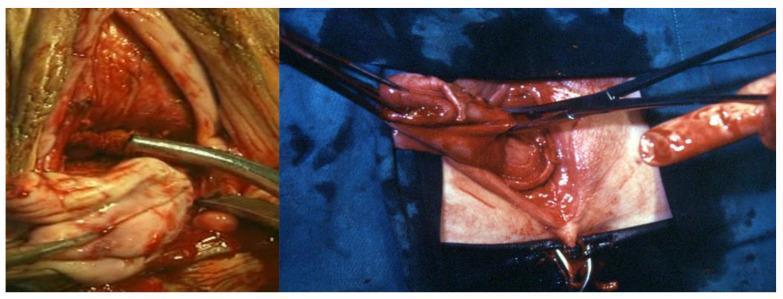
Left — Heaney clamp positioned with the lower blade beneath the sacrouterine ligament for ligation; paracervical structures visible.
Right — Clockwise uterine rotation providing access to the contralateral uterosacral-paracervical complex; clamps bundle the ligaments in preparation for sequential transection.
5. Upper Pedicles — Round Ligament, Utero-ovarian Ligament & Fallopian Tube
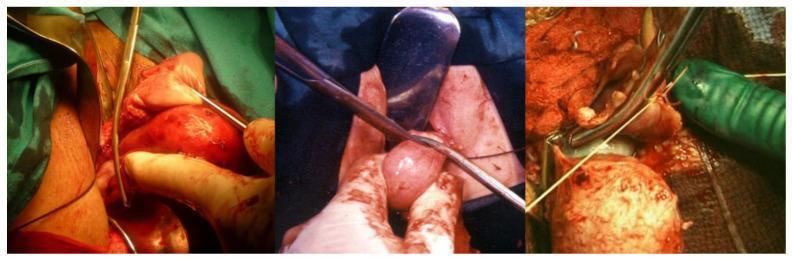
Left — Heaney clamp grasping and elevating the round ligament, utero-ovarian ligament, and fallopian tube complex.
Center — Division of the clamped adnexal structures, separating them from the uterine body.
Right — Suture ligation of the divided upper pedicles to secure hemostasis.
6. Colpotomy Line & Sacrouterine / Cardinal Ligament Anatomy
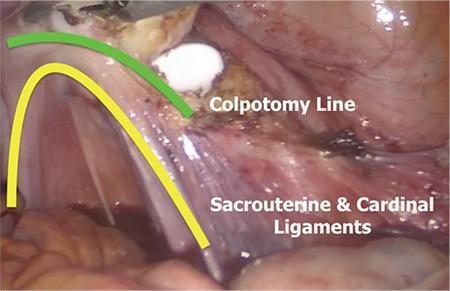
Endoscopic view labeling the anatomical relationship between the colpotomy line (green arc) and the sacrouterine and cardinal ligaments (yellow arc). These fibrous striated structures fan upward toward the colpotomy, providing the structural support that is systematically divided during hysterectomy. Preservation of their stumps enables vault suspension.
7. Deep Pelvic Vascular & Nerve Anatomy (Parametrial Dissection)
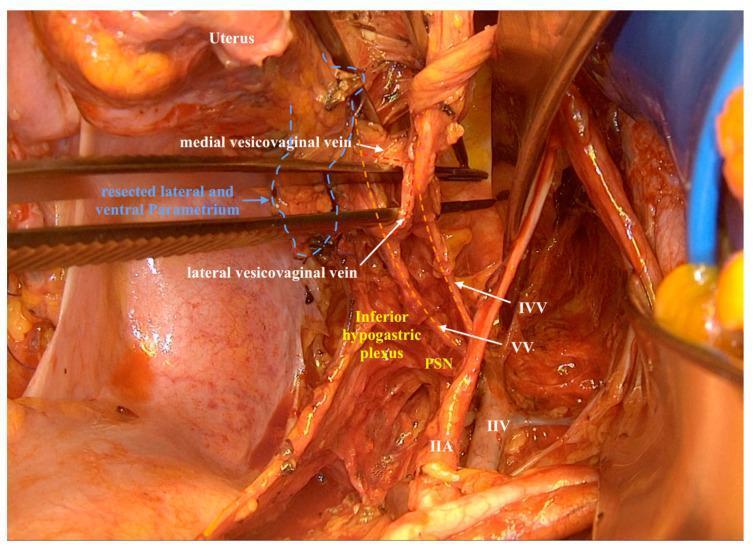
Detailed intraoperative anatomy following parametrial resection, showing:
- VV = Vaginal vein
- IVV = Inferior vesical vein
- Medial and lateral vesicovaginal veins
- IIA/IIV = Internal iliac artery and vein (pelvic sidewall)
- PSN = Pelvic splanchnic nerves
- Inferior hypogastric plexus — critical to identify and preserve for bladder/sexual function
8. vNOTES-Assisted Hysterectomy with Uterosacral Suspension
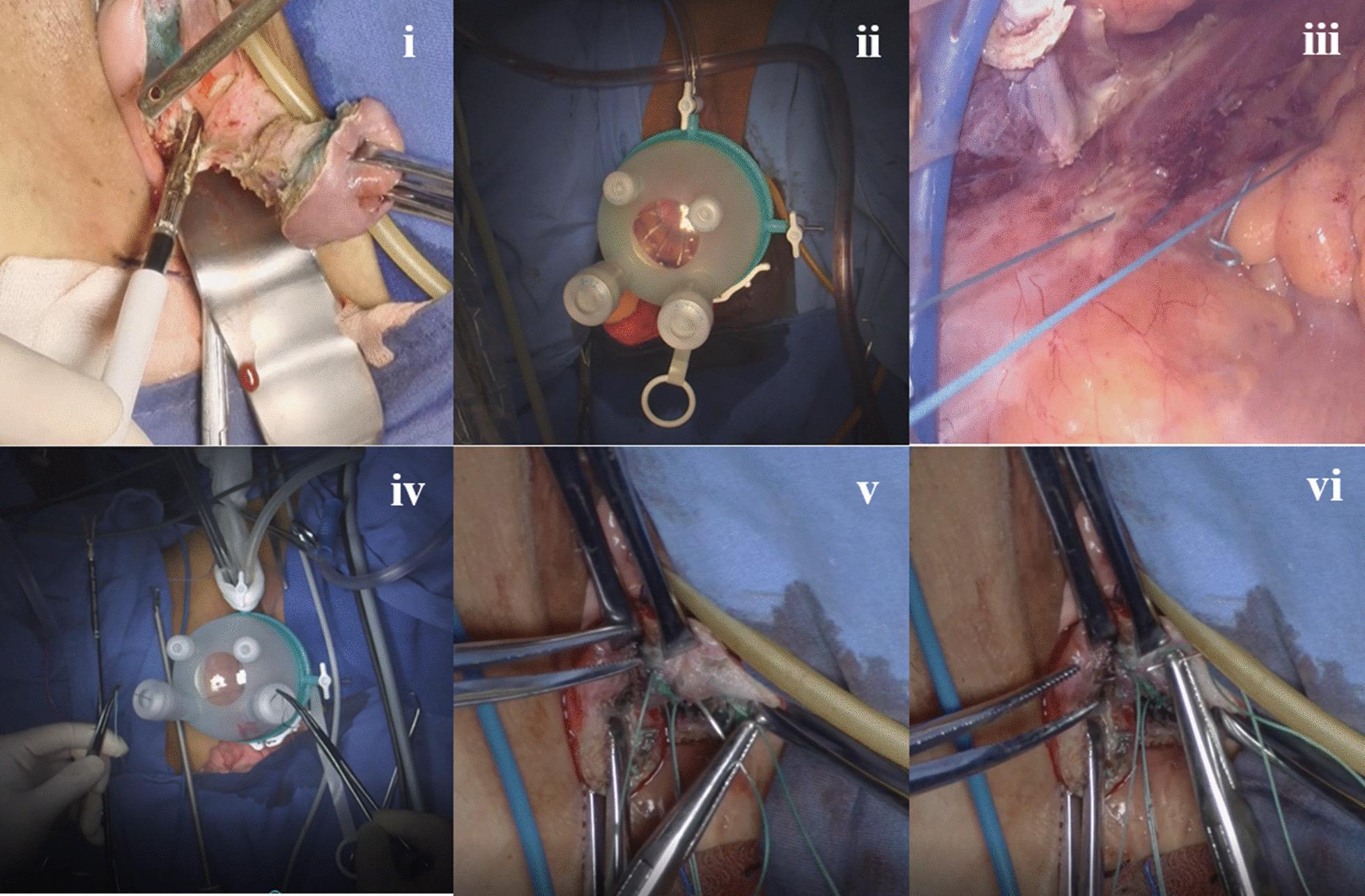
Six-panel series combining transvaginal hysterectomy with endoscopic uterosacral ligament suspension (vNOTES):
- (i) Transvaginal phase with retractors
- (ii) Single-port laparoscopic platform at vaginal introitus
- (iii) Endoscopic view — blue non-absorbable sutures placed around the uterosacral ligament near the ischial spine
- (iv) External instrumentation confirming suture tension
- (v–vi) Apical suspension anchored to cardinal ligament stump and pubocervical fascia
Images sourced from peer-reviewed PMC clinical literature. All depict intraoperative anatomy for surgical education.
Create a PDF quick-reference guide on vaginal hysterectomy surgical planes and landmarks
Reading File
Running Command
mkdir -p /home/daytona/workspace/vaginal-hx-guide && ls /home/daytona/workspace/
Writing File
~/vaginal-hx-guide/generate_pdf.py
from reportlab.lib.pagesizes import A4
from reportlab.lib import colors
from reportlab.lib.units import cm, mm
from reportlab.lib.styles import getSampleStyleSheet, ParagraphStyle
from reportlab.lib.enums import TA_LEFT, TA_CENTER, TA_JUSTIFY
from reportlab.platypus import (
    SimpleDocTemplate, Paragraph, Spacer, Table, TableStyle,
    HRFlowable, KeepTogether, PageBreak
)
from reportlab.platypus.flowables import Flowable
from reportlab.graphics.shapes import Drawing, Rect, String, Line, Circle, Polygon
from reportlab.graphics import renderPDF
import io

OUTPUT = "/home/daytona/workspace/vaginal-hx-guide/Vaginal_Hysterectomy_Quick_Reference.pdf"

# ─── Colour palette ────────────────────────────────────────────────────────────
DARK_BLUE   = colors.HexColor("#1A3A5C")
MID_BLUE    = colors.HexColor("#2E6DA4")
LIGHT_BLUE  = colors.HexColor("#D6E8F7")
ACCENT      = colors.HexColor("#C0392B")   # red for warnings / key structures
GOLD        = colors.HexColor("#D4A017")
GREEN       = colors.HexColor("#1E7B45")
PALE_GREEN  = colors.HexColor("#E8F5EC")
PALE_AMBER  = colors.HexColor("#FFF8E1")
PALE_RED    = colors.HexColor("#FDECEA")
WHITE       = colors.white
GREY_LIGHT  = colors.HexColor("#F4F6F8")
GREY_MID    = colors.HexColor("#BDC3C7")
TEXT_DARK   = colors.HexColor("#1C2833")

# ─── Document setup ────────────────────────────────────────────────────────────
doc = SimpleDocTemplate(
    OUTPUT,
    pagesize=A4,
    leftMargin=1.8*cm, rightMargin=1.8*cm,
    topMargin=2.2*cm, bottomMargin=2.0*cm,
    title="Vaginal Hysterectomy – Surgical Planes & Landmarks",
    author="Orris Medical Reference",
    subject="Quick-Reference Guide"
)

W, H = A4
CONTENT_W = W - 3.6*cm

styles = getSampleStyleSheet()

# ─── Custom styles ─────────────────────────────────────────────────────────────
def S(name, **kw):
    return ParagraphStyle(name, **kw)

sTitle = S("sTitle",
    fontName="Helvetica-Bold", fontSize=22, textColor=WHITE,
    spaceAfter=4, spaceBefore=0, alignment=TA_CENTER)

sSubtitle = S("sSubtitle",
    fontName="Helvetica", fontSize=11, textColor=LIGHT_BLUE,
    spaceAfter=2, alignment=TA_CENTER)

sH1 = S("sH1",
    fontName="Helvetica-Bold", fontSize=13, textColor=WHITE,
    spaceBefore=6, spaceAfter=4, leftIndent=6)

sH2 = S("sH2",
    fontName="Helvetica-Bold", fontSize=10.5, textColor=DARK_BLUE,
    spaceBefore=8, spaceAfter=3)

sH3 = S("sH3",
    fontName="Helvetica-Bold", fontSize=9.5, textColor=MID_BLUE,
    spaceBefore=5, spaceAfter=2)

sBody = S("sBody",
    fontName="Helvetica", fontSize=9, textColor=TEXT_DARK,
    spaceAfter=3, leading=13, alignment=TA_JUSTIFY)

sBullet = S("sBullet",
    fontName="Helvetica", fontSize=9, textColor=TEXT_DARK,
    spaceAfter=2, leading=13, leftIndent=14, firstLineIndent=-10)

sBold = S("sBold",
    fontName="Helvetica-Bold", fontSize=9, textColor=TEXT_DARK,
    spaceAfter=2, leading=13, leftIndent=14, firstLineIndent=-10)

sWarning = S("sWarning",
    fontName="Helvetica-Bold", fontSize=8.5, textColor=ACCENT,
    spaceAfter=2, leading=12, leftIndent=10)

sCaption = S("sCaption",
    fontName="Helvetica-Oblique", fontSize=8, textColor=colors.HexColor("#555555"),
    spaceAfter=2, alignment=TA_CENTER)

sTableHdr = S("sTableHdr",
    fontName="Helvetica-Bold", fontSize=8.5, textColor=WHITE,
    alignment=TA_CENTER, leading=11)

sTableCell = S("sTableCell",
    fontName="Helvetica", fontSize=8.5, textColor=TEXT_DARK,
    leading=12, alignment=TA_LEFT)

sTableCellBold = S("sTableCellBold",
    fontName="Helvetica-Bold", fontSize=8.5, textColor=TEXT_DARK,
    leading=12, alignment=TA_LEFT)

sFooter = S("sFooter",
    fontName="Helvetica-Oblique", fontSize=7.5, textColor=colors.HexColor("#7F8C8D"),
    alignment=TA_CENTER)

# ─── Flowable helpers ──────────────────────────────────────────────────────────
class ColorBox(Flowable):
    """Rounded background box for section headers."""
    def __init__(self, text_para, bg_color, width, height=26, radius=4):
        Flowable.__init__(self)
        self.text_para = text_para
        self.bg_color = bg_color
        self.width = width
        self.height = height
        self.radius = radius

    def draw(self):
        c = self.canv
        c.setFillColor(self.bg_color)
        c.roundRect(0, 0, self.width, self.height, self.radius, fill=1, stroke=0)
        self.text_para.wrapOn(c, self.width - 12, self.height)
        self.text_para.drawOn(c, 6, 6)

    def wrap(self, availW, availH):
        return self.width, self.height

class HLine(Flowable):
    def __init__(self, width, color=GREY_MID, thickness=0.6):
        Flowable.__init__(self)
        self.width = width
        self.color = color
        self.thickness = thickness
    def draw(self):
        self.canv.setStrokeColor(self.color)
        self.canv.setLineWidth(self.thickness)
        self.canv.line(0, 0, self.width, 0)
    def wrap(self, w, h):
        return self.width, self.thickness + 1

def section_header(text, color=DARK_BLUE, number=None):
    label = f"{number}. {text}" if number else text
    p = Paragraph(label, sH1)
    return [ColorBox(p, color, CONTENT_W, height=28), Spacer(1, 6)]

def h2(text): return [Paragraph(text, sH2)]
def h3(text): return [Paragraph(text, sH3)]
def body(text): return [Paragraph(text, sBody)]
def bullet(text, bold_prefix=None):
    if bold_prefix:
        return [Paragraph(f"• <b>{bold_prefix}:</b> {text}", sBullet)]
    return [Paragraph(f"• {text}", sBullet)]
def warn(text): return [Paragraph(f"⚠ {text}", sWarning)]
def sp(n=4): return [Spacer(1, n)]
def hline(): return [HLine(CONTENT_W)]

# ─── Anatomy diagram ───────────────────────────────────────────────────────────
def make_anatomy_diagram():
    """Simple schematic of pelvic surgical planes — sagittal cross-section view."""
    d = Drawing(CONTENT_W, 210)
    cx = CONTENT_W / 2

    # Background
    d.add(Rect(0, 0, CONTENT_W, 210, fillColor=colors.HexColor("#F0F4F8"), strokeColor=None))

    # ── Sacrum (posterior wall) ──
    d.add(Polygon([cx+60,10, cx+110,10, cx+120,80, cx+80,160, cx+60,170],
                  fillColor=colors.HexColor("#D5C4A1"), strokeColor=colors.HexColor("#9E8B60"), strokeWidth=1))
    d.add(String(cx+72, 85, "Sacrum", fontSize=7.5, fillColor=TEXT_DARK, fontName="Helvetica"))

    # ── Rectum ──
    d.add(Rect(cx+30, 15, 28, 90, rx=10, ry=10,
               fillColor=colors.HexColor("#F5CBA7"), strokeColor=colors.HexColor("#CA6F1E"), strokeWidth=1))
    d.add(String(cx+34, 58, "Rectum", fontSize=7, fillColor=TEXT_DARK, fontName="Helvetica"))

    # ── Posterior cul-de-sac (pouch of Douglas) ──
    d.add(Polygon([cx-5, 105, cx+5, 95, cx+30, 110, cx+20, 125, cx-5, 120],
                  fillColor=colors.HexColor("#AED6F1"), strokeColor=MID_BLUE, strokeWidth=1.2))
    d.add(String(cx+5, 107, "Post. Cul-de-Sac", fontSize=6.8, fillColor=DARK_BLUE, fontName="Helvetica-Bold"))

    # ── Uterus body ──
    d.add(Polygon([cx-45,85, cx-10,140, cx+10,140, cx+45,85, cx+20,65, cx-20,65],
                  fillColor=colors.HexColor("#FADBD8"), strokeColor=colors.HexColor("#922B21"), strokeWidth=1.5))
    d.add(String(cx-18, 100, "Uterus", fontSize=8, fillColor=ACCENT, fontName="Helvetica-Bold"))

    # ── Cervix ──
    d.add(Rect(cx-16, 42, 32, 30, rx=5, ry=5,
               fillColor=colors.HexColor("#F5B7B1"), strokeColor=ACCENT, strokeWidth=1.5))
    d.add(String(cx-12, 53, "Cervix", fontSize=7.5, fillColor=ACCENT, fontName="Helvetica-Bold"))

    # ── Vaginal canal ──
    d.add(Rect(cx-14, 10, 28, 32, rx=4, ry=4,
               fillColor=colors.HexColor("#FDECEA"), strokeColor=ACCENT, strokeWidth=1))
    d.add(String(cx-12, 22, "Vagina", fontSize=7, fillColor=TEXT_DARK, fontName="Helvetica"))

    # ── Bladder ──
    d.add(Polygon([cx-80, 55, cx-55, 80, cx-20, 80, cx-18, 50, cx-55, 40],
                  fillColor=colors.HexColor("#D1F2EB"), strokeColor=GREEN, strokeWidth=1.5))
    d.add(String(cx-75, 58, "Bladder", fontSize=7.5, fillColor=GREEN, fontName="Helvetica-Bold"))

    # ── Vesicouterine space (surgical plane) ──
    d.add(Line(cx-18, 75, cx-55, 78, strokeColor=GREEN, strokeWidth=2))
    d.add(String(cx-100, 82, "Vesicouterine", fontSize=6.5, fillColor=GREEN, fontName="Helvetica-Bold"))
    d.add(String(cx-100, 74, "Space", fontSize=6.5, fillColor=GREEN, fontName="Helvetica-Bold"))

    # ── Uterosacral ligament (left) ──
    d.add(Line(cx+10, 72, cx+30, 108, strokeColor=GOLD, strokeWidth=2))
    d.add(String(cx+32, 108, "USL", fontSize=7, fillColor=GOLD, fontName="Helvetica-Bold"))

    # ── Cardinal ligament (right label) ──
    d.add(Line(cx+44, 85, cx+65, 100, strokeColor=colors.HexColor("#8E44AD"), strokeWidth=2))
    d.add(String(cx+67, 98, "Cardinal Lig.", fontSize=6.5,
                 fillColor=colors.HexColor("#8E44AD"), fontName="Helvetica-Bold"))

    # ── Uterine artery ──
    d.add(Line(cx-45, 90, cx-70, 108, strokeColor=ACCENT, strokeWidth=1.8))
    d.add(String(cx-108, 110, "Uterine A.", fontSize=6.5, fillColor=ACCENT, fontName="Helvetica-Bold"))

    # ── Anterior peritoneal fold ──
    d.add(Line(cx-18, 82, cx-52, 82, strokeColor=MID_BLUE, strokeWidth=1.5, strokeDashArray=[3,2]))
    d.add(String(cx-115, 84, "Ant. Peritoneal", fontSize=6.5, fillColor=MID_BLUE, fontName="Helvetica-Bold"))
    d.add(String(cx-115, 76, "Fold", fontSize=6.5, fillColor=MID_BLUE, fontName="Helvetica-Bold"))

    # ── Colpotomy line ──
    d.add(Line(cx-14, 42, cx+16, 42, strokeColor=colors.HexColor("#F39C12"), strokeWidth=2.5))
    d.add(String(cx-14, 32, "Colpotomy Line", fontSize=7, fillColor=colors.HexColor("#F39C12"),
                 fontName="Helvetica-Bold"))

    # Legend
    legend_items = [
        (ACCENT, "Uterus / Cervix"),
        (GREEN, "Bladder / Vesicouterine Plane"),
        (GOLD, "Uterosacral Lig. (USL)"),
        (colors.HexColor("#8E44AD"), "Cardinal Lig."),
        (MID_BLUE, "Peritoneal Fold (dashed)"),
        (colors.HexColor("#F39C12"), "Colpotomy Line"),
    ]
    lx, ly = 8, 12
    for i, (col, label) in enumerate(legend_items):
        d.add(Rect(lx, ly + i*14, 10, 8, fillColor=col, strokeColor=None))
        d.add(String(lx+14, ly + i*14 + 1, label, fontSize=6.5, fillColor=TEXT_DARK, fontName="Helvetica"))

    return d

# ─── Page header/footer callback ───────────────────────────────────────────────
def on_page(canvas, doc):
    canvas.saveState()
    # Header bar
    canvas.setFillColor(DARK_BLUE)
    canvas.rect(0, H - 1.4*cm, W, 1.4*cm, fill=1, stroke=0)
    canvas.setFillColor(WHITE)
    canvas.setFont("Helvetica-Bold", 9)
    canvas.drawString(1.8*cm, H - 0.9*cm, "VAGINAL HYSTERECTOMY — Surgical Planes & Landmarks")
    canvas.setFont("Helvetica", 8)
    canvas.drawRightString(W - 1.8*cm, H - 0.9*cm, "Quick Reference Guide")
    # Footer
    canvas.setFillColor(GREY_MID)
    canvas.rect(0, 0, W, 1.1*cm, fill=1, stroke=0)
    canvas.setFillColor(colors.HexColor("#555555"))
    canvas.setFont("Helvetica-Oblique", 7.5)
    canvas.drawString(1.8*cm, 0.42*cm, "For surgical education. Not a substitute for clinical training.")
    canvas.drawRightString(W - 1.8*cm, 0.42*cm, f"Page {doc.page}")
    canvas.restoreState()

# ─── Build content ─────────────────────────────────────────────────────────────
story = []

# ══════════════════════════════════════════════════════════════════════
# COVER BLOCK
# ══════════════════════════════════════════════════════════════════════
class CoverBlock(Flowable):
    def __init__(self, width, height=110):
        Flowable.__init__(self)
        self.width = width
        self.height = height
    def draw(self):
        c = self.canv
        c.setFillColor(DARK_BLUE)
        c.roundRect(0, 0, self.width, self.height, 8, fill=1, stroke=0)
        c.setFillColor(MID_BLUE)
        c.roundRect(4, 4, self.width-8, self.height-8, 6, fill=0, stroke=1)
        c.setFillColor(WHITE)
        c.setFont("Helvetica-Bold", 20)
        c.drawCentredString(self.width/2, self.height-38, "Vaginal Hysterectomy")
        c.setFont("Helvetica-Bold", 14)
        c.drawCentredString(self.width/2, self.height-58, "Surgical Planes & Landmarks")
        c.setFillColor(LIGHT_BLUE)
        c.setFont("Helvetica", 10)
        c.drawCentredString(self.width/2, self.height-78, "Quick-Reference Guide for Surgical Trainees")
        c.setFillColor(GOLD)
        c.setFont("Helvetica-Bold", 8)
        c.drawCentredString(self.width/2, 14, "Berek & Novak's Gynecology  |  Campbell-Walsh-Wein Urology")
    def wrap(self, w, h): return self.width, self.height

story.append(CoverBlock(CONTENT_W))
story.append(Spacer(1, 10))

# ─ intro note
story += body(
    "This guide summarises the key surgical planes, anatomical landmarks, and ligament complexes "
    "encountered during vaginal hysterectomy, in operative sequence. Mastery of these planes is "
    "essential for safe dissection, haemostasis, and avoidance of urinary tract and bowel injury."
)
story += sp(4)

# ══════════════════════════════════════════════════════════════════════
# SECTION 1 — SURGICAL PLANES OVERVIEW (DIAGRAM)
# ══════════════════════════════════════════════════════════════════════
story += section_header("Surgical Planes — Schematic Overview", DARK_BLUE, "1")
story.append(make_anatomy_diagram())
story += [Spacer(1, 4)]
story += [Paragraph(
    "Sagittal schematic of female pelvic anatomy showing key surgical planes and structures encountered "
    "during vaginal hysterectomy. Colpotomy line (orange) = site of circumferential vaginal incision.",
    sCaption)]
story += sp(6)

# ══════════════════════════════════════════════════════════════════════
# SECTION 2 — STEP-BY-STEP PLANES TABLE
# ══════════════════════════════════════════════════════════════════════
story += section_header("Operative Sequence — Planes & Key Actions", MID_BLUE, "2")

steps_data = [
    [Paragraph("Step", sTableHdr), Paragraph("Plane / Space", sTableHdr),
     Paragraph("Key Landmarks", sTableHdr), Paragraph("Critical Points", sTableHdr)],

    [Paragraph("1\nColpotomy", sTableCellBold),
     Paragraph("Vaginal epithelium\n→ cervical stroma", sTableCell),
     Paragraph("Cervicovaginal junction\nBladder sulcus\nExternal cervical os", sTableCell),
     Paragraph("Incise ≥1 cm distal to bladder. Inject dilute epi for hydrodissection. "
               "Angle posteriorly to facilitate cul-de-sac entry.", sTableCell)],

    [Paragraph("2\nPost. Cul-de-Sac\nEntry", sTableCellBold),
     Paragraph("Pouch of Douglas\n(rectouterine space)", sTableCell),
     Paragraph("Posterior peritoneal fold\nUterosacral ligaments\nCul-de-sac of Douglas", sTableCell),
     Paragraph("Peritoneum glistens — confirm entry with finger. Secure to vaginal wall with "
               "figure-of-eight suture. Inspect for adhesive disease.", sTableCell)],

    [Paragraph("3\nUSL Ligation", sTableCellBold),
     Paragraph("Parametrium\n(inferior portion)", sTableCell),
     Paragraph("Uterosacral ligament\nLower cardinal ligament\nUreter (lateral — must stay away)", sTableCell),
     Paragraph("Clamp perpendicular to uterine axis, tips touch cervix. Keep pedicle <0.5 cm distal "
               "to clamp. Tag suture (most inferior pedicle).", sTableCell)],

    [Paragraph("4\nVesicouterine\nSpace", sTableCellBold),
     Paragraph("Vesicouterine space\n→ Anterior peritoneum", sTableCell),
     Paragraph("Anterior peritoneal fold\nVesicocervical fascia\nBladder base", sTableCell),
     Paragraph("Scissors directed toward uterus. Correct plane is avascular. Once peritoneum "
               "identified: elevate, enter sharply. Place Heaney retractor to protect bladder.", sTableCell)],

    [Paragraph("5\nCardinal Lig.\nLigation", sTableCellBold),
     Paragraph("Parametrium\n(lateral cervix)", sTableCell),
     Paragraph("Cardinal (Mackenrodt's) ligament\nUterine vasculature\nUreter (runs 1.5 cm lateral)", sTableCell),
     Paragraph("Sequential bites medial to ureter. Ligate individually or with USL. Continue "
               "superiorly until uterine arteries are reached.", sTableCell)],

    [Paragraph("6\nUterine Artery\nLigation", sTableCellBold),
     Paragraph("At level of internal os\n(uterine isthmus)", sTableCell),
     Paragraph("Uterine artery & vein\nBroad ligament\nUreter (crosses under — 'water under the bridge')", sTableCell),
     Paragraph("Double ligate: suture-tie + medial transfixion ligature. Ureter at greatest "
               "risk here — runs 1–2 cm laterally. Confirm both sides before fundal delivery.", sTableCell)],

    [Paragraph("7\nFundal\nDelivery", sTableCellBold),
     Paragraph("Broad ligament\nMesosalpinx", sTableCell),
     Paragraph("Broad ligament\nRound ligament\nUtero-ovarian ligament\nFallopian tube", sTableCell),
     Paragraph("Deliver fundus posteriorly. Finger guides clamp behind utero-ovarian pedicle. "
               "Double ligate upper pedicles. Tag sutures for identification.", sTableCell)],

    [Paragraph("8\nAdnexal\nRemoval\n(if performed)", sTableCellBold),
     Paragraph("Infundibulopelvic\nligament space", sTableCell),
     Paragraph("Infundibulopelvic ligament\nOvarian vessels\nUreter (nearby — confirm first)", sTableCell),
     Paragraph("Draw ovary medially with Babcock. Clamp across IP ligament. Transfixion tie + "
               "suture ligature. If mesosalpinx delicate, take serial bites.", sTableCell)],

    [Paragraph("9\nVault\nClosure", sTableCellBold),
     Paragraph("Vaginal cuff\n(peritonealised)", sTableCell),
     Paragraph("Vaginal cuff angles\nUSL stumps\nCut edges of peritoneum", sTableCell),
     Paragraph("Incorporate USL stumps into lateral angles for apical support. Close with "
               "delayed absorbable suture. Inspect all pedicles for haemostasis.", sTableCell)],
]

col_w = [2.0*cm, 3.0*cm, 4.5*cm, 7.3*cm]
steps_table = Table(steps_data, colWidths=col_w, repeatRows=1)
steps_table.setStyle(TableStyle([
    ("BACKGROUND",   (0,0), (-1,0),  DARK_BLUE),
    ("TEXTCOLOR",    (0,0), (-1,0),  WHITE),
    ("ALIGN",        (0,0), (-1,-1), "LEFT"),
    ("VALIGN",       (0,0), (-1,-1), "TOP"),
    ("FONTNAME",     (0,0), (-1,0),  "Helvetica-Bold"),
    ("FONTSIZE",     (0,0), (-1,-1), 8.5),
    ("ROWBACKGROUNDS", (0,1), (-1,-1), [WHITE, GREY_LIGHT]),
    ("BACKGROUND",   (0,1), (0,-1),  LIGHT_BLUE),
    ("GRID",         (0,0), (-1,-1), 0.4, GREY_MID),
    ("TOPPADDING",   (0,0), (-1,-1), 5),
    ("BOTTOMPADDING",(0,0), (-1,-1), 5),
    ("LEFTPADDING",  (0,0), (-1,-1), 5),
    ("RIGHTPADDING", (0,0), (-1,-1), 5),
]))
story.append(steps_table)
story += sp(8)

# ══════════════════════════════════════════════════════════════════════
# SECTION 3 — LIGAMENT ANATOMY REFERENCE
# ══════════════════════════════════════════════════════════════════════
story += section_header("Ligament & Support Structure Reference", DARK_BLUE, "3")

lig_data = [
    [Paragraph("Structure", sTableHdr), Paragraph("Attachments", sTableHdr),
     Paragraph("Surgical Significance", sTableHdr), Paragraph("Suture", sTableHdr)],

    [Paragraph("Uterosacral Ligament (USL)", sTableCellBold),
     Paragraph("Cervix/upper vagina → sacral fascia S2–S4", sTableCell),
     Paragraph("Primary apical support. First pedicle clamped. Tag for vault suspension / McCall culdoplasty.", sTableCell),
     Paragraph("0-Vicryl / 0-PGA transfixion", sTableCell)],

    [Paragraph("Cardinal Ligament\n(Mackenrodt's)", sTableCellBold),
     Paragraph("Cervix & upper vagina → pelvic sidewall / internal iliac fascia", sTableCell),
     Paragraph("Contains uterine vessels. Ureter runs 1.5 cm lateral. Sequential bites after USL.", sTableCell),
     Paragraph("0-Vicryl transfixion", sTableCell)],

    [Paragraph("Uterine Artery", sTableCellBold),
     Paragraph("Arises from anterior division of internal iliac artery", sTableCell),
     Paragraph("Ureter crosses beneath it laterally ('water under the bridge'). Double ligate before fundal delivery.", sTableCell),
     Paragraph("Suture-tie + transfixion\n0-Vicryl", sTableCell)],

    [Paragraph("Utero-ovarian Ligament\n+ Round Ligament", sTableCellBold),
     Paragraph("Ovary/cornu of uterus → broad ligament / inguinal canal", sTableCell),
     Paragraph("Upper pedicle — clamped last. Finger guides clamp posteriorly. Double ligate.", sTableCell),
     Paragraph("0-Vicryl double ligature", sTableCell)],

    [Paragraph("Infundibulopelvic\nLigament (IP / Suspensory)", sTableCellBold),
     Paragraph("Ovary → pelvic sidewall; contains ovarian vessels", sTableCell),
     Paragraph("Only clamped if adnexal removal planned. Ureter runs parallel below — confirm first.", sTableCell),
     Paragraph("Transfixion + ligature\n0-Vicryl", sTableCell)],

    [Paragraph("Broad Ligament", sTableCellBold),
     Paragraph("Peritoneal fold enclosing uterus, tubes, ovaries", sTableCell),
     Paragraph("Contains parametrial tissue and vasculature. Opened during upper pedicle dissection.", sTableCell),
     Paragraph("Haemostasis as needed", sTableCell)],
]

lig_col_w = [3.8*cm, 4.0*cm, 5.8*cm, 3.2*cm]
lig_table = Table(lig_data, colWidths=lig_col_w, repeatRows=1)
lig_table.setStyle(TableStyle([
    ("BACKGROUND",   (0,0), (-1,0),  MID_BLUE),
    ("TEXTCOLOR",    (0,0), (-1,0),  WHITE),
    ("ALIGN",        (0,0), (-1,-1), "LEFT"),
    ("VALIGN",       (0,0), (-1,-1), "TOP"),
    ("ROWBACKGROUNDS", (0,1), (-1,-1), [WHITE, PALE_GREEN]),
    ("GRID",         (0,0), (-1,-1), 0.4, GREY_MID),
    ("TOPPADDING",   (0,0), (-1,-1), 5),
    ("BOTTOMPADDING",(0,0), (-1,-1), 5),
    ("LEFTPADDING",  (0,0), (-1,-1), 5),
    ("RIGHTPADDING", (0,0), (-1,-1), 5),
]))
story.append(lig_table)
story += sp(8)

# ══════════════════════════════════════════════════════════════════════
# SECTION 4 — DANGER ZONES & INJURY AVOIDANCE
# ══════════════════════════════════════════════════════════════════════
story += section_header("Danger Zones & Injury Avoidance", ACCENT, "4")

danger_data = [
    [Paragraph("Structure at Risk", sTableHdr), Paragraph("When at Risk", sTableHdr),
     Paragraph("Prevention Strategy", sTableHdr)],

    [Paragraph("Ureter", sTableCellBold),
     Paragraph("Cardinal lig. ligation\nUterine artery ligation\nIP ligament ligation", sTableCell),
     Paragraph("Keep clamps medial. Ureter runs 1–2 cm lateral to cervix and crosses beneath uterine artery. "
               "Confirm peristalsis on both ureters at end of case if concern.", sTableCell)],

    [Paragraph("Bladder", sTableCellBold),
     Paragraph("Anterior colpotomy\nVesicouterine space dissection\nVault closure", sTableCell),
     Paragraph("Incise ≥1 cm distal to bladder sulcus. Use Heaney retractor to protect bladder throughout anterior dissection. "
               "Backfill if uncertain. If cystotomy: complete hysterectomy then repair in 2 layers.", sTableCell)],

    [Paragraph("Rectum", sTableCellBold),
     Paragraph("Posterior colpotomy\nCul-de-sac entry", sTableCell),
     Paragraph("Place traction on posterior vaginal epithelium, not deep tissues. Confirm entry into peritoneal cavity "
               "digitally before extending incision.", sTableCell)],

    [Paragraph("Uterine Vessels\n(haemorrhage)", sTableCellBold),
     Paragraph("Uterine artery step\nCardinal lig. ligation\nUpper pedicle delivery", sTableCell),
     Paragraph("Double ligate uterine artery (suture-tie + transfixion). Keep pedicles <0.5 cm distal to clamp. "
               "Tag all pedicles with hemostats for identification at haemostasis check.", sTableCell)],

    [Paragraph("Pelvic Splanchnic\nNerves / Hypogastric\nPlexus", sTableCellBold),
     Paragraph("Deep parametrial dissection\nUSL ligation (posterior)", sTableCell),
     Paragraph("Avoid excessively deep or lateral bites in the posterior parametrium. Nerve-sparing technique "
               "relevant in radical procedures. Injury may cause bladder/bowel/sexual dysfunction.", sTableCell)],
]

danger_col_w = [3.5*cm, 4.5*cm, 8.8*cm]
danger_table = Table(danger_data, colWidths=danger_col_w, repeatRows=1)
danger_table.setStyle(TableStyle([
    ("BACKGROUND",   (0,0), (-1,0),  ACCENT),
    ("TEXTCOLOR",    (0,0), (-1,0),  WHITE),
    ("ALIGN",        (0,0), (-1,-1), "LEFT"),
    ("VALIGN",       (0,0), (-1,-1), "TOP"),
    ("ROWBACKGROUNDS", (0,1), (-1,-1), [WHITE, PALE_RED]),
    ("GRID",         (0,0), (-1,-1), 0.4, GREY_MID),
    ("TOPPADDING",   (0,0), (-1,-1), 5),
    ("BOTTOMPADDING",(0,0), (-1,-1), 5),
    ("LEFTPADDING",  (0,0), (-1,-1), 5),
    ("RIGHTPADDING", (0,0), (-1,-1), 5),
]))
story.append(danger_table)
story += sp(8)

# ══════════════════════════════════════════════════════════════════════
# SECTION 5 — SURGICAL PLANES QUICK-REFERENCE BOX
# ══════════════════════════════════════════════════════════════════════
story += section_header("Key Surgical Planes at a Glance", MID_BLUE, "5")

planes_data = [
    [Paragraph("Plane", sTableHdr), Paragraph("Boundaries", sTableHdr),
     Paragraph("How to Enter", sTableHdr), Paragraph("Tissue Character", sTableHdr)],

    [Paragraph("Posterior\nCul-de-Sac", sTableCellBold),
     Paragraph("Posterior uterus / cervix anteriorly; rectum posteriorly; peritoneum superiorly", sTableCell),
     Paragraph("Sharply after placing traction on posterior vaginal epithelium; peritoneum glistens and tents", sTableCell),
     Paragraph("Avascular peritoneal sheen; feel of popping into peritoneal cavity", sTableCell)],

    [Paragraph("Vesicouterine\nSpace", sTableCellBold),
     Paragraph("Bladder posteriorly; anterior uterus/cervix anteriorly; vesicouterine peritoneum superiorly", sTableCell),
     Paragraph("Mayo scissors directed toward uterus; blunt finger once correct plane found", sTableCell),
     Paragraph("Avascular, loose areolar tissue; correct plane is bloodless; resistance = wrong plane", sTableCell)],

    [Paragraph("Parametrial\nSpace", sTableCellBold),
     Paragraph("Lateral to cervix and uterus; medial to broad ligament/pelvic sidewall", sTableCell),
     Paragraph("Sequential clamping of USL, cardinal, and uterine vessel pedicles progressing superiorly", sTableCell),
     Paragraph("Fibrovascular — contains uterine vessels; bleeding expected; keep clamps medial", sTableCell)],

    [Paragraph("Retroperitoneal\n(Adnexal)", sTableCellBold),
     Paragraph("Above broad ligament; lateral to round ligament; contains IP ligament and ovarian vessels", sTableCell),
     Paragraph("Open broad ligament after uterine delivery; identify IP ligament under direct vision", sTableCell),
     Paragraph("Fatty/retroperitoneal; ureter runs parallel below IP ligament — confirm position", sTableCell)],
]

planes_col_w = [2.8*cm, 4.8*cm, 4.8*cm, 4.4*cm]
planes_table = Table(planes_data, colWidths=planes_col_w, repeatRows=1)
planes_table.setStyle(TableStyle([
    ("BACKGROUND",   (0,0), (-1,0),  MID_BLUE),
    ("TEXTCOLOR",    (0,0), (-1,0),  WHITE),
    ("ALIGN",        (0,0), (-1,-1), "LEFT"),
    ("VALIGN",       (0,0), (-1,-1), "TOP"),
    ("ROWBACKGROUNDS", (0,1), (-1,-1), [WHITE, LIGHT_BLUE]),
    ("GRID",         (0,0), (-1,-1), 0.4, GREY_MID),
    ("TOPPADDING",   (0,0), (-1,-1), 5),
    ("BOTTOMPADDING",(0,0), (-1,-1), 5),
    ("LEFTPADDING",  (0,0), (-1,-1), 5),
    ("RIGHTPADDING", (0,0), (-1,-1), 5),
]))
story.append(planes_table)
story += sp(8)

# ══════════════════════════════════════════════════════════════════════
# SECTION 6 — MNEMONIC & TIPS BOX
# ══════════════════════════════════════════════════════════════════════
story += section_header("Operative Mnemonics & Pearls", GREEN, "6")

# Two-column tips layout
col1 = [
    Paragraph("<b>Sequence Mnemonic — \"Post Cardinal Vesical Uterine Fundal\"</b>", sBody),
    Paragraph("• <b>Post</b>erior cul-de-sac entry", sBullet),
    Paragraph("• <b>Cardinal</b>/uterosacral ligation", sBullet),
    Paragraph("• <b>Vesical</b> space — anterior entry", sBullet),
    Paragraph("• <b>Uterine</b> artery ligation", sBullet),
    Paragraph("• <b>Fundal</b> delivery + upper pedicles", sBullet),
    Spacer(1,6),
    Paragraph("<b>Ureter Rule of Thumb</b>", sH3),
    Paragraph("• 2 cm lateral to cervix at the level of the internal os", sBullet),
    Paragraph("• Crosses under uterine artery: <i>\"water under the bridge\"</i>", sBullet),
    Paragraph("• Confirm bilateral peristalsis at case end if concern", sBullet),
]

col2 = [
    Paragraph("<b>Avascular Plane Clues</b>", sBody),
    Paragraph("• Correct vesicouterine plane = bloodless, white, loose tissue", sBullet),
    Paragraph("• Resistance to blunt dissection = wrong plane (stop, go sharply)", sBullet),
    Paragraph("• Peritoneal entry: glistening surface + 'pop' sensation", sBullet),
    Spacer(1,6),
    Paragraph("<b>Haemostasis Checklist</b>", sH3),
    Paragraph("• Tag all pedicles (most inferior = USL, most superior = UO ligament)", sBullet),
    Paragraph("• Inspect in sequence before vault closure", sBullet),
    Paragraph("• Pedicle distal to clamp ≤ 0.5 cm", sBullet),
    Paragraph("• Flash second clamp if large pedicle during ligation", sBullet),
]

tips_table = Table([[col1, col2]], colWidths=[CONTENT_W/2 - 3, CONTENT_W/2 - 3])
tips_table.setStyle(TableStyle([
    ("VALIGN",  (0,0), (-1,-1), "TOP"),
    ("LEFTPADDING",  (0,0), (-1,-1), 6),
    ("RIGHTPADDING", (0,0), (-1,-1), 6),
    ("TOPPADDING",   (0,0), (-1,-1), 4),
    ("BOTTOMPADDING",(0,0), (-1,-1), 4),
    ("BACKGROUND",   (0,0), (0,0),  PALE_GREEN),
    ("BACKGROUND",   (1,0), (1,0),  PALE_AMBER),
    ("BOX",          (0,0), (0,0),  0.5, GREEN),
    ("BOX",          (1,0), (1,0),  0.5, GOLD),
    ("ROUNDEDCORNERS", (0,0), (-1,-1), [4,4,4,4]),
]))
story.append(tips_table)
story += sp(8)

# ══════════════════════════════════════════════════════════════════════
# SECTION 7 — MCCALL CULDOPLASTY NOTE
# ══════════════════════════════════════════════════════════════════════
story += section_header("Vault Suspension: McCall Culdoplasty", DARK_BLUE, "7")
story += body(
    "At vault closure, apical support is restored by incorporating the uterosacral ligament stumps "
    "into the cuff repair. The McCall culdoplasty additionally plicates the peritoneum of the "
    "posterior cul-de-sac to prevent enterocele formation."
)
story += sp(3)

mccall_data = [
    [Paragraph("Step", sTableHdr), Paragraph("Action", sTableHdr)],
    [Paragraph("1", sTableCellBold),
     Paragraph("Identify the tagged uterosacral ligament stumps bilaterally (most inferior pedicles).", sTableCell)],
    [Paragraph("2", sTableCellBold),
     Paragraph("Place a delayed absorbable suture through the posterior peritoneum, across the "
               "cul-de-sac, and through both uterosacral stumps.", sTableCell)],
    [Paragraph("3", sTableCellBold),
     Paragraph("Pass the same suture (or a separate one) through the posterior vaginal cuff epithelium "
               "bilaterally to incorporate the stumps into the cuff.", sTableCell)],
    [Paragraph("4", sTableCellBold),
     Paragraph("Tie the suture to plicate the posterior cul-de-sac peritoneum and suspend the vaginal apex "
               "to the uterosacral ligaments.", sTableCell)],
    [Paragraph("5", sTableCellBold),
     Paragraph("Close the vaginal cuff with interrupted or running 0-gauge delayed absorbable suture, "
               "incorporating the lateral uterosacral stumps in the angles for maximum apical support.", sTableCell)],
]
mc_col_w = [1.5*cm, CONTENT_W - 1.5*cm]
mc_table = Table(mccall_data, colWidths=mc_col_w, repeatRows=1)
mc_table.setStyle(TableStyle([
    ("BACKGROUND",   (0,0), (-1,0),  DARK_BLUE),
    ("TEXTCOLOR",    (0,0), (-1,0),  WHITE),
    ("ALIGN",        (0,0), (0,-1),  "CENTER"),
    ("VALIGN",       (0,0), (-1,-1), "TOP"),
    ("ROWBACKGROUNDS", (0,1), (-1,-1), [WHITE, LIGHT_BLUE]),
    ("GRID",         (0,0), (-1,-1), 0.4, GREY_MID),
    ("TOPPADDING",   (0,0), (-1,-1), 5),
    ("BOTTOMPADDING",(0,0), (-1,-1), 5),
    ("LEFTPADDING",  (0,0), (-1,-1), 6),
    ("RIGHTPADDING", (0,0), (-1,-1), 6),
]))
story.append(mc_table)
story += sp(8)

# ══════════════════════════════════════════════════════════════════════
# REFERENCES
# ══════════════════════════════════════════════════════════════════════
story += hline()
story += sp(4)
story.append(Paragraph("<b>References</b>", sH2))
refs = [
    "Berek JS (ed.). <i>Berek & Novak's Gynecology</i>, 16th ed. Wolters Kluwer, 2020. Chapter 27: Hysterectomy.",
    "Wein AJ et al. (eds.). <i>Campbell-Walsh-Wein Urology</i>, 12th ed. Elsevier, 2021. "
        "Chapter 68: Vaginal Hysterectomy with McCall Culdoplasty Technique.",
    "Townsend CM et al. (eds.). <i>Sabiston Textbook of Surgery</i>, 21st ed. Elsevier, 2022. "
        "Section: Vaginal Hysterectomy.",
]
for r in refs:
    story.append(Paragraph(f"• {r}", sBullet))

story += sp(6)
story.append(Paragraph(
    "This guide is intended for surgical education and training purposes only. "
    "Clinical decisions must be based on complete operative assessment, institutional protocols, and consultant guidance.",
    sFooter))

# ─── Build PDF ────────────────────────────────────────────────────────────────
doc.build(story, onFirstPage=on_page, onLaterPages=on_page)
print(f"PDF generated: {OUTPUT}")
Your credits are exhausted. Your daily credits reset tomorrow, or you can purchase a top-up for more.
This is a shared conversation. Sign in to Orris to start your own chat.