
Hey orris I am a first year in tamilnadu medical student having exams starting from 27th
Which subjects are you being examined on? · What kind of help are you looking for?
Your 16-Day Exam Prep Plan (July 11 - July 26)
How Tamil Nadu 1st Year MBBS Exams Work
- Theory papers: Anatomy (Paper 1 - General + Upper Limb, Paper 2 - Lower Limb + Thorax + Abdomen + Head & Neck), Physiology, Biochemistry
- Practical/viva on each subject
- University exams follow the MCI/NMC curriculum pattern
Phase 1: Days 1-6 (High-Yield Revision)
Anatomy (Most content-heavy - give it the most time)
- Upper limb: Brachial plexus, rotator cuff, carpal tunnel, cubital fossa
- Lower limb: Femoral triangle, popliteal fossa, sciatic nerve, arches of foot
- Thorax: Heart borders & surfaces, coronary arteries, mediastinum
- Abdomen: Inguinal canal, portal circulation, peritoneum
- Head & Neck: Cranial nerves, triangles of neck, sinuses
- Embryology: Heart development, gut rotation, pharyngeal arches
- Histology: All basic tissues + organ-specific slides
Physiology
- Nerve & muscle: Action potential, neuromuscular junction, muscle contraction
- CVS: Cardiac cycle, ECG, JVP, Frank-Starling law, heart sounds
- Respiratory: Lung volumes, V/Q ratio, oxygen dissociation curve
- Renal: GFR, tubular functions, countercurrent mechanism, acid-base
- GIT: Secretions, absorption, GI hormones
- Endocrine: Hypothalamo-pituitary axis, thyroid, adrenal, insulin/glucagon
- Blood: Haemopoiesis, clotting cascade, blood groups
Biochemistry
- Carbohydrate metabolism: Glycolysis, TCA, ETC, glycogen metabolism, gluconeogenesis
- Lipid metabolism: Beta-oxidation, ketone bodies, cholesterol synthesis
- Protein metabolism: Urea cycle, transamination
- Enzymes: Km, Vmax, inhibition types
- Vitamins & minerals: Deficiencies are high-yield
- Molecular biology: DNA replication, transcription, translation, PCR
- Clinical biochemistry: LFTs, RFTs, diabetes markers
Phase 2: Days 7-11 (Previous Year Questions + Practice)
- Spend 2 days each on Anatomy, Physiology, Biochemistry PYQs
- Write out answers for 10-mark questions (essay format matters in university exams)
- For anatomy: practice drawing diagrams - they carry separate marks
Phase 3: Days 12-16 (Final Sprint)
- Day 12-13: Rapid revision of all three - use short notes / mnemonics only
- Day 14: Practical preparation (instruments, specimens, slide identification)
- Day 15: Viva prep - know your definitions cold (GFR, action potential threshold, Km, etc.)
- Day 16: Light revision, rest, sleep by 10 PM
Daily Schedule Template
| Time | Activity |
|---|---|
| 6:00-8:00 AM | Fresh topic study (new content) |
| 8:00-9:00 AM | Breakfast + break |
| 9:00-12:00 PM | Continue topic + diagrams |
| 12:00-1:00 PM | Lunch + rest |
| 1:00-3:30 PM | Previous year questions |
| 3:30-4:00 PM | Break |
| 4:00-6:30 PM | Second subject |
| 6:30-7:30 PM | Walk / break |
| 7:30-9:30 PM | Short notes + revision |
| 9:30-10:00 PM | Wind down |
Quick Tips for TN University Exams
- Draw diagrams even when not asked - examiners reward them
- Clinical correlations at the end of answers impress viva examiners
- Enumerate before explaining - numbered points score better than paragraphs
- For Biochemistry: always include metabolic pathways as flow charts
- Know normal values cold (they appear in spotters and viva)
I want a 2 days physiology plan mainly focussing on paper 2.. remember that I haven't studied much of anything
Tamil Nadu Dr MGR University 1st year MBBS Physiology Paper 2 syllabus topics
https://www.tnmgrmu.ac.in/index.php/library/e-questions/firs…
2-Day Physiology Paper 2 Plan
Starting from scratch - exam on the 27th
What Paper 2 Covers (MGR University)
| System | Weight |
|---|---|
| CVS (Heart, BP, ECG) | ⭐⭐⭐ Highest |
| Respiratory | ⭐⭐⭐ Highest |
| Renal + Acid-Base | ⭐⭐ High |
| Endocrinology | ⭐⭐ High |
| GIT | ⭐ Medium |
| CNS / Special Senses | ⭐ Medium |
| Reproductive | ⭐ Medium |
DAY 1 - Saturday Evening to Sunday Night
Theme: CVS + Respiratory (The two biggest systems)
SLOT 1 (Tonight, 7:30 PM - 10:30 PM) - CVS Part 1
- Cardiac cycle - phases, events, pressure changes (Wiggers diagram)
- Heart sounds - S1, S2 causes; S3, S4 in pathology
- ECG - waves and what they represent, normal intervals, lead positions
- Cardiac output - definition, normal value, Fick's principle, measurement methods
- Frank-Starling law - the concept in one clear statement
- Read the heading + key points from your notes/textbook
- Write the definition / one-liner
- Draw one diagram (Wiggers diagram, ECG strip)
- Note 2 clinical points at the end
- Wiggers diagram (cardiac cycle)
- Normal ECG with labeled waves
SLOT 2 (Sunday 6:00 AM - 9:00 AM) - CVS Part 2
- Arterial Blood Pressure - determinants, normal values, pulse pressure, mean arterial pressure
- Regulation of BP - Baroreceptor reflex (most important), chemoreceptors, RAAS
- Venous return & JVP - a, c, v waves; what they represent
- Microcirculation & lymphatics - Starling forces, oedema formation
- Coronary circulation - peculiarities (very high PYQ topic in MGR)
- Baroreceptor reflex arc
SLOT 3 (Sunday 10:00 AM - 1:00 PM) - Respiratory Part 1
- Lung volumes and capacities - all 4 volumes + 4 capacities, normal values (MEMORISE these)
- Mechanics of breathing - compliance, surfactant, work of breathing
- Ventilation - alveolar ventilation, dead space (anatomical vs physiological)
- Diffusion - Fick's law, factors affecting O2 and CO2 diffusion
- Spirometry trace with all volumes labeled
SLOT 4 (Sunday 2:30 PM - 5:30 PM) - Respiratory Part 2
- Oxygen transport - oxyhemoglobin dissociation curve (MUST MASTER - high PYQ)
- CO2 transport - three forms, Haldane effect, Bohr effect
- V/Q ratio - normal value, mismatches, regional differences in lung
- Regulation of respiration - respiratory centres, Hering-Breuer reflex, chemical control
- O2 dissociation curve with shift factors (Bohr effect)
- Respiratory control centres
SLOT 5 (Sunday 7:00 PM - 9:30 PM) - CVS + Resp Quick Revision + PYQs
- "Describe the cardiac cycle with a diagram" (10 marks)
- "Explain the regulation of arterial blood pressure" (10 marks)
- "Describe the transport of oxygen in blood" (10 marks)
- "Write about lung volumes and capacities" (10 marks)
DAY 2 - Monday
Theme: Renal + Endocrine + GIT + CNS (Rapid coverage)
SLOT 6 (Monday 6:00 AM - 9:00 AM) - Renal
- GFR - definition, normal value, autoregulation, measurement (inulin clearance)
- Tubular reabsorption - proximal tubule (65%), glucose Tm, renal threshold
- Countercurrent mechanism - how the medullary gradient is built (draw it)
- Concentration and dilution of urine - ADH role
- Acid-base regulation by kidney - HCO3 reabsorption, H+ secretion, buffer systems
- Countercurrent multiplier in loop of Henle
SLOT 7 (Monday 9:30 AM - 12:00 PM) - Endocrinology
| Gland | Must Know |
|---|---|
| Hypothalamo-pituitary | Portal circulation, releasing hormones, feedback loops |
| Thyroid | T3/T4 synthesis, effects, regulation |
| Adrenal cortex | Zones + their hormones, cortisol effects, Conn's/Cushing's |
| Insulin & Glucagon | Secretion triggers, effects on metabolism |
| Parathyroid & Calcium | PTH vs calcitonin vs Vit D - calcium regulation |
- Hypothalamo-pituitary-thyroid axis (feedback loop)
SLOT 8 (Monday 1:00 PM - 3:00 PM) - GIT
- Gastric secretion - HCl secretion mechanism (proton pump), phases of gastric secretion
- Pancreatic secretion - enzymes, regulation
- Bile - composition, enterohepatic circulation
- Absorption - glucose, fat, iron, B12 (sites and mechanisms)
- GI hormones - Gastrin, Secretin, CCK (source, stimulus, action)
SLOT 9 (Monday 3:30 PM - 5:30 PM) - CNS / Special Senses
- Cerebellum - functions, signs of cerebellar lesion (DANIA mnemonic)
- Basal ganglia - functions, Parkinson's disease physiology
- Sleep - stages, REM vs NREM, functions
- Vision - visual pathway, lesions at different points
- Hearing - how sound is conducted, Rinne and Weber tests physiology
SLOT 10 (Monday 7:00 PM - 9:30 PM) - Full Day 2 Revision + PYQ Essays
- "Describe GFR - its measurement and regulation" (10 marks)
- "Write about insulin - secretion and effects" (10 marks)
- "Explain gastric secretion" (10 marks)
Key Mnemonics to Memorize
- TV = 500 mL, IRV = 3000 mL, ERV = 1100 mL, RV = 1200 mL
- VC = 4600 mL, TLC = 5800 mL, FRC = 2300 mL
- CO2 ↑, Acid (pH ↓), 2,3-DPG ↑, Exercise, Temperature ↑
- PR = 0.12-0.20 s, QRS = 0.08-0.10 s, QT = 0.35-0.44 s
- Gastrin = G cells (stomach antrum)
- Secretin = S cells (duodenum)
- CCK = I cells (duodenum)
Answer Writing Format (for 10-mark essays)
1. Definition / Introduction (2 lines)
2. Diagram (if applicable) - label everything
3. Enumerated points with subheadings
4. Clinical correlation at the end (1-2 lines)
What to Skip (seriously, no time)
- Reproductive physiology (low yield, complex)
- Detailed CSF physiology
- Temperature regulation (unless it's a known PYQ at your college)
I want to focus on cvs, rs, cns and special senses in addition 2 other topics from the remaining.. what can I read
Pick 2 topics to add alongside CVS, RS, CNS & Special Senses:
Your 6-System Reading List
1. CVS - Cardiovascular System
Must-Read Topics (in this order)
| # | Topic | What to focus on |
|---|---|---|
| 1 | Cardiac cycle | Phases, Wiggers diagram, pressure-volume changes |
| 2 | Heart sounds | S1 & S2 causes; S3/S4 clinical significance |
| 3 | ECG | P, QRS, T waves; what each represents; normal intervals |
| 4 | Cardiac output | Definition, normal value, Fick's principle, factors affecting |
| 5 | Frank-Starling law | Concept + clinical relevance (heart failure) |
| 6 | Arterial BP | Determinants, pulse pressure, MAP formula |
| 7 | BP regulation | Baroreceptor reflex (most important), RAAS, chemoreceptors |
| 8 | JVP | a, c, v waves and what they represent |
| 9 | Coronary circulation | Peculiarities - flows in diastole, autoregulation |
| 10 | Microcirculation | Starling forces, oedema formation |
2. RS - Respiratory System
Must-Read Topics (in this order)
| # | Topic | What to focus on |
|---|---|---|
| 1 | Lung volumes & capacities | All 4 volumes + 4 capacities, normal values - memorise |
| 2 | Spirometry | How it measures volumes, FEV1/FVC ratio |
| 3 | Compliance & surfactant | Definition, factors, why surfactant matters (IRDS) |
| 4 | O2 transport | Oxyhemoglobin dissociation curve, Bohr effect, shift factors |
| 5 | CO2 transport | 3 forms, Haldane effect, carbonic anhydrase |
| 6 | V/Q ratio | Normal value (0.8), regional differences, mismatches |
| 7 | Diffusion | Fick's law, O2 vs CO2 diffusion capacity |
| 8 | Control of respiration | Respiratory centres (DRG/VRG), Hering-Breuer reflex, chemical control |
| 9 | Hypoxia | Types - hypoxic, anaemic, stagnant, histotoxic |
| 10 | Altitude & exercise | Acclimatisation changes (commonly asked) |
3. CNS - Central Nervous System
Must-Read Topics (pick these 5 - enough to answer any CNS question)
| # | Topic | What to focus on |
|---|---|---|
| 1 | Cerebellum | 3 functional lobes, functions, signs of lesion (DANIA) |
| 2 | Basal ganglia | Circuit, functions, Parkinson's & Huntington's physiology |
| 3 | Thalamus | Relay functions, role in pain |
| 4 | Hypothalamus | Functions (temperature, sleep, appetite, autonomic) |
| 5 | Sleep | NREM vs REM stages, EEG patterns, functions of sleep |
| 6 | EEG | 4 waves (alpha, beta, theta, delta) - which state each |
4. Special Senses
Must-Read Topics
| # | Topic | What to focus on |
|---|---|---|
| 1 | Vision | Rods vs cones, dark adaptation, visual pathway + lesions |
| 2 | Hearing | Sound conduction (air vs bone), cochlea basics, Rinne & Weber physiology |
| 3 | Pain | Gate control theory, referred pain, types of pain fibres |
| 4 | Taste & Smell | Basic mechanism, cranial nerves involved |
5. Endocrinology
Must-Read Topics (overlap with Reproductive - study together)
| # | Topic | What to focus on |
|---|---|---|
| 1 | Hypothalamo-pituitary axis | Portal system, releasing hormones, feedback loops |
| 2 | Thyroid | T3/T4 synthesis steps, effects on metabolism, TSH regulation |
| 3 | Adrenal cortex | 3 zones + hormones (GFR → Salt, Sugar, Sex), cortisol effects |
| 4 | Adrenal medulla | Adrenaline vs noradrenaline effects |
| 5 | Insulin & Glucagon | Secretion triggers, opposing metabolic effects |
| 6 | Parathyroid + Calcium | PTH vs Calcitonin vs Vit D - calcium regulation triangle |
| 7 | Growth hormone | Effects, IGF-1, acromegaly vs gigantism |
6. Reproductive Physiology
Must-Read Topics (keep it focused)
| # | Topic | What to focus on |
|---|---|---|
| 1 | Menstrual cycle | Follicular vs luteal phase, hormone changes (FSH/LH/E2/P4) - draw the graph |
| 2 | Ovulation | LH surge mechanism, corpus luteum formation |
| 3 | Pregnancy hormones | hCG, progesterone, oestrogen roles |
| 4 | Spermatogenesis | Steps, Sertoli cell functions, testosterone |
| 5 | Puberty | Changes in male and female, Tanner stages briefly |
How to Split This Across 2 Days
Day 1
| Time | System |
|---|---|
| Morning (3 hrs) | CVS - full coverage |
| Afternoon (3 hrs) | RS - full coverage |
| Evening (2 hrs) | CVS + RS revision + write 2 essay answers |
Day 2
| Time | System |
|---|---|
| Morning (2 hrs) | Endocrine |
| Mid-morning (1.5 hrs) | Reproductive |
| Afternoon (2 hrs) | CNS |
| Late afternoon (1.5 hrs) | Special Senses |
| Evening (2 hrs) | Full revision of all 6 - diagrams only |
The 10 Diagrams You Must Draw (non-negotiable)
- Wiggers diagram
- ECG strip with labeled waves
- Spirometry trace with all volumes
- O2 dissociation curve with shift factors
- Baroreceptor reflex arc
- Respiratory control centres
- Hypothalamo-pituitary feedback loop
- Menstrual cycle hormone graph
- Visual pathway with lesion effects
- Countercurrent mechanism (if you add Renal later)
I want to read all questions from those topics in this questionbank.. give me a perfect plan to study cvs, rs, cns, and specia senses covering all questions in question bank
cd /home/daytona/workspace/attachments/24f5f8a0-a9d2-42fb-bb1d-d33875167946/ && python3 -c " import pdfplumber with pdfplumber.open('TYTANZ QUESTION BANK.pdf') as pdf: print(f'Total pages: {len(pdf.pages)}') # Print first 3 pages to understand structure for i in range(min(3, len(pdf.pages))): print(f'\n--- PAGE {i+1} ---') print(pdf.pages[i].extract_text()) "
cd /home/daytona/workspace/attachments/24f5f8a0-a9d2-42fb-bb1d-d33875167946/ && python3 -c " import pdfplumber with pdfplumber.open('TYTANZ QUESTION BANK.pdf') as pdf: # Extract ALL text to find physiology section for i in range(len(pdf.pages)): text = pdf.pages[i].extract_text() if text and ('PHYSIOLOGY' in text.upper() or 'CVS' in text.upper() or 'CARDIOVASCULAR' in text.upper() or 'RESPIRATORY' in text.upper()): print(f'\n=== PAGE {i+1} ===') print(text) "
cd /home/daytona/workspace/attachments/24f5f8a0-a9d2-42fb-bb1d-d33875167946/ && python3 -c " import pdfplumber with pdfplumber.open('TYTANZ QUESTION BANK.pdf') as pdf: # Get CNS and Special Senses pages (around page 28-31) for i in range(27, 35): text = pdf.pages[i].extract_text() if text: print(f'\n=== PAGE {i+1} ===') print(text) "
TYTANZ QB - Complete 2-Day Study Plan
CVS + RS + CNS + Special Senses
Star rating guide: *** = Very high PYQ frequency | ** = Moderate | * = Low but possible | (no star) = Attempt only if time permits
DAY 1 - CVS + RESPIRATORY
MORNING SESSION (6:00 AM - 9:30 AM)
CARDIOVASCULAR - ESSAYS (7 questions)
| # | Essay Question | Stars | Time |
|---|---|---|---|
| 1 | Define cardiac cycle & events. Describe pressure & volume changes during cardiac cycle | *** | 30 min |
| 2 | Define arterial blood pressure. Mechanism of regulation of ABP | *** | 25 min |
| 3 | Define cardiac output. Factors regulating it. Methods to measure it | *** | 25 min |
| 4 | Define ECG. Normal waves, segments & intervals. Note on ECG leads | - | 20 min |
| 5 | Structure & function of conducting system of heart. Properties of cardiac muscle | ** | 20 min |
| 6 | Innervation of heart & regulation of heart rate | - | 15 min |
| 7 | Define shock & its types. Hypovolemic shock & management | * | 15 min |
- Wiggers diagram (cardiac cycle - pressure/volume curves)
- Normal ECG with labeled waves, intervals, segments
- Conducting system of heart
MID-MORNING SESSION (10:00 AM - 1:00 PM)
CARDIOVASCULAR - SHORT NOTES (39 questions)
| # | Short Note | Stars |
|---|---|---|
| 5 | Action potential in cardiac tissues | ** |
| 6 | Pacemaker potential | *** |
| 7 | Conducting system of heart | * |
| 8 | ECG leads | *** |
| 9 | Einthoven's law & Kirchoff's law | * |
| 10 | Lead II ECG | *** |
| 35 | Normal ECG | *** |
| 36 | Significance of PR interval & ST segment | *** |
| # | Short Note | Stars |
|---|---|---|
| 3 | Frank-Starling law of heart | * |
| 4 | Properties of cardiac muscles | - |
| 12 | Heart sounds | *** |
| 33 | Tracing of intra-atrial pressure curve | * |
| 34 | Changes in ventricular volume during phases | ** |
| 37 | Preload & Afterload | * |
| 39 | Cardiac output & Cardiac index | ** |
| 15 | Law of Laplace | - |
| 13 | Heart lung preparation | * |
| # | Short Note | Stars |
|---|---|---|
| 1 | Windkessel vessels | - |
| 11 | JVP | - |
| 14 | Regulation of heart rate | * |
| 16 | Korotkov sounds | * |
| 17 | Microcirculation | - |
| 18 | Baroreceptor reflex | * |
| 19 | Cushing reflex | - |
| 20 | Humoral mechanism of BP regulation | ** |
| 21 | CV changes during exercise | - |
| 22 | Autoregulation of blood flow | * |
| # | Short Note | Stars |
|---|---|---|
| 2 | Cardiac innervation - Sympathetic & Parasympathetic | - |
| 23 | Special features of cerebral blood flow | - |
| 24 | Regulation of cerebral blood flow | * |
| 25 | Special features of coronary circulation | * |
| 26 | Regulation of coronary circulation | *** |
| 27 | Triple response | *** |
| 28 | Fetal circulation | ** |
| 29 | Hypovolemic shock | * |
| 30 | Types of shock and causes | ** |
| 31 | Heart failure | * |
| 32 | Heart block | ** |
| 38 | Reynold's number | ** |
AFTERNOON SESSION (2:30 PM - 5:30 PM)
RESPIRATORY - ESSAYS (6 questions)
| # | Essay Question | Stars | Time |
|---|---|---|---|
| 1 | Neural control of respiration. Note on periodic breathing | **** | 25 min |
| 2 | Chemical control of respiration. Note on Cheyne Stokes breathing | **** | 25 min |
| 3 | Hypoxia - causes, types and features | *** | 20 min |
| 4 | Oxygen dissociation curve with diagram. Note on Bohr effect | ** | 20 min |
| 5 | Mechanics of breathing | ** | 20 min |
| 6 | Physiological changes during and after exercise | - | 15 min |
- O2 dissociation curve with Bohr effect and shift factors
- Respiratory control centres (DRG, VRG, pneumotaxic, apneustic)
- Spirometry trace with all volumes
EVENING SESSION (6:30 PM - 9:00 PM)
RESPIRATORY - SHORT NOTES (19 questions)
| # | Short Note | Stars |
|---|---|---|
| 1 | Non-respiratory functions of lungs | *** |
| 2 | Special features of pulmonary circulation | *** |
| 3 | Lung volumes and capacities | ** |
| 4 | Compliance of lungs | * |
| 5 | Ventilation-perfusion ratio | * |
| 6 | Role of surfactant in pulmonary mechanics | * |
| 7 | Caisson's disease (Dysbarism/Decompression sickness) | * |
| 8 | Alveolar capillary membrane | * |
| 9 | Transport of O2 and CO2 | * |
| 10 | Cardiopulmonary resuscitation (CPR) | ** |
| 11 | O2-hemoglobin dissociation curve | * |
| 12 | Neural control of respiration | ** |
| 13 | Chemical control of respiration | ** |
| 14 | Timed vital capacity (FEV1/FVC) | - |
| 15 | Periodic breathing | - |
| 16 | Cheyne Stokes breathing | * |
| 17 | Hering-Breuer reflex | ** |
| 18 | Acclimatization | * |
| 19 | Dead space | - |
| 20 | Asphyxia | - |
DAY 2 - CNS + SPECIAL SENSES
MORNING SESSION (6:00 AM - 9:00 AM)
CNS - ESSAYS (8 questions)
| # | Essay Question | Stars | Time |
|---|---|---|---|
| 1 | Descending tracts of spinal cord. Pyramidal tract in detail - function & lesions at different levels | *** | 30 min |
| 2 | Nuclei of hypothalamus. Connections and functions | *** | 25 min |
| 3 | Classify pain. Receptors for pain. Analgesic system in brain. Dual pathway for pain | * | 20 min |
| 4 | Ascending tracts of spinal cord. Posterior column tracts with diagram | * | 20 min |
| 5 | Connections and functions of basal ganglia. Clinical disorders & physiological basis of management | *** | 25 min |
| 6 | Functional lobes of cerebellum. Structure, connections, functions. Clinical features of cerebellar disease | *** | 25 min |
| 7 | ARAS - Components, functions and significance | ** | 15 min |
| 8 | Referred pain - definition, examples, dermatome role, projection theory, facilitation theory | * | 15 min |
- Pyramidal tract (internal capsule pathway)
- Basal ganglia circuit (direct + indirect pathway)
- Cerebellar connections (afferents + efferents)
MID-MORNING SESSION (9:30 AM - 12:00 PM)
CNS - SHORT NOTES (24 questions)
| # | Short Note | Stars |
|---|---|---|
| 1 | Waves of EEG and clinical significance | ** |
| 2 | EEG changes during sleep | * |
| 3 | REM and NREM sleep | - |
| 19 | Types of memory. Neural mechanism of memory | ** |
| 20 | Role and function of the Limbic System | ** |
| 22 | Control of appetite | * |
| # | Short Note | Stars |
|---|---|---|
| 4 | Role of hypothalamus in hunger and satiety | ** |
| 5 | Functions of thalamus | *** |
| 6 | Hypothalamic thermostat mechanism | - |
| 10 | Homunculus | ** |
| # | Short Note | Stars |
|---|---|---|
| 7 | Parkinson's disease | ** |
| 8 | Basal ganglia and its functions | ** |
| 9 | Brown Sequard syndrome | *** |
| 13 | Tracts of Goll and Burdach | * |
| 15 | Spinocerebellar tract | * |
| 17 | Differences between UMN & LMN lesions | ** |
| # | Short Note | Stars |
|---|---|---|
| 11 | Saltatory conduction | ** |
| 12 | Formation, circulation and functions of CSF | ** |
| 14 | Blood brain barrier | - |
| 16 | Degeneration & Regeneration of nerve fibres | - |
| 18 | Gate control theory | - |
| 21 | Neuromuscular transmission | * |
| 23 | Synapse | * |
| 24 | Stretch reflex | * |
AFTERNOON SESSION (1:30 PM - 4:30 PM)
SPECIAL SENSES - ESSAYS (6 questions)
| # | Essay Question | Stars | Time |
|---|---|---|---|
| 1 | Photochemical mechanism of vision. Mechanism of dark adaptation | * | 25 min |
| 2 | Draw and explain visual pathway. Effects of lesions at various levels | *** | 30 min |
| 3 | Refractive errors of the eye. Physiological basis of their correction | * | 20 min |
| 4 | Auditory pathway with diagram. Note on conduction deafness | * | 25 min |
| 5 | Mechanisms of hearing | * | 20 min |
| 6 | Middle ear and its functions. Transmission of sound waves & mechanism of hearing | - | 15 min |
- Visual pathway with lesion effects at each level (most commonly drawn diagram in exams)
- Auditory pathway
LATE AFTERNOON SESSION (5:00 PM - 7:00 PM)
SPECIAL SENSES - SHORT NOTES (23 questions)
| # | Short Note | Stars |
|---|---|---|
| 1 | Aqueous humor | ** |
| 2 | Dark adaptation | *** |
| 3 | Optic pathway with lesions at various levels | ** |
| 4 | Pupillary light reflex | * |
| 5 | Mechanism of accommodation for near vision | * |
| 6 | Color vision | *** |
| 7 | Refractive errors of the eyes | *** |
| 17 | Theories of color vision | - |
| 18 | Refractive errors/defects of image forming mechanism | - |
| 19 | Mechanism of phototransduction | - |
| # | Short Note | Stars |
|---|---|---|
| 8 | Structure and functions of middle ear | *** |
| 9 | Cochlea | - |
| 10 | Organ of Corti | - |
| 11 | Travelling wave theory | - |
| 12 | Sound waves in air → action potentials in cochlear nerve | - |
| 13 | Cochlear microphonic potential | ** |
| 15 | Theories of hearing | - |
| 16 | Hearing defects | - |
| # | Short Note | Stars |
|---|---|---|
| 14 | Taste pathway with diagram | *** |
| 20 | Mechanism of gustatory transduction | - |
| 21 | Olfactory pathway and applied physiology | - |
| 22 | Taste pathway | * |
| 23 | Otolith organ | * |
EVENING SESSION (7:30 PM - 9:30 PM)
FULL REVISION
- Go through all ***** and **** questions only
- Redraw 5 key diagrams from memory (Wiggers, O2 curve, Visual pathway, Pyramidal tract, Cardiac cycle)
- Write quick 3-line outlines for all 7 CVS essays and 6 RS essays
Quick Reference - Question Count Summary
| System | Essays | Short Notes | Total |
|---|---|---|---|
| CVS | 7 | 39 | 46 |
| RS | 6 | 19 | 25 |
| CNS | 8 | 24 | 32 |
| Special Senses | 6 | 23 | 29 |
| TOTAL | 27 | 105 | 132 |
Non-Negotiable Diagrams (draw these before exam day)
- Wiggers diagram - cardiac cycle
- Normal ECG - labeled waves + intervals
- Conducting system of heart
- O2 dissociation curve with Bohr effect
- Respiratory control centres
- Spirometry trace with all volumes/capacities
- Pyramidal tract
- Basal ganglia circuit
- Visual pathway with lesion effects
- Auditory pathway
teach me[descending tracts]
Descending Tracts of the Spinal Cord
Complete exam notes + diagrams
THE BIG PICTURE - Memorise this first
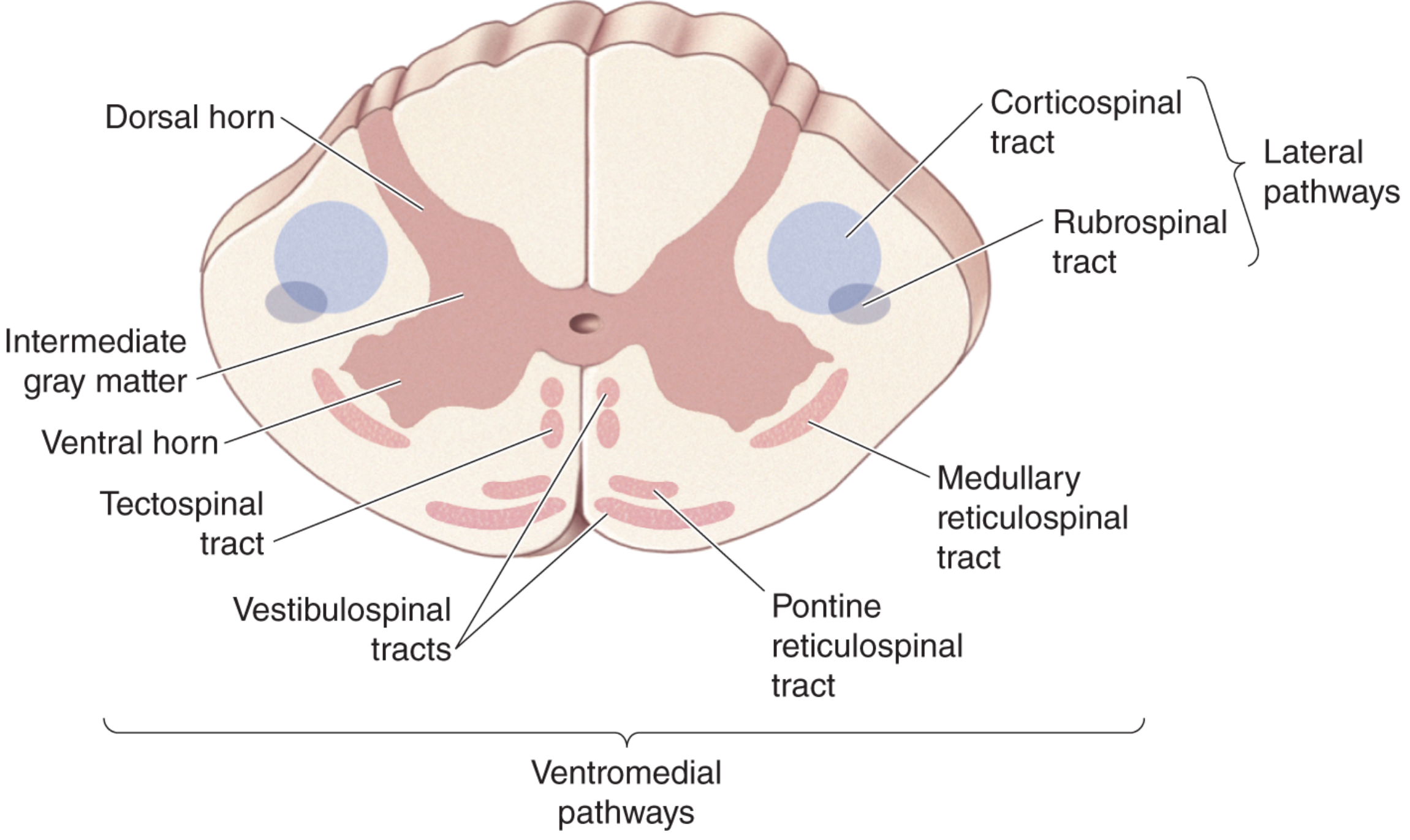
| Group | Location in cord | Controls | Origin |
|---|---|---|---|
| Lateral pathways | Lateral column | Voluntary movements - distal limb muscles (hands, fingers) | Cerebral cortex + Red nucleus |
| Ventromedial pathways | Ventral/anterior column | Posture, balance, axial muscles, head/neck orientation | Brainstem |
Golden rule to remember: Lateral = Voluntary (cortical). Ventromedial = Postural (brainstem).
TRACTS AT A GLANCE - spinal cord cross-section
GROUP 1 - LATERAL PATHWAYS
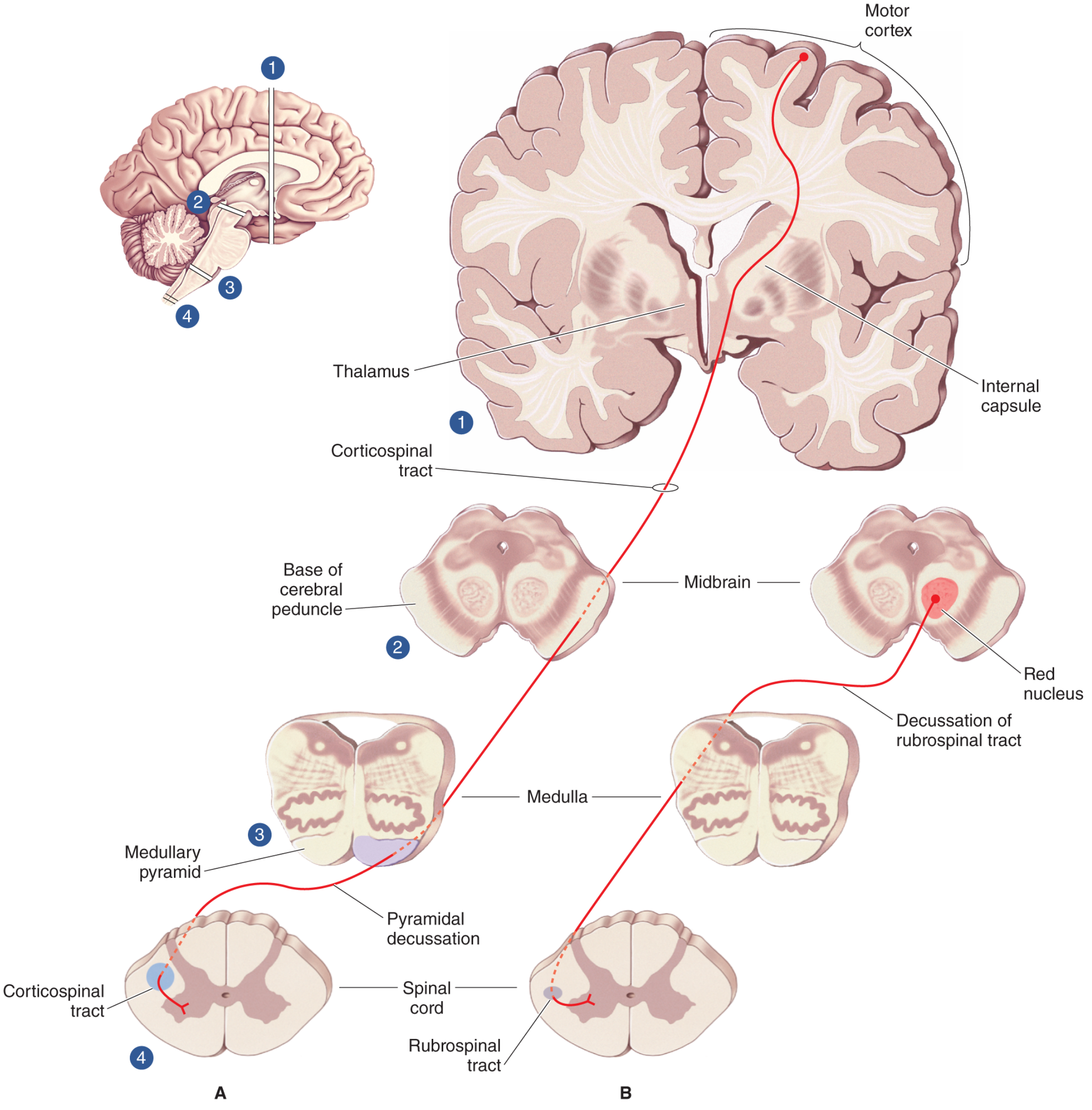
1. Lateral Corticospinal Tract (Pyramidal Tract) ⭐⭐⭐⭐⭐
- Primary motor cortex (area 4) - 30%
- Premotor + supplementary motor areas (area 6) - 30%
- Somatosensory areas (parietal lobe) - 40%
- The large Betz cells of the motor cortex give rise to the fastest-conducting fibers (70 m/s)
- Motor cortex → Corona radiata
- → Posterior limb of internal capsule (between caudate nucleus and putamen)
- → Crus cerebri / base of cerebral peduncle (midbrain)
- → Base of pons (dispersed here by transverse pontocerebellar fibers)
- → Medullary pyramid (forms a bulge on the ventral medulla - hence "pyramidal tract")
- → Pyramidal decussation at caudal medulla - 85-90% of fibers cross here
- → Lateral corticospinal tract in lateral column of spinal cord
- → Terminates on interneurons and LMNs in lateral anterior horn (controls distal muscles)
- Contralateral weakness/paralysis
- Spasticity (increased muscle tone)
- Hyperreflexia
- Babinski sign positive (extensor plantar response)
- Loss of fine finger movements (least likely to recover)
2. Rubrospinal Tract
- Red nucleus (midbrain) → crosses immediately at ventral tegmental decussation in pons
- Descends in lateral column of spinal cord (runs with/alongside corticospinal tract)
- Terminates on interneurons in anterior horn → facilitates flexor muscles, inhibits extensor muscles of upper limb
- Only reaches cervical levels of spinal cord
GROUP 2 - VENTROMEDIAL PATHWAYS
3. Vestibulospinal Tract
- Origin: Vestibular nuclei (pons/medulla) - receives input from vestibular apparatus (semicircular canals, otolith organs)
- Course: Descends ipsilaterally in anterior column
- Function: Maintains balance and upright posture. Activates extensor muscles (anti-gravity muscles). Inhibits flexors.
- Lateral vestibulospinal = whole cord; Medial vestibulospinal = cervical cord only
4. Reticulospinal Tracts (two tracts)
| Pontine (Medial) Reticulospinal | Medullary (Lateral) Reticulospinal | |
|---|---|---|
| Origin | Pons (pontine reticular formation) | Medulla (medullary reticular formation) |
| Course | Ipsilateral, anterior column | Bilateral, lateral column |
| Effect on muscles | Facilitates extensors (anti-gravity) | Inhibits extensors, facilitates flexors |
| Function | Postural support for voluntary movement | Modulates reflex activity |
5. Tectospinal Tract
- Origin: Superior colliculus of midbrain tectum
- Decussation: Crosses in midbrain
- Course: Descends to cervical cord only
- Function: Coordinates head and neck movements in response to visual stimuli (turning your head toward a sudden visual stimulus)
6. Anterior Corticospinal Tract (often listed separately)
- The uncrossed 10-15% of cortical fibers
- Crosses at segmental level in cord
- Controls bilateral postural movements of trunk/proximal muscles
SUMMARY TABLE - All Descending Tracts
| Tract | Origin | Decussation | Location in cord | Function |
|---|---|---|---|---|
| Lateral corticospinal | Motor cortex | Pyramidal decussation (medulla) | Lateral column | Voluntary fine movements - distal |
| Anterior corticospinal | Motor cortex | Segmental (in cord) | Anterior column | Bilateral postural/trunk movements |
| Rubrospinal | Red nucleus (midbrain) | Ventral tegmental decussation (pons) | Lateral column | Flexor activity - arms |
| Vestibulospinal | Vestibular nuclei | None (ipsilateral) | Anterior column | Balance, extensor (anti-gravity) tone |
| Pontine reticulospinal | Pontine reticular formation | Mostly ipsilateral | Anterior column | Facilitates extensors |
| Medullary reticulospinal | Medullary reticular formation | Bilateral | Lateral column | Inhibits extensors, modulates reflexes |
| Tectospinal | Superior colliculus (midbrain) | In midbrain | Anterior column | Head/neck movement toward visual stimulus |
HOW TO REMEMBER THE DECUSSATION LEVELS
- Pyramidal → Passes medulla before crossing (caudal medulla)
- Rubro → crosses Right away in pons
- Tecto → crosses in midTrain (midbrain)
EXAM ANSWER OUTLINE - "Enumerate descending tracts. Describe pyramidal tract in detail." (10 marks)
1. Introduction - Definition of descending tracts, 2 groups (lateral/ventromedial)
2. Enumerate all 6 tracts (table form)
3. Pyramidal (lateral corticospinal) tract:
a. Origin - motor cortex (30% area 4, 30% area 6, 40% parietal)
b. Course - corona radiata → internal capsule → cerebral peduncle
→ pons → medullary pyramid → pyramidal decussation
→ lateral corticospinal tract → anterior horn LMN
c. Diagram - draw the tract (A diagram from above)
d. Functions - fine voluntary movements, especially fingers
e. Effects of lesion - UMN signs (spasticity, hyperreflexia, Babinski +ve,
contralateral weakness, loss of fine movements)
4. Brief note on other tracts (3 lines each)
5. Clinical correlation - stroke affecting internal capsule → contralateral hemiplegia
CLINICAL CORRELATION (impress the examiner)
A patient with a right middle cerebral artery stroke develops left-sided hemiplegia with spasticity and Babinski sign. This is because the lateral corticospinal tract originates in the right motor cortex, passes through the right posterior limb of the internal capsule (commonly affected in MCA strokes), decussates at the pyramidal decussation, and controls the left side of the body. Loss of cortical inhibition → spasticity. Loss of corticospinal input → Babinski sign.