
Does vasculitis infarct have hemorrhagic component
Reading File
Vasculitis infarcts can have a hemorrhagic component, but it depends on the type and stage. The underlying vessel wall inflammation weakens vascular integrity, predisposing to both ischemic infarction and secondary hemorrhagic transformation.
Searching sources...
Finding Sources
Finding Sources
Searching PubMed
vasculitis infarct hemorrhagic transformation
Good hits. Let me pull the key sections from Robbins and the Rheumatology text for the full context.
Reading File
Reading File
Let me also fetch the brain infarct image and read the hemorrhagic infarct section more fully.
Loading Image
Reading File
Excellent. I now have a thorough picture from authoritative sources. Here is the complete answer:
Does a Vasculitis Infarct Have a Hemorrhagic Component?
Yes - it can, but the default pattern is ischemic (pale/anemic), with hemorrhage occurring as a secondary event. The answer requires understanding the general mechanism of hemorrhagic transformation, then applying it specifically to vasculitis.
General Principle: Hemorrhagic Transformation of Brain Infarcts
Brain infarcts are classified into two groups based on whether secondary hemorrhage is present:
- Nonhemorrhagic (pale/anemic) infarct - the default pattern, because the brain has end-organ circulation with limited collateral supply.
- Hemorrhagic infarct - occurs due to secondary hemorrhagic transformation (HT).
HT develops when the ischemic event lasts long enough to damage the small blood vessels in the affected area, and then reperfusion occurs (either spontaneously or therapeutically). The reperfusion hemorrhages are initially punctate but may become multiple or even confluent.
"Secondary hemorrhage can occur from ischemia-reperfusion injury following spontaneous or therapeutic dissolution or fragmentation of the intravascular occlusive material."
- Robbins & Cotran Pathologic Basis of Disease
How Vasculitis Fits In
Vasculitis causes infarcts via luminal narrowing, thrombosis, and/or embolization from inflamed vessels. Robbins states directly:
"Inflammatory processes that involve blood vessels may also lead to luminal narrowing, thrombosis, and cerebral infarcts... Polyarteritis nodosa and other noninfectious vasculitides may involve cerebral vessels and cause single or multiple infarcts throughout the brain."
- Robbins & Cotran, p. 1153
Vasculitis adds additional mechanisms that increase the likelihood of hemorrhage compared to atherosclerotic occlusion alone:
| Mechanism | How Vasculitis Promotes Hemorrhage |
|---|---|
| Vessel wall inflammation and necrosis | Weakens the vessel wall directly, facilitating rupture or leakage |
| Aneurysm formation | Inflammation-induced wall damage can produce microaneurysms (seen in polyarteritis nodosa) |
| Reperfusion after thrombosis | Fragmentation of inflammatory thrombus causes reperfusion hemorrhagic transformation |
| Necrotizing arteritis | Wall necrosis leads to direct hemorrhage, not just ischemia |
Specific Vasculitis Contexts
CNS Vasculitis (primary or secondary):
- Typically causes small lacunar infarcts in deep brain nuclei and brainstem from small-vessel occlusions.
- The Rheumatology 2-Volume Set notes: "Hemorrhagic strokes, in the context of anticoagulation, have been seen."
ANCA-associated vasculitis:
- A 2025 systematic review (PMID 40643697) specifically examined intracranial hemorrhage risk in ANCA-associated vasculitis treated with glucocorticoids - confirming hemorrhagic CNS events are a recognized complication.
Leprosy (a specific vasculitis example from Harrison's):
- Harrison's describes a "central hemorrhagic infarct" developing in leprosy reactions with skin vasculitis, showing hemorrhagic infarction is a recognized endpoint.
Necrotizing vasculitis (e.g., PAN, Churg-Strauss):
- These involve transmural fibrinoid necrosis of vessel walls. Infarcts in this setting are at high risk for hemorrhagic conversion because the damaged vessel wall cannot contain blood even after reperfusion.
Pathological Image: Hemorrhagic vs. Ischemic Infarct
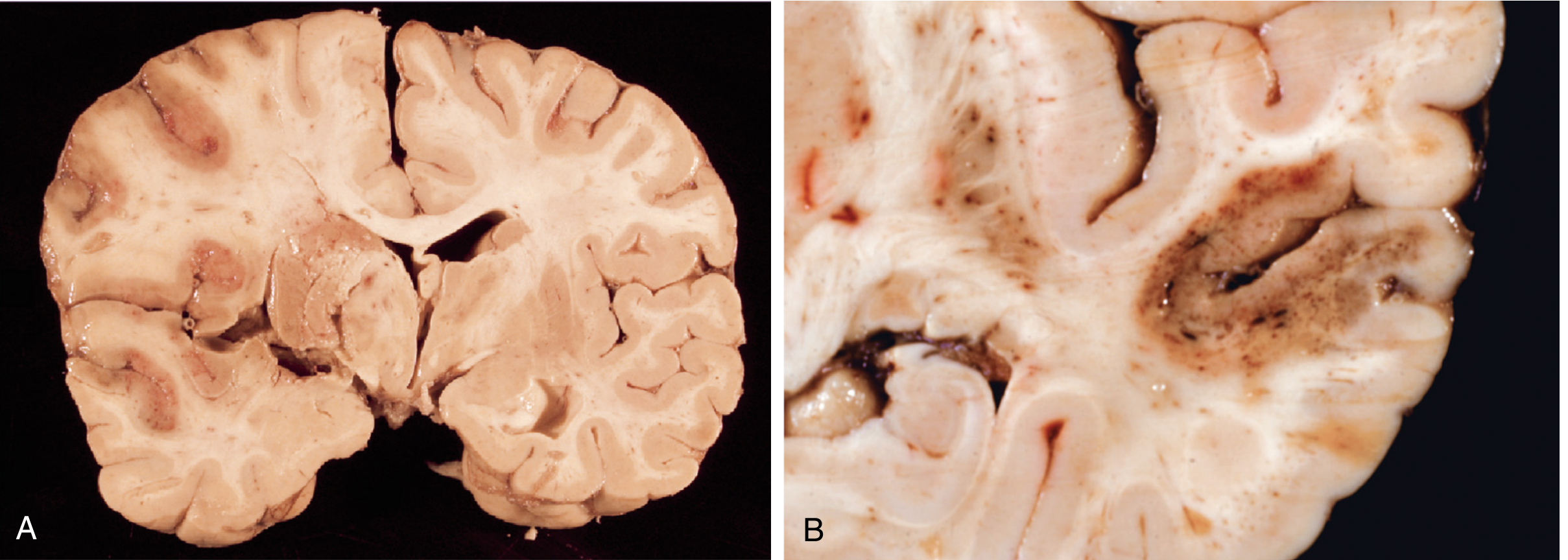
Fig. 28.9 from Robbins: (A) Pale ischemic infarct in MCA territory. (B) Hemorrhagic infarct with punctate hemorrhages in the temporal lobe - the typical pattern of hemorrhagic transformation after ischemia-reperfusion.
Summary
| Feature | Details |
|---|---|
| Default infarct type in vasculitis | Pale/ischemic (anemic) infarct initially |
| Hemorrhagic component present? | Yes - frequently, due to vessel wall necrosis, aneurysm formation, and hemorrhagic transformation |
| Mechanism of hemorrhage | Reperfusion through damaged/necrotic vessel walls; direct wall rupture; microaneurysm rupture |
| Typical pattern | Punctate petechial hemorrhages that may coalesce; or frank intracerebral hemorrhage in necrotizing vasculitis |
| Clinical implication | Thrombolytics and anticoagulation are contraindicated or dangerous when hemorrhagic conversion is present |
So in short: vasculitis infarcts start as pale ischemic infarcts but have a higher-than-average propensity for hemorrhagic transformation compared to bland embolic infarcts, because the inflamed and necrotic vessel walls are intrinsically fragile. In necrotizing forms (like PAN), primary hemorrhagic infarction without a preceding pale phase is also possible.
- Robbins, Cotran & Kumar - Pathologic Basis of Disease, p. 1153
- Rheumatology 2-Volume Set (Elsevier, 2022), block 23
This is a shared conversation. Sign in to Orris to start your own chat.