
Imci diarrhoea all
I'll look up the IMCI diarrhoea guidelines from the medical library right away.
Searching sources...
Reading File
Finding Sources
Finding Sources
Finding Sources
Finding Sources
Reading File
Reading File
Now let me search specifically for the IMCI diarrhoea classification and management content:
Finding Sources
Reading File
Reading File
Reading File
Reading File
Now let me get the Plans A, B, C content:
Reading File
Reading File
Reading File
I now have enough comprehensive content. Let me also get the content around Plan C and the persistent diarrhoea/dysentery parts:
Reading File
Now let me get the classification table for the child (2 months - 5 years) with diarrhoea including persistent diarrhoea and dysentery:
Reading File
I also need to retrieve the Plan C flowchart image and look at the dehydration classification table more carefully. Let me fetch the Plan C image:
Loading Image
Loading Image
I now have all the content needed. Here is the complete, detailed answer:
IMCI - Diarrhoea: Complete Coverage
Source: Park's Textbook of Preventive and Social Medicine (IMCI Chapter)
IMCI Case Management Process (Overview)
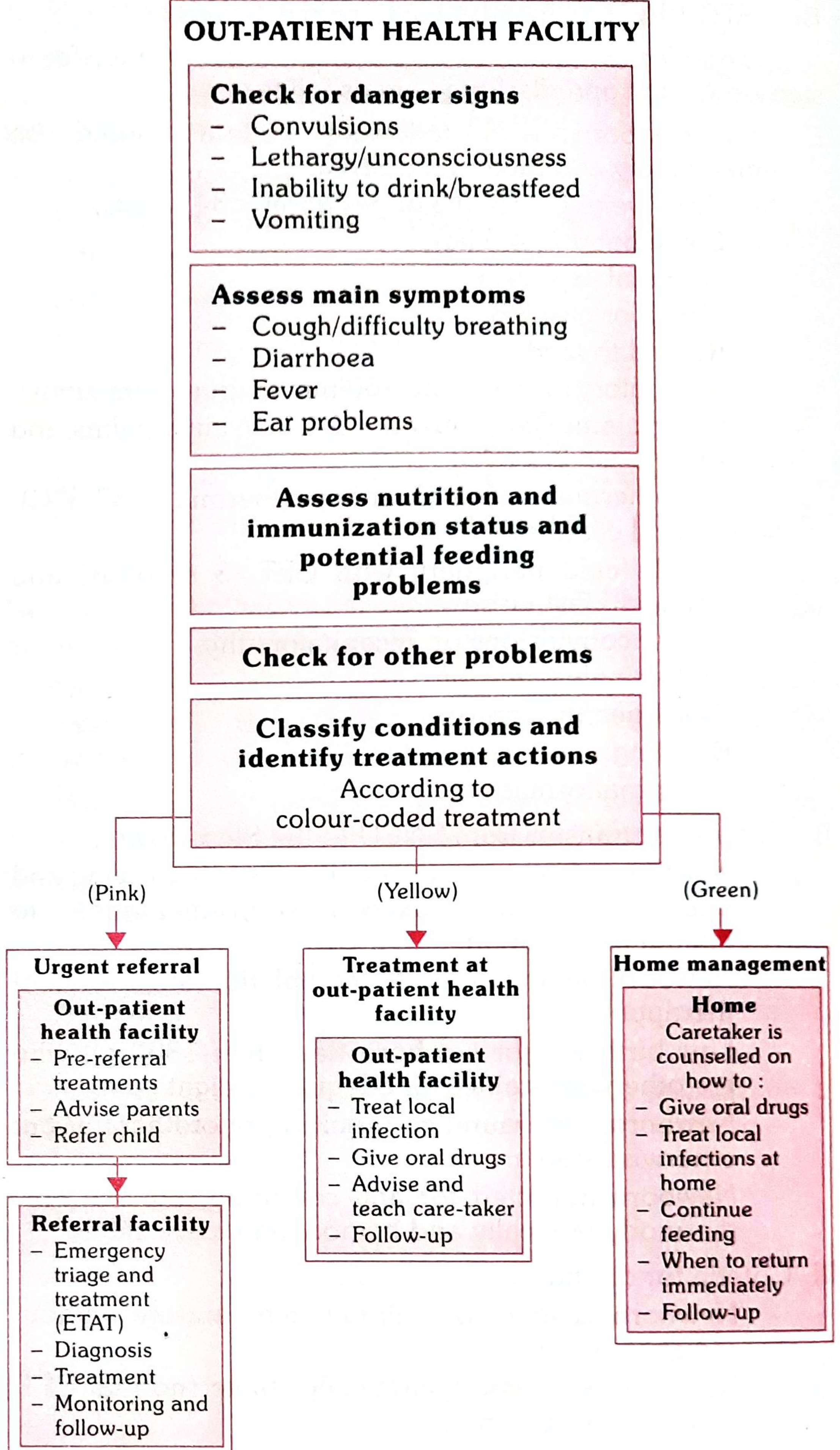
IMCI applies to children aged 1 week up to 5 years. Illness classification uses a colour-coded triage system:
- 🔴 PINK = Urgent hospital referral
- 🟡 YELLOW = Specific outpatient treatment
- 🟢 GREEN = Home management
STEP 1: ASSESS - Does the Child Have Diarrhoea?
Ask:
- For how long has diarrhoea been present?
- Is there blood in the stool?
Look and Feel:
- Child's general condition: lethargic/unconscious? Restless and irritable?
- Sunken eyes
- Offer fluid - is the child not able to drink or drinking poorly? OR drinking eagerly/thirsty?
- Skin pinch of abdomen: goes back very slowly (>2 seconds)? Or slowly?
STEP 2: CLASSIFY DIARRHOEA
A) Classify for DEHYDRATION
Child (2 months - 5 years):
| Signs | Classification | Treatment |
|---|---|---|
| Two of: Lethargic/unconscious; Sunken eyes; Not able to drink/drinking poorly; Skin pinch goes back very slowly | 🔴 PINK: SEVERE DEHYDRATION | If no other severe classification: Plan C. If also has another severe classification: Refer URGENTLY with ORS sips en route. If child ≥2 years and cholera in area: give antibiotic for cholera. |
| Two of: Restless/irritable; Sunken eyes; Drinks eagerly/thirsty; Skin pinch goes back slowly | 🟡 YELLOW: SOME DEHYDRATION | Plan B (ORS in clinic over 4 hours). If severe classification: refer urgently with ORS. Follow-up in 2 days if not improving. |
| Not enough signs for some or severe dehydration | 🟢 GREEN: NO DEHYDRATION | Plan A (home treatment). Advise when to return. Follow-up in 2 days if not improving. |
Young Infant (up to 2 months) - same signs apply but:
- Infant movement (on own / only when stimulated / not at all) is assessed instead of drinking
- "Very slowly" criterion for skin pinch same as above
B) Classify for PERSISTENT DIARRHOEA (if diarrhoea ≥14 days)
| Signs | Classification | Treatment |
|---|---|---|
| Dehydration present | 🔴 PINK: SEVERE PERSISTENT DIARRHOEA | Treat dehydration before referral. Refer to hospital. |
| No dehydration | 🟡 YELLOW: PERSISTENT DIARRHOEA | Advise on feeding; give multivitamins and minerals (including zinc) for 14 days. Follow-up in 5 days. |
C) Classify for DYSENTERY (if blood in stool)
| Signs | Classification | Treatment |
|---|---|---|
| Blood in the stool | 🟡 YELLOW: DYSENTERY | Give ciprofloxacin for 3 days. Follow-up in 3 days. |
STEP 3: TREATMENT PLANS
PLAN A - Treat Diarrhoea at Home (No Dehydration)
4 Rules of Home Treatment:
1. Give Extra Fluid (as much as the child will take):
- Breastfed infants: breastfeed frequently + longer at each feed
- Exclusively breastfed: ORS or clean water in addition to breast milk
- Not exclusively breastfed: ORS, food-based fluids (soup, rice water, yoghurt drinks), or clean water
ORS amounts after each loose stool:
| Age | ORS after each loose stool |
|---|---|
| Up to 2 years | 50-100 ml |
| 2 years or more | 100-200 ml |
- Give frequent small sips from a cup
- If vomits: wait 10 min, then continue more slowly
- Continue until diarrhoea stops
- Give mother 2 packets of ORS to take home
2. Give Zinc (age 2 months up to 5 years) - 20 mg tablet:
| Age | Dose | Duration |
|---|---|---|
| 2 months up to 6 months | ½ tablet (10 mg) daily | 14 days |
| 6 months up to 5 years | 1 tablet (20 mg) daily | 14 days |
- Infants: dissolve tablet in small amount of expressed breast milk, ORS, or clean water
- Older children: tablet can be chewed or dissolved in small amount of water
3. Continue Feeding (exclusive breastfeeding if age <6 months)
4. When to Return - advise caregiver to return immediately if child gets worse
PLAN B - Treat Some Dehydration with ORS (in clinic, over 4 hours)
ORS amounts in the first 4 hours:
| Weight | Age | ORS (ml) |
|---|---|---|
| <6 kg | Up to 4 months | 200-450 ml |
| 6-<10 kg | 4 months up to 12 months | 450-800 ml |
| 10-<12 kg | 12 months up to 2 years | 800-960 ml |
| 12-19 kg | 2 years up to 5 years | 960-1600 ml |
Formula: approximate amount (ml) = weight (kg) × 75
- Give more if child wants more
- Infants <6 months not breastfed: also give 100-200 ml clean water (not needed with low osmolarity ORS)
- Continue breastfeeding whenever child wants
- After vomiting: wait 10 min, then continue more slowly
After 4 hours: Reassess, reclassify dehydration, choose appropriate plan, begin feeding in clinic.
If mother must leave before completing: Show her how to prepare ORS and how much to give to finish 4-hour treatment at home. Explain the 4 Rules.
PLAN C - Treat Severe Dehydration Quickly
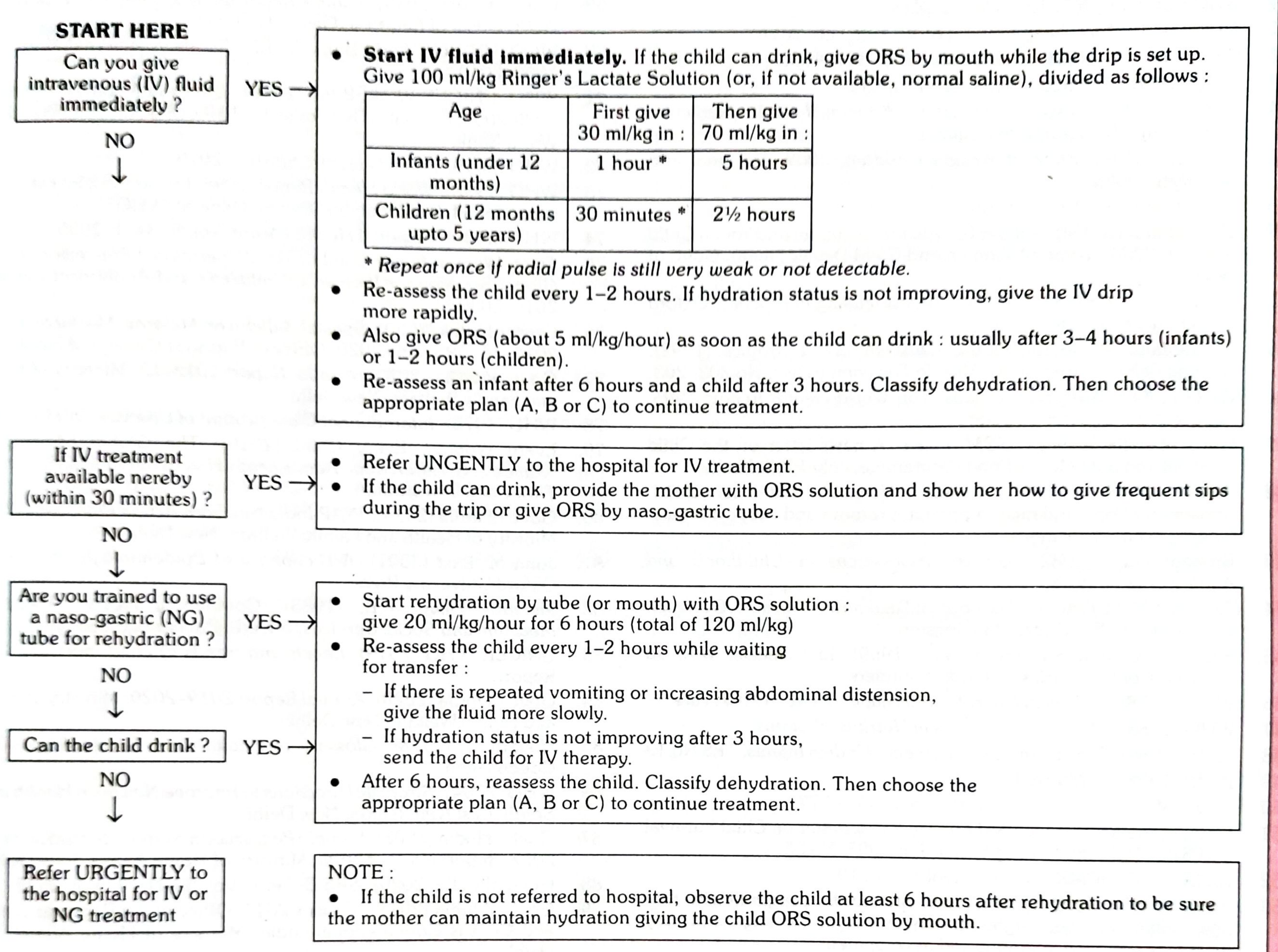
Summary of Plan C (follow arrows):
If IV fluids available immediately → YES:
- Start IV fluid immediately: 100 ml/kg Ringer's Lactate (or normal saline if RL unavailable)
Patient First give 30 ml/kg in: Then give 70 ml/kg in: Infants (<12 months) 1 hour* 5 hours Children (12 months - 5 years) 30 minutes* 2½ hours *Repeat once if radial pulse still very weak or not detectable - Reassess every 1-2 hours; if not improving, speed up drip
- Also give ORS ~5 ml/kg/hour as soon as child can drink (after 3-4 hours in infants, 1-2 hours in children)
- Reassess: infant after 6 hours, child after 3 hours. Classify dehydration. Choose appropriate plan.
If IV not available but available nearby (within 30 min) → YES:
- Refer URGENTLY to hospital
- Give ORS or ORS by NG tube en route
If trained to use NG tube → YES:
- Start ORS via NG tube/mouth: 20 ml/kg/hour for 6 hours (total 120 ml/kg)
- Reassess every 1-2 hours
- If repeated vomiting or increasing abdominal distension: give fluid more slowly
- If hydration not improving after 3 hours: send for IV therapy
If child can drink → YES: same NG protocol applies
If none of the above → NO: Refer URGENTLY for IV or NG treatment
NOTE: If child is not referred, observe at least 6 hours after rehydration to confirm mother can maintain hydration with oral ORS.
Key Points to Remember
| Feature | Detail |
|---|---|
| Diarrhoea definition (young infant) | Stools changed from usual, many and watery (more water than faecal matter). Normal frequent/semi-solid stools of a breastfed baby are NOT diarrhoea. |
| Persistent diarrhoea | Diarrhoea ≥ 14 days |
| Dysentery | Blood in stool - treat with ciprofloxacin 3 days |
| Zinc supplementation | 2 months - 5 years, 14 days course in ALL cases of diarrhoea |
| Cholera antibiotic | Only if child ≥2 years AND cholera in your area (in severe dehydration) |
| Breastfeeding | Must be continued in all plans - never stop |
| Follow-up: no dehydration | 2 days if not improving |
| Follow-up: persistent diarrhoea (yellow) | 5 days |
| Follow-up: dysentery | 3 days |
- Park's Textbook of Preventive and Social Medicine, IMCI Chapter (block 9)
This is a shared conversation. Sign in to Orris to start your own chat.