


Create image of masterchart of topic teratomas from text in given two images, including everything and nothing must be skipped.
A detailed medical masterchart/study chart on TERATOMAS with the following complete information organized in a clean, professional layout with colored sections and clear hierarchy: TITLE: TERATOMAS - MASTER CHART (large bold title at top, dark teal background) SECTION 1 - INTRODUCTION (teal header): - Arise from Totipotent cells - Have the capacity to differentiate into all 3 germ cell layers: Ectoderm, Mesoderm, Endoderm SECTION 2 - MOST COMMON (orange header): - Most common BENIGN TUMOR OF OVARY in reproductive age group - Most common BENIGN NEOPLASM DIAGNOSED DURING PREGNANCY - Most common GERM CELL TUMOR - Commonest tumor to UNDERGO TORSION SECTION 3 - AGE GROUP & TUMOUR MARKERS (split row, blue headers): Age Group: 40-50 years | Tumour Markers: AFP in immature teratoma SECTION 4 - 3 TYPES (dark header spanning full width): THREE TYPES: 1) Mature (Benign) 2) Immature (Malignant) 3) Monodermal/Highly Specialized --- TYPE 1: MATURE (BENIGN) TERATOMA (green section) --- • Also known as DERMOID CYST • Have predominant ECTODERMAL ELEMENTS GROSS: • A unilocular cyst • C/S: cyst filled with paste-like sebaceous secretions and desquamated keratin admixed with masses of hair • Solid prominence (Rokitansky's protuberance): tissue elements like tooth, bone, cartilage, other odd tissues present MICROSCOPY: • Cyst wall: skin (stratified squamous epithelium) with skin appendages (sebaceous glands, hair shafts, other skin adnexal structures) • Structures from all 3 germ layers: - Ectoderm: skin, neural tissue, glia - Mesoderm: smooth muscle, cartilage, bone, fat - Endoderm: respiratory tract epithelium, gut, thyroid --- TYPE 2: IMMATURE (MALIGNANT) TERATOMA (red/pink section) --- • Contains IMMATURE OR EMBRYONAL STRUCTURES (contrast to mature/adult structures of benign teratomas) GROSS: • Unilateral solid mass • C/S: variegated appearance - areas of haemorrhages, necrosis, tiny cysts, heterogeneous admixture of various tissue elements MICROSCOPY: • Parts may show mature tissues; most composed of immature tissues with embryonic appearance • Prognostic factor: Relative amount of immature neural tissue --- TYPE 3: MONODERMAL (SPECIALISED) TERATOMA (purple section) --- • Composed entirely of ONE tissue type • Most common: STRUMA OVARII • Struma ovarii: teratoma composed exclusively of THYROID TISSUE - recognisable grossly and microscopically • Rarely struma ovarii hyperfunctions → HYPERTHYROIDISM GROSS: Cystic lesion composed entirely of mature thyroid tissue MICROSCOPY: Appearance of a follicular adenoma of the thyroid SECTION 5 - PROGNOSIS (bottom, dark blue): • Mature Teratoma → GOOD PROGNOSIS • Immature Teratoma → EXTREMELY POOR PROGNOSIS Use a clean medical textbook chart style with colored boxes for each type, bullet points, bold key terms, white background with colored section headers (teal, orange, green, red, purple, dark blue). Make it visually clear, well-spaced, comprehensive and easy to read. All text must be fully legible.
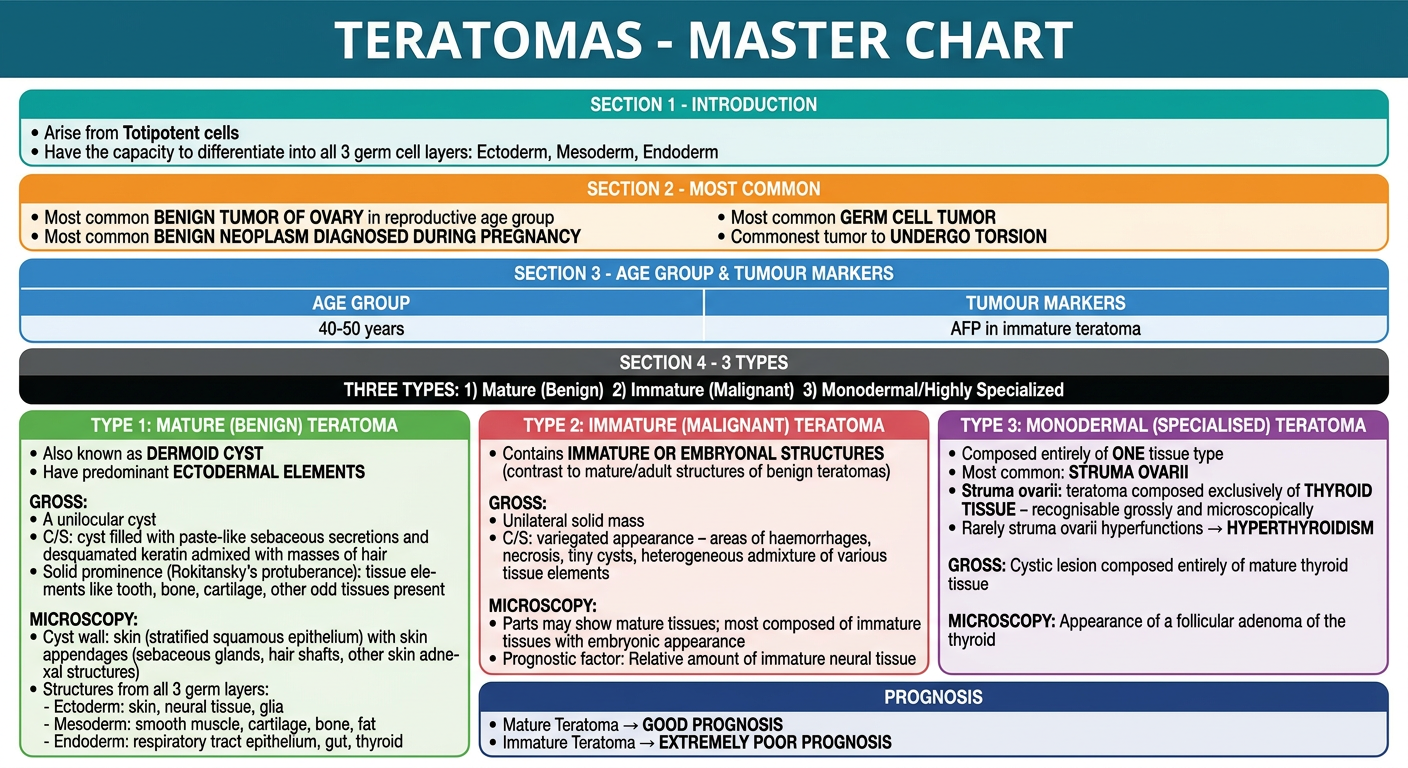
- Introduction - Totipotent cell origin, 3 germ layers
- Most Common mnemonics - benign ovarian tumor, pregnancy neoplasm, germ cell tumor, torsion
- Age group (40-50 yrs) and Tumour marker (AFP in immature)
- Type 1 - Mature/Benign (Dermoid Cyst) - Gross (unilocular, Rokitansky's protuberance) + Microscopy (all 3 layers with examples)
- Type 2 - Immature/Malignant - Gross (unilateral solid, variegated) + Microscopy (embryonal structures, prognostic factor = immature neural tissue)
- Type 3 - Monodermal/Specialised (Struma Ovarii) - Thyroid tissue, hyperthyroidism, follicular adenoma appearance
- Prognosis - Mature = good, Immature = extremely poor
Create images of schematic gross specimen as per the text of gross of each 3 particular type of teratoma.
Medical schematic illustration of gross specimen of Mature (Benign) Teratoma - Dermoid Cyst of ovary. Clean labeled anatomical diagram style on white background. Show a unilocular cyst cut open (cross-section view) revealing: - The outer smooth ovarian cyst wall - Interior filled with thick paste-like yellowish sebaceous secretions and desquamated keratin - Masses of tangled hair visible inside the cyst cavity - A clearly visible solid protuberance on the inner wall labeled "Rokitansky's Protuberance" - this bump contains embedded structures: a small white tooth, a piece of bone/cartilage, and nodular tissue - The cyst lining appears smooth and glistening Label all key structures with clear arrows: - "Unilocular cyst wall" - "Sebaceous secretions + desquamated keratin (paste-like)" - "Masses of hair" - "Rokitansky's Protuberance" - "Tooth" - "Bone/Cartilage" - "Odd tissue elements" Title at top: "TYPE 1: MATURE (BENIGN) TERATOMA - DERMOID CYST" Subtitle: "Gross Specimen - Schematic Diagram" Use clean medical illustration style with soft colors - pale yellow for sebaceous content, tan/brown for cyst wall, white/ivory for tooth and bone, pink for soft tissue. Professional medical textbook diagram aesthetic with neat label lines.
Medical schematic illustration of gross specimen of Immature (Malignant) Teratoma of ovary. Clean labeled anatomical diagram style on white background. Show a unilateral solid ovarian mass cut open (cross-section view) with a variegated cut surface revealing: - Large solid mass (not a simple cyst - predominantly solid) - Variegated/heterogeneous cut surface with multiple different areas clearly demarcated: - Dark red-brown areas of haemorrhage - Pale/grey-white areas of necrosis - Tiny scattered small cysts within the solid tissue - Heterogeneous admixture of different tissue elements with irregular texture - Irregular outer surface of the mass - No single dominant cyst - solid with mixed appearance Label all key structures with clear arrows: - "Unilateral solid mass" - "Areas of Haemorrhage" (pointing to dark red areas) - "Areas of Necrosis" (pointing to pale areas) - "Tiny cysts" (pointing to small cystic spaces) - "Heterogeneous tissue elements" (pointing to mixed texture area) - "Variegated cut surface" (overall label) Title at top: "TYPE 2: IMMATURE (MALIGNANT) TERATOMA" Subtitle: "Gross Specimen - Schematic Diagram" Use clean medical illustration style - dark red for hemorrhage, pale grey/cream for necrosis, pink/tan for solid tissue, white for tiny cysts. Professional medical textbook diagram with neat labeled arrows.
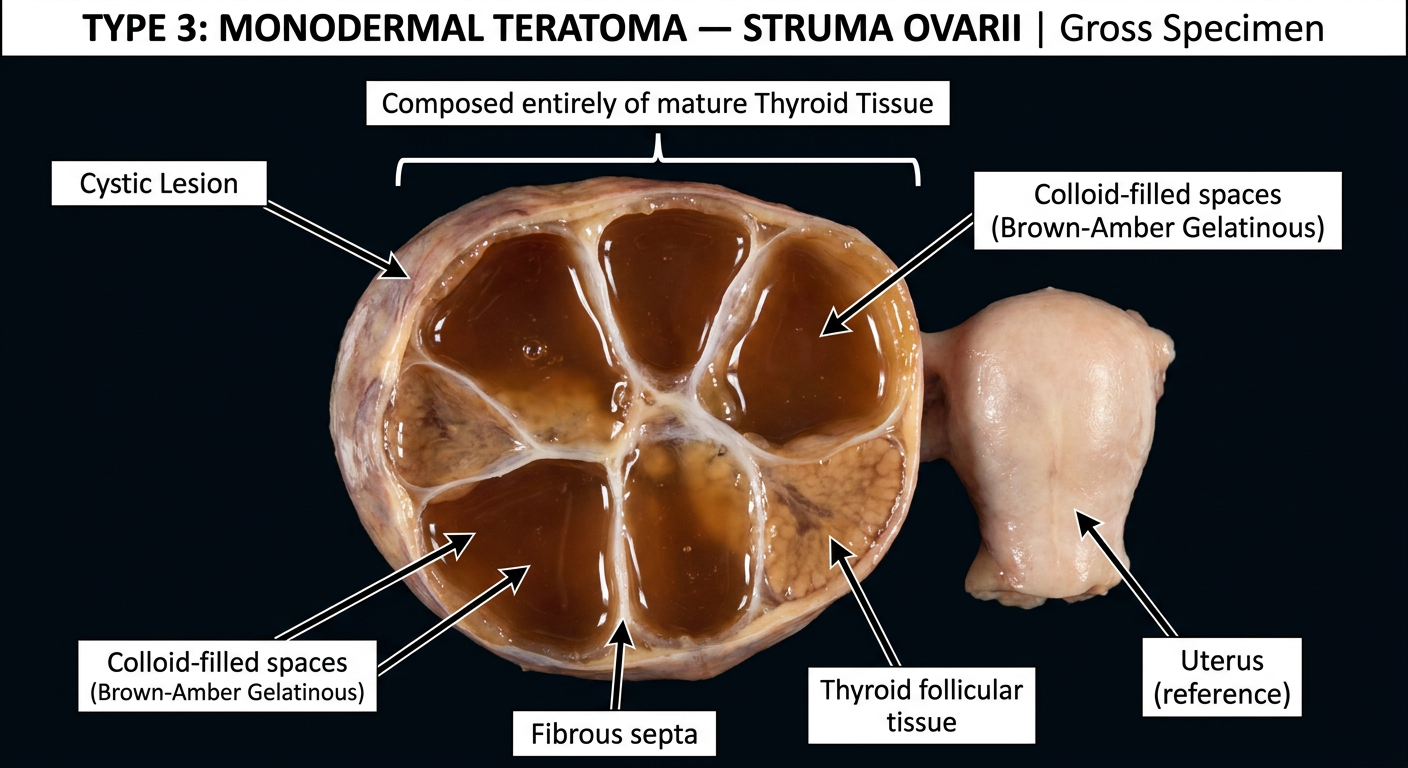
Medical schematic illustration of gross specimen of Monodermal (Specialised) Teratoma - Struma Ovarii of ovary. Clean labeled anatomical diagram style on white background. Show a cystic ovarian lesion cut open (cross-section view) composed entirely of mature thyroid tissue: - Cystic lesion - predominantly cystic structure - The cyst interior filled entirely with colloid-filled follicles (characteristic of thyroid tissue) - Multiple colloid-filled cysts of varying sizes visible - brown/amber colored gelatinous colloid material inside the follicles - Glistening brown-amber colloid material typical of thyroid follicles - The overall appearance resembles thyroid gland tissue grossly - Smooth outer cyst wall - Show the uterus nearby as a small labeled reference structure (as seen in classic specimens) Label all key structures with clear arrows: - "Cystic lesion" - "Colloid-filled follicles (thyroid tissue)" - "Gelatinous brown colloid material" - "Composed entirely of mature thyroid tissue" - "Uterus" (small reference structure) Title at top: "TYPE 3: MONODERMAL (SPECIALISED) TERATOMA - STRUMA OVARII" Subtitle: "Gross Specimen - Schematic Diagram" Use clean medical illustration style - amber/brown for colloid, tan/beige for cyst wall, multiple brown-toned cystic spaces to represent thyroid follicles. Professional medical textbook diagram aesthetic with neat label lines and arrows.
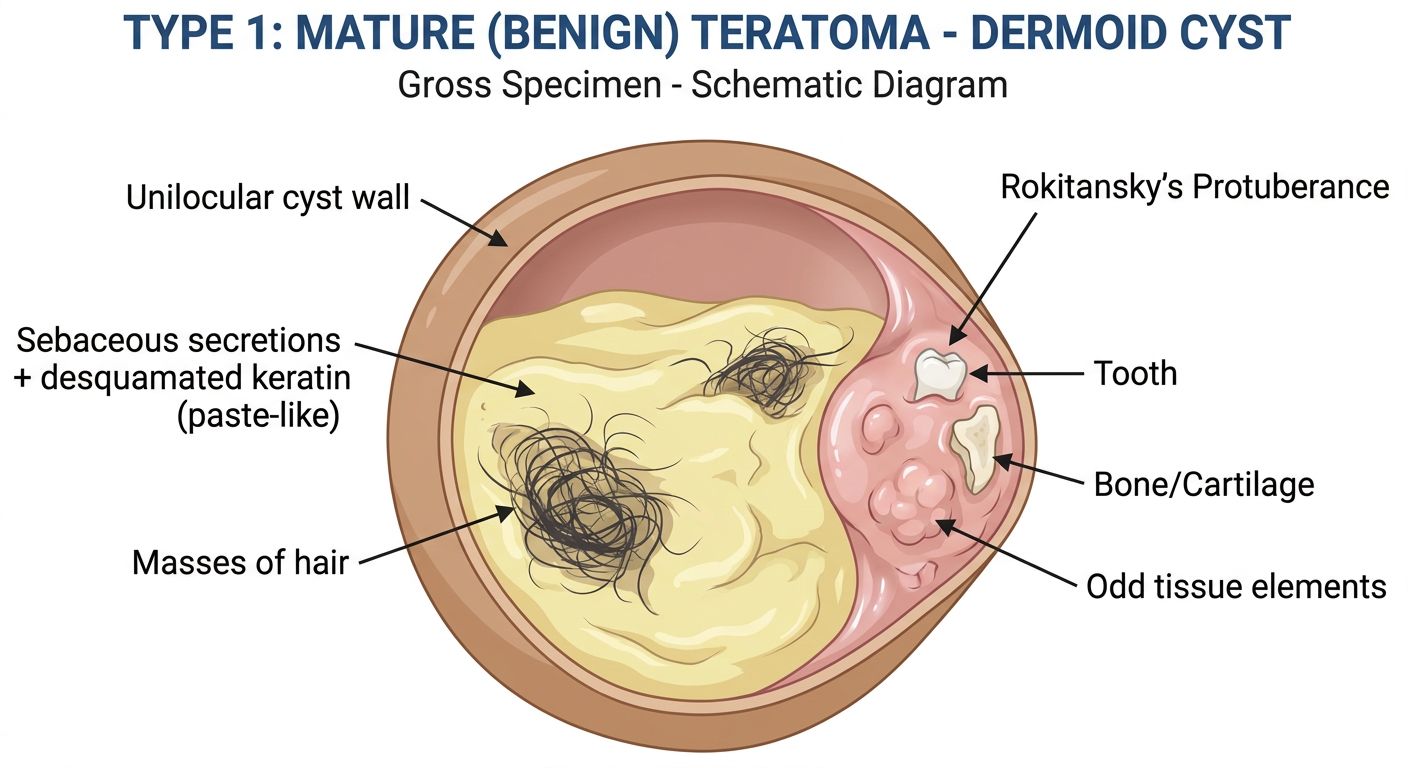
- Unilocular cyst with paste-like sebaceous content, hair masses, and Rokitansky's protuberance with tooth/bone/cartilage
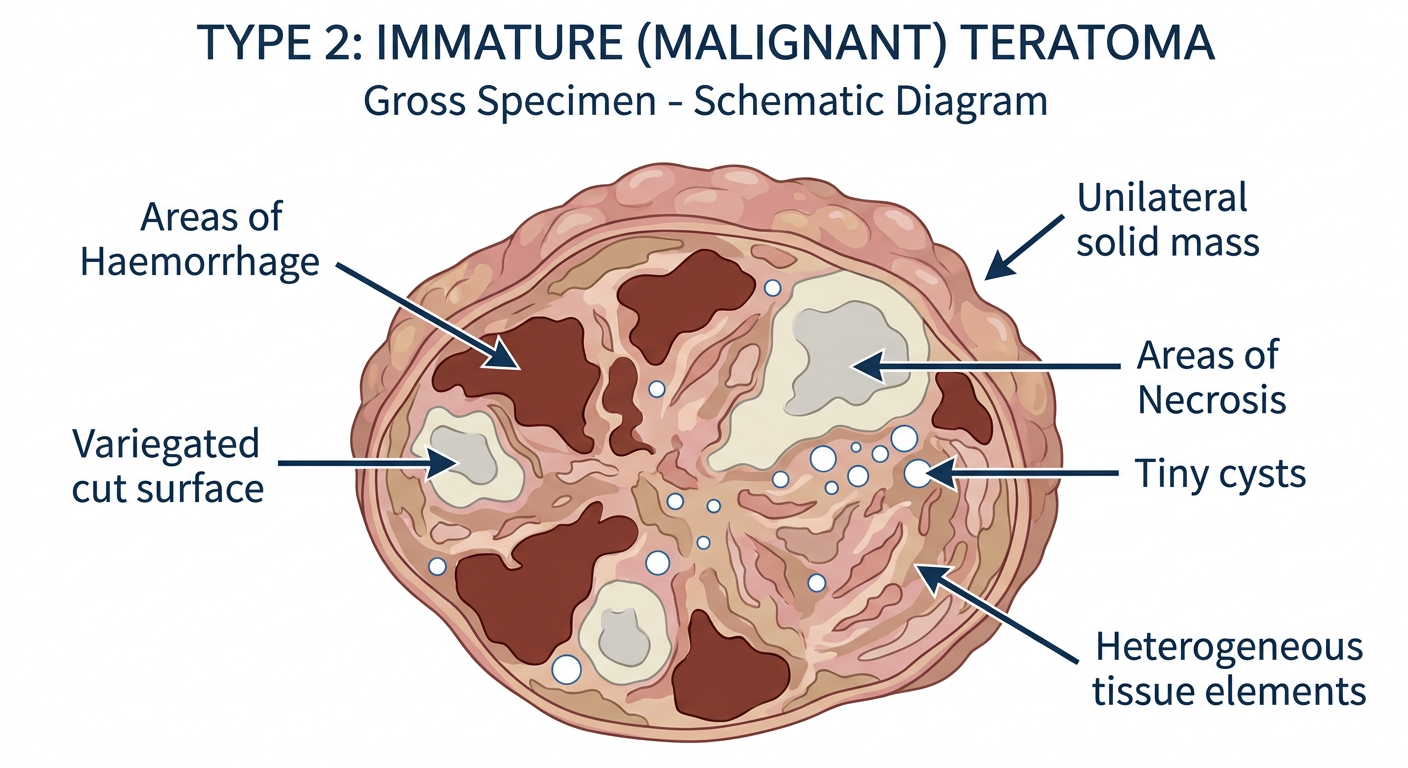
- Unilateral solid mass with variegated cut surface showing haemorrhage, necrosis, tiny cysts, and heterogeneous tissue elements
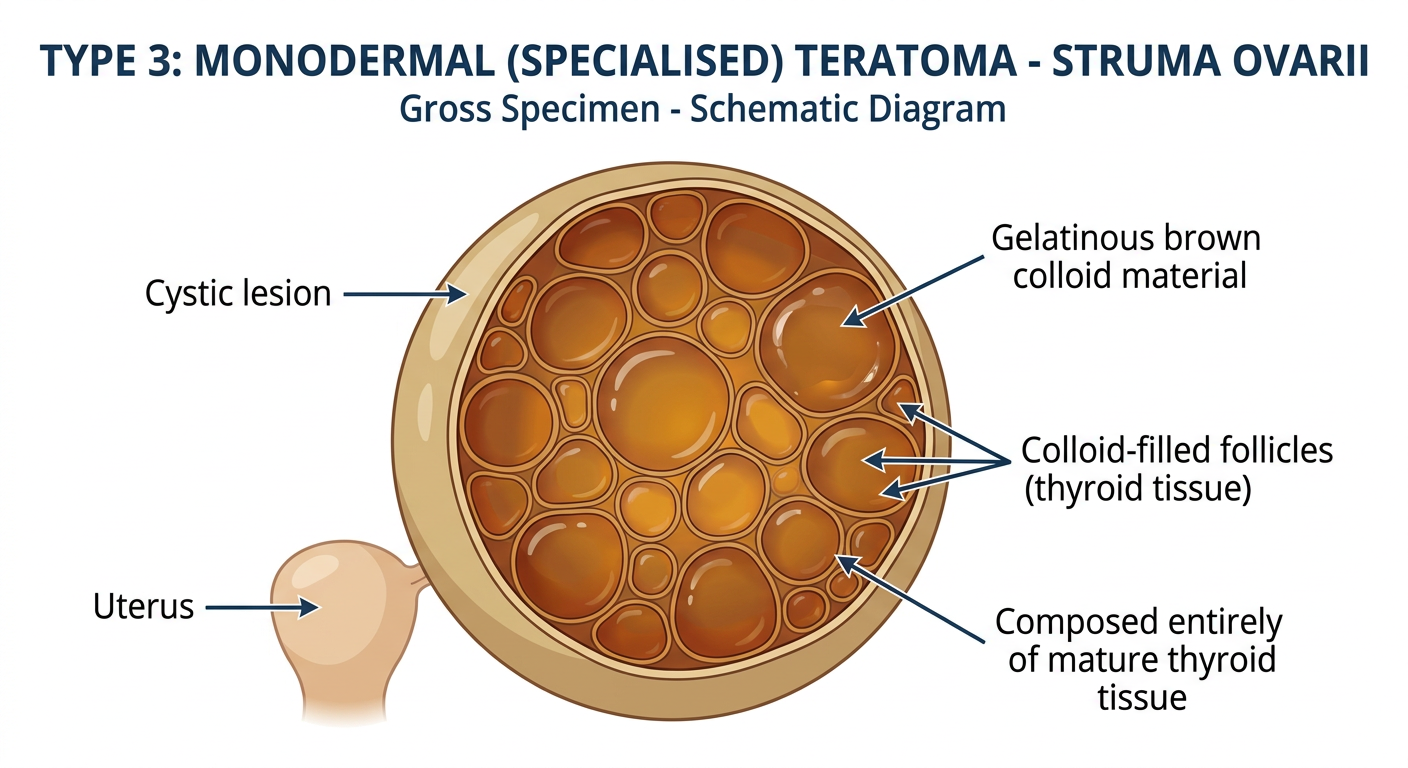
- Cystic lesion composed entirely of mature thyroid tissue with colloid-filled follicles (amber/brown gelatinous material)
Create microscopy diagrams showing histology of each teratoma type
Detailed medical histology schematic diagram of Mature (Benign) Teratoma - Dermoid Cyst microscopy, H&E stain appearance, clean labeled illustration style on white background. Show a microscopic cross-section field with multiple tissue types from all 3 germ layers clearly visible and labeled: ECTODERM-derived (top region): - Stratified squamous epithelium lining the cyst wall (multiple layers of flat squamous cells) - Sebaceous glands beneath the epithelium (lobular glands with pale foamy cells) - Hair follicle shaft cross-section (concentric layers) - Skin adnexal structures MESODERM-derived (middle region): - Smooth muscle bundles (elongated spindle cells in fascicles, pink) - Cartilage island (blue-purple chondrocytes in lacunae within basophilic matrix) - Adipose tissue/fat (clear vacuolated adipocytes, large empty-looking cells) - Bone trabeculae if space permits ENDODERM-derived (bottom region): - Respiratory tract epithelium (columnar ciliated cells lining a duct) - Glandular structures (simple columnar epithelium forming glands) - Thyroid follicles (round follicles filled with pink colloid) All structures clearly labeled with arrows: - "Stratified squamous epithelium (Ectoderm)" - "Sebaceous glands (Ectoderm)" - "Hair follicle (Ectoderm)" - "Smooth muscle (Mesoderm)" - "Cartilage (Mesoderm)" - "Adipocytes/Fat (Mesoderm)" - "Columnar/Respiratory epithelium (Endoderm)" - "Glands (Endoderm)" Title: "TYPE 1: MATURE (BENIGN) TERATOMA - DERMOID CYST" Subtitle: "Microscopy - H&E Schematic | All 3 Germ Layers Present" H&E color scheme: pink eosinophilic cytoplasm, purple-blue hematoxylin nuclei, pale pink collagen, blue-purple cartilage matrix, clear adipocyte vacuoles. Professional medical histology textbook illustration style with clear cell detail.
Detailed medical histology schematic diagram of Immature (Malignant) Teratoma microscopy, H&E stain appearance, clean labeled illustration style on white background. Show a microscopic field with a MIX of mature and immature/embryonal structures - this is the key distinguishing feature: IMMATURE/EMBRYONAL structures (majority of the field - these dominate): - Immature neural tissue: primitive neuroepithelium forming rosettes (Homer-Wright rosette-like structures - circular arrangements of small dark blue primitive cells around a central space), densely packed small blue cells with scant cytoplasm and hyperchromatic nuclei - this is the KEY PROGNOSTIC element - Immature cartilage: irregular bluish cartilage islands with immature chondrocytes, poorly defined lacunae - Immature stroma: loose primitive mesenchymal cells, spindle-shaped with oval nuclei, myxoid background - Glands lined by immature columnar epithelium MATURE structures (smaller portion of field): - Area of stratified squamous epithelium (mature, well-differentiated) - Small area of mature glandular tissue Key features to emphasize: - Embryonic/primitive appearance of most cells - Hyperchromatic nuclei - High nuclear-to-cytoplasm ratio in immature areas - Contrast between mature and immature zones Labels with arrows: - "Immature neural tissue / Primitive neuroepithelium (KEY - Prognostic factor)" - "Neural rosettes" - "Immature cartilage" - "Immature stroma (embryonic)" - "Glands" - "Stratified squamous lining (mature area)" - "Immature or embryonal structures (PREDOMINANT)" Title: "TYPE 2: IMMATURE (MALIGNANT) TERATOMA" Subtitle: "Microscopy - H&E Schematic | Prognostic factor = Amount of immature neural tissue" H&E colors: deep purple-blue for immature neural cells and rosettes, pale blue for immature cartilage matrix, pink for cytoplasm, light pink for stroma. Professional medical histology textbook illustration.
Detailed medical histology schematic diagram of Monodermal (Specialised) Teratoma - Struma Ovarii microscopy, H&E stain appearance showing appearance of a follicular adenoma of the thyroid. Clean labeled illustration style on white background. Show a microscopic field that looks exactly like thyroid tissue / follicular adenoma of thyroid: THYROID FOLLICLE STRUCTURES (entire field - only ONE tissue type present): - Multiple thyroid follicles of varying sizes filling the entire field - Large follicles: round to oval, lined by flattened follicular epithelium (simple cuboidal to flat cells), filled with abundant pink homogeneous colloid material inside - Medium follicles: lined by cuboidal follicular cells, colloid present - Small follicles: lined by columnar follicular cells, less colloid - Follicular cells: uniform cuboidal cells with round nuclei, pale cytoplasm - Dense pink-staining colloid inside follicles (homogeneous eosinophilic material) - Thin fibrovascular stroma between follicles - Overall appearance identical to normal thyroid or follicular adenoma - Scalloping artifact at colloid edges (resorption vacuoles at follicle periphery) Labels with arrows: - "Thyroid follicles (ONLY tissue type - monodermal)" - "Pink homogeneous colloid" - "Follicular epithelium (cuboidal cells)" - "Fibrovascular stroma" - "Appearance of follicular adenoma of thyroid" - "Composed exclusively of thyroid tissue" - "Resorption vacuoles/scalloping" Title: "TYPE 3: MONODERMAL TERATOMA - STRUMA OVARII" Subtitle: "Microscopy - H&E Schematic | Appearance of Follicular Adenoma of Thyroid" H&E colors: bright eosinophilic pink for colloid inside follicles, pale pink cytoplasm of follicular cells, purple-blue nuclei, pale pink fibrous stroma between follicles. Classic thyroid histology appearance. Professional medical histology textbook illustration style.
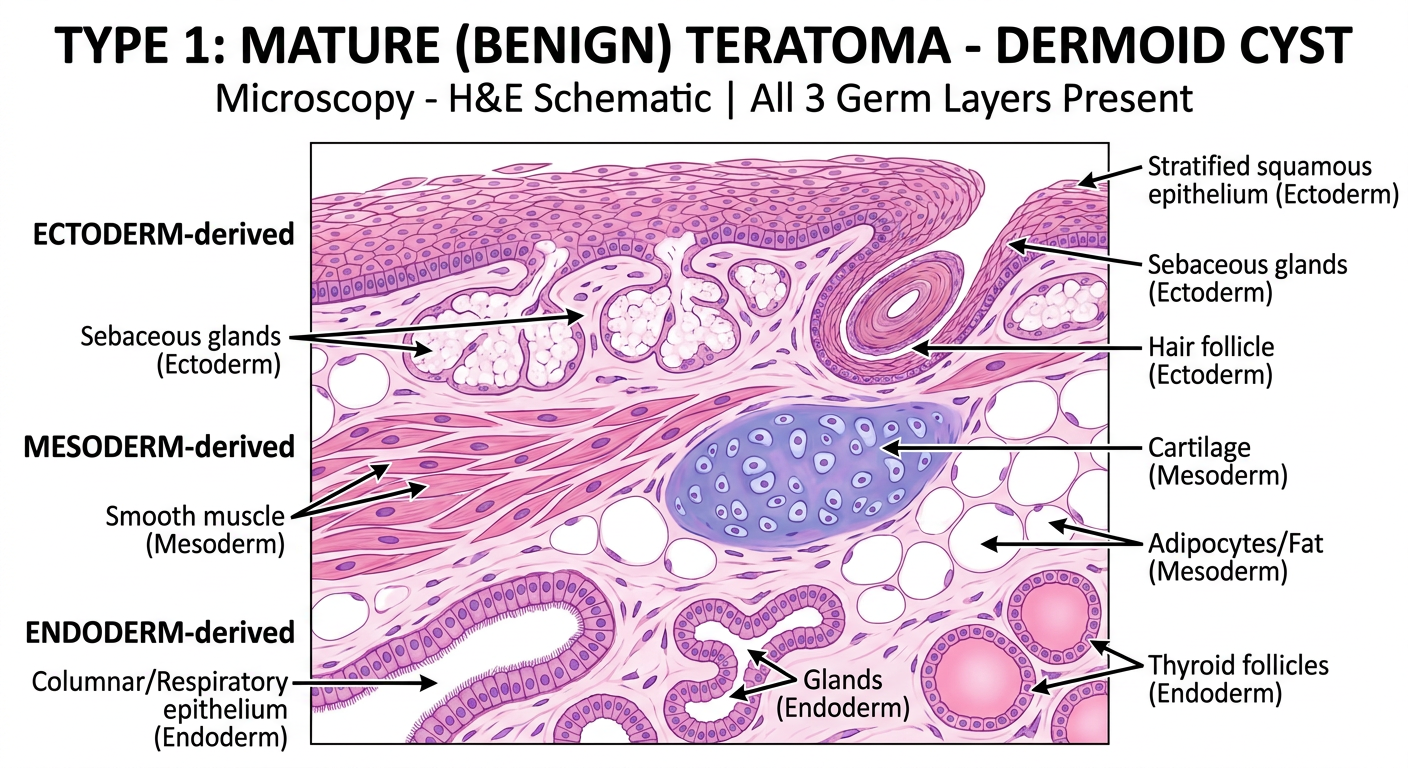
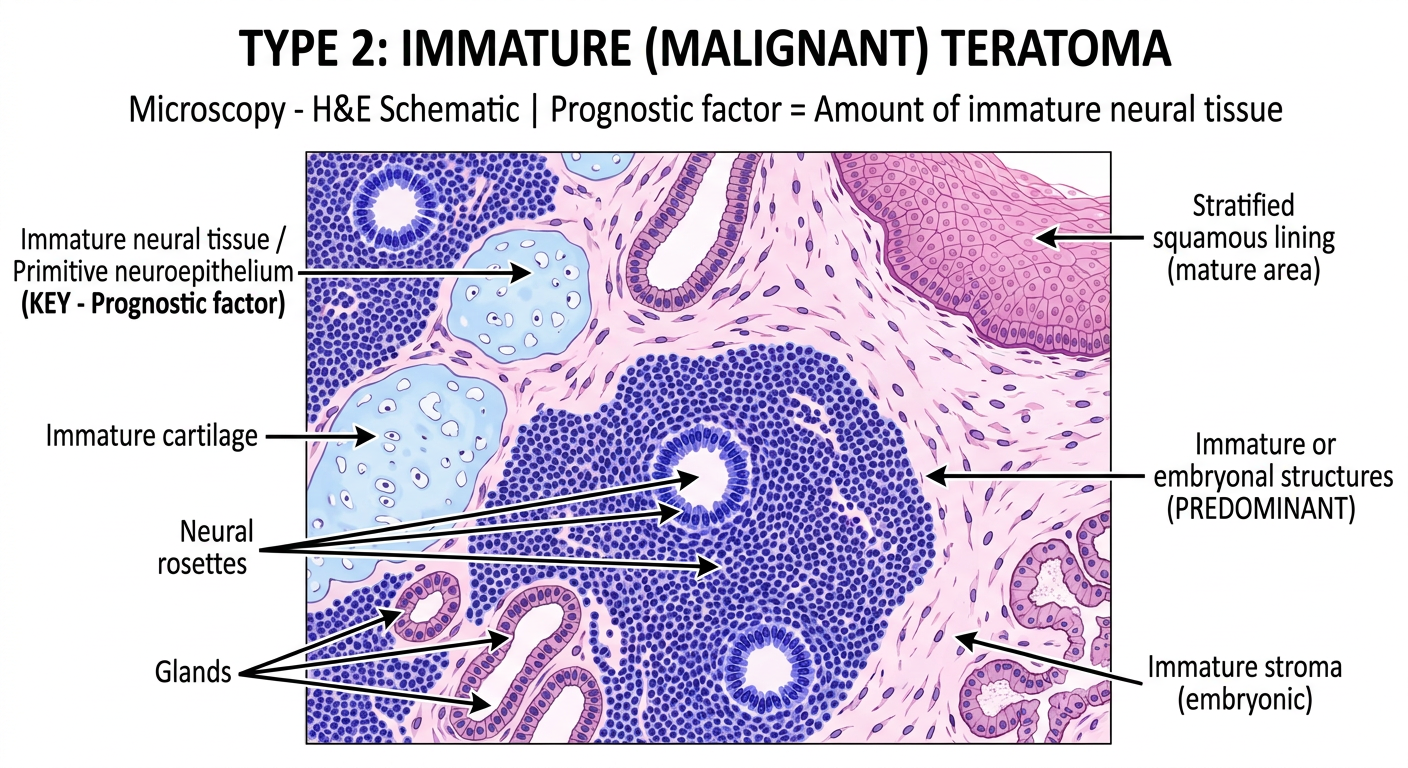
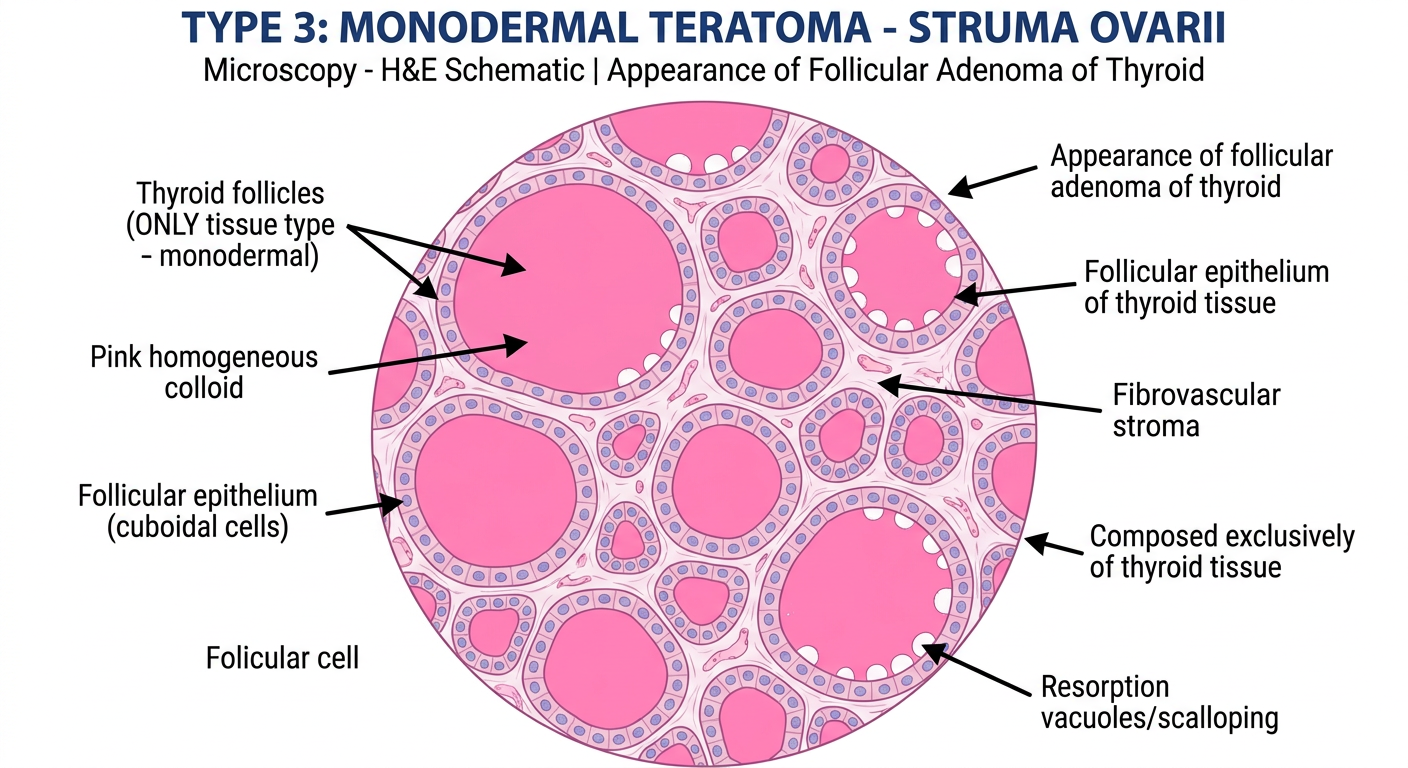
Now, not schematic but actual images of gross specimen of every tyoe of teratoma , with each & every word of feature depicted, given in text in given 2 images.
Photorealistic medical gross pathology specimen photograph of Mature Benign Teratoma - Dermoid Cyst of ovary, shot on black surgical drape background like a real pathology lab photo. Show the specimen cut open (bisected) to reveal the interior clearly: EXTERIOR: Smooth, glistening white-grey ovarian cyst wall, rounded unilocular cyst shape INTERIOR (cut surface fully open and spread): - The cyst cavity is packed with thick, greasy, paste-like yellowish-white sebaceous material (like thick waxy paste) - Visible tangled masses of dark brown-black human hair matted throughout the sebaceous content - A distinct solid nodular protuberance protruding from the inner cyst wall - this is Rokitansky's protuberance - a firm raised bump on the inner wall - Embedded within the Rokitansky's protuberance: a clearly visible white ivory tooth (recognizable molar or incisor shape), a hard white piece of bone/cartilage fragment, other irregular tissue nodules - The sebaceous content has a greasy, paste-like consistency visible in texture - Hair shafts clearly visible mixed in the sebaceous material Photorealistic surgical pathology specimen photo quality, bright even laboratory lighting, sharp focus, high detail. All features must be clearly visible and recognizable. Real anatomical specimen appearance.
Photorealistic medical gross pathology specimen photograph of Immature Malignant Teratoma of ovary, shot on black surgical drape background like a real pathology lab photo. Show a large SOLID unilateral ovarian mass, bisected to show the cut surface: EXTERIOR: Large irregular solid mass, firm, lobulated outer surface, no simple cyst - predominantly solid tumor INTERIOR CUT SURFACE (variegated appearance - this is the key feature): - Large areas of dark red-brown hemorrhage (fresh and old blood-soaked tissue) - Pale cream-white to grey areas of necrosis (soft, friable, dead tissue zones) - Multiple tiny small cysts scattered throughout the solid tissue (small pinpoint to few mm cystic spaces) - Heterogeneous admixture of different tissue elements - different colors and textures visible across the cut surface (pink-tan solid tissue, grey-white firm areas, yellow-white areas) - No single dominant large cyst - entirely different from dermoid cyst - Irregular variegated patchwork of different tissues visible The overall cut surface looks chaotic and heterogeneous - classic malignant appearance with hemorrhage, necrosis, and mixed tissues. Photorealistic surgical pathology specimen photo quality, bright even laboratory lighting, sharp focus, high detail. Real anatomical specimen appearance, placed on black drape.
Photorealistic medical gross pathology specimen photograph of Monodermal Specialised Teratoma - Struma Ovarii of ovary, shot on dark surgical drape background like a real pathology lab photo. Show an ovarian cystic lesion bisected open to reveal interior: EXTERIOR: Ovarian cyst, smooth outer surface, moderate sized INTERIOR CUT SURFACE (must look like thyroid tissue - this is the only tissue type): - Multiple cystic spaces of varying sizes packed with brown-amber gelatinous colloid material (the characteristic appearance of thyroid follicles) - The colloid is glistening, amber-brown, semi-transparent gel-like material filling the cysts - exactly like thyroid colloid - Multiple locules separated by thin white fibrous septa - The brown amber colored colloid-filled spaces are the dominant feature throughout - Overall brownish-amber color of the interior resembling thyroid gland tissue - Some areas show darker brown, some lighter amber translucent colloid - The uterus can be seen as a separate pale structure nearby for size reference The whole interior looks like a cut thyroid gland or multinodular goiter - rich brown colloid-filled follicular spaces. This is the classic appearance of struma ovarii. Photorealistic surgical pathology specimen photo quality, bright even laboratory lighting, sharp focus, high detail. Real anatomical specimen appearance. The colloid must appear as genuine brown gelatinous thyroid-like material.
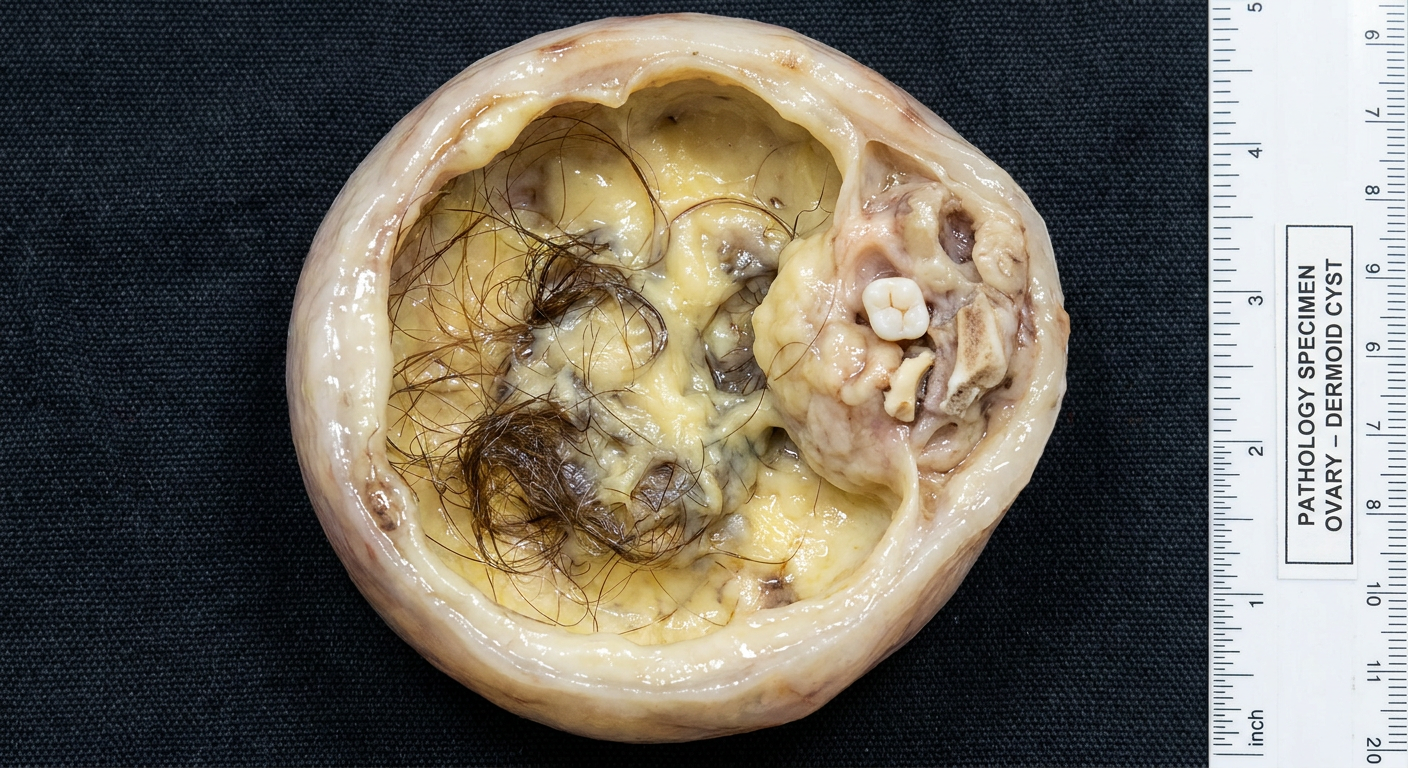
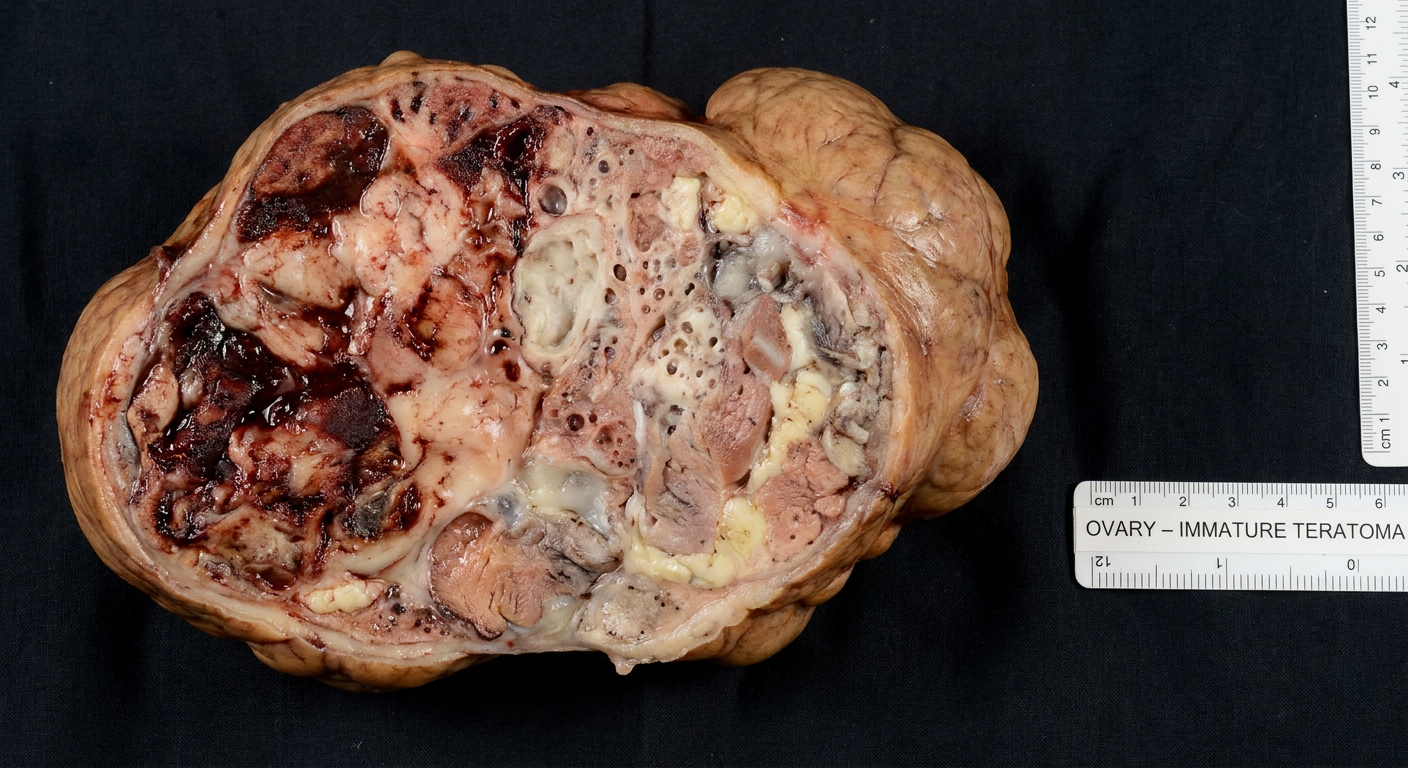
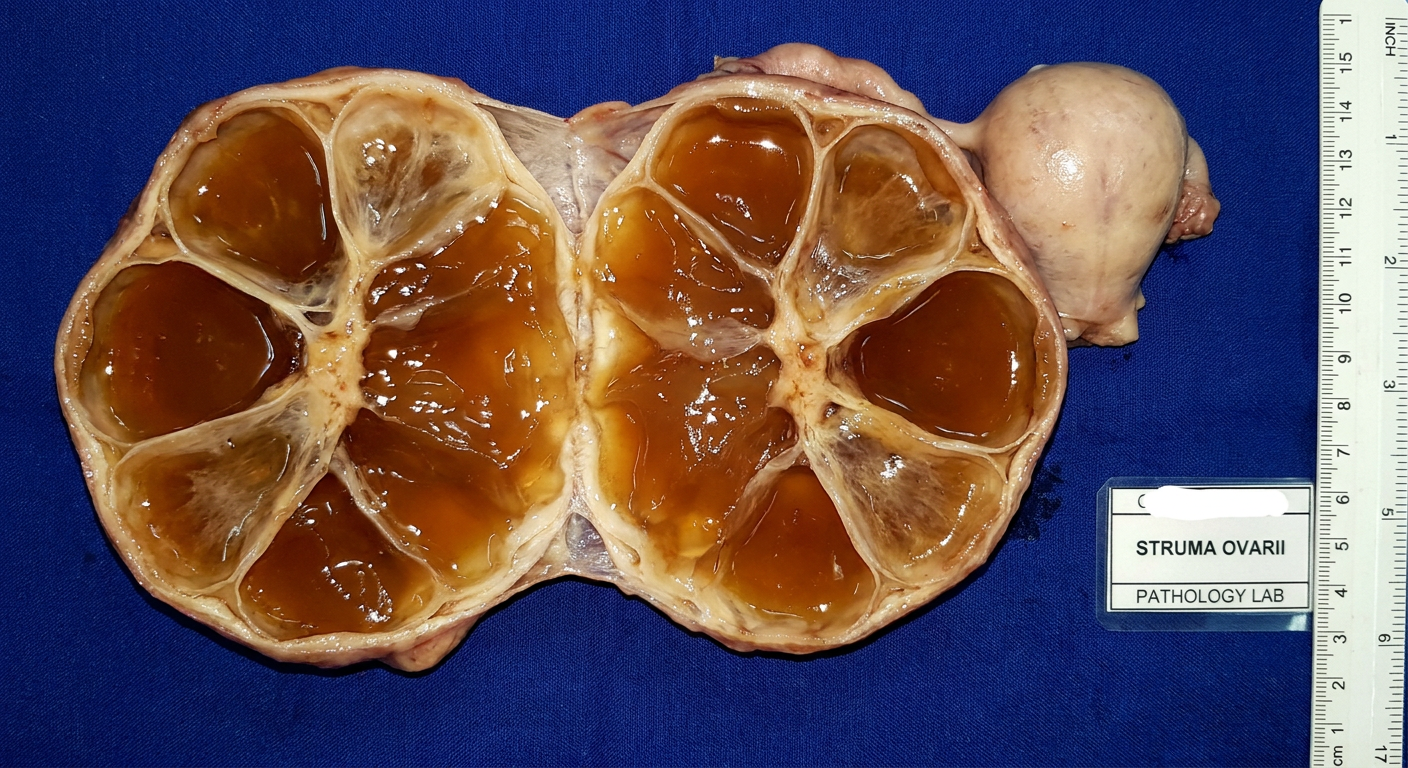
Why you dont labeling the features in picture ?? Do it right now...😡
Photorealistic medical gross pathology specimen photograph of Mature Benign Teratoma - Dermoid Cyst of ovary, bisected open, on black background. The specimen shows all classic features clearly visible. SPECIMEN FEATURES (all must be visible): - Smooth outer unilocular cyst wall (white-grey) - Interior packed with thick yellowish-white paste-like sebaceous secretions and desquamated keratin - Tangled masses of dark brown-black hair mixed in the sebaceous content - A firm solid Rokitansky's protuberance nodule on the inner wall - A white ivory tooth embedded in the protuberance - Bone/cartilage fragment visible - Other odd tissue nodules MANDATORY LABELED ANNOTATIONS directly on the image with white label boxes and black arrow lines pointing to each structure: → Label "Unilocular cyst wall" pointing to outer wall → Label "Sebaceous secretions + Keratin (paste-like)" pointing to the yellowish paste content → Label "Masses of Hair" pointing to the tangled hair → Label "Rokitansky's Protuberance" pointing to the solid inner nodule → Label "Tooth" pointing to the white tooth → Label "Bone / Cartilage" pointing to hard tissue fragment → Label "Odd tissue elements" pointing to other nodules TITLE BAR at top: "TYPE 1: MATURE (BENIGN) TERATOMA — DERMOID CYST | Gross Specimen" White text labels with leader lines/arrows must be clearly readable against the specimen. Professional anatomical pathology photo with annotations overlay.
Photorealistic medical gross pathology specimen photograph of Immature Malignant Teratoma of ovary, large solid mass bisected open showing variegated cut surface, on black background. All classic features clearly visible. SPECIMEN FEATURES (all must be visible): - Large unilateral solid mass (not a cyst) - Variegated cut surface with multiple zones - Dark red-brown areas of haemorrhage - Pale cream-white/grey areas of necrosis - Tiny small cysts scattered in solid tissue - Heterogeneous admixture of various tissue elements with different colors and textures MANDATORY LABELED ANNOTATIONS directly on the image with white label boxes and black arrow lines pointing precisely to each structure: → Label "Unilateral Solid Mass" pointing to overall mass → Label "Variegated Cut Surface" with bracket over entire cut face → Label "Areas of Haemorrhage" pointing to dark red-brown zone → Label "Areas of Necrosis" pointing to pale grey-white zone → Label "Tiny Cysts" pointing to small cystic spaces → Label "Heterogeneous Tissue Elements" pointing to mixed-texture area TITLE BAR at top: "TYPE 2: IMMATURE (MALIGNANT) TERATOMA | Gross Specimen" White text labels with clear leader lines/arrows must be readable against the dark background and specimen. Professional anatomical pathology photo with annotation overlay. Labels must NOT overlap each other.
Photorealistic medical gross pathology specimen photograph of Monodermal Specialised Teratoma - Struma Ovarii of ovary, cystic lesion bisected open, on dark background. Classic thyroid tissue appearance throughout. All features clearly visible. SPECIMEN FEATURES (all must be visible): - Cystic lesion (ovarian cyst cut open) - Interior composed ENTIRELY of mature thyroid tissue - Multiple locules/spaces filled with glistening brown-amber gelatinous colloid (thyroid follicle colloid) - Thin white fibrous septa separating the colloid spaces - Overall brown-amber color of entire interior resembling thyroid gland - Uterus visible as a separate pale structure nearby for anatomical reference MANDATORY LABELED ANNOTATIONS directly on the image with white label boxes and black arrow lines pointing precisely to each structure: → Label "Cystic Lesion" pointing to outer cyst → Label "Composed entirely of mature Thyroid Tissue" with bracket over entire interior → Label "Colloid-filled spaces (Brown-Amber Gelatinous)" pointing to brown colloid → Label "Fibrous septa" pointing to white dividing walls → Label "Thyroid follicular tissue" pointing to a specific zone → Label "Uterus (reference)" pointing to uterus TITLE BAR at top: "TYPE 3: MONODERMAL TERATOMA — STRUMA OVARII | Gross Specimen" White text labels with clear leader lines/arrows must be readable. Professional anatomical pathology photo with annotation overlay. Labels must NOT overlap each other.
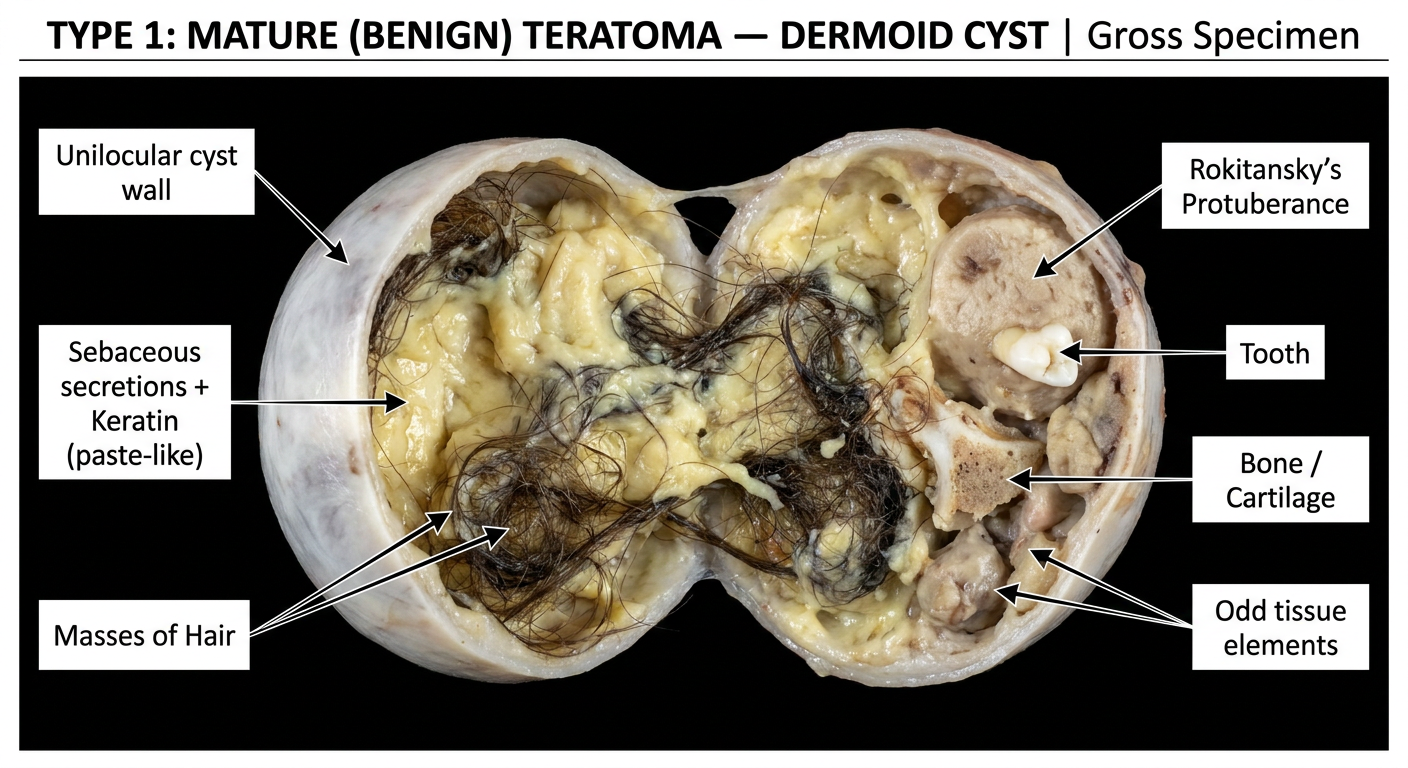
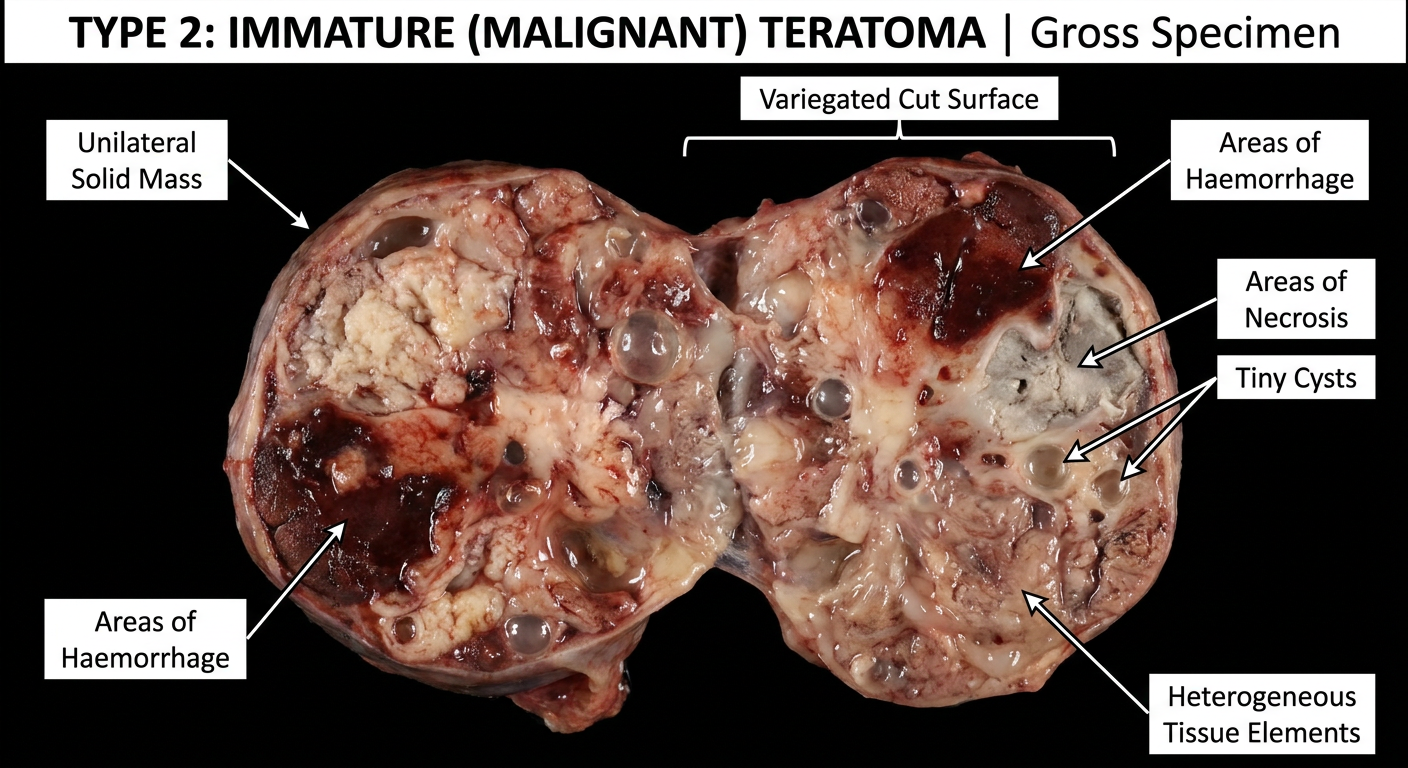
Histology microscopy diagram of liver
Highly detailed labeled histology microscopy diagram of normal liver tissue, H&E stain appearance, professional medical textbook illustration style. Show a well-organized liver lobule cross-section at medium-high magnification with all key histological structures clearly visible and labeled: CENTRAL VEIN: - Central vein (terminal hepatic venule) in the center - large thin-walled vessel - Hepatic sinusoids radiating outward from central vein like spokes of a wheel HEPATOCYTES: - Hepatocytes arranged in cords/plates (hepatic plates) radiating from central vein - large polygonal cells with round central nuclei, abundant eosinophilic (pink) granular cytoplasm, some binucleate cells visible - Hepatocyte cords 1-2 cells thick - Liver cell plates/cords clearly arranged in radiating pattern SINUSOIDS: - Hepatic sinusoids (vascular channels) between hepatocyte cords - irregular, wide capillary-like spaces - Kupffer cells visible lining the sinusoids - large irregular star-shaped cells with dark nuclei projecting into sinusoidal lumen - Space of Disse (perisinusoidal space) between sinusoidal endothelium and hepatocytes PORTAL TRIAD (at periphery/corner of lobule): - Portal tract containing 3 structures grouped together: 1. Portal vein branch (largest, thin-walled, irregular) 2. Hepatic artery branch (small, thick-walled, round, muscular) 3. Bile duct (simple cuboidal epithelium, round lumen) - Surrounding connective tissue (portal stroma) BILE CANALICULI: - Bile canaliculi between adjacent hepatocytes (tiny channels between hepatocyte membranes) LIMITING PLATE: - Periportal hepatocytes forming the limiting plate around portal tract ALL LABELS with clear arrows pointing to exact structures: → "Central Vein (Terminal Hepatic Venule)" → "Hepatocytes (Hepatic plates/cords)" → "Binucleate hepatocyte" → "Hepatic Sinusoids" → "Kupffer Cells" → "Space of Disse" → "Portal Tract / Portal Triad" → "Portal Vein branch" → "Hepatic Artery branch" → "Bile Duct" → "Bile Canaliculi" → "Limiting Plate" TITLE at top: "NORMAL LIVER — HISTOLOGY (H&E)" Subtitle: "Hepatic Lobule Structure" H&E color scheme: pink eosinophilic hepatocyte cytoplasm, purple-blue nuclei, pale pink sinusoidal walls, red blood cells in vessels (red), pale connective tissue stroma. Accurate medical histology textbook quality with all labels neat, non-overlapping, with clear leader lines.
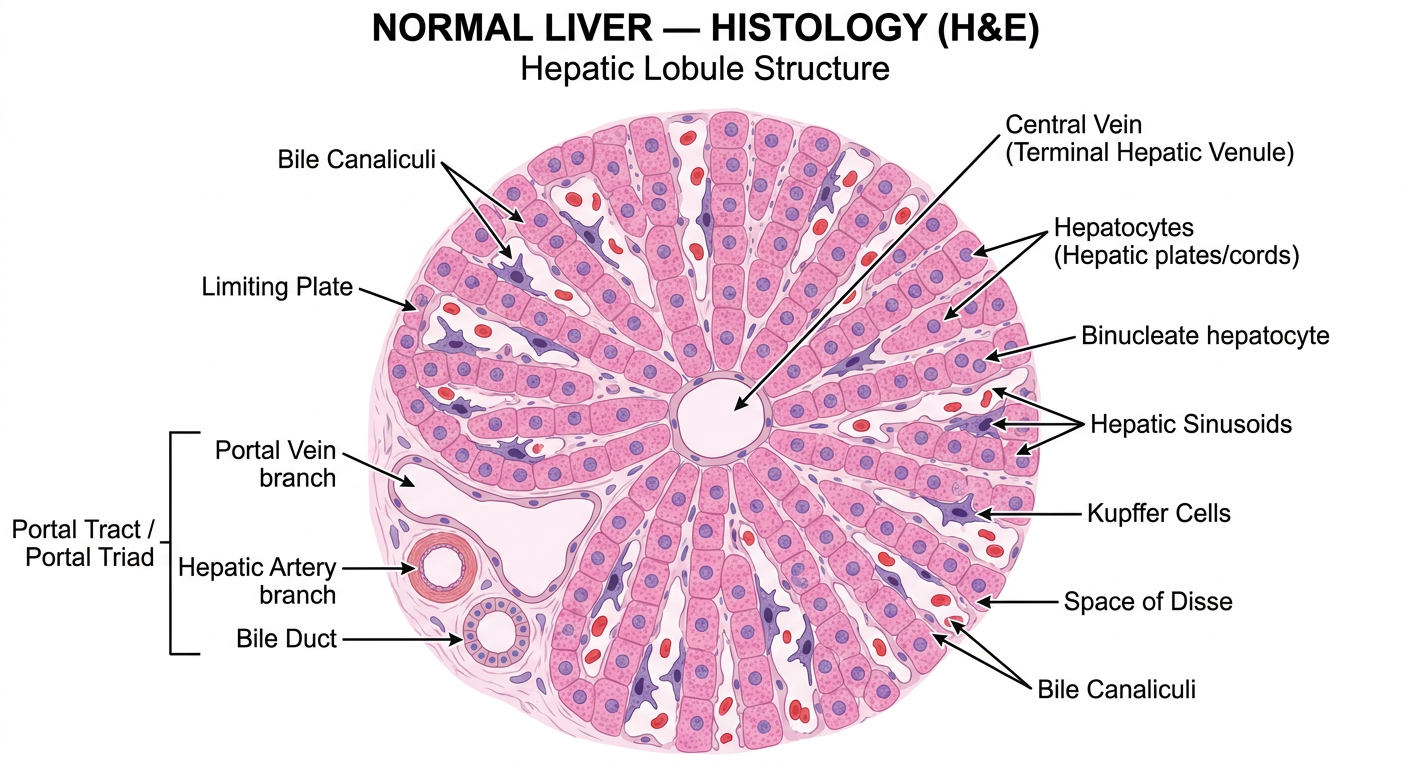
| Structure | Key Features |
|---|---|
| Central Vein | Terminal hepatic venule at lobule center |
| Hepatocytes | Polygonal cells in radiating cords/plates, pink cytoplasm, some binucleate |
| Hepatic Sinusoids | Wide irregular vascular channels between hepatocyte cords |
| Kupffer Cells | Star-shaped macrophages lining sinusoids |
| Space of Disse | Perisinusoidal space between endothelium and hepatocytes |
| Portal Triad | Portal vein + hepatic artery + bile duct grouped in portal tract |
| Bile Canaliculi | Tiny channels between adjacent hepatocyte membranes |
| Limiting Plate | Periportal hepatocytes bordering the portal tract |
Histology microscopy of liver. H & E schematic
Highly detailed schematic H&E histology diagram of normal liver tissue, clean medical illustration style on white background, like a textbook teaching diagram. Draw a clear schematic cross-section of a hepatic lobule at medium magnification showing every structure in precise H&E color scheme: CENTRAL VEIN (center of image): - Large round thin-walled vessel at the center, lumen containing pale pink plasma with scattered red blood cells (red discs) - Label: "Central Vein (Terminal Hepatic Venule)" HEPATOCYTE CORDS/PLATES (radiating outward from central vein like wheel spokes): - Hepatocytes drawn as large polygonal cells with distinct cell borders - Abundant pink (eosinophilic) granular cytoplasm - Large round central nucleus with purple-blue hematoxylin staining, visible nucleolus - Some cells showing 2 nuclei (binucleate) - label one - Cords are 1-2 cells thick, clearly radiating pattern - Label: "Hepatocytes", "Hepatic Cord (1-2 cells thick)", "Binucleate hepatocyte" HEPATIC SINUSOIDS (between hepatocyte cords): - Irregular, wide vascular channels between the hepatocyte cords - Lined by flat endothelial cells - Kupffer cells: large irregular star-shaped cells with dark nuclei protruding into sinusoidal space, brown-purple cytoplasm - Scattered red blood cells (red) inside sinusoidal lumen - Label: "Hepatic Sinusoid", "Kupffer Cell (resident macrophage)", "Sinusoidal endothelial cell" SPACE OF DISSE: - Narrow clear space between sinusoidal endothelium and hepatocyte surface - Label: "Space of Disse (perisinusoidal space)" BILE CANALICULI: - Tiny intercellular channels between adjacent hepatocytes, shown as small dark lines/spaces between hepatocyte cell membranes - Label: "Bile Canaliculus" PORTAL TRIAD (at 2-3 corners of the lobule, peripheral): Draw portal tract with all 3 components surrounded by loose connective tissue stroma: 1. PORTAL VEIN BRANCH - largest, thin-walled, irregular shaped lumen, pale wall Label: "Portal Vein branch (largest)" 2. HEPATIC ARTERY BRANCH - small, round, THICK muscular wall (tunica media visible), smaller lumen Label: "Hepatic Artery branch (thick wall, small)" 3. BILE DUCT - round, lined by simple cuboidal to low columnar epithelium, cells with round nuclei Label: "Bile Duct (cuboidal epithelium)" 4. Surrounding portal connective tissue stroma (pale pink) Label: "Portal Tract / Portal Triad" LIMITING PLATE: - Row of hepatocytes immediately surrounding the portal tract - Label: "Limiting Plate (periportal hepatocytes)" ZONE DEMARCATION (optional overlay): - Dotted lines showing Zone 1 (periportal), Zone 2 (mid-lobular), Zone 3 (centrilobular) of hepatic acinus - Label zones lightly TITLE at very top in bold dark text: "LIVER — H&E SCHEMATIC HISTOLOGY" Subtitle: "Hepatic Lobule | All structures labeled" STRICT H&E COLOR PALETTE: - Hepatocyte cytoplasm: medium pink (eosin) - Nuclei: dark purple-blue (hematoxylin) - Red blood cells: bright red/orange - Collagen/stroma: pale light pink - Bile duct epithelium: purple-blue nuclei, pale cytoplasm - Kupffer cells: dark purple irregular shape - Sinusoid walls: thin, pale - Cartilage (none here) - Background: pure white Style: Clean schematic medical illustration, not photorealistic - clearly drawn cell outlines, uniform coloring, no photographic texture. All labels in black text with neat leader lines and arrowheads. Labels placed outside the specimen area pointing inward. No overlapping labels. High resolution, highly detailed, professional medical atlas quality.
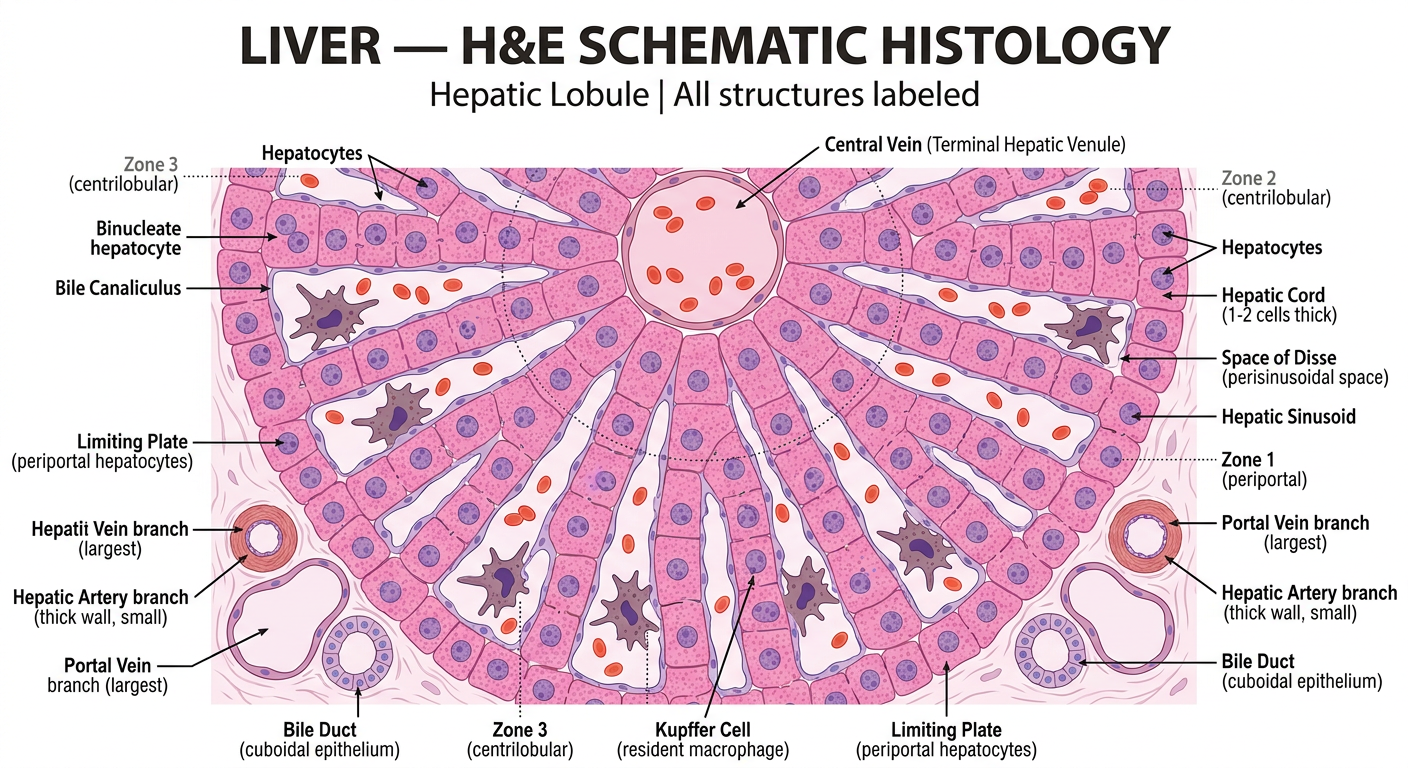
| Structure | H&E Appearance |
|---|---|
| Central Vein | Large thin-walled vessel at lobule center, pale lumen |
| Hepatocytes | Large polygonal cells, pink cytoplasm, purple-blue round nuclei, some binucleate |
| Hepatic Cords | 1-2 cell thick plates radiating outward from central vein |
| Hepatic Sinusoids | Irregular wide channels between hepatocyte cords, red cells inside |
| Kupffer Cells | Large dark star-shaped macrophages lining sinusoids |
| Space of Disse | Narrow perisinusoidal space between endothelium and hepatocytes |
| Bile Canaliculi | Tiny intercellular channels between hepatocyte membranes |
| Portal Triad | Portal vein (largest, thin-walled) + hepatic artery (small, thick-walled) + bile duct (cuboidal epithelium) |
| Limiting Plate | Periportal hepatocyte row bordering the portal tract |
| Zones 1-2-3 | Periportal → mid-lobular → centrilobular (acinar zones) |