
Angiotensin 2 actions
Reading File
Now let me search the medical library for Angiotensin II actions in parallel:
Finding Sources
Finding Sources
Good results. Let me now read the most relevant sections in parallel - Costanzo Physiology, Brenner & Rector (physiologic effects), and Katzung Pharmacology:
Reading File
Reading File
Reading File
Excellent content from Costanzo and Brenner & Rector. Let me now read the Katzung pharmacology section on Angiotensin and also read more from Brenner & Rector on tubule transport and the AT2 receptor actions:
Reading File
Reading File
I now have comprehensive content from multiple authoritative textbooks. Let me also fetch the Katzung angiotensin II pharmacological actions section and the RAS diagram image:
Reading File
Loading Image
Now let me read the Katzung section specifically on Ang II pharmacological actions (receptors and effects):
Reading File
I now have comprehensive information from Katzung, Costanzo, and Brenner & Rector. I have enough to provide a thorough answer.
Angiotensin II (Ang II) - Actions
Angiotensin II is a biologically active octapeptide (Asp-Arg-Val-Tyr-Ile-His-Pro-Phe) produced via the renin-angiotensin system. It is one of the most potent vasopressors known - roughly 40 times more potent than norepinephrine on a molar basis. Its actions are mediated primarily through AT1 receptors (Gq-coupled GPCRs), with opposing effects mediated by AT2 receptors.
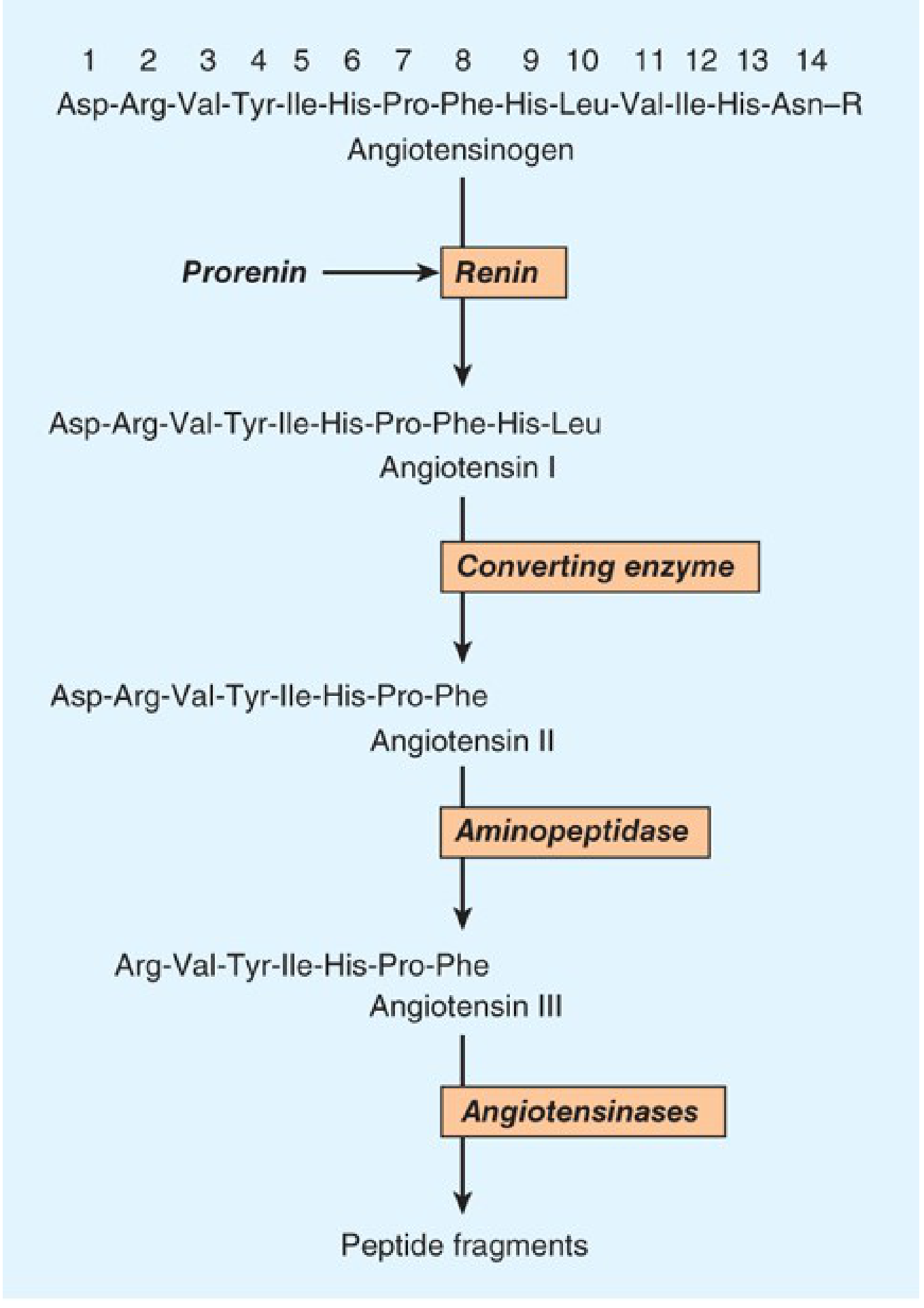
1. Cardiovascular Actions (Blood Pressure)
- Direct vasoconstriction: Ang II binds AT1 receptors on vascular (especially arteriolar) smooth muscle, activating an IP3/Ca²+ second messenger system, causing potent vasoconstriction and increasing total peripheral resistance (TPR), raising blood pressure.
- Rapid onset: The pressor response to IV Ang II begins within 10-15 seconds and is sustained during long-term infusion.
- Baroreceptor resetting: Ang II acts on the brain to reset the baroreceptor reflex to a higher pressure set-point, reducing efferent vagal tone - so the pressor response is NOT accompanied by reflex bradycardia.
- Autonomic stimulation: Stimulates sympathetic ganglia, increases epinephrine/norepinephrine release from the adrenal medulla, and facilitates sympathetic transmission (increased NE release + reduced NE reuptake).
- Cardiac: Minor positive inotropic effect; physiologic significance is unclear. (Katzung's Basic and Clinical Pharmacology, 16th Edition)
2. Adrenal Cortex
- Stimulates aldosterone synthesis and release from the zona glomerulosa - the most important indirect mechanism for sodium and water retention.
- At higher concentrations, also stimulates glucocorticoid synthesis.
- Aldosterone acts on principal cells of the distal tubule and collecting duct to increase Na+ reabsorption - this process requires gene transcription/new protein synthesis, accounting for the slow (hours to days) response time of RAAS. (Costanzo Physiology, 7th Edition)
3. Renal Actions
Ang II has dose-dependent effects on the kidney:
- At low doses: Increases renal vascular resistance (RVR) and lowers renal blood flow (RBF) without affecting GFR - filtration fraction increases.
- At higher doses: Further increases RVR with reduction in both RBF and GFR; filtration fraction still elevated.
- Afferent and efferent arteriolar constriction: Ang II constricts both arterioles, but preferentially raises efferent arteriolar resistance - maintaining GFR despite reduced RBF.
- Proximal tubule Na+ reabsorption (direct effect): Stimulates the luminal Na+/H+ exchanger and basolateral Na+/HCO3- cotransporter and Na+-K+ ATPase at picomolar concentrations - enhances Na+ and HCO3- reabsorption independently of aldosterone. (At concentrations >10⁻⁹ M, these same transporters are inhibited - biphasic effect.)
- Distal tubule: Stimulates apical Na+/H+ exchange (early distal tubule) and amiloride-sensitive Na+ channels (late distal tubule).
- Acid-base regulation: In collecting duct, stimulates vacuolar H+-ATPase in intercalated A-cells via AT1R, promoting H+ secretion.
- Intraglomerular pressure: Raises intraglomerular capillary pressure (Pgc) and reduces the ultrafiltration coefficient (Kf). Chronic infusion can lead to glomerular capillary damage and proteinuria. (Brenner and Rector's The Kidney)
4. Brain Actions
- Thirst: Acts on the hypothalamus to stimulate thirst and increase water intake.
- ADH secretion: Stimulates antidiuretic hormone (ADH/vasopressin) release from the posterior pituitary, increasing water reabsorption in collecting ducts.
- Salt craving: Directly promotes salt appetite.
- Baroreceptor resetting (as noted above). (Costanzo Physiology, 7th Edition)
5. AT2 Receptor Actions (opposing AT1)
AT2 receptor stimulation generally opposes AT1 effects:
- Vasodilation (via increased NO synthesis and cGMP - bradykinin-dependent and independent mechanisms)
- Natriuresis (AT2R is abundant on proximal tubule epithelium)
- AT2 effects appear to be counter-regulatory against the pressor/volume-retaining actions of AT1 (Brenner and Rector's The Kidney)
Summary Table
| Target Organ | AT1-Mediated Action | Net Effect |
|---|---|---|
| Vascular smooth muscle | Vasoconstriction (IP3/Ca²+) | ↑ BP, ↑ TPR |
| Adrenal cortex (zona glomerulosa) | ↑ Aldosterone release | ↑ Na+ and water retention |
| Kidney - arterioles | Constriction (afferent + efferent) | ↑ RVR, ↑ filtration fraction |
| Kidney - proximal tubule | ↑ Na+/H+ exchange, ↑ NaHCO3 reabsorption | ↑ Na+ and HCO3- reabsorption |
| Kidney - collecting duct | ↑ H+-ATPase | ↑ H+ secretion |
| Brain - hypothalamus | ↑ Thirst, ↑ ADH | ↑ Water intake and retention |
| Adrenal medulla | ↑ Epi/NE release | ↑ Sympathetic tone |
| Autonomic ganglia | Stimulation | ↑ Sympathetic transmission |
| Heart | Minor positive inotropy | Minor ↑ contractility |
Clinical relevance: ACE inhibitors (e.g., captopril, enalapril) block ALL of the above AT1-mediated actions by preventing Ang II formation. Angiotensin receptor blockers (ARBs, e.g., losartan) block AT1 receptors directly, providing more complete blockade of Ang II actions without affecting bradykinin levels (unlike ACE inhibitors). Ang II has also received FDA approval as a vasopressor for vasodilatory shock unresponsive to catecholamines. - Katzung's Basic and Clinical Pharmacology, 16th Edition
This is a shared conversation. Sign in to Orris to start your own chat.