
Classify lower-limb orthoses based on their anatomical region and functional purpose.
Reading File
Now let me search the medical library for content on lower-limb orthoses.
Finding Sources
Finding Sources
Finding Sources
Finding Sources
Good - Miller's Review of Orthopaedics has a dedicated block on orthoses. Let me read it fully.
Reading File
Finding Sources
Reading File
Finding Sources
Excellent - I've found the dedicated orthoses section. Let me read the rest of it and also check Campbell's orthoses section.
Reading File
Reading File
Now let me also get the table that shows the classification of orthoses and their indications from Miller's block 2, and also check the neurology text for clinical context.
Reading File
Reading File
Searching Images
lower limb orthosis types AFO KAFO HKAFO classification diagram
I now have comprehensive information from the textbooks. Let me compile a thorough, well-structured answer.
Classification of Lower-Limb Orthoses
Lower-limb orthoses (LLOs) are external devices that modulate directional forces from the body and joints to control motion, support deformities, protect healing structures, and substitute for lost function. They are named by the joints they span and, increasingly, by their functional purpose.
I. By Anatomical Region (Regional Classification)
1. Foot Orthoses (FO)
Cover only the plantar surface of the foot (within the shoe).
| Type | Material | Functional Purpose |
|---|---|---|
| Rigid FO | Hard plastic/carbon fiber | Limit joint motion; stabilize flexible deformities |
| Semirigid FO | Semi-flexible plastic | Provide support + absorb shock |
| Soft FO | Foam/viscoelastic | Accommodate fixed deformities; pressure relief for neuropathic/dysvascular/ulcerative feet |
Shoes as orthoses - Specially designed footwear can serve orthotic functions:
- Extra-depth shoes (high toe box): dissipate pressure over bony prominences; recommended for diabetic patients
- SACH heels: absorb initial loading shock; lessen force transmission to the midfoot
- Rocker soles: reduce bending forces on arthritic/stiff midfoot; used for metatarsalgia, hallux rigidus, and forefoot problems; must be rigid to be effective
- Medial heel out-flaring: treats severe flatfoot; used with a foot orthosis
2. Ankle-Foot Orthosis (AFO)
Spans from below the knee to the foot. The most commonly prescribed lower-limb orthosis.
Construction:
- Metal double-upright bars attached to the shoe (greater rigidity; better for mediolateral instability; adjustable; heavier)
- Thermoplastic elastomer (TPE) shell fitting inside a shoe (lightweight; cosmetically preferred)
Subtypes by rigidity and motion allowed:
| Subtype | Motion Permitted | Indication |
|---|---|---|
| Rigid (solid) AFO | None | Flaccid foot drop; severe plantar spasticity; post-hindfoot fusion |
| Posterior leaf-spring AFO | Some dorsiflexion allowed in swing | Excessive ankle plantar flexion during swing phase of gait |
| Hinged AFO (articulated) | Free or spring-assisted plantar flexion/dorsiflexion | Hemiparesis; allows heel strike and rising to stand; can be fine-tuned |
| Plantar-flexion-stop AFO | Limits plantar flexion only | Footdrop; CVA with hemiplegia |
| Arizona brace | Controls hindfoot | Hindfoot arthritis; midfoot collapse |
Key clinical indications:
- Footdrop (any cause - stroke, peripheral nerve palsy, Charcot-Marie-Tooth, SCI)
- Plantar spasticity after stroke or spinal cord injury
- Post-hindfoot arthrodesis (absorb GRF, protect fusion sites, protect midfoot)
- Ankle osteoarthritis (with rocker-bottom shoe)
- Mediolateral subtalar instability
- Inadequate dorsiflexion for heel contact or toe clearance in swing phase
AFO angulation effects on the knee:
- Slight plantar flexion → extends the knee earlier (helps knee buckling in stance)
- 5 degrees of dorsiflexion → decreases knee hyperextension (prevents snap-back in midstance)
3. Knee Orthosis (KO)
Spans only the knee joint (subset of KAFO).
Functional purposes:
- Relieve pain in knee osteoarthritis (unloader braces offload medial/lateral compartment)
- Stabilize the patella-deficient knee
- Stabilize the ACL-deficient knee
- Facilitate post-operative rehabilitation
4. Knee-Ankle-Foot Orthosis (KAFO)
Extends from the upper thigh to the foot; controls both the knee and ankle-foot complex.
Functions:
- Controls unstable knee joint (primary indication)
- Provides mediolateral stability of the knee
- Prescribed amounts of flexion or extension control
- Stabilizes ankle and foot in plantigrade position (prevents equinus/equinovarus)
- Provides stability for patients with proximal muscle weakness
Knee-lock designs: Vary from drop-lock (manual engagement), bail lock (easier unlocking), ratchet lock, and stance-control locks (allow swing-phase flexion while locking in stance).
Clinical indications: Polio, post-SCI ambulation (with metal uprights), muscular dystrophy, myelomeningocele (L3 level), severe hemiplegia with knee snap-back.
In myelomeningocele: KAFO is used for the L3 level (household ambulation); AFO suffices for L4-L5 (community ambulation); HKAFO is needed for L1-L2 (non-functional/therapeutic walking).
5. Hip-Knee-Ankle-Foot Orthosis (HKAFO)
Extends from the pelvis/hip to the foot; provides hip, knee, and ankle-foot control simultaneously.
Functions:
- Provides hip and pelvic stability
- Enables therapeutic upright activities for high-level paralysis
Limitations:
- Cumbersome; rarely used by adult paraplegics because of high energy expenditure for minimal functional gain
- In experimental settings: used with implanted electrodes and computerized functional stimulation for SCI patients
Special variant - Reciprocating Gait Orthosis (RGO):
- Modified HKAFO with wire cables linking hip flexion on one side to hip extension on the contralateral side
- Used in children with upper lumbar myelomeningocele (L1-L2) for therapeutic upright activities and simulated walking
- Also used in select thoracic-level SCI patients for short-distance ambulation
6. Hip Orthosis (HO)
Spans the hip joint only (not extending to knee).
Examples and indications:
- Pavlik harness: the mainstay for early treatment of developmental dysplasia of the hip (DDH) in infants; holds the hip in flexion and abduction
- Abduction orthoses (e.g., Rhino cruiser, Denis Browne bar): for DDH after Pavlik harness treatment or post-reduction
- Hip spica orthoses: post-operative hip containment
II. By Functional Purpose (Functional Classification)
| Functional Category | Definition | Examples |
|---|---|---|
| Static/Immobilizing | Prevent all motion; rest the joint | Rigid AFO, solid ankle cast brace, rigid KO |
| Static-progressive | Incrementally stretch a contracted joint over time | Serial casting AFO, turnbuckle KAFO for knee flexion contracture |
| Dynamic | Allow controlled motion via springs, hinges, or elastics; resist or assist movement | Hinged AFO, spring-loaded posterior leaf-spring, stance-control KAFO |
| Corrective | Gradually correct a flexible/passable deformity | Twister cables (rotational deformities), Denis Browne bar |
| Accommodative | Accommodate a fixed deformity without attempting correction | Soft foot orthosis for neuropathic foot, custom molded AFO for fixed equinus |
| Functional/Stabilizing | Substitute for absent/weak muscle function or stabilize unstable joints | AFO for footdrop, KAFO for quadriceps weakness, RGO for paraplegia |
| Unloading/Protective | Reduce mechanical stress on painful or healing tissues | Unloader KO for OA, Arizona brace for hindfoot arthritis, post-fusion AFO |
| Fracture braces | Maintain alignment of healing fractures while allowing function | Tibial fracture brace (below-knee), prefabricated ankle fracture orthosis |
III. Summary Hierarchy by Region
Lower-Limb Orthoses
├── Foot Orthosis (FO)
│     ├── Rigid
│     ├── Semirigid
│     └── Soft
├── Ankle-Foot Orthosis (AFO)
│     ├── Rigid / solid ankle
│     ├── Posterior leaf-spring
│     ├── Hinged (articulated)
│     └── Plantar-flexion-stop
├── Knee Orthosis (KO)
│     ├── Unloader (OA)
│     ├── Patellar stabilizing
│     └── Ligamentous (ACL)
├── Knee-Ankle-Foot Orthosis (KAFO)
│     └── With various knee-lock designs
├── Hip-Knee-Ankle-Foot Orthosis (HKAFO)
│     └── Reciprocating Gait Orthosis (RGO) [modified HKAFO]
└── Hip Orthosis (HO)
      ├── Pavlik harness
      └── Abduction orthoses
Key Principles
- Orthoses are not indicated for fixed deformities that cannot be passively corrected or for spastic deformities that cannot be easily controlled manually.
- Orthoses are named by the joints they control, the function they provide, and the method of obtaining control - e.g., a short-leg below-knee brace = AFO.
- Orthoses may be static, static-progressive, or dynamic in their mechanism.
- Material choice (metal uprights vs. thermoplastic) affects rigidity, weight, adjustability, and cosmesis - each has distinct clinical roles.
Sources: Miller's Review of Orthopaedics 9th Ed, Section 4 Orthoses, pp. 885-887 | Campbell's Operative Orthopaedics 15th Ed 2026 | Bradley and Daroff's Neurology in Clinical Practice
for 20mRKWER ANSWER IN DETAILED
I want to make sure I give you exactly what you need. "20mRKWER" isn't clear to me - could you clarify?
Asking for Preferences
What does '20mRKWER' refer to? Please clarify what you'd like a detailed answer on.
Got it - you want a 20-mark exam-style answer on the classification of lower-limb orthoses. Let me pull deep content from the textbooks to build a full, structured answer.
Searching sources...
Finding Sources
Finding Sources
Reading File
Finding Sources
Reading File
Finding Sources
Finding Sources
Finding Sources
Reading File
I now have everything needed for a comprehensive 20-mark exam answer. Here it is:
Classification of Lower-Limb Orthoses
Introduction (2 marks)
An orthosis is an externally applied device used to modify the structural and functional characteristics of the neuromuscular and skeletal systems. The primary function of an orthosis is control of the motion of certain body segments. Orthoses are used to:
- Protect long bones or unstable joints
- Support flexible deformities
- Substitute for a functional task (e.g., weak muscle group)
- Facilitate fracture healing while allowing function
They may be static (prevent all motion), static-progressive (incrementally stretch contracted tissues), or dynamic (allow controlled, spring-assisted, or resisted motion).
Key principle: Orthoses are NOT indicated for fixed deformities that cannot be passively corrected, or for spastic deformities that cannot be easily controlled manually.
Orthoses are named by the joints they control - e.g., a below-knee short-leg brace = Ankle-Foot Orthosis (AFO).
I. Classification by Anatomical Region (12 marks)
A. Shoes and Shoe Modifications
The simplest level of lower-limb orthotic intervention. Two shoe types are used: the Blucher (open throat), which better accommodates foot orthoses, and the Bal (closed throat).
| Modification | Mechanism | Indication |
|---|---|---|
| Extra-depth shoe (high toe box) | Dissipates local pressure over bony prominences | Claw toes, diabetic foot |
| SACH (Solid Ankle Cushion Heel) | Absorbs shock of initial loading; reduces midfoot force transmission | Post-amputation, arthritic ankle |
| Rocker sole (must be rigid) | Lessens bending forces on stiff/arthritic midfoot during midstance | Metatarsalgia, hallux rigidus, forefoot stiffness |
| Medial heel out-flare | Shifts ground reaction force medially | Severe flatfoot (used with FO) |
| Pressure-dissipating insole | Distributes plantar pressure | Insensate/neuropathic foot |
B. Foot Orthosis (FO)
Covers only the plantar foot surface; used within the shoe. Functions: align and support the foot, prevent/correct/accommodate deformities, improve foot function.
| Type | Material | Properties | Indication |
|---|---|---|---|
| Rigid FO | Hard plastic, carbon fiber | Limits joint motion | Stabilize flexible deformities |
| Semirigid FO | Semi-flexible plastic | Balances support and shock absorption | General biomechanical correction, sports |
| Soft FO | Viscoelastic foam | Best shock absorption; accommodates fixed deformity | Neuropathic foot, dysvascular ulcers, fixed deformities |
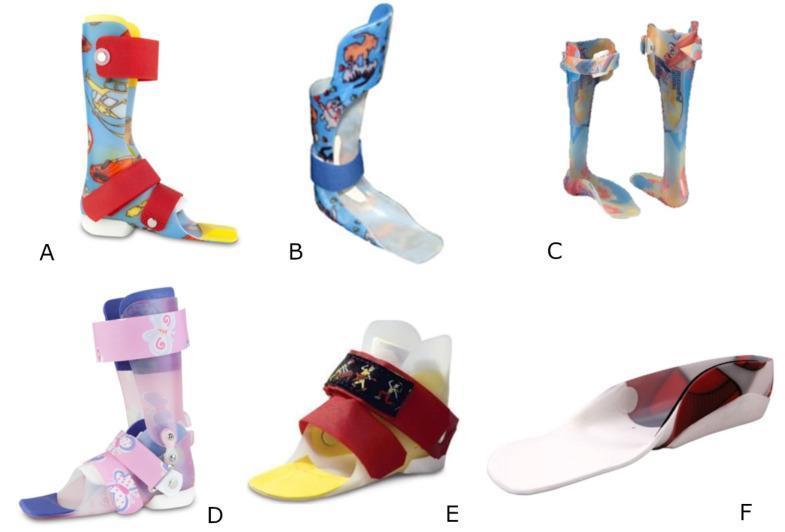
C. Ankle-Foot Orthosis (AFO) (Most common lower-limb orthosis)
Spans from below knee to foot. Controls the ankle joint and indirectly affects the knee.
Construction:
- Metal double-upright attached to shoe: greater rigidity, adjustable, better for severe mediolateral instability, heavier
- Thermoplastic elastomer (TPE) shell: lightweight, cosmetic, fits inside shoe, trim lines determine control level
Subtypes:
| Subtype | Motion | Indication |
|---|---|---|
| Rigid (solid-ankle) AFO | No ankle motion | Severe flaccid footdrop, plantar spasticity, post-hindfoot fusion, SCI |
| Posterior Leaf Spring (PLS) AFO | Allows limited dorsiflexion in swing | Mild footdrop; excessive plantar flexion in swing phase |
| Hinged (articulated) AFO | Free or controlled sagittal motion via mechanical joint | Hemiplegia; allows heel strike and active push-off; fine-tunable |
| Plantar-flexion-stop AFO | Blocks plantar flexion only | Footdrop (CVA, peroneal nerve palsy) |
| Ground Reaction AFO (GRAFO) | Anterior shell; creates knee extension moment | Crouch gait (cerebral palsy), quadriceps weakness |
| Supra-malleolar orthosis (SMO) | Full ankle ROM; controls hindfoot only | Hindfoot valgus/varus in children |
| Arizona brace | Lace-up; controls hindfoot and ankle | Hindfoot arthritis, posterior tibial tendon dysfunction |
Trimlines and control: Full/anterior trimline → maximum mediolateral control; posterior trimline → posterior leaf spring effect. Choice considers function, level of control, limb sensation, and swelling.
AFO angulation and knee effects (clinically important):
- Angling AFO in slight plantar flexion → extends the knee earlier in stance (treats knee buckling in hemiplegia)
- Angling AFO in 5° dorsiflexion → reduces knee hyperextension / snap-back in midstance
Primary AFO indications:
- Footdrop (any cause - CVA, SCI, peroneal palsy, Charcot-Marie-Tooth disease)
- Plantar spasticity (CVA, SCI)
- Post-hindfoot arthrodesis (absorbs GRF, protects fusion and midfoot)
- Ankle arthritis (with rocker-bottom shoe)
- Mediolateral subtalar instability
- Toe clearance failure in swing phase
D. Knee Orthosis (KO)
Spans the knee joint only (a subset of KAFO when used in isolation).
| Type | Indication |
|---|---|
| Unloader (valgus/varus) brace | Knee osteoarthritis - offloads the affected compartment |
| Patellar stabilizing brace | Patellofemoral pain, patellar instability |
| Functional/ligamentous brace | ACL-deficient knee (prophylactic or post-reconstruction) |
| Post-operative rehab brace | Controls range of motion after knee surgery |
| Extension cylinder/immobilizer | Tibial plateau fracture, patellar fracture, meniscal injury |
E. Knee-Ankle-Foot Orthosis (KAFO)
Extends from the upper thigh to the foot. Primarily used to control an unstable knee joint while also managing the ankle-foot complex.
Functions:
- Mediolateral stability of the knee
- Prescribed flexion or extension control at the knee
- Stabilizes ankle-foot in plantigrade position
- Prevents progressive equinus and equinovarus deformities
Knee-lock designs in KAFOs:
| Lock Type | Feature |
|---|---|
| Drop-lock | Manual engagement/disengagement |
| Bail (ring) lock | Easier to unlock; released by bale ring |
| Ratchet lock | Allows incremental extension; treats flexion contractures |
| Stance-control (dynamic) | Locks in stance, unlocks in swing; more physiologic gait |
Indications:
- Poliomyelitis (quadriceps/proximal weakness)
- Spinal cord injury (SCI) - thoracic/lumbar paraplegia
- Muscular dystrophy
- Myelomeningocele - L3 level (household ambulation)
- Severe hemiplegia with knee snap-back
- Supplemented with pelvic band/hip locks when hip control also needed
F. Hip-Knee-Ankle-Foot Orthosis (HKAFO)
Extends from pelvis/hip to foot. Provides hip, knee, ankle, and foot control simultaneously.
Functions:
- Hip and pelvic stability
- Enables therapeutic upright posture and simulated walking
Limitation: Rarely used by adult paraplegics because of its cumbersome nature and the enormous energy expenditure required for minimal functional gains.
Special variant - Reciprocating Gait Orthosis (RGO):
- A modified HKAFO with wire cables (or linkage system) coupling hip flexion on one side to hip extension on the contralateral side
- Translates trunk shift and upper limb effort into reciprocal stepping motion
- Used in children with upper lumbar myelomeningocele (L1-L2) for therapeutic ambulation and as a complement to wheelchair use
- Also used in select thoracic-level SCI patients
- The Walkabout device acts as an RGO
Experimental use: In conjunction with implanted electrodes and computerized functional electrical stimulation (FES) in paraplegic patients.
G. Hip Orthosis (HO)
Controls the hip joint alone.
| Device | Mechanism | Indication |
|---|---|---|
| Pavlik harness | Holds hip in flexion + abduction; dynamic | Mainstay for early DDH (developmental dysplasia of the hip) in infants |
| Rigid abduction orthosis (Rhino, Denis Browne bar) | Maintains abduction | DDH after failed Pavlik / post-closed reduction |
| Hip spica brace | Post-operative containment | Legg-Calve-Perthes disease, post hip surgery |
| Dynamic containment orthoses (Scottish Rite, Toronto brace) | Allow ambulation while containing femoral head | Legg-Calve-Perthes disease |
II. Classification by Functional Mechanism (4 marks)
| Functional Type | Mechanism | Example |
|---|---|---|
| Static | Prevents all motion; rests joint | Rigid AFO, solid-ankle brace |
| Static-progressive | Incrementally stretches contracted joint over time | Serial casting AFO, turnbuckle KAFO |
| Dynamic | Springs/hinges allow controlled or resisted motion | Posterior leaf spring AFO, hinged AFO, stance-control KAFO |
| Corrective | Gradually corrects passively correctable deformity | Pavlik harness, Denis Browne bar, twister cables |
| Accommodative | Adapts to a fixed deformity without correcting it | Soft FO for neuropathic foot |
| Functional/Substitutive | Substitutes for absent/weak muscle or stabilizes unstable joint | AFO for footdrop, KAFO for quadriceps weakness, RGO for paraplegia |
| Protective/Unloading | Reduces mechanical stress on healing or painful tissues | Unloader KO for OA, post-fusion AFO |
| Fracture brace | Maintains fracture alignment while allowing function | Tibial fracture brace, prefabricated ankle brace |
III. Myelodysplasia - Orthosis Level Reference Table (2 marks)
(Demonstrates clinical application of the classification)
| Spinal Level | Hip | Knee | Feet | Orthosis | Ambulation |
|---|---|---|---|---|---|
| L1 | Ext rotation/flexed | - | Equinovarus | HKAFO | Non-functional |
| L2 | Adduction/flexed | Flexed | Equinovarus | HKAFO | Non-functional |
| L3 | Adduction/flexed | Recurvatum | Equinovarus | KAFO | Household |
| L4 | Adduction/flexed | Extended | Cavovarus | AFO | Household + some community |
| L5 | Flexed | Limited flexion | Calcaneal valgus | AFO | Community |
| S1 | - | - | Foot deformities | Shoes | Near normal |
Summary Diagram
LOWER-LIMB ORTHOSES
│
├─ SHOES / SHOE MODIFICATIONS
│     └─ SACH heel, Rocker sole, Extra-depth, Medial heel flare
│
├─ FOOT ORTHOSIS (FO)
│     ├─ Rigid
│     ├─ Semirigid
│     └─ Soft
│
├─ ANKLE-FOOT ORTHOSIS (AFO) ← Most common
│     ├─ Rigid / Solid-ankle
│     ├─ Posterior Leaf Spring
│     ├─ Hinged (articulated)
│     ├─ Ground Reaction (GRAFO)
│     ├─ Supra-malleolar (SMO)
│     └─ Arizona brace
│
├─ KNEE ORTHOSIS (KO)
│     ├─ Unloader (OA)
│     ├─ Patellar stabilizing
│     └─ Ligamentous (ACL)
│
├─ KNEE-ANKLE-FOOT ORTHOSIS (KAFO)
│     └─ Designs: Drop-lock / Bail-lock / Ratchet / Stance-control
│
├─ HIP-KNEE-ANKLE-FOOT ORTHOSIS (HKAFO)
│     └─ Reciprocating Gait Orthosis (RGO) — modified HKAFO
│
└─ HIP ORTHOSIS (HO)
      ├─ Pavlik harness
      ├─ Rigid abduction orthosis
      └─ Containment orthoses (Perthes)
Sources: Miller's Review of Orthopaedics 9th Ed, Section 4 Orthoses, pp. 885-887 | Campbell's Operative Orthopaedics 15th Ed 2026 | Bradley and Daroff's Neurology in Clinical Practice
This is a shared conversation. Sign in to Orris to start your own chat.