
GERD in git
Reading File
Finding Sources
Finding Sources
The best comprehensive sources are Sleisenger & Fordtran's GI (dedicated section) and Goldman-Cecil Medicine. Let me read both in parallel.
Reading File
Reading File
Excellent content from Goldman-Cecil. Let me read more of that section to cover symptoms, diagnosis, and treatment.
Reading File
The file has moved past the GERD section. Let me read the GERD content more carefully from where it was cut off (around line 3076).
Reading File
I now have comprehensive content. Let me fetch the key classification diagram.
Loading Image
I now have enough to give a thorough answer. Here is a comprehensive overview of GERD:
Gastroesophageal Reflux Disease (GERD)
Definition
GERD develops when the reflux of stomach contents into the esophagus causes troublesome symptoms or complications. Physiologic reflux occurs in healthy individuals; it becomes pathologic when it overwhelms or disrupts the normal defense mechanisms.
Epidemiology
- Prevalence: 10–20% in the Western world, <5% in Asia
- In the US, up to 44% of people report ever having GERD symptoms; ~30% had symptoms in the prior week
- Higher prevalence in North America > Europe, and northern > southern Europe
- Risk factors: obesity (especially central), increasing age, positive family history
- Genetic contribution: more common in monozygotic than dizygotic twins
Pathophysiology
Normal defense has three layers:
- Antireflux barrier at the gastroesophageal junction — lower esophageal sphincter (LES), crural diaphragm, phrenoesophageal ligament, and angle of His
- Esophageal clearance — peristalsis clears volume; weakly alkaline saliva neutralizes residual acid
- Epithelial defense — pre-epithelial (bicarbonate/unstirred water layer), epithelial (tight junctions, ion transporters), and postepithelial (blood supply)
Mechanisms of failure:
- Transient LES relaxations (tLESRs) — the primary mechanism; vagally mediated, triggered by gastric distention
- Low resting LES pressure — allows reflux when intra-abdominal pressure rises
- Hiatal hernia — spatially separates the LES from the crural diaphragm, acts as a reservoir, reduces LES pressure
- Obesity — increased intra-abdominal fat raises intragastric pressure, increases tLESRs frequency, and predisposes to hiatal hernia
- Acid pocket — unbuffered acid in the gastric cardia, displaced into a hiatal hernia, is the source of postprandial acid reflux
- Impaired peristalsis — contractions <20 mmHg are ineffective for clearance; worsens with esophagitis severity
- Reduced saliva — smoking, Sjögren syndrome impair neutralization
Damage occurs when acid and acidified pepsin breach intercellular junctions → dilate intercellular spaces → trigger chemokine release → attract inflammatory cells.
Montreal Classification
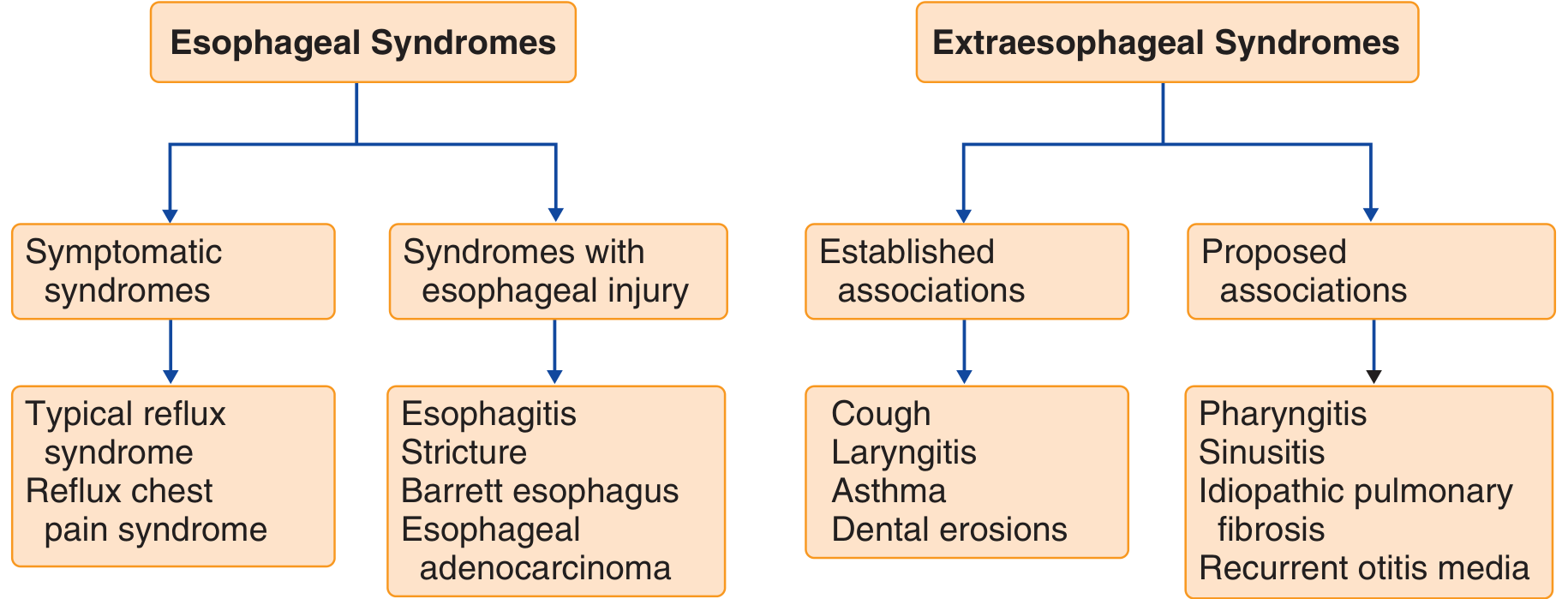
Esophageal syndromes:
- Symptomatic: typical reflux syndrome, reflux chest pain syndrome
- With esophageal injury: esophagitis, stricture, Barrett esophagus, esophageal adenocarcinoma
Extraesophageal syndromes:
- Established associations: cough, laryngitis, asthma, dental erosions
- Proposed associations: pharyngitis, sinusitis, idiopathic pulmonary fibrosis, recurrent otitis media
Clinical Manifestations
| Category | Symptoms |
|---|---|
| Classic (esophageal) | Heartburn, acid regurgitation |
| Atypical (esophageal) | Chest pain, dysphagia, odynophagia |
| Extraesophageal | Chronic cough, laryngitis, asthma, dental erosions |
Extraesophageal symptoms are more reliably attributed to GERD when they are accompanied by classic symptoms and confirmed by objective testing.
Complications
- Erosive esophagitis — mucosal breaks visible on endoscopy; graded by Los Angeles classification (A–D)
- Peptic stricture — from chronic acid exposure causing fibrosis; presents as progressive dysphagia
- Barrett esophagus — intestinal metaplasia of the esophageal mucosa (specialized columnar epithelium replacing squamous); a precancerous condition
- Esophageal adenocarcinoma — risk rises with BMI; relative risk 2.27–11.3× in obese patients vs. normal weight
Diagnosis
Empirical PPI trial is the initial approach for typical symptoms (heartburn/regurgitation) without alarm features.
Upper endoscopy (EGD) is indicated for:
- Alarm symptoms: dysphagia, odynophagia, weight loss, GI bleeding, anemia
- Failure of PPI therapy
- Screening for Barrett esophagus in high-risk patients (chronic GERD >5 years + risk factors)
Ambulatory pH or pH-impedance monitoring:
- Gold standard for documenting abnormal esophageal acid exposure
- Useful when diagnosis is uncertain or symptoms persist despite PPI
Esophageal manometry: evaluates LES pressure and peristaltic function; required before anti-reflux surgery.
Management
Lifestyle modifications
- Weight loss (most evidence-based lifestyle intervention)
- Elevate head of bed
- Avoid trigger foods (fatty/spicy foods, chocolate, caffeine, alcohol, mint)
- Avoid meals within 2–3 hours of recumbency
- Smoking cessation
Pharmacologic therapy
| Drug class | Role |
|---|---|
| Proton pump inhibitors (PPIs) | First-line; most effective acid suppression (omeprazole, lansoprazole, esomeprazole, etc.) |
| H₂ receptor antagonists (H₂RAs) | Second-line or as-needed; less potent than PPIs |
| Antacids | Symptomatic relief for mild/infrequent symptoms |
| Alginates | Form a raft over gastric contents; useful for postprandial reflux |
| Baclofen | GABA-B agonist; reduces tLESRs; used in refractory cases |
PPIs are taken 30–60 minutes before a meal for maximal efficacy.
Surgical / endoscopic therapy
- Laparoscopic Nissen fundoplication — wrap of gastric fundus around the LES; indicated for patients intolerant of or non-responsive to antisecretory therapy (especially those with documented reflux and predominant regurgitation)
- LINX device — magnetic sphincter augmentation
- Endoscopic therapies (e.g., transoral incisionless fundoplication [TIF]) for selected patients
Barrett Esophagus & Surveillance
Barrett esophagus carries a ~0.5%/year risk of progression to adenocarcinoma. Surveillance endoscopy intervals depend on degree of dysplasia:
- No dysplasia: every 3–5 years
- Low-grade dysplasia: every 6–12 months or endoscopic eradication therapy
- High-grade dysplasia: endoscopic eradication therapy (endoscopic mucosal resection + radiofrequency ablation)
— Goldman-Cecil Medicine, pp. 1429–1431 | Sleisenger and Fordtran's Gastrointestinal and Liver Disease
This is a shared conversation. Sign in to Orris to start your own chat.