
Expalin in detail about smart health devices
smart health devices 2025 2026 overview types applications
smart health devices wearables IoT healthcare latest trends 2026
smart health devices wearables monitoring
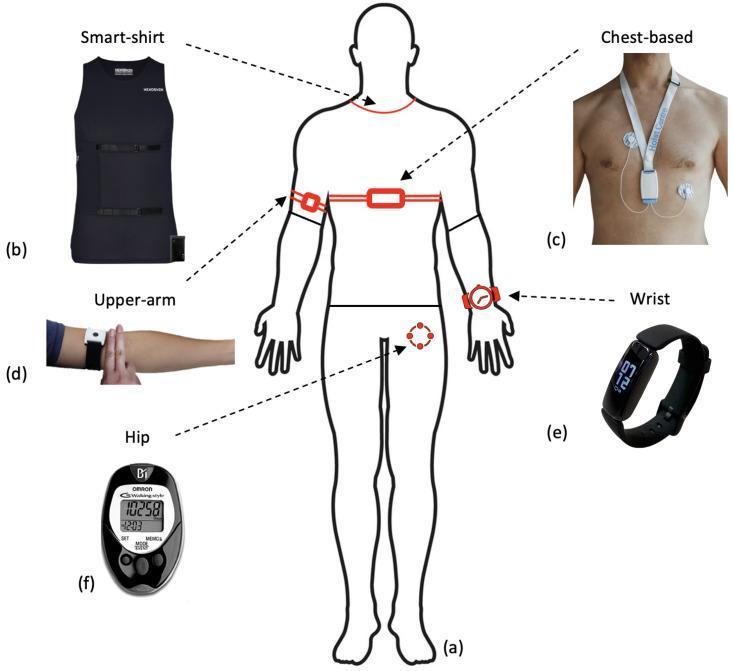
An educational infographic and clinical photograph collage illustrating the anatomical placement of various wearable sensor devices used for perioperative physiological monitoring and health research. (a) A central human silhouette acts as a anatomical map with dotted lines indicating six specific sensor locations. (b) A 'smart shirt' (Hexoskin) covers the torso to collect integrated ECG and respiratory data. (c) A chest-based single-lead ECG wearable is shown as a necklace-style device with adhesive electrodes on the precordium. (d) An upper-arm sensor is pictured utilizing reflective photoplethysmography (PPG) for hemodynamic monitoring. (e) A wrist-worn device (Fitbit) is displayed for tracking physical activity via accelerometry and heart rate via PPG. (f) A hip-worn tri-axis accelerometer (pedometer) is shown for measuring step count and ambulatory movement. The image demonstrates the diversity of medical wearables for longitudinal monitoring of vital signs, including heart rate variability, oxygen saturation, and mobility, used to stratify patient risk and predict postoperative outcomes.
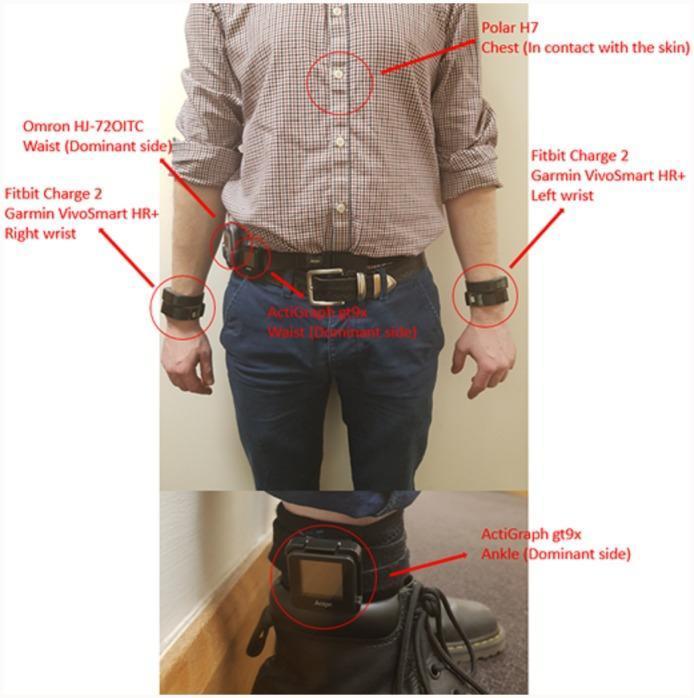
This clinical photograph illustrates the standardized anatomical placement of multiple wearable health-tracking and physical activity monitoring devices on a human participant for research purposes. The image is split into a primary frontal view of the torso and limbs, with an inset focusing on the lower extremity. Key monitoring locations and devices include: 1) Chest: A Polar H7 heart rate sensor positioned sub-sternally in direct contact with the skin. 2) Waist (Dominant Side): An Omron HJ-720ITC pedometer and an ActiGraph GT9X Link accelerometer attached to the belt line. 3) Bilateral Wrists: Dual-placement of Fitbit Charge 2 and Garmin VivoSmart HR+ wrist-worn trackers on both the right and left arms to assess inter-device reliability. 4) Ankle (Dominant Side): An additional ActiGraph GT9X device secured over the sock to capture lower-limb kinematics. The visualization serves as a methodological reference for clinical studies evaluating the accuracy of consumer and research-grade wearables in tracking heart rate, step count, and energy expenditure across different body segments.
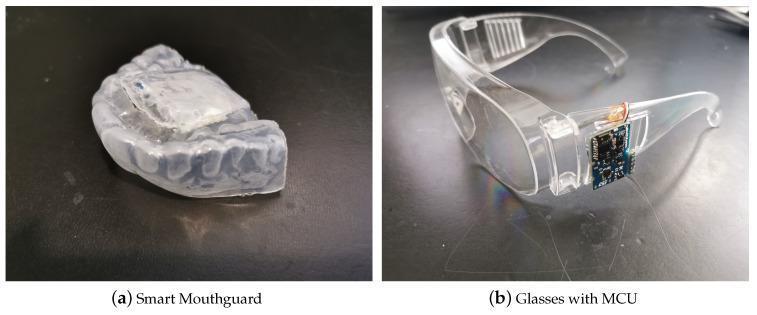
This clinical photograph displays two wearable medical sensor platforms designed for head motion tracking and physiological monitoring. Panel (a) illustrates a smart mouthguard fabricated from translucent ethylene-vinyl acetate (EVA) thermoformed to a subject's upper dental arch. It features visible indentations for teeth and a micro-control unit (MCU) embedded within the material, positioned to sit near the hard palate when worn. Panel (b) shows clear plastic glasses with an MCU circuit board externally mounted to the left temple. The MCU is a small, rectangular PCB containing visible electronic components (resistors, chips) and integrated sensors, connected via thin wiring and an orange adhesive. These devices represent advances in dental and ocular wearables for monitoring biomechanics, gait analysis, or bruxism. The rigid coupling of these sensors to the maxilla and skull ensures precise data collection regarding head movement, which is critical in sports medicine and rehabilitative research.
Smart Health Devices - A Detailed Guide
What Are Smart Health Devices?
- Advanced biosensors - for capturing physiological signals with high fidelity
- Edge AI - processes data directly on the device in real time
- Bluetooth 6.0 / Wi-Fi - for reliable, low-power connectivity
- Cloud platforms - for data storage, trend analysis, and sharing with clinicians
Major Categories of Smart Health Devices
1. Fitness Trackers
- Monitor step count, active minutes, and workout intensity
- Track sleep stages (light, deep, REM)
- Provide reminders to move and guided breathing exercises
- Sync with smartphone apps for goal setting and trend analysis
2. Smartwatches
- ECG (electrocardiogram) - detects atrial fibrillation and other arrhythmias
- Blood oxygen (SpO2) - monitors oxygen saturation
- Fall detection - alerts emergency contacts after a hard fall
- Blood pressure monitoring - increasingly being added to newer models
- Skin temperature sensing - useful for cycle tracking and early illness detection
- Irregular heart rhythm notifications
3. Smart Rings
- Heart rate and heart rate variability (HRV)
- Body temperature fluctuations
- Sleep architecture
- Activity and recovery scores
4. Continuous Glucose Monitors (CGMs)
- Real-time glucose readings sent to a phone or receiver
- Trend arrows show if glucose is rising or falling rapidly
- Alerts for dangerous highs (hyperglycemia) or lows (hypoglycemia)
- Integration with insulin pumps for closed-loop ("artificial pancreas") systems
- 2025-2026 expansion: CGMs now available to non-diabetics for metabolic health optimization
5. Smart Blood Pressure Monitors
- Automatic Bluetooth/Wi-Fi syncing to health apps and cloud portals
- Irregular heartbeat detection
- Morning hypertension alerts
- Integration with telehealth platforms so physicians can access data remotely
6. Pulse Oximeters
7. Smart Patches and Biosensors
- VitalPatch by VitalConnect - monitors ECG, heart rate, respiration rate, skin temperature, posture, and activity
- Cardiac event monitors - worn for weeks to detect intermittent arrhythmias
- Sweat-analyzing patches - detect biomarkers for stress, hydration, and conditions like cystic fibrosis
- Post-surgical monitoring patches that transmit vitals to nursing stations
8. Medical-Grade Wearables
- Holter monitors - portable ECG devices worn 24-48 hours
- Implantable loop recorders - subcutaneous devices that monitor heart rhythm for up to 3 years
- Remote diaphragm stimulators - for patients with respiratory failure
- Smart insulin pens - track dose timing and amount, integrate with CGMs
9. Sleep Tracking Devices
- ResMed CPAP/APAP devices - track apneic events, mask usage, and AHI (Apnea-Hypopnea Index) for sleep apnea management
- Bedside sleep analyzers - radar-based devices (like Google Nest Hub) that monitor breathing and movement without contact
- Smart pillows and mattress pads - track heart rate, respiration, and sleep stages through pressure sensors
10. Smart Hearing Aids
- Bluetooth connectivity to smartphones
- Fall detection capability
- Language translation in real time
- Physical activity tracking
- Over-the-air firmware updates from audiologists
11. Smart Glasses and AR Wearables
- Surgical assistance and hands-free information display
- Medical training with augmented reality overlays
- Vision health monitoring
12. Smart Scales and Body Composition Analyzers
- Body fat percentage, muscle mass, bone density, visceral fat, BMI
- Sync automatically with health apps (Apple Health, Google Fit, Withings)
- Track multiple users and trends over months
How Smart Health Devices Work - The Technology Stack
[Body Sensors] → [Signal Processing / Edge AI] → [Wireless Transmission]
                                                        ↓
[Smartphone App / Cloud Platform] → [Analytics / AI Interpretation] → [User & Clinician Insights]
- Sensors capture physiological signals - optical (PPG for heart rate/SpO2), electrical (ECG), chemical (glucose, sweat), mechanical (accelerometers for movement/falls), and thermal (temperature).
- Microprocessors filter noise and run algorithms on raw data locally (edge computing).
- Wireless protocols (Bluetooth 6.0, Wi-Fi, cellular, NFC) transmit data securely.
- Cloud AI identifies patterns, anomalies, and trends across large datasets.
- Apps and dashboards present actionable insights to users and clinicians.
AI Integration in Smart Health Devices (2026)
- Anomaly detection - flags unusual heart rhythms, abnormal sleep patterns, or glucose spikes
- Predictive scoring - recovery scores, readiness scores, sleep quality scores
- Personalization - adapts baselines to individual physiology rather than population averages
- Women's health AI - Oura's 2026 model predicts cycles, fertility windows, and detects early pregnancy signs from temperature data
- Mental health monitoring - HRV trends, stress scores, and breathing pattern analysis
Clinical Applications
| Application | Device Type | Benefit |
|---|---|---|
| Atrial fibrillation detection | Smartwatch ECG | Early diagnosis, stroke prevention |
| Diabetes management | CGM + insulin pump | Tight glucose control, fewer hypoglycemic events |
| Hypertension management | Smart BP monitor | Daily trending, medication titration |
| Sleep apnea | Smart CPAP | Therapy adherence tracking, remote adjustment |
| Post-surgical monitoring | Smart patch | Early complication detection |
| Fall prevention in elderly | Smartwatch / pendant | Automatic emergency alerts |
| Cardiac rehabilitation | Holter / event monitor | Long-term arrhythmia monitoring |
Hospital-at-Home Model
Challenges and Limitations
| Challenge | Details |
|---|---|
| Data privacy & security | Health data is sensitive; breaches can be severe. HIPAA compliance is required for clinical devices |
| Accuracy vs. medical-grade | Consumer wearables are not substitutes for clinical instruments |
| Health anxiety | Continuous monitoring can generate false alerts and psychological distress |
| Battery life | High sensor density drains power; most devices need daily or weekly charging |
| Interoperability | Devices from different manufacturers do not always share data smoothly |
| Regulatory approval | FDA clearance requirements vary; many consumer devices operate in a grey area |
| Digital divide | Cost and tech literacy limit access for elderly or low-income populations |
Current Clinical Image of Wearable Sensor Placement
Future Directions
- Smart clothing - shirts and leggings with embedded biometric sensors for seamless, continuous monitoring
- Implantable subcutaneous sensors - long-term glucose, lactate, or cortisol monitoring without external devices
- Smart contact lenses - intraocular pressure monitoring for glaucoma, glucose detection in tear fluid
- Non-invasive blood pressure waveform analysis - cuffless, continuous BP from optical sensors
- Brain-computer interfaces - early-stage wearables for neurological monitoring and control
- Closed-loop drug delivery - CGMs paired with smart insulin pumps that automatically adjust doses