
Which bp medicine given in which condition
Here's a quick overview before I pull detailed clinical guidance:
Common antihypertensives by condition:
- ACE inhibitors (e.g., ramipril) - heart failure, diabetic nephropathy, post-MI
- ARBs (e.g., losartan) - same as ACEi but when ACEi not tolerated (cough)
- Beta-blockers (e.g., metoprolol) - angina, post-MI, heart failure, tachyarrhythmias
- Calcium channel blockers (e.g., amlodipine) - isolated systolic HTN, elderly, angina
- Thiazide diuretics (e.g., hydrochlorothiazide) - uncomplicated HTN, elderly, Black patients
Searching sources...
Reading File
Finding Sources
Finding Sources
Reading File
Reading File
Reading File
Reading File
Finding Sources
Reading File
Reading File
I now have comprehensive information from Harrison's and Fuster & Hurst's. Let me also fetch the treatment flowchart image for visual clarity.
Loading Image
Here is a thorough, evidence-based guide to antihypertensive drug selection by condition, drawn from Harrison's Principles of Internal Medicine (22nd Ed., 2025) and Fuster & Hurst's The Heart (15th Ed.).
Antihypertensive Drugs: Which Drug for Which Condition
Treatment Flowchart (Uncomplicated Hypertension)
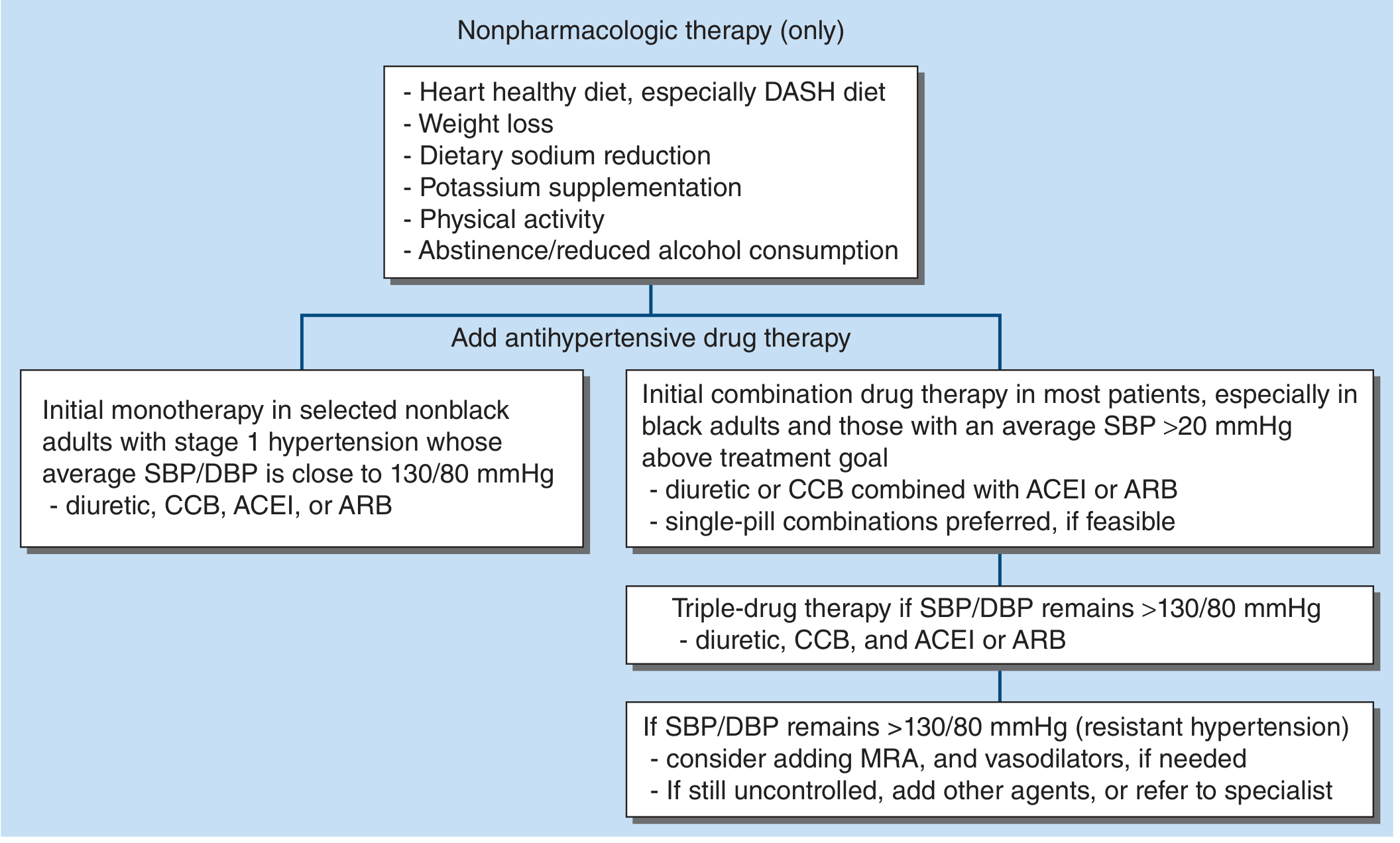
1. Uncomplicated / Primary Hypertension
Four first-line drug classes are equally acceptable when there is no specific compelling indication:
| Drug Class | Examples | Key Notes |
|---|---|---|
| Thiazide/Thiazide-like diuretics | Chlorthalidone, HCTZ, Indapamide | Meta-analyses show "best in class" for CVD prevention; chlorthalidone preferred (longer half-life) |
| ACE Inhibitors (ACEi) | Ramipril, Lisinopril, Enalapril | Avoid in pregnancy; do not combine with ARB |
| Angiotensin Receptor Blockers (ARB) | Losartan, Valsartan, Candesartan | Use when ACEi causes cough; avoid in pregnancy |
| Calcium Channel Blockers (CCB-DHP) | Amlodipine, Felodipine, Nifedipine LA | Best for stroke prevention; good in elderly |
Beta-blockers are no longer recommended as first-line for uncomplicated HTN - head-to-head trials show inferior CVD protection, especially for stroke prevention compared to the four classes above.
Combination strategy:
- Dual therapy: Diuretic OR CCB + ACEi or ARB
- Triple therapy: Diuretic + CCB + ACEi or ARB
- Resistant HTN: Add mineralocorticoid receptor antagonist (MRA) like spironolactone, alpha-blocker, or vasodilator
2. Condition-Specific Drug Choices (Compelling Indications)
Heart Failure (HFrEF)
- ACEi or ARB - cornerstone; reduces mortality
- Beta-blockers (carvedilol, metoprolol succinate, bisoprolol) - proven mortality benefit
- MRA (spironolactone, eplerenone) - reduces mortality and hospitalizations
- SGLT2 inhibitors - especially if diabetes coexists (empagliflozin, dapagliflozin)
- Loop diuretics (furosemide) - for volume overload/congestion
- Non-DHP CCBs (diltiazem, verapamil) are CONTRAINDICATED in HFrEF
Post-Myocardial Infarction (Post-MI)
- Beta-blockers - first-line (metoprolol, carvedilol); reduce reinfarction and mortality
- ACEi or ARB - especially if EF is reduced
- MRA - if EF reduced and no significant renal impairment or hyperkalemia
- Avoid non-DHP CCBs if LV dysfunction is present
Angina / Ischemic Heart Disease
- Beta-blockers - first choice for stable angina (anti-ischemic)
- CCB (both DHP and non-DHP) - alternative or add-on for angina
- ACEi - reduce cardiovascular events in established IHD
- Long-acting nitrates - add-on for symptom control
Chronic Kidney Disease (CKD) / Proteinuria
- ACEi or ARB - primary agents; reduce intraglomerular pressure via efferent arteriolar dilation, slow proteinuria progression. Especially important with proteinuria and advanced CKD
- Diuretics - loop diuretics (furosemide) when eGFR <30 mL/min/1.73m² (thiazides less effective at low eGFR; however, chlorthalidone showed benefit even in stage 4 CKD in a recent RCT)
- CCBs - safe add-on but dilate afferent arteriole; use in combination with ACEi/ARB
- Monitor potassium carefully with ACEi/ARB + CKD
Diabetes Mellitus
- ACEi or ARB - preferred (renal protection, reduce microalbuminuria)
- SGLT2 inhibitors - now strongly recommended for cardio-renal protection beyond BP lowering
- CCBs - good add-on; metabolically neutral
- Thiazides - use with caution (slight dyslipidemia and dysglycemia risk, but still effective)
- Beta-blockers - can mask hypoglycemia symptoms; use if other indications (e.g., post-MI, HF)
Stroke Prevention / Cerebrovascular Disease
- CCBs - particularly effective for stroke prevention (superior to beta-blockers)
- ACEi or ARB - reduce recurrent stroke risk
- Thiazide diuretics - also effective for stroke prevention
- Target: SBP/DBP <130/80 mmHg
Isolated Systolic Hypertension (Elderly)
- Thiazide diuretics or CCBs - first choice; proven in large trials
- Start with lower doses; titrate gradually
- ACEi or ARB - also appropriate
Black / African-American Patients
- Thiazide diuretics + CCBs preferred (ACEi/ARBs less effective as monotherapy in this population)
- Combination therapy is usually needed
- ACEi/ARBs have higher rates of angioedema in Black patients
Hypertension in Pregnancy
- Labetalol (oral) - first-line
- Methyldopa - safe, traditional choice
- Nifedipine (oral) - alternative
- ACEi, ARBs, direct renin inhibitors are CONTRAINDICATED (teratogenic)
Hypertensive Emergency (IV Agents)
- Labetalol IV - versatile; safe in most emergencies
- Nicardipine IV - good for most hypertensive emergencies, including peri-operative
- Sodium nitroprusside IV - severe/refractory emergencies (watch for cyanide toxicity)
- Hydralazine IV - used in pregnancy-related emergencies
- Esmolol IV - aortic dissection, hypertensive crises with tachycardia
Pheochromocytoma
- Alpha-blockers first (phenoxybenzamine or doxazosin) - always before beta-blockers
- Beta-blockers added AFTER alpha-blockade - to control tachycardia (never give beta-blocker alone - can cause paradoxical hypertension)
Primary Aldosteronism (Conn's Syndrome)
- Spironolactone or eplerenone (MRAs) - first-line
- Also effective: amiloride
Benign Prostatic Hypertrophy (BPH) + HTN
- Alpha-1 blockers (doxazosin, terazosin) - treat both BPH and HTN simultaneously
Aortic Dissection
- Beta-blockers IV (labetalol, esmolol) - reduce HR and BP
- Sodium nitroprusside or nicardipine - if BP not controlled, always WITH beta-blockade
3. Quick Reference Summary Table
| Condition | Preferred Drug(s) | Avoid |
|---|---|---|
| Uncomplicated HTN | Thiazide, CCB, ACEi, ARB | Beta-blockers (1st line) |
| Heart failure (HFrEF) | ACEi/ARB + Beta-blocker + MRA | Non-DHP CCB |
| Post-MI | Beta-blocker + ACEi/ARB | - |
| Angina | Beta-blocker, CCB | - |
| CKD / Proteinuria | ACEi or ARB | NSAIDs |
| Diabetes | ACEi or ARB, SGLT2i | Beta-blockers (relative) |
| Stroke prevention | CCB, ACEi/ARB, Thiazide | - |
| Elderly / isolated SBP | Thiazide or CCB | - |
| Black patients | Thiazide + CCB | ACEi/ARB monotherapy |
| Pregnancy | Labetalol, Methyldopa, Nifedipine | ACEi, ARB |
| Pheochromocytoma | Alpha-blocker first, then Beta | Beta-blocker alone |
| Primary aldosteronism | Spironolactone / Eplerenone | - |
| BPH + HTN | Alpha-blocker (doxazosin) | - |
| Hypertensive emergency | IV Labetalol, Nicardipine, Nitroprusside | Oral agents alone |
Sources: Harrison's Principles of Internal Medicine 22E (2025), p. 2187-2190; Fuster & Hurst's The Heart 15th Ed., p. 249-250
This is a shared conversation. Sign in to Orris to start your own chat.