
Ecg
I can help with ECG (electrocardiogram) topics! The query is a bit broad though — let me ask what you're looking for.
Asking for Preferences
What would you like to know about ECG?
Reading File
Finding Sources
Searching Images
ECG electrocardiogram waves P QRS T basic interpretation
Finding Sources
Finding Sources
Reading File
Finding Sources
Finding Sources
Reading File
Reading File
Reading File
Loading Image
Here is a comprehensive overview of ECG basic interpretation and waves, sourced from Costanzo Physiology and Goldman-Cecil Medicine.
What Is an ECG?
The electrocardiogram (ECG/EKG) measures tiny potential differences on the body's surface that reflect the heart's electrical activity. Because the myocardium depolarizes and repolarizes in a specific sequence (atria first, then ventricles), potential differences are established between different parts of the heart and detected by surface electrodes.
The Normal ECG Waveform
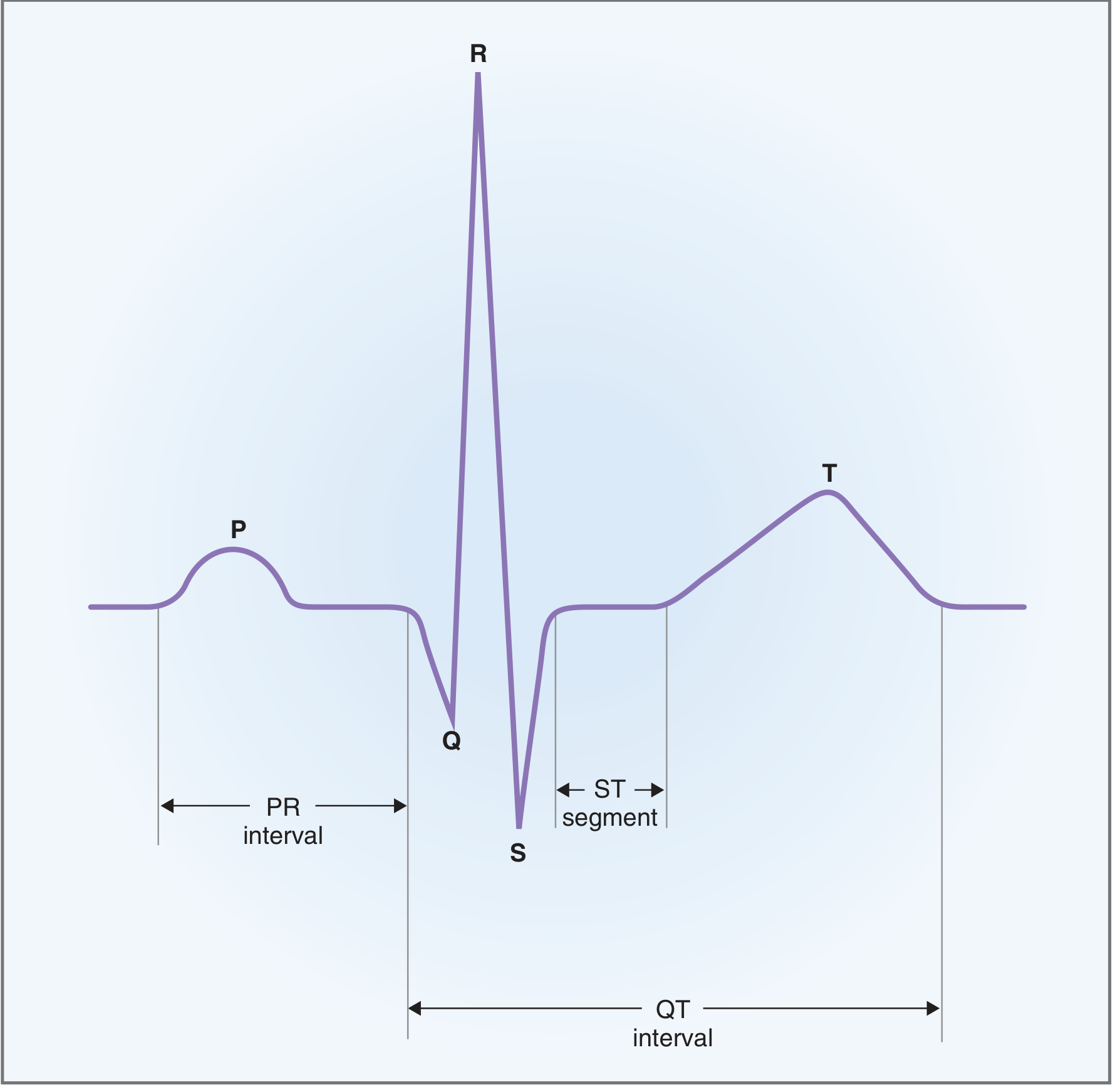
Waves, Intervals & Segments
Waves
| Wave | Represents | Notes |
|---|---|---|
| P wave | Atrial depolarization | Wider P wave = slower atrial conduction. Atrial repolarization is buried in the QRS complex |
| Q wave | Initial ventricular depolarization (septal) | Small Q waves are normal; pathological Q waves suggest infarction |
| R wave | Main ventricular depolarization (upward deflection) | Should show normal progression V1→V6 |
| S wave | Terminal ventricular depolarization (downward) | — |
| T wave | Ventricular repolarization | Normally concordant with QRS direction |
| U wave | (rarely seen) Late ventricular repolarization | Prominent in hypokalemia |
Intervals & Segments
| Name | Measurement | Normal Value | Meaning |
|---|---|---|---|
| PR interval | Onset of P wave → onset of QRS | 0.12–0.20 s (3–5 small boxes) | AV node conduction time; prolonged = AV block, shortened = pre-excitation |
| QRS complex | Q onset → S offset | <0.12 s (< 3 small boxes) | Ventricular depolarization; widened = bundle branch block or ventricular rhythm |
| ST segment | End of QRS (J point) → onset of T wave | Isoelectric (flat) | Elevated = STEMI, pericarditis; depressed = ischemia, NSTEMI |
| QT interval | QRS onset → T wave end | <0.44 s (varies with HR) | Ventricular depolarization + repolarization; prolonged = risk of torsades |
ECG Paper / Grid Standards
- Horizontal axis = time: Each small box (1 mm) = 0.04 s; each large box (5 mm) = 0.20 s
- Vertical axis = voltage: Each small box = 0.1 mV; 10 mm = 1 mV
- Standard recording speed: 25 mm/sec over a 10-second period
The Cardiac Conduction System (Basis of ECG)
The electrical sequence generating each ECG complex:
- SA node (high right atrium) → spontaneous depolarization → P wave
- AV node → physiologic conduction delay → flat PR segment
- Bundle of His → Right & Left bundle branches → Purkinje fibers → QRS complex
- Ventricular repolarization → ST segment + T wave
The J (junction) point marks the end of the QRS and the start of the ST segment.
A Systematic Approach to ECG Reading
- Rate — Count R-R intervals (300 ÷ number of large boxes between R waves)
- Rhythm — Regular or irregular? P before every QRS?
- Axis — Leads I and aVF: both positive = normal axis (0° to +90°)
- P wave — Present, upright in II? Morphology?
- PR interval — 0.12–0.20 s?
- QRS width — Narrow (<0.12 s) or wide?
- ST segment — Elevated, depressed, or isoelectric?
- T wave — Upright, inverted, or peaked?
- QT interval — Corrected QTc within normal limits?
Sources: Costanzo Physiology, 7th ed. | Goldman-Cecil Medicine, International ed.
Would you like to go deeper on any specific part — such as axis calculation, bundle branch blocks, or a particular lead system?
This is a shared conversation. Sign in to Orris to start your own chat.