
Marasmus and kwashiorkor
Reading File
Now let me search the library and PubMed in parallel for comprehensive coverage.
Finding Sources
Searching PubMed
marasmus kwashiorkor protein energy malnutrition
Good. Now let me read the key sections in parallel - Robbins Pathology (most comprehensive) and Park's Preventive Medicine, plus Sleisenger for nutritional perspective.
Reading File
Reading File
Reading File
Excellent content. Let me now fetch the clinical images and also read the Sleisenger section for management/treatment details.
Loading Image
Reading File
I now have comprehensive data from multiple authoritative textbooks. Let me compile the full answer.
Marasmus and Kwashiorkor
Both are forms of Severe Acute Malnutrition (SAM), collectively called Protein-Energy Malnutrition (PEM). They differ primarily in the relative deficit of protein versus total calories.
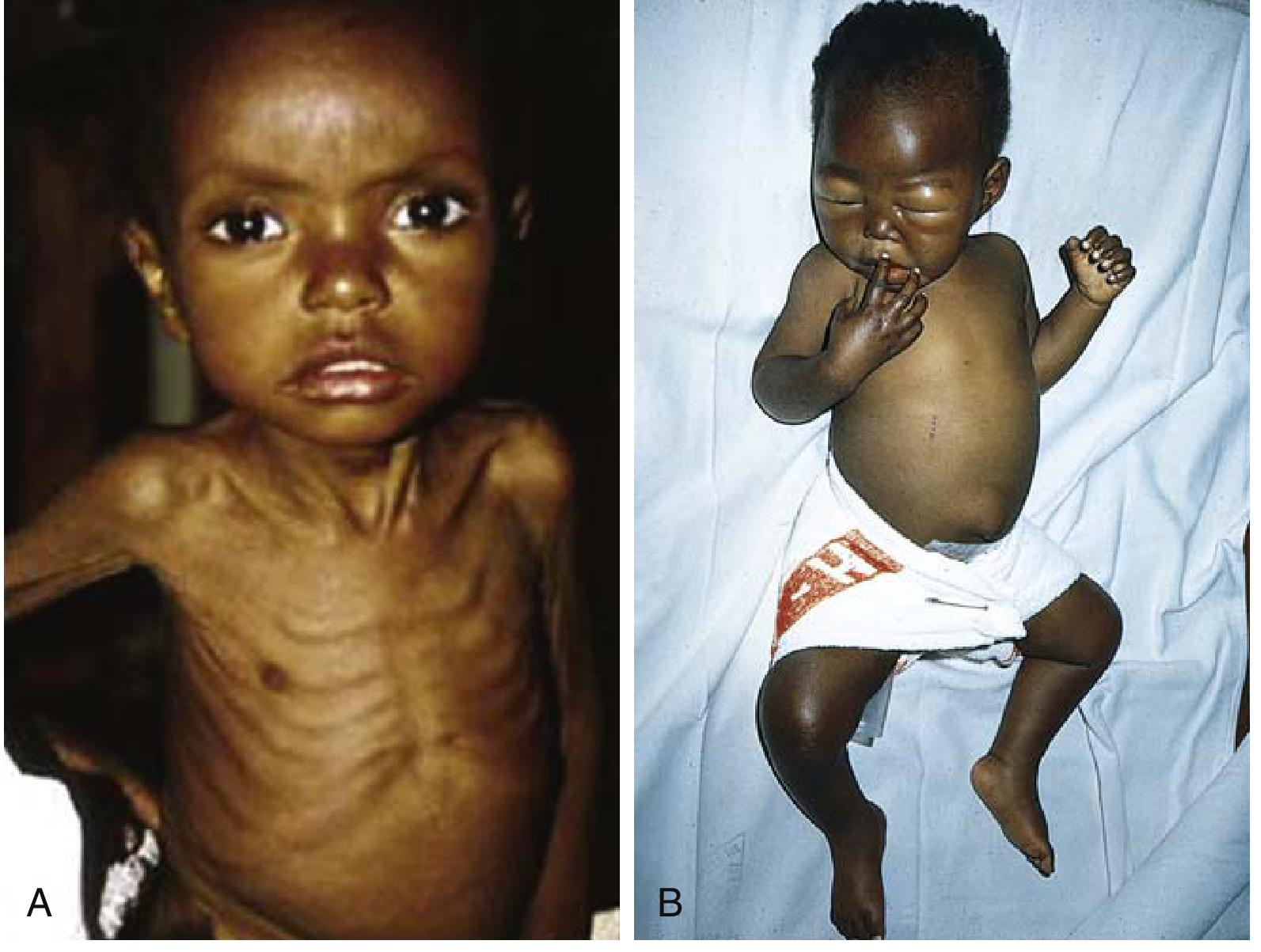
Marasmus
Definition & Cause
Marasmus results from a severe deficiency of total calories (both protein and energy). Weight falls to <60% of expected for sex, height, and age.
Pathophysiology
- The body catabolizes the somatic protein compartment (muscle) to provide amino acids as fuel - this is an adaptive response.
- The visceral protein compartment is relatively spared, so serum albumin is normal or near-normal.
- Subcutaneous fat is mobilized and consumed as fuel.
- Low leptin stimulates the hypothalamic-pituitary-adrenal axis → elevated cortisol → contributes to lipolysis.
Clinical Features
| Feature | Finding |
|---|---|
| Weight | <60% of expected |
| Edema | Absent |
| Muscle/fat | Severely wasted |
| Serum albumin | Normal or mildly reduced |
| Appetite | Good (alert, hungry) |
| Mood | Alert |
| Subcutaneous fat | Markedly depleted |
| Liver | Not enlarged |
- Extremities are emaciated; the head appears disproportionately large
- Anemia and multivitamin deficiency signs are present
- T cell-mediated immune deficiency → concurrent infections are common
Kwashiorkor
Definition & Cause
Kwashiorkor occurs when protein deprivation is relatively greater than caloric deficit. The name comes from the Ga language of Ghana, meaning "disease of the displaced child" - the child displaced from the breast when another baby is born, subsequently fed an almost exclusively carbohydrate diet.
Common settings:
- Early weaning in impoverished regions (sub-Saharan Africa, Southeast Asia, Central America)
- Chronic diarrheal states (malabsorption)
- Protein-losing enteropathy, nephrotic syndrome, extensive burns
- Rare: fad diets, rice-based beverage substitution for milk (reported in the US)
Pathophysiology
- Marked protein deprivation → severe loss of the visceral protein compartment
- Hypoalbuminemia → generalized/dependent edema (hallmark)
- Reduced synthesis of apoprotein (carrier protein for lipoproteins) → fatty liver (hepatomegaly)
- Leaky cell membranes allow potassium and intracellular ions to leak into the extracellular space → osmotic water movement → edema
- Often triggered or worsened by a superimposed infection/physiologic stress on a baseline malnourished child
Clinical Features
| Feature | Finding |
|---|---|
| Weight | 60-80% of expected (masked by edema) |
| Edema | Present (generalized/dependent) - the cardinal sign |
| Muscle/fat | Relatively spared |
| Serum albumin | Low (hypoalbuminemia) |
| Appetite | Poor |
| Mood | Apathetic alone; irritable when handled |
| Liver | Enlarged, fatty |
| Abdomen | Protuberant (weak muscles + hepatomegaly + intestinal distention; ascites rare) |
Characteristic skin & hair changes:
- Skin: alternating zones of hyperpigmentation, desquamation, and hypopigmentation - the "flaky paint" or "crazy paving" appearance
- Hair: loss of color, alternating light/dark bands ("flag sign"), straightening, fine texture, easily plucked ("easily removable")
Side-by-Side Comparison
| Feature | Marasmus | Kwashiorkor |
|---|---|---|
| Primary deficit | Total calories (protein + energy) | Protein > energy |
| Weight | <60% expected | 60-80% expected |
| Edema | Absent | Present (cardinal) |
| Serum albumin | Normal/near-normal | Low |
| Subcutaneous fat | Markedly depleted | Relatively spared |
| Muscle wasting | Severe | Mild (masked by edema) |
| Liver | Normal | Fatty (enlarged) |
| Appetite | Good | Poor |
| Mood | Alert | Apathetic/irritable |
| Skin/hair changes | Absent | "Flaky paint," flag sign |
| Immune deficiency | T-cell mediated | Present + worse |
Marasmic-Kwashiorkor
A mixed form exists - features of both conditions - seen when marasmus is complicated by superimposed severe protein deficiency or infection.
Assessment Tools
- Growth charts: weight-for-age is the first indicator of PEM
- Mid-upper arm circumference (MUAC):
-
13.5 cm = normal
- 12.5-13.5 cm = mild-moderate malnutrition
- <12.5 cm = severe malnutrition (MUAC is unreliable under 1 year; stable 1-5 years)
-
- Waterlow Classification:
- Wasting = weight for height (acute malnutrition)
- Stunting = height for age (chronic malnutrition)
- Severe = weight-for-height <70% of median OR >-3 Z-score
Management
Principles (WHO 10-step approach for SAM)
- Treat/prevent hypoglycemia
- Treat/prevent hypothermia
- Treat/prevent dehydration (use ReSoMal, not standard ORS - lower sodium, higher potassium)
- Correct electrolyte imbalance (especially potassium and magnesium)
- Treat/prevent infection (broad-spectrum antibiotics empirically)
- Correct micronutrient deficiencies (vitamin A, folic acid, zinc, copper, multivitamins - no iron initially)
- Cautious initial feeding (stabilization phase)
- Rebuild wasted tissues (rehabilitation phase - high-protein, high-calorie feeds)
- Provide stimulation, play, and emotional support
- Prepare for follow-up after recovery
Refeeding syndrome is a risk - start low, go slow with calories.
Prevention
- Promote breastfeeding
- Develop low-cost weaning foods; frequent small feeds
- Immunization programs (infections worsen nutritional status)
- Nutrition education and family diet improvement
- Family planning (birth spacing)
- Food fortification
Sources: Robbins & Kumar Basic Pathology; Robbins, Cotran & Kumar Pathologic Basis of Disease; Sleisenger and Fordtran's Gastrointestinal and Liver Disease; Park's Textbook of Preventive and Social Medicine
This is a shared conversation. Sign in to Orris to start your own chat.