
Scheme of trigeminal nerve
Reading File
This is a visual anatomy question - I'll search for trigeminal nerve diagrams and content in the medical library, plus web sources, in parallel.
Finding Sources
Searching the Web
trigeminal nerve anatomy diagram branches scheme
Now let me read the Gray's Anatomy section and fetch the best diagram images in parallel:
Reading File
Loading Image
Loading Image
Let me also fetch the earthslab diagram and read the Bradley Neurology section for the branches detail:
Loading Image
Reading File
Excellent - I have two great diagrams and thorough textbook content. Here is the full scheme of the trigeminal nerve:
Trigeminal Nerve (CN V) - Complete Scheme
Overview Diagram
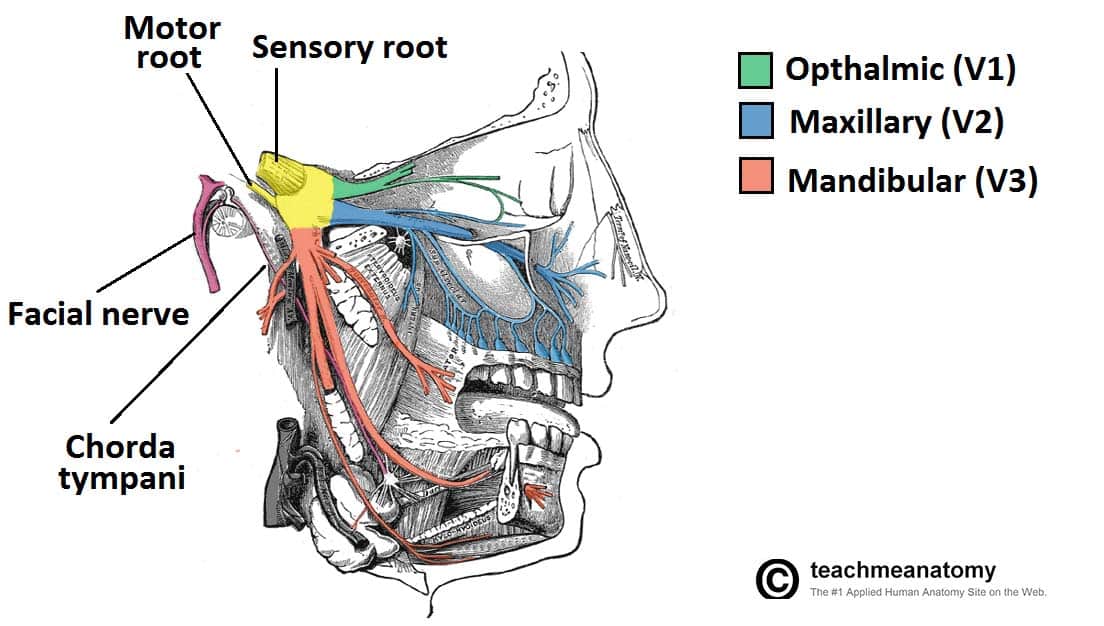
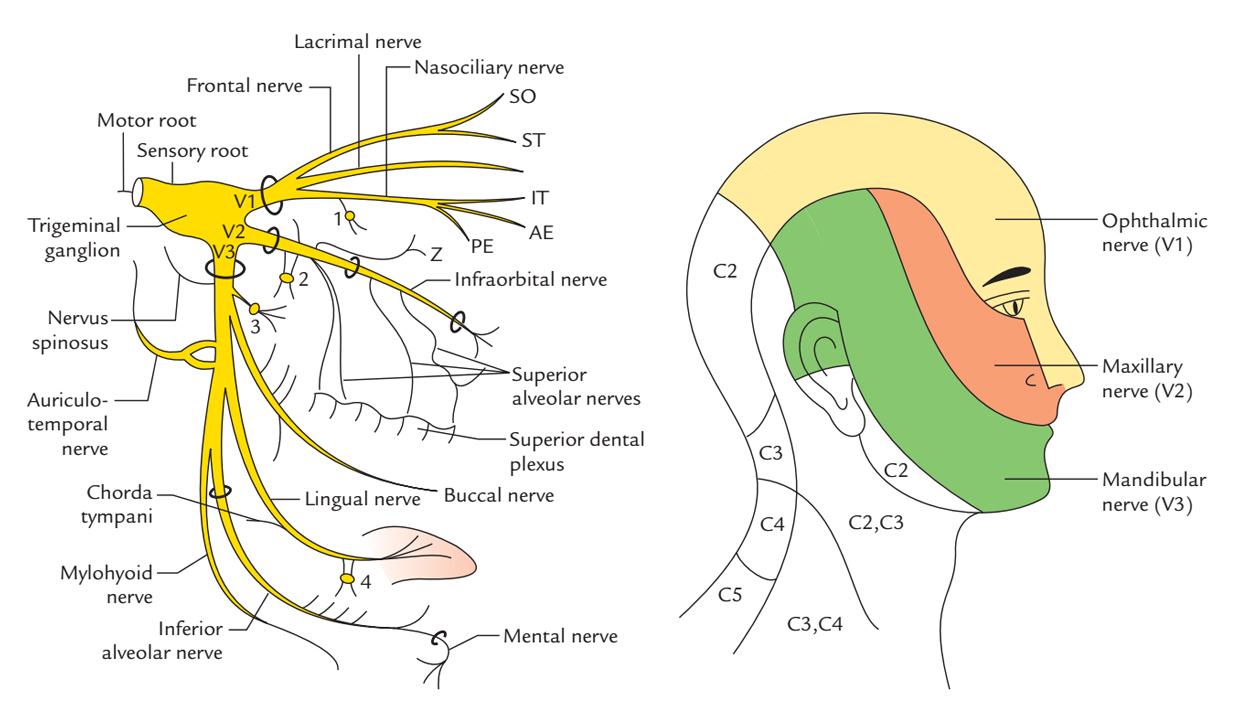
Origin and Roots
The trigeminal nerve exits the anterolateral surface of the pons as two roots:
- Large sensory root - carries GSA (general somatic afferent) fibers
- Small motor root - carries BE (branchial efferent) fibers
Both roots pass over the medial tip of the petrous part of the temporal bone into the middle cranial fossa, where the sensory root expands into the trigeminal (Gasserian/semilunar) ganglion, housed in a dural pouch called Meckel's cave (trigeminal cave). The motor root runs separately, below the ganglion.
Three Divisions
From the anterior border of the trigeminal ganglion arise the three terminal divisions:
V1 - Ophthalmic Nerve (purely sensory)
- Travels in the lateral wall of the cavernous sinus
- Enters orbit through the superior orbital fissure
- Divides into three branches:
- Lacrimal nerve - lacrimal gland, lateral upper eyelid
- Frontal nerve - splits into supraorbital and supratrochlear nerves (forehead, anterior scalp)
- Nasociliary nerve - eye, nassal mucosa, ethmoid cells, tip of nose
- Sensory territory: forehead, anterior scalp, upper eyelid, cornea, nose bridge, nasal cavity, frontal sinus, falx cerebri, dura in anterior cranial fossa
V2 - Maxillary Nerve (purely sensory)
- Travels in the lateral wall of the cavernous sinus (just below V1)
- Leaves cranium through foramen rotundum into the pterygopalatine fossa
- Key branches:
- Infraorbital nerve (main continuation) - exits via infraorbital foramen
- Zygomatic nerve (Z) - cheek/temporal area
- Superior alveolar nerves - upper teeth and gums (via superior dental plexus)
- Palatine nerves - hard and soft palate
- Nasal branches - nasal cavity
- Pharyngeal branch - nasopharynx
- Sensory territory: cheek, lower eyelid, side of nose, upper lip, upper teeth, palate, maxillary sinus, dura in middle cranial fossa
V3 - Mandibular Nerve (mixed - sensory + motor)
- Motor root joins here; the only mixed division
- Leaves cranium through foramen ovale into infratemporal fossa
- Sensory branches:
- Auriculotemporal nerve - scalp above ear, auricle, external acoustic meatus, part of tympanic membrane
- Lingual nerve - anterior 2/3 tongue (general sensation only; taste via chorda tympani which joins it)
- Buccal nerve - cheek mucosa and skin
- Inferior alveolar nerve - lower teeth; terminates as the mental nerve (chin and lower lip)
- Nervus spinosus - re-enters cranium via foramen spinosum, innervates dura in middle cranial fossa
- Motor branches to muscles of mastication:
- Masseter, temporalis, medial and lateral pterygoids
- Also: tensor tympani, tensor veli palatini, mylohyoid, anterior belly of digastric
Nuclei (4 total)
| Nucleus | Location | Function |
|---|---|---|
| Motor nucleus | Pons (medial/anterior) | Motor output to mastication muscles |
| Principal (main) sensory nucleus | Pons (lateral) | Touch, pressure, 2-point discrimination |
| Spinal nucleus | Pons to medulla (down to C2) | Pain and temperature |
| Mesencephalic nucleus | Midbrain | Proprioception from jaw muscles |
Cutaneous Sensory Map
| Division | Area Supplied |
|---|---|
| V1 | Forehead, scalp to vertex, upper eyelid, cornea, bridge of nose |
| V2 | Cheek, lower eyelid, side of nose, upper lip, temple (anterior) |
| V3 | Lower lip, chin, lower cheek, jaw (not angle), anterior auricle |
| Not covered | Angle of jaw (C2/C3), posterior scalp (C2), ear (C2/C3) |
Key Clinical Points
- Corneal reflex: afferent via V1, efferent via CN VII (facial) - absent in V1 or facial nerve lesions
- Trigeminal neuralgia: severe paroxysmal unilateral pain, most often V2/V3 territory
- Herpes zoster (shingles): can affect any division, V1 (ophthalmic zoster) is most dangerous due to corneal involvement
- Numb chin syndrome: mental nerve branch involvement - ominous sign of metastatic disease
- Numb cheek syndrome: maxillary division branches involved
- Gradenigo syndrome: V1 + CN VI + facial nerve lesion at petrous apex (often from otitis media)
(Sources: Gray's Anatomy for Students, p. 6574-6590; Bradley and Daroff's Neurology in Clinical Practice, p. 1827-1829)
This is a shared conversation. Sign in to Orris to start your own chat.