
A 28-year-old female presented with a history of abdominal distension for the past two weeks. She was evaluated and found to have moderate ascites. Ascitic fluid tapping done, which showed lymphocyte predominant fluid. And CB nat is negative. ADA is around 64. She was started on ATT for past two weeks. Symptomatically, her ascitic, her abdominal distension was reduced, not completely. Also, she has abdominal pain and nausea. On asking the previous history, she has a history of leprosy for which she underwent multi-drug therapy three years back. And following continuous fever, she was started on prednisone, 30 milligrams daily, and then tapered and then stopped before six months. Also, she had leprosy presented with painful subcutaneous nodules in both arms, on and off. Even after completing the treatment for leprosy for one year, she continues to develop this tender nodule subcutaneously on and off. What may be the case? How to manage this case?
ENL erythema nodosum leprosum treatment management
Diagnosis: Two Concurrent Conditions
- Tuberculous Peritonitis - explaining the ascites
- Erythema Nodosum Leprosum (ENL) / Type 2 Leprosy Reaction - explaining the recurrent painful subcutaneous nodules
Part 1: Tuberculous Peritonitis
Why the diagnosis fits
- Moderate ascites with lymphocyte-predominant exudate (50-10,000 leukocytes/µL, majority lymphocytes)
- ADA of 64 U/L - well above the 30 U/L cutoff (sensitivity 94%, specificity 92% per Henry's Clinical Diagnosis textbook)
- CB-NAAT negative - this does not rule out TB peritonitis; AFB is rarely seen on ascitic fluid smears, and cultures are positive in only ~50% even with large-volume submissions
- Murray & Nadel's Textbook of Respiratory Medicine, p. 1429
Why she is at elevated risk for TB
Management of TB peritonitis
- Continue standard ATT: Isoniazid + Rifampicin + Pyrazinamide + Ethambutol for 2 months (intensive phase), then Isoniazid + Rifampicin for 4 months (continuation phase). Total duration: 6 months
- Note: Some guidelines recommend 9 months for peritoneal TB due to concerns about response
- Adjunctive prednisolone for peritoneal TB is debated; some guidelines use it to reduce adhesions, but given her prior steroid use and ENL history (see below), this requires individualized assessment
- Monitor with repeat imaging/clinical assessment at 6-8 weeks for response
- Remaining abdominal pain and nausea may be symptoms of peritonitis itself and should improve as treatment continues
Part 2: Erythema Nodosum Leprosum (ENL) - Type 2 Leprosy Reaction
The key diagnostic insight
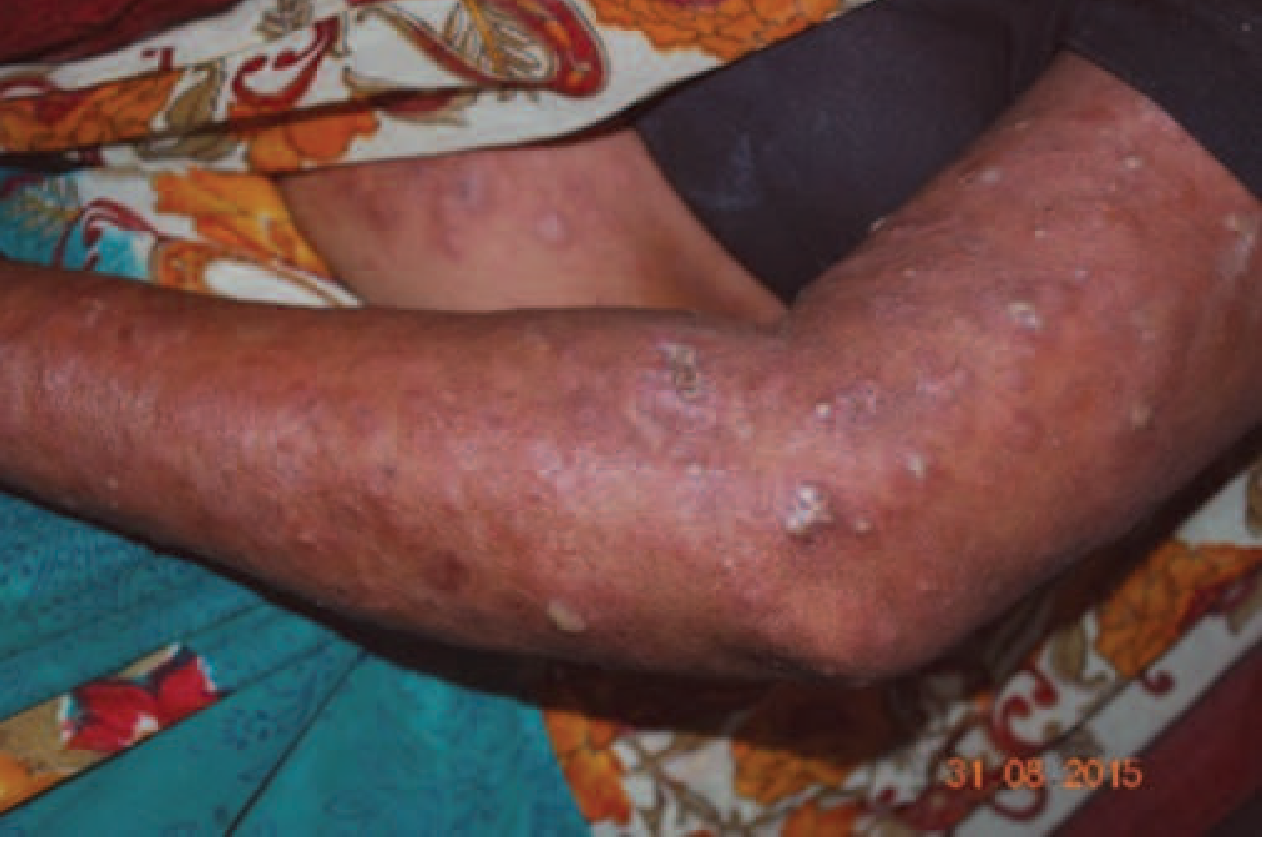
- Occurs mostly during MDT, but also develops in untreated patients and after treatment completion
- Can recur episodically for months to years post-MDT
- Involves skin, nerves, and other organs (lymph nodes, liver, spleen, kidneys, eyes, testes)
Why ENL keeps recurring
"Leprosy reactions and new nerve damage may also occur after completion of multidrug treatment. While the risk diminishes with time, these manifestations can occur up to 3 years after the conclusion of therapy."
- Harrison's Principles of Internal Medicine, 22E, p. 1454
Management of ongoing ENL
| Drug | Dose | Notes |
|---|---|---|
| Prednisolone | 1-2 mg/kg/day, tapering 10-15% every 15 days | Full course up to 3 months; re-escalate if worsening |
| Thalidomide | 100-400 mg/day | Drug of choice for recurrent/chronic ENL - but CONTRAINDICATED in women of childbearing age unless strict dual contraception is confirmed (teratogenic - absolutely mandatory pregnancy testing and contraception) |
| Clofazimine | 100-300 mg/day | Acts slowly (6-12 weeks onset), useful for recurrent/chronic ENL; also has anti-inflammatory properties |
- Thalidomide is potentially usable but requires mandatory pregnancy testing and two reliable forms of contraception - this must be discussed and documented before prescribing
- If thalidomide is not feasible, clofazimine (100 mg 3x/day, tapering) is the alternative long-term option for recurrent ENL
- Steroids may be needed for acute flares but require caution given the TB peritonitis co-diagnosis (steroids may be acceptable adjunctive therapy for TB peritonitis but at lower doses)
- NSAIDs for mild episodes
- Assess for nerve function impairment at each visit (ENL can cause silent neuritis - test for ulnar/median/posterior tibial nerve function)
- Monitor eyes for iridocyclitis/uveitis - a serious ENL complication
- Monitor renal function (ENL nephritis)
Putting It All Together: The Critical Connection
- She had multibacillary leprosy (given the severity and bilateral limb involvement)
- She developed ENL (Type 2 reaction) - manifesting as painful subcutaneous nodules + fever → appropriately treated with prednisone
- Prolonged corticosteroid use for ENL suppressed her immune system and likely reactivated latent TB → leading to tuberculous peritonitis
- She is now on ATT (correct), but her ENL continues post-MDT (expected and documented up to 3 years after therapy)
Immediate Action Plan
| Priority | Action |
|---|---|
| 1 | Continue ATT - reassess at 6-8 weeks; CB-NAAT negativity does not invalidate the diagnosis given ADA 64 + lymphocytic exudate |
| 2 | Do NOT stop ATT based on incomplete response at 2 weeks - TB peritonitis resolves slowly |
| 3 | Evaluate current ENL activity - examine the nodules; check for nerve tenderness/function (ulnar, median, posterior tibial) |
| 4 | Treat active ENL - if nerve involvement, start prednisolone; if purely cutaneous recurrent ENL, consider clofazimine or thalidomide (with mandatory contraception confirmation) |
| 5 | Avoid high-dose steroids concurrently with ATT if possible, or use at minimum necessary dose |
| 6 | Monitor for ENL systemic involvement - urinalysis (nephritis), eye exam (iridocyclitis), LFTs |
| 7 | Consider repeating ascitic fluid culture (send large volume, 300-500 mL) for mycobacterial culture to improve diagnostic yield |
- Harrison's Principles of Internal Medicine, 22E, pp. 1452-1454
- Fitzpatrick's Dermatology, 5th ed., pp. 1489-1500
- Murray & Nadel's Respiratory Medicine, p. 1429
Search for latest guidelines on managing TB peritonitis with concurrent ENL
tuberculous peritonitis treatment guidelines
erythema nodosum leprosum ENL management corticosteroids
WHO guidelines TB peritonitis treatment 2023 2024 corticosteroids adjunct
PMID: 41886473
PMID: 41871154
extrapulmonary tuberculosis peritoneal treatment duration steroids
leprosy reaction tuberculosis coinfection corticosteroids risk
PMID: 38645889
PMID: 41093045
abdominal tuberculosis peritonitis diagnosis management
https://pmc.ncbi.nlm.nih.gov/articles/PMC6293474
PMID: 36899289
PMID: 39953910
PMID: 40023548
leprosy tuberculosis reactivation corticosteroid immunosuppression
leprosy tuberculosis coinfection mycobacterium
thalidomide clofazimine ENL leprosy reaction steroid sparing
Latest Guidelines: Managing TB Peritonitis with Concurrent ENL
1. TB Peritonitis: Current Evidence-Based Recommendations
ATT Regimen (Standard, well-established)
2RHZE / 4RH - Rifampicin + Isoniazid + Pyrazinamide + Ethambutol for 2 months, then Rifampicin + Isoniazid for 4 months. Total: 6 months.
Assessing Response to ATT
- Do not rely solely on subjective symptom improvement - use objective markers
- 2-month assessment is the key checkpoint: look for reduction in ascites on imaging, improvement in constitutional symptoms
- ADA levels may not reliably track response (do not retest ADA as a response marker)
- In this patient, partial reduction of ascites at 2 weeks on ATT is a positive sign - full response takes 6-8 weeks
Adjunctive Corticosteroids in TB Peritonitis
| Source | Recommendation |
|---|---|
| WHO 2017 Drug-Sensitive TB Update | Steroids conditionally recommended for TB pericarditis (very low evidence) and strongly for TB meningitis. No formal recommendation for peritonitis. |
| Expert Review (Schutz et al., 2018 - PMC6293474) | Evidence for steroids in peritoneal TB is "observational, limited, with small sample sizes"; not routinely recommended |
| RCT data (1960s) | One controlled trial of 47 patients showed a non-significant trend toward fewer adhesions/obstruction with prednisone in TB peritonitis (p=0.234) |
| StatPearls / Current consensus | "The role of adjunctive corticosteroids has not been established" in peritoneal TB |
2. ENL Management: Latest Evidence (2025-2026)
The Corticosteroid Risk Problem - A 2026 Warning
"Infections were the second most common adverse effect (15.5%) of corticosteroids in leprosy... Infections accounted for three-quarters of corticosteroid-associated mortality, predominantly due to tuberculosis, with 88.2% of corticosteroid-associated mortalities occurring in individuals with ENL."
- Lun et al., PLoS Negl Trop Dis, 2026 (PMID 41886473)
Preferred Steroid-Sparing Approaches for ENL in 2025-2026
- Drug of choice for chronic/recurrent ENL
- Blocks TNF-α production, targeting the immune complex-driven inflammation of ENL
- CRITICAL CONTRAINDICATION: Absolutely teratogenic - in this 28-year-old woman, mandatory pregnancy testing + dual reliable contraception must be confirmed before use
- Not appropriate if she could be pregnant or not willing to use strict contraception
- Preferred steroid-sparing agent when thalidomide cannot be used
- Anti-inflammatory via inhibiting phospholipase A2 and T-cell function
- Onset of action slow (6-12 weeks) - not suitable for acute flares
- Safe to use concurrently with ATT (no major interactions)
- PDE4 inhibitor - blocks downstream TNF-α, IL-17, IL-23
- A 2025 review + case report (Gayoso Cantero et al., Travel Med Infect Dis, 2025 - PMID 41093045) documents successful use in steroid-dependent, thalidomide-refractory ENL - enabling complete withdrawal of both corticosteroids and thalidomide
- No teratogenic risk (unlike thalidomide)
- May be the best option in a young woman with concurrent active TB where steroids and thalidomide both carry concerns
- Currently off-label for ENL; cost and access may be limiting factors
3. The Specific Challenge: Managing Both Simultaneously
The rifampicin interaction
- Rifampicin resistance acquisition: If the patient received rifampicin monthly (leprosy dose), and is now taking rifampicin daily (TB dose), this is an intensification - no problem
- However, if ENL recurs during active TB treatment and rifampicin is already being used, any ENL treatment decision must not compromise ATT adherence
- Rakotoarisaona et al. (2024, PMID 38645889) - Madagascar case series of 5 TB-leprosy coinfections - concluded: "Dermatologists should screen leprosy patients for latent/active TB before long-term corticosteroids, and rifampicin resistance is the greatest risk of combined treatment"
Practical Management Algorithm for This Patient
Active TB Peritonitis (on ATT)
        +
Recurrent/Chronic ENL
        ↓
Step 1: Continue full 6-month ATT (2RHZE/4RH) — non-negotiable
        ↓
Step 2: Assess ENL severity
  ├─ Mild (skin nodules only, no nerve involvement)
  │     → Clofazimine 100-300 mg/day (steroid-sparing, TB-safe)
  │     → NSAIDs for symptomatic relief
  │
  └─ Moderate-severe (neuritis, systemic symptoms, or
     risk of nerve damage)
        ↓
        Use MINIMUM effective corticosteroid dose
        Prednisolone 0.5-1 mg/kg/day (not full 2 mg/kg)
        Taper aggressively over 6-8 weeks (not 3 months)
        Avoid open-ended long-course steroids
        ↓
        Transition to steroid-sparing agent ASAP:
        ├─ Thalidomide 100 mg/day (if dual contraception confirmed)
        └─ Apremilast 30 mg BD (if thalidomide not feasible)
Monitoring Parameters
| Parameter | Frequency | Why |
|---|---|---|
| Ascites reassessment (USG) | At 2 months of ATT | Objective ATT response check |
| LFTs | Monthly | Hepatotoxicity from ATT (INH + RIF + PZA all hepatotoxic) |
| Nerve function assessment | Every clinic visit | Silent neuritis from ENL |
| Eye exam | Every 6 months | ENL iridocyclitis; also ethambutol optic neuritis |
| Blood glucose / BP | Monthly if on steroids | Corticosteroid metabolic effects |
| Screen for other opportunistic infections | At baseline | Prior steroid exposure → risk of fungal infections, Strongyloides |
| Pregnancy test | Before thalidomide | Mandatory, teratogenic risk |
Summary of Evidence Levels
| Recommendation | Evidence Quality | Source |
|---|---|---|
| 6-month ATT (2RHZE/4RH) for TB peritonitis | High (multiple RCTs, WHO guideline) | WHO 2017; Jha et al. 2023; Sampath 2025 |
| Steroids NOT routinely indicated for TB peritonitis alone | Moderate (limited RCT data) | Schutz et al. 2018; Cochrane review |
| Corticosteroid toxicity in ENL includes TB mortality (88.2% of steroid deaths) | High (systematic review, 111 studies) | Lun et al. 2026 [PMID 41886473] |
| Thalidomide first-line for recurrent ENL | Moderate (multiple studies) | WHO leprosy guidelines; Fitzpatrick's |
| Clofazimine effective steroid-sparing for ENL | Moderate | WHO; Harrison's 22E |
| Apremilast for refractory/steroid-dependent ENL | Low-moderate (case reports + review) | Gayoso Cantero et al. 2025 [PMID 41093045] |
| Screen leprosy patients on steroids for TB | Expert consensus | Rakotoarisaona et al. 2024 [PMID 38645889] |
| Standardised ENL classification needed (limits guideline development) | High (systematic review) | de Barros et al. 2026 [PMID 41871154] |