
P anca test significance in dermatology
Reading File
Now let me search the medical library and PubMed in parallel.
Finding Sources
Finding Sources
Searching PubMed
p-ANCA dermatology skin manifestations
Good hits. Let me now read the key sections from Andrews' dermatology on ANCA-positive vasculitides and Fitzpatrick's on autoimmune serologies.
Reading File
Reading File
Reading File
Let me read more on the specific diseases and also fetch the ANCA frequency chart image.
Reading File
Reading File
Loading Image
Now let me also read about EGPA and drug-induced ANCA vasculitis in dermatology, plus cocaine-associated vasculitis.
Reading File
Finding Sources
I now have comprehensive information to provide a thorough answer. Let me also read the GPA and cocaine vasculitis section quickly.
Reading File
Reading File
I now have comprehensive information to provide a detailed, well-structured answer. Here it is:
P-ANCA (Perinuclear ANCA): Significance in Dermatology
What is P-ANCA?
Antineutrophil cytoplasmic antibodies (ANCAs) are autoantibodies directed against antigens in the cytoplasm of neutrophils. On indirect immunofluorescence (IIF), they produce two main patterns:
| Pattern | Target Antigen | IIF Appearance |
|---|---|---|
| c-ANCA | Proteinase 3 (PR3) | Cytoplasmic, granular |
| p-ANCA | Myeloperoxidase (MPO) | Perinuclear |
| Atypical ANCA | Neither PR3 nor MPO | Atypical |
Important: The specificity of the p-ANCA pattern alone is low. Anti-MPO antibodies confirmed by ELISA are required to make p-ANCA clinically meaningful for diagnosing vasculitis. A 2017 international consensus recommends high-quality immunoassays for PR3 and MPO without needing IIF as the initial screen.
ANCA-Associated Vasculitides (AAV) with Dermatological Relevance
The three primary ANCA-associated vasculitides (AAVs) are MPA, GPA, and EGPA. When used appropriately, ANCA testing achieves 85% sensitivity and 98% specificity for these conditions.
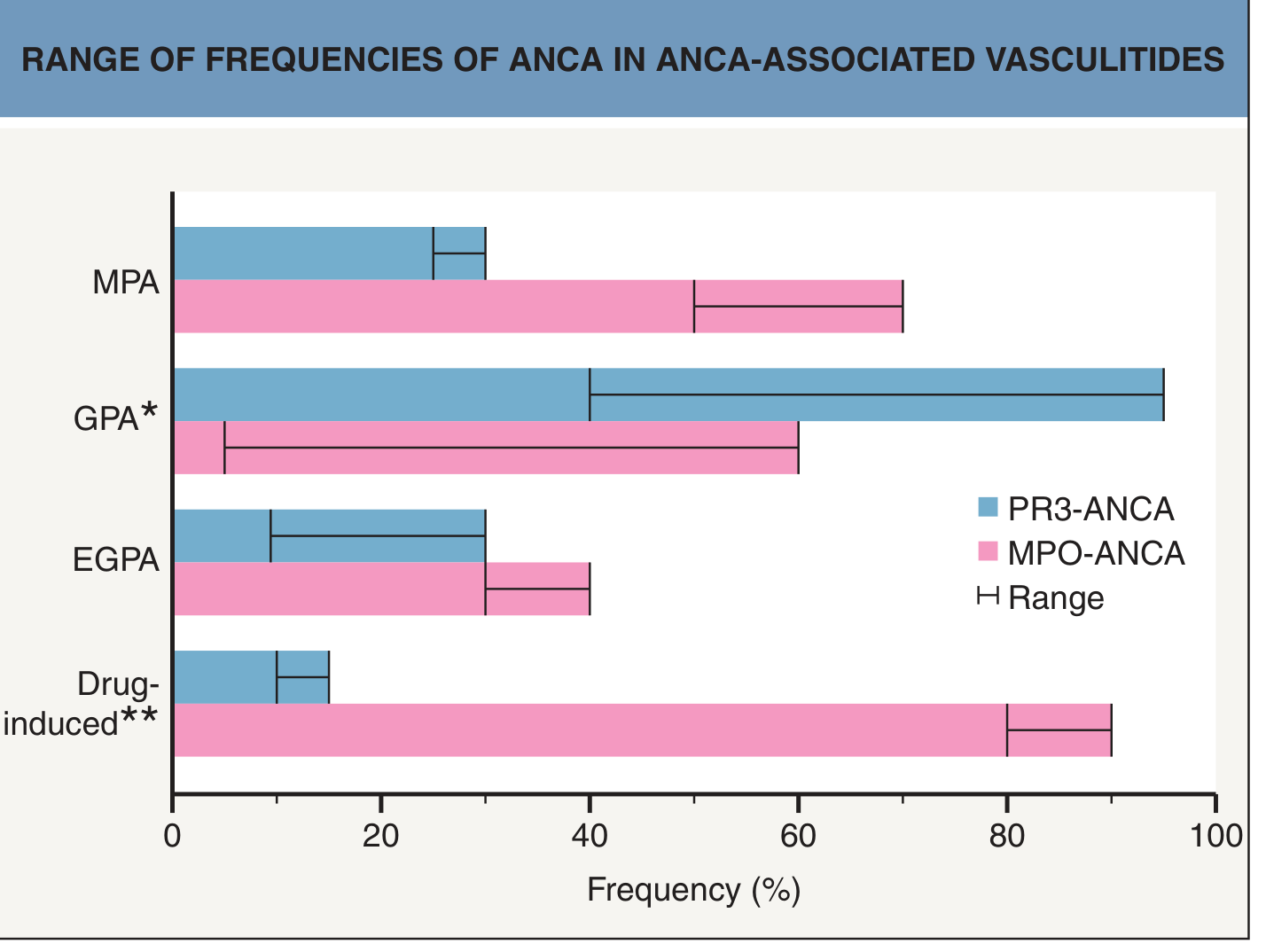
1. Microscopic Polyangiitis (MPA) — p-ANCA is the dominant pattern
- ANCA positivity: ~70% positive; p-ANCA (anti-MPO) more frequent than c-ANCA
- Skin involved in 44% — the skin may be the initial presenting feature
- Cutaneous findings:
- Purpuric papules and macules (most common)
- Livedo reticularis (in ~2/3 of those with skin-first presentation)
- Retiform purpura, cutaneous ulcers, digital ischemia
- Necrotizing leukocytoclastic vasculitis (LCV) in reticular dermis on biopsy
- Systemic: glomerulonephritis (80–90%), pulmonary capillaritis, vasculitic neuropathy (58%)
- Distinguishing feature from PAN: presence of GN, pulmonary symptoms; ANCA rarely positive in PAN
2. Granulomatosis with Polyangiitis (GPA) — c-ANCA dominant, but ~10% have p-ANCA
- ANCA positivity: ~90% in active generalized disease
- ~90% are c-ANCA (anti-PR3); the remainder are p-ANCA (anti-MPO)
- Skin involved in ~1/3 of patients at presentation; cutaneous involvement is a risk marker for severe systemic disease (GN, alveolar hemorrhage)
- Cutaneous findings:
- Purpuric papules/macules, petechiae
- Papulonecrotic lesions (especially extensor surfaces, elbows)
- Subcutaneous nodules, ulcerations resembling pyoderma gangrenosum
- "Strawberry gums" — hypertrophic gingivitis, characteristic and biopsy-accessible
- Saddle-nose deformity, nasal septal perforation (mucosal involvement)
- Livedo reticularis is rare in GPA
- Histology: LCV ± granulomatous inflammation; palisaded granulomas with multinucleated giant cells
3. Eosinophilic Granulomatosis with Polyangiitis (EGPA / Churg-Strauss)
- ANCA positivity: ~40–50%; predominantly p-ANCA (anti-MPO)
- Associated with asthma, peripheral eosinophilia (>1000 cells/μL) — helps differentiate from asthma/atopy
- Skin: purpura, papulonecrotic nodules ("Churg-Strauss nodules"), subcutaneous nodules
P-ANCA in Drug-Induced Vasculitis — Critical Dermatological Context
This is one of the most practically important applications:
- Drugs causing p-ANCA/MPO-ANCA-positive vasculitis:
- Propylthiouracil (PTU)
- Minocycline
- Hydralazine
- Allopurinol, sulfonamides, gold, thiazides, phenytoin
- Key clue: Both c-ANCA AND p-ANCA positive simultaneously → suspect drug-induced vasculitis, including levamisole-tainted cocaine
- Levamisole-adulterated cocaine (present in up to 70% of U.S. seized cocaine):
- Produces ecchymotic purpura/necrosis with predilection for ears, nose, thighs, buttocks
- Both c-ANCA and p-ANCA can be elevated
- c-ANCA reacts with human neutrophil elastase (HNE-ANCA) — patients with true GPA/MPA are HNE-ANCA negative — useful distinguishing test
- Also causes agranulocytosis (atypical for true AAV)
P-ANCA in Non-Vasculitic Dermatological Conditions
The p-ANCA pattern (without MPO specificity) can be found as a false-positive or non-specific finding in:
| Condition | Notes |
|---|---|
| Inflammatory bowel disease (IBD) | Atypical ANCA common in UC; does not indicate vasculitis |
| SLE | Can present with cutaneous vasculitis; ANCA testing part of pulmonary-renal workup |
| Rheumatoid arthritis | Low-titer, usually non-MPO specific |
| Cryoglobulinemia | Positive ANCAs can be found |
| Skin-limited vasculitis | Annual incidence of underlying AAV ~4 per million in biopsy-proven cutaneous small-vessel vasculitis (~10%) |
| Infectious diseases | TB, endocarditis, HIV |
Diagnostic Algorithm for Dermatologists
Skin vasculitis suspected
       ↓
Screen: IIF for ANCA pattern
       ↓
Positive p-ANCA pattern
       ↓
Confirm with ELISA: Anti-MPO antibody?
   ├─ YES → Strongly suggests MPA, EGPA, or drug-induced AAV
   │         Assess: renal function, pulmonary symptoms, drug history
   └─ NO  → Atypical ANCA — consider IBD, SLE, infection
              (low specificity for primary vasculitis)
Key Takeaways
- p-ANCA alone (by IIF) has low specificity — MPO confirmation by ELISA is essential
- p-ANCA/MPO-ANCA is the hallmark of MPA, and skin is involved in nearly half of MPA cases — often as the presenting feature
- ~10% of GPA patients have p-ANCA (not c-ANCA); these must be distinguished from MPA
- Dual positivity (p-ANCA + c-ANCA) should always raise suspicion for drug-induced vasculitis or levamisole-cocaine exposure
- HNE-ANCA is a useful differentiator: positive in cocaine/levamisole vasculitis, negative in true GPA/MPA
- ANCA testing does not replace clinical evaluation, histopathology, and organ-specific investigations
- ANCA positivity in skin-limited vasculitis warrants systemic workup (renal, pulmonary), since AAV underlies ~10% of such cases
Sources: Andrews' Diseases of the Skin, 13th ed.; Dermatology, 5th ed. (Elsevier); Fitzpatrick's Dermatology, 9th ed.
This is a shared conversation. Sign in to Orris to start your own chat.