
Give me differential diagnosis for tuberculoma
Reading File
Now let me search the library for tuberculoma differential diagnosis in parallel.
Finding Sources
Finding Sources
Searching PubMed
tuberculoma differential diagnosis intracranial
Reading File
Reading File
Reading File
Now let me search for more specific differential diagnosis content from neurology and radiology textbooks:
Finding Sources
Finding Sources
Finding Sources
Finding Sources
Finding Sources
Reading File
Finding Sources
I now have comprehensive data from multiple textbooks. Let me compile the full answer.
Differential Diagnosis of Tuberculoma
Tuberculoma (intracranial/CNS) is a tumor-like mass of tuberculous granulation tissue occurring in the brain parenchyma, most often at the grey-white matter junction. Because it appears as a ring-enhancing or solid mass lesion on neuroimaging, its differential is broad and grouped below by category.
1. Infectious / Parasitic Lesions
| Condition | Key Distinguishing Features |
|---|---|
| Neurocysticercosis | Most common mimic in endemic areas; thin-walled cystic lesion, scolex visible on MRI ("hole-with-dot" sign); serology positive |
| Toxoplasma encephalitis | Especially in HIV (CD4 <100); multiple ring-enhancing lesions; responds rapidly to empirical pyrimethamine-sulfadiazine; Toxoplasma IgG positive |
| Pyogenic brain abscess | Usually single thick-walled ring-enhancing lesion; restricted diffusion on DWI (bright); fever + systemic sepsis; often from contiguous ear/sinus source or hematogenous spread |
| Tuberculous abscess | Rare; larger than tuberculoma, thinner enhancing rim (lobulated); restricted diffusion in non-enhancing core, similar to pyogenic abscess |
| Fungal granuloma (Cryptococcus, Aspergillus, Histoplasma, Candida) | Immunocompromised host; cryptococcal lesions often cause meningitis; may have gelatinous pseudocysts |
| Amoebic abscess (Entamoeba histolytica) | Rare; hepatic abscess usually coexistent |
| Hydatid cyst (Echinococcus) | Large, smooth, unilocular cyst; no perilesional edema; endemic area |
| Cerebral malaria | Multiple petechial/hemorrhagic foci; travel history; positive blood smear |
2. Primary CNS Tumors
| Condition | Key Distinguishing Features |
|---|---|
| High-grade glioma (GBM) | Irregular ring enhancement; marked mass effect; vasogenic edema; heterogeneous; elevated MRS Cho:NAA ratio |
| Low-grade glioma | Non-enhancing; diffuse T2 signal; usually in white matter |
| Metastatic carcinoma | Multiple lesions at grey-white junction; known primary; marked surrounding edema; enhancing nodule or ring |
| Primary CNS lymphoma (PCNSL) | Periventricular location; hyperdense on CT; homogeneous enhancement; associated with HIV (CD4 <50); solitary lesion often >4 cm; EBV PCR positive in CSF |
| Meningioma | Dural-based; uniformly enhancing; "dural tail"; no surrounding edema unless large |
| Medulloblastoma/ependymoma | Children; posterior fossa midline location |
3. Demyelinating / Inflammatory Lesions
| Condition | Key Distinguishing Features |
|---|---|
| Tumefactive MS | Young adults; "open-ring" enhancement (incomplete ring, open toward grey matter); juxtacortical/periventricular; CSF oligoclonal bands |
| Neurosarcoidosis | Leptomeningeal and parenchymal lesions; predilection for basal meninges; systemic sarcoid (hilar adenopathy, elevated ACE); responds to steroids |
| Vasculitis (CNS) | Multiple infarct-like lesions; angiography abnormal; CSF inflammatory |
| ADEM | Post-infectious; multifocal white matter; bilateral; often in children |
4. Vascular Lesions
| Condition | Key Distinguishing Features |
|---|---|
| Cavernous malformation | "Popcorn" appearance on MRI; hemosiderin rim (dark on GRE/SWI); no enhancement; no edema |
| Hemorrhagic infarct | DWI bright (restricted); vascular territory; evolving signal changes |
| AVM / aneurysm | Flow voids; vascular blush on angiography |
Radiological Clues Specific to Tuberculoma
- Target sign: central calcification or nidus + rim enhancement on CT - classically described in tuberculoma but not pathognomonic (also seen in cysticercosis)
- Non-caseating stage: low T1, high T2 signal (like edema)
- Caseating stage: low T2 signal (characteristic - due to inspissated caseous material with high protein and free radical content)
- Calcified (healed): hyperdense on CT, no enhancement
- DWI: variable - may show elevated or restricted diffusion; pyogenic abscess classically shows bright DWI
Summary Priority in Clinical Context
| Setting | Top Differentials |
|---|---|
| HIV patient | Toxoplasma, PCNSL, PML, CMV encephalitis, cryptococcal abscess |
| Immunocompetent patient in TB-endemic region | Neurocysticercosis, pyogenic abscess, glioma, metastasis |
| Child in tropical region | Neurocysticercosis, tuberculoma itself, medulloblastoma (cerebellar) |
| Developed country | CNS lymphoma, metastasis, high-grade glioma |
In HIV patients, ring-enhancing CNS lesions are empirically treated for Toxoplasma first; tuberculoma is considered if there is known TB exposure or residence in a highly endemic area. A brain biopsy is definitive when empiric therapy fails. - Rosen's Emergency Medicine, p. 2652; Adams and Victor's Principles of Neurology 12e, p. 730; Grainger & Allison's Diagnostic Radiology, p. 1473
Create a visual comparison chart: tuberculoma vs neurocysticercosis vs brain abscess
Reading File
Reading File
Running Command
ls -la /home/daytona/workspace/ 2>/dev/null || echo "workspace empty or not found"
Running Command
mkdir -p /home/daytona/workspace/neuro-comparison
Writing File
~/neuro-comparison/chart.js
const pptxgen = require("pptxgenjs");
const pres = new pptxgen();
pres.layout = "LAYOUT_WIDE"; // 13.3" x 7.5"

// ─── COLOUR PALETTE ───────────────────────────────────────────────
const BG       = "0D1B2A";   // deep navy (dominant)
const PANEL    = "12263A";   // slightly lighter navy panel
const ACCENT1  = "00C2CB";   // teal – tuberculoma
const ACCENT2  = "F4A832";   // amber – neurocysticercosis
const ACCENT3  = "E84855";   // coral-red – brain abscess
const WHITE    = "FFFFFF";
const GREY     = "8FA3B1";
const DIVIDER  = "1E3A52";

// ─── HELPER ───────────────────────────────────────────────────────
function colCard(slide, x, w, color) {
  slide.addShape(pres.ShapeType.rect, {
    x, y: 0.78, w, h: 6.45,
    fill: { color: PANEL },
    line: { color: color, width: 2.5 }
  });
}

function hdrBar(slide, x, w, color, emoji, title, subtitle) {
  slide.addShape(pres.ShapeType.rect, {
    x, y: 0.78, w, h: 0.88,
    fill: { color: color }, line: { color: color, width: 0 }
  });
  slide.addText([
    { text: emoji + "  " + title, options: { bold: true, fontSize: 14, color: WHITE, breakLine: true } },
    { text: subtitle, options: { fontSize: 9.5, color: WHITE, italic: true } }
  ], { x: x + 0.12, y: 0.82, w: w - 0.24, h: 0.80, valign: "middle", margin: 0 });
}

function rowLabel(slide, y, label) {
  slide.addShape(pres.ShapeType.rect, {
    x: 0.18, y, w: 2.6, h: 0.56,
    fill: { color: DIVIDER }, line: { color: DIVIDER, width: 0 },
    rounding: 0.08
  });
  slide.addText(label, {
    x: 0.22, y: y + 0.04, w: 2.52, h: 0.48,
    fontSize: 9, bold: true, color: ACCENT1, valign: "middle", margin: 0, charSpacing: 1
  });
}

function cell(slide, x, y, w, lines, color) {
  // Thin left accent bar
  slide.addShape(pres.ShapeType.rect, {
    x: x + 0.10, y: y + 0.04, w: 0.04, h: 0.46,
    fill: { color }, line: { color, width: 0 }
  });
  const richLines = lines.map((l, i) => ({
    text: l,
    options: { breakLine: i < lines.length - 1 ? true : false }
  }));
  slide.addText(richLines, {
    x: x + 0.22, y: y + 0.03, w: w - 0.32, h: 0.52,
    fontSize: 8.8, color: WHITE, valign: "middle", margin: 0
  });
}

// ════════════════════════════════════════════════════════════════
//  SLIDE 1 – MASTER COMPARISON TABLE
// ════════════════════════════════════════════════════════════════
const s1 = pres.addSlide();
s1.background = { color: BG };

// Title bar
s1.addShape(pres.ShapeType.rect, {
  x: 0, y: 0, w: 13.3, h: 0.78, fill: { color: "091420" }, line: { color: "091420", width: 0 }
});
s1.addText("NEURO-INFECTIOUS MASS LESIONS  |  Visual Comparison Chart", {
  x: 0.3, y: 0.04, w: 10, h: 0.68, fontSize: 15, bold: true, color: WHITE, valign: "middle", margin: 0
});
s1.addText("Tuberculoma  •  Neurocysticercosis  •  Brain Abscess", {
  x: 0.3, y: 0.42, w: 13, h: 0.34, fontSize: 9, color: GREY, valign: "middle", margin: 0
});

// Column widths: row labels 2.78 | col1 3.38 | col2 3.38 | col3 3.38 | margins
const COL = [2.96, 6.34, 9.72];
const CW  = 3.22;

// Column cards + headers
colCard(s1, COL[0], CW, ACCENT1);
colCard(s1, COL[1], CW, ACCENT2);
colCard(s1, COL[2], CW, ACCENT3);

hdrBar(s1, COL[0], CW, ACCENT1, "🟦", "TUBERCULOMA",          "M. tuberculosis granuloma");
hdrBar(s1, COL[1], CW, ACCENT2, "🟨", "NEUROCYSTICERCOSIS",   "Taenia solium larvae");
hdrBar(s1, COL[2], CW, ACCENT3, "🟥", "PYOGENIC BRAIN ABSCESS","Bacterial / polymicrobial");

// Row definitions  [y-position, label, [tb data], [ncc data], [ba data]]
const ROWS = [
  [1.72, "CAUSATIVE AGENT",
    ["M. tuberculosis"],
    ["Taenia solium (larval cyst)"],
    ["Streptococcus, Staph,", "Gram-negatives (polymicrobial)"]
  ],
  [2.34, "EPIDEMIOLOGY",
    ["TB-endemic regions;", "immunocompromised"],
    ["Rural developing world;", "pork-eating populations"],
    ["Any; post-surgery, dental,", "ear/sinus source, IV drug use"]
  ],
  [2.96, "LOCATION",
    ["Grey-white junction;", "any lobe; posterior fossa kids"],
    ["Grey-white junction,", "subarachnoid / ventricular"],
    ["Frontal / temporal lobes;", "often near cortex"]
  ],
  [3.58, "NUMBER",
    ["Single or multiple"],
    ["Often multiple (all stages)"],
    ["Usually solitary; can be multiple"]
  ],
  [4.20, "CT APPEARANCE",
    ["Iso/hypo-dense; rim or solid", "enhancement; target sign*"],
    ["Cyst ± scolex (dense dot);", "wall calcification late stage"],
    ["Hypodense centre; thick", "irregular ring enhancement"]
  ],
  [4.82, "MRI SIGNATURE",
    ["T2 LOW in caseating stage", "(diagnostic clue); DWI variable"],
    ["T2 bright cyst fluid;", "scolex = eccentric T1 bright dot"],
    ["T2 bright centre; DWI", "BRIGHT (restricted diffusion)"]
  ],
  [5.44, "KEY DIAGNOSTICS",
    ["TST/IGRA; chest X-ray;", "CSF AFB/PCR; biopsy"],
    ["Serology (ELISA/EITB);", "scolex on MRI; stool O&P"],
    ["Blood cultures; CSF culture;", "Gram stain of aspirate"]
  ],
  [6.05, "TREATMENT",
    ["HRZE × 2 mo → HR × 7-10 mo;", "steroids if cerebral oedema"],
    ["Albendazole + praziquantel;", "anti-epileptics; steroids"],
    ["Surgical drainage / aspiration;", "IV antibiotics 4-8 weeks"]
  ],
];

ROWS.forEach(([y, label, tb, ncc, ba]) => {
  rowLabel(s1, y, label);
  cell(s1, COL[0], y, CW, tb,  ACCENT1);
  cell(s1, COL[1], y, CW, ncc, ACCENT2);
  cell(s1, COL[2], y, CW, ba,  ACCENT3);
});

// Footer note
s1.addText("* Target sign (central calcification + rim enhancement) seen in tuberculoma and cysticercosis — not pathognomonic for either  |  DWI = diffusion-weighted imaging  |  HRZE = isoniazid-rifampin-pyrazinamide-ethambutol", {
  x: 0.18, y: 7.18, w: 12.94, h: 0.28, fontSize: 6.5, color: GREY, valign: "middle", margin: 0
});

// ════════════════════════════════════════════════════════════════
//  SLIDE 2 – DWI / MRI SIGNAL QUICK-REFERENCE CARD
// ════════════════════════════════════════════════════════════════
const s2 = pres.addSlide();
s2.background = { color: BG };

s2.addShape(pres.ShapeType.rect, {
  x: 0, y: 0, w: 13.3, h: 0.78, fill: { color: "091420" }, line: { color: "091420", width: 0 }
});
s2.addText("MRI SIGNAL PATTERN  |  At-a-Glance Differentiator", {
  x: 0.3, y: 0.12, w: 12, h: 0.55, fontSize: 15, bold: true, color: WHITE, valign: "middle", margin: 0
});

// Signal grid helper
function sigBox(slide, x, y, w, h, fillColor, labelColor, label, detail) {
  slide.addShape(pres.ShapeType.roundRect, {
    x, y, w, h, rectRadius: 0.12,
    fill: { color: fillColor }, line: { color: fillColor, width: 0 }
  });
  slide.addText([
    { text: label, options: { bold: true, fontSize: 11, color: labelColor, breakLine: true } },
    { text: detail, options: { fontSize: 8.5, color: labelColor } }
  ], { x: x + 0.12, y, w: w - 0.24, h, valign: "middle", margin: 0 });
}

const sequences = [
  { seq: "T1 WI",  tb: ["Iso/hypo-intense", "rim may enhance"],         tbc: "1E3A52", ncc: ["Hypo-intense (cyst)", "Bright scolex dot"],       nccc: "1E4A2A", ba: ["Hypo-intense centre", "Enhancing thick rim"],       bac: "3A1E24" },
  { seq: "T2 WI",  tb: ["LOW signal", "(caseation – key clue)"],         tbc: "103A4A", ncc: ["HIGH signal (cyst fluid)", "Hypo scolex"],         nccc: "1E4A2A", ba: ["HIGH signal centre", "Surrounding oedema"],          bac: "3A1E24" },
  { seq: "DWI",    tb: ["Variable", "(elevated or restricted)"],          tbc: "1E3A52", ncc: ["Variable;", "cyst usually bright"],               nccc: "1E4A2A", ba: ["BRIGHT (restricted)", "Pus = high viscosity"],          bac: "5A1E28" },
  { seq: "T1+Gad", tb: ["Rim OR solid", "enhancement"],                  tbc: "1E3A52", ncc: ["Ring or nodular;", "scolex may enhance"],         nccc: "1E4A2A", ba: ["THICK irregular ring", "enhancement"],                 bac: "3A1E24" },
  { seq: "MRS",    tb: ["↑ Lipid/lactate", "No Cho:NAA shift"],          tbc: "1E3A52", ncc: ["Succinate peak", "(anaerobic glycolysis)"],        nccc: "1E4A2A", ba: ["↑ Acetate, succinate", "↑ Amino acids"],              bac: "3A1E24" },
];

// Column headers
[["TUBERCULOMA", ACCENT1], ["NEUROCYSTICERCOSIS", ACCENT2], ["BRAIN ABSCESS", ACCENT3]].forEach(([label, col], i) => {
  const x = 3.5 + i * 3.2;
  s2.addShape(pres.ShapeType.rect, { x, y: 0.82, w: 3.1, h: 0.44, fill: { color: col }, line: { color: col, width: 0 } });
  s2.addText(label, { x, y: 0.82, w: 3.1, h: 0.44, fontSize: 9, bold: true, color: WHITE, align: "center", valign: "middle", margin: 0 });
});

sequences.forEach((row, ri) => {
  const rowY = 1.32 + ri * 1.12;
  // Sequence label
  s2.addShape(pres.ShapeType.rect, { x: 0.18, y: rowY, w: 3.22, h: 1.0, fill: { color: DIVIDER }, line: { color: DIVIDER, width: 0 }, rounding: 0.1 });
  s2.addText(row.seq, { x: 0.18, y: rowY, w: 3.22, h: 1.0, fontSize: 12, bold: true, color: WHITE, align: "center", valign: "middle", margin: 0 });

  // TB cell
  sigBox(s2, 3.50, rowY, 3.1, 1.0, row.tbc, ACCENT1, row.tb[0], row.tb[1]);
  // NCC cell
  sigBox(s2, 6.70, rowY, 3.1, 1.0, row.nccc, ACCENT2, row.ncc[0], row.ncc[1]);
  // BA cell
  sigBox(s2, 9.90, rowY, 3.1, 1.0, row.bac, ACCENT3, row.ba[0], row.ba[1]);
});

s2.addText("MRS = Magnetic Resonance Spectroscopy  |  Gad = Gadolinium contrast  |  DWI restricted diffusion (bright) = high cellularity / viscosity", {
  x: 0.18, y: 7.18, w: 12.94, h: 0.28, fontSize: 6.5, color: GREY, valign: "middle", margin: 0
});

// ════════════════════════════════════════════════════════════════
//  SLIDE 3 – CLINICAL DECISION ALGORITHM
// ════════════════════════════════════════════════════════════════
const s3 = pres.addSlide();
s3.background = { color: BG };

s3.addShape(pres.ShapeType.rect, {
  x: 0, y: 0, w: 13.3, h: 0.78, fill: { color: "091420" }, line: { color: "091420", width: 0 }
});
s3.addText("CLINICAL DECISION FRAMEWORK  |  Ring-Enhancing Lesion Workup", {
  x: 0.3, y: 0.12, w: 12, h: 0.55, fontSize: 15, bold: true, color: WHITE, valign: "middle", margin: 0
});

// Decision boxes helper
function dBox(slide, x, y, w, h, fillColor, lineColor, text, textColor, fontSize) {
  slide.addShape(pres.ShapeType.roundRect, {
    x, y, w, h, rectRadius: 0.14,
    fill: { color: fillColor }, line: { color: lineColor, width: 1.5 }
  });
  slide.addText(text, {
    x: x + 0.08, y, w: w - 0.16, h, fontSize: fontSize || 9, color: textColor || WHITE,
    align: "center", valign: "middle", margin: 0, bold: false
  });
}

function arrow(slide, x1, y1, x2, y2, color) {
  slide.addShape(pres.ShapeType.line, {
    x: x1, y: y1, w: x2 - x1, h: y2 - y1,
    line: { color: color || GREY, width: 1.5, endArrowType: "arrow" }
  });
}

// Start node
dBox(s3, 4.9, 0.90, 3.5, 0.62, "1A2E42", ACCENT1, "Ring/nodular enhancing brain\nlesion on CT/MRI", WHITE, 9.5);

// 3 branches
const branches = [
  { x: 0.6,  color: ACCENT1, title: "DWI BRIGHT\n+ Fever + Leukocytosis", dx: 1.0,  dw: 2.5, dh: 0.72,
    items: ["Blood cultures (3 sets)", "CT chest/abdomen", "Ear / dental exam", "MRS: ↑ acetate/succinate", "→ BRAIN ABSCESS"] },
  { x: 4.9,  color: ACCENT2, title: "SCOLEX visible\n+ Pork exposure + Seizures", dx: 4.9, dw: 3.5, dh: 0.72,
    items: ["Serology: EITB/ELISA", "Stool O&P", "MRS: succinate peak", "All-stage cysts on MRI", "→ NEUROCYSTICERCOSIS"] },
  { x: 9.2,  color: ACCENT1, title: "T2 LOW signal\n+ TB history + Caseation", dx: 9.2, dw: 3.5, dh: 0.72,
    items: ["TST / IGRA", "Chest X-ray / CT", "CSF AFB PCR", "Sputum culture", "→ TUBERCULOMA"] },
];

// branch connectors
arrow(s3, 6.65, 1.52, 1.85, 2.08, GREY);
arrow(s3, 6.65, 1.52, 6.65, 2.08, GREY);
arrow(s3, 6.65, 1.52, 10.95, 2.08, GREY);

branches.forEach((b, i) => {
  dBox(s3, b.dx, 2.08, b.dw, b.dh, "1E3A52", b.color, b.title, WHITE, 9);
  b.items.forEach((item, ii) => {
    const yy = 2.92 + ii * 0.60;
    const isFinal = item.startsWith("→");
    s3.addShape(pres.ShapeType.rect, {
      x: b.dx + 0.04, y: yy, w: b.dw - 0.08, h: 0.54,
      fill: { color: isFinal ? b.color : "162B3E" },
      line: { color: isFinal ? b.color : DIVIDER, width: isFinal ? 0 : 0.5 }
    });
    s3.addText(item, {
      x: b.dx + 0.12, y: yy, w: b.dw - 0.2, h: 0.54,
      fontSize: isFinal ? 9.5 : 8.5, bold: isFinal, color: WHITE,
      align: "left", valign: "middle", margin: 0
    });
  });
});

// HIV patient note
s3.addShape(pres.ShapeType.roundRect, {
  x: 0.18, y: 6.45, w: 12.94, h: 0.72, rectRadius: 0.1,
  fill: { color: "1A1A2E" }, line: { color: "7B5EA7", width: 1.5 }
});
s3.addText("⚠  HIV PATIENT (CD4 < 100):  Empirically treat Toxoplasma first (pyrimethamine + sulfadiazine × 2 wks) → repeat MRI.  If no response → biopsy.  Also consider PCNSL (EBV PCR in CSF), CMV encephalitis, PML (JC virus PCR).", {
  x: 0.30, y: 6.50, w: 12.70, h: 0.62, fontSize: 8.5, color: "C9B8E8", valign: "middle", margin: 0
});

// ════════════════════════════════════════════════════════════════
//  Save
// ════════════════════════════════════════════════════════════════
pres.writeFile({ fileName: "/home/daytona/workspace/neuro-comparison/Tuberculoma_vs_NCC_vs_BrainAbscess.pptx" })
  .then(() => console.log("DONE"))
  .catch(e => console.error(e));
Running Command
cd /home/daytona/workspace/neuro-comparison && node chart.js
Running Command
ls -lh /home/daytona/workspace/neuro-comparison/
Your comparison chart is ready - 3 slides, 153 KB:
Tuberculoma vs NCC vs BrainAbscess
Presentation · PPTX
Here's what's inside each slide:
Slide 1 - Master Comparison Table
A side-by-side table with color-coded columns (teal = Tuberculoma, amber = NCC, red = Brain Abscess) covering 8 rows: causative agent, epidemiology, location, number of lesions, CT appearance, MRI signature, key diagnostics, and treatment.
Slide 2 - MRI Signal Quick-Reference
Sequence-by-sequence breakdown across T1, T2, DWI, T1+Gadolinium, and MRS - each cell color-coded per disease with the key distinguishing signal in bold. The most important differentiator (T2 LOW in tuberculoma's caseating stage, DWI BRIGHT in brain abscess) is highlighted prominently.
Slide 3 - Clinical Decision Algorithm
A branching flowchart starting from "ring-enhancing lesion" with three diagnostic pathways, specific investigation steps per branch, and a dedicated HIV patient warning box at the bottom covering Toxoplasma, PCNSL, CMV, and PML.
There are multiple lesions with ring enhancement with surrounding edema
This is a classic neuroradiology scenario. Multiple ring-enhancing lesions with surrounding edema narrows the differential considerably - the multiplicity itself is a key discriminator.
Searching sources...
Finding Sources
Finding Sources
Reading File
Finding Sources
Finding Sources
Reading File
Finding Sources
Finding Sources
Finding Sources
Reading File
Finding Sources
Reading File
Excellent. I now have rich data from Harrison's, Robbins, Rosen's, and Grainger & Allison. Here's the focused, clinically organized answer:
Multiple Ring-Enhancing Lesions with Surrounding Edema
The multiplicity of ring-enhancing lesions is a powerful filter - it strongly favors certain diagnoses and largely rules out others (e.g., primary glioblastoma is almost always solitary).
Priority Differential (Most Likely First)
1. Cerebral Metastases ⭐ Most Common Cause Overall
- ~50% of brain metastases are multiple at presentation
- Location: grey-white junction (hematogenous embolization)
- Each lesion has ring enhancement + disproportionate surrounding edema (often more than the lesion size would suggest)
- Primary sources in order of frequency: Lung (41%) > Breast (19%) > Melanoma (10%) > GIT (7%) > Sarcoma (7%)
- Melanoma, thyroid, renal cell, and choriocarcinoma are notorious for hemorrhagic metastases
- Key history: known malignancy, weight loss, smoking, breast lump
- Harrison's 22e, p. 767
2. Cerebral Toxoplasmosis ⭐ Most Common in HIV/Immunocompromised
- CD4 count typically <100 cells/µL; multiple ring-enhancing lesions with marked edema
- "Eccentric target sign" on T1+Gad MRI (eccentric nodular enhancement within the ring) - specific for toxoplasmosis
- Seizures occur in 15-40% of cases
- Basal ganglia and thalamus are classically affected (deep lesions)
- Toxoplasma IgG positive (reflects past exposure/reactivation)
- Empiric treatment with pyrimethamine + sulfadiazine; clinical/radiological response within 2 weeks confirms diagnosis
- Harrison's 22e, p. 1652
3. Multiple Tuberculomas
- Multiple lesions with ring or solid nodular enhancement
- TB-endemic region, history of TB or TB contact, immunocompromised
- T2 hypointensity (caseation) is characteristic
- "Target sign" (central calcification + rim enhancement) possible
- Associated findings: basal meningeal enhancement, hydrocephalus
- IGRA/TST positive; chest X-ray abnormal in ~50%
4. Neurocysticercosis (NCC)
- Multiple lesions common; all lesions may be at different stages simultaneously (vesicular, colloidal, granular-nodular, calcified)
- Scolex visible as an eccentric bright dot within a cyst on T1 MRI - pathognomonic
- Predominant at grey-white junction and subarachnoid space
- Colloidal stage causes the most edema and symptoms
- Seizures are the most common presentation
- Serology (EITB assay), pork exposure history, stool O&P
5. Multiple Pyogenic Abscesses (Septic Emboli)
- Multiple abscesses strongly suggest hematogenous seeding - look for the source:
- Bacterial endocarditis (septic emboli - most classic cause of multiple abscesses)
- Cyanotic congenital heart disease (right-to-left shunt bypasses pulmonary filter)
- Bronchiectasis / chronic lung abscess (hematogenous spread)
- IV drug use
- DWI bright (restricted diffusion) in the pus core - most reliable MRI sign of abscess
- Fever, leukocytosis, elevated CRP/ESR; blood cultures x 3
- Echocardiography essential to find source
- Robbins Basic Pathology, p. 835
6. Primary CNS Lymphoma (PCNSL)
- Can be multiple (especially in HIV); periventricular location typical
- Usually homogeneous enhancement (not ring) in immunocompetent patients; ring enhancement more common in HIV-associated PCNSL
- Lesions often >4 cm; crosses the corpus callosum ("butterfly" pattern)
- EBV PCR in CSF positive in HIV-associated PCNSL
- CD4 often <50 in HIV patients
7. Fungal Granulomas (Cryptococcus, Aspergillus, Candida)
- Aspergillus: ring-enhancing lesions with surrounding hemorrhage/infarction; angioinvasive
- Cryptococcus: gelatinous pseudocysts, soap-bubble lesions in basal ganglia; may have ring-enhancing granulomas
- Severely immunocompromised (transplant, hematological malignancy, steroids, HIV CD4 <50)
8. Demyelinating Lesions (Tumefactive MS / ADEM)
- Multiple lesions; but open-ring or incomplete ring enhancement (ring opens toward grey matter) - distinguishing feature of demyelination
- Less edema relative to lesion size compared to metastases
- Periventricular/juxtacortical/posterior fossa in MS
- ADEM: post-infectious in children; bilateral asymmetric white matter lesions
9. Chagas' Disease (Reactivation - Rare)
- South American patients; HIV with CD4 <200
- Multiple hypodense lesions with ring enhancement; subcortical location (distinguishes from deeper toxoplasma lesions)
- T. cruzi amastigotes on biopsy; positive serology
- Harrison's 22e, p. 1652
Key Clinical Questions to Narrow It Down
| Question | Points Toward |
|---|---|
| Known primary malignancy? | Metastases |
| HIV/CD4 <100? | Toxoplasma first, then PCNSL |
| TB-endemic area / TB contact? | Tuberculomas |
| Fever + murmur + IV drug use? | Septic emboli (endocarditis) |
| Seizures in young person + pork exposure? | Neurocysticercosis |
| Scolex on MRI (bright dot in cyst)? | NCC - pathognomonic |
| T2 hypointense lesion? | Tuberculoma (caseation) |
| DWI bright core? | Pyogenic abscess |
| Periventricular, open ring? | Demyelination |
| Subcortical in South American HIV patient? | Chagas reactivation |
Bottom Line
In an immunocompetent patient from a developing country: NCC and tuberculomas are the top picks.
In an HIV patient: empirically treat Toxoplasma first - if no response in 2 weeks, biopsy to exclude PCNSL.
In any patient: search hard for a primary malignancy - metastases are the single most common cause of multiple ring-enhancing lesions globally.
There is open ring enhancement, give me all about that
Open ring enhancement is a classic MRI sign pointing strongly toward demyelination. Let me pull everything from the library on this.
Searching sources...
Finding Sources
Finding Sources
Finding Sources
Reading File
Reading File
Reading File
Reading File
Reading File
Loading Image
Loading Image
Finding Sources
Finding Sources
Reading File
Reading File
Finding Sources
Loading Image
Finding Sources
Reading File
Finding Sources
Excellent. I now have rich, authoritative data from multiple sources including actual MRI images. Here is the complete answer:
Open Ring Enhancement - Complete Guide
What It Is
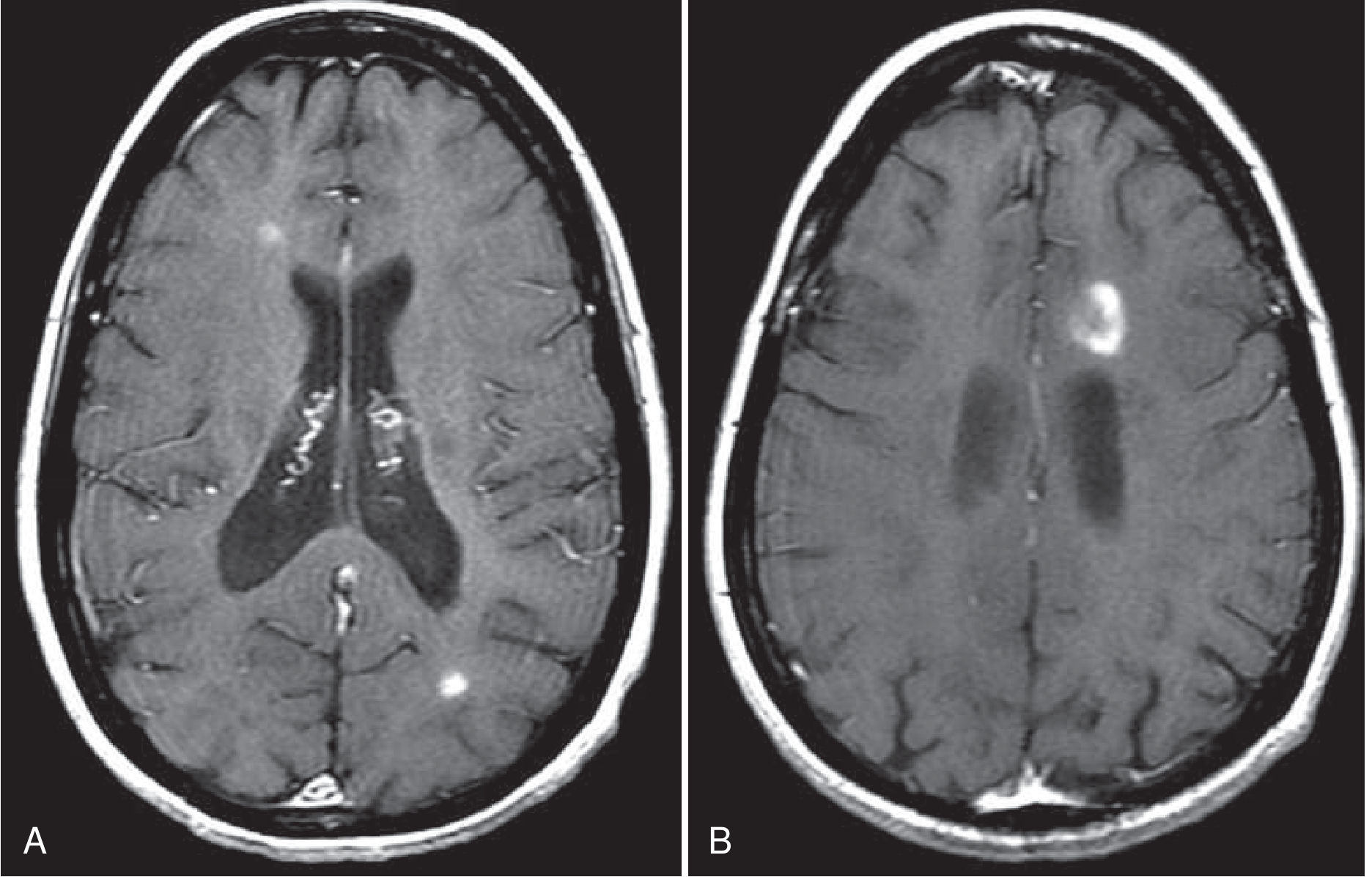
The open ring sign (also called incomplete ring enhancement) describes a ring of gadolinium enhancement on T1-weighted MRI that is not complete - it has a gap, and that gap characteristically faces the cortical grey matter (the open side points toward grey matter, while the enhancing arc faces the white matter).
Pathophysiological Basis
The open ring pattern in MS reflects the unequal distribution of blood-brain barrier (BBB) disruption across the lesion:
- The white matter side of a demyelinating plaque has active perivascular inflammation, leukocyte infiltration, and substantial BBB breakdown - this enhances with gadolinium
- The cortical/subcortical grey matter side has a less intense inflammatory reaction, less BBB disruption, and therefore does not take up contrast
- This asymmetry creates the open/incomplete ring with the open border facing grey matter
Enhancement reflects passive leakage of contrast from intravascular to interstitial space through disrupted tight junctions. It typically lasts 3-8 weeks (median 3.1 weeks, 55% resolve in <3 weeks), and is rapidly suppressed by steroids. - Grainger & Allison's Diagnostic Radiology, p. 1505
MRI Images
Fig. 80.9 - Axial T1+Gad: Panel A shows homogeneous enhancement; Panel B shows the open ring pattern - specific for demyelinating lesions:
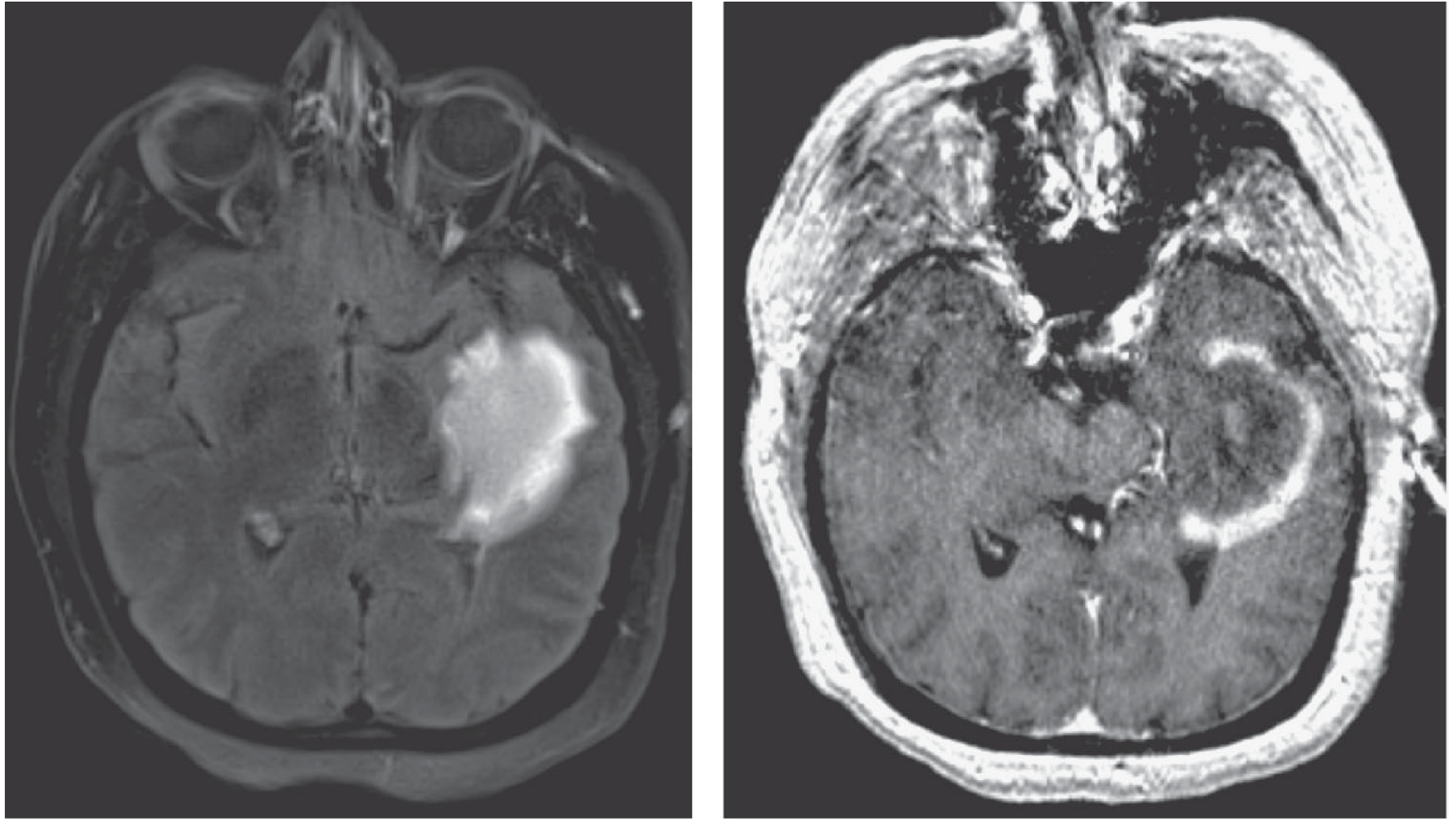
Tumefactive MS - Left: T2-FLAIR showing large demyelinating lesion; Right: T1+Gad showing classic open ring of enhancement (arc open toward grey matter):
Causes of Open Ring Enhancement
Primary Cause - Demyelinating Disease
| Condition | Details |
|---|---|
| Multiple Sclerosis (MS) - acute plaque | Classic cause; open ring is more typical of MS than any other entity; enhancement lasts days to weeks; may evolve from nodular → ring over time |
| Tumefactive MS | Large (>2 cm) solitary lesion; mimics tumor/abscess; open ring with arc facing grey matter; relative paucity of mass effect for lesion size; DWI shows peripheral restriction |
| Marburg variant MS | Fulminant; multiple large bilateral lesions, all may enhance simultaneously; poor prognosis |
| Baló concentric sclerosis | Alternating concentric bands of enhancement/non-enhancement; "onion-ring" or whorled appearance on T2 |
| ADEM | Post-infectious; open ring or patchy "cloud-like" enhancement; lesions usually larger, poorly marginated, subcortical; more common in children |
| NMO Spectrum Disorder | Less likely to show open ring; spinal cord lesions span >3 segments; AQP4-IgG positive |
Key Imaging Features of Open Ring / Demyelinating Lesions
| Feature | Finding |
|---|---|
| Shape of gap | Open side faces cortical/subcortical grey matter (not random) |
| T2/FLAIR | Bright; lesion larger than the enhancing component |
| T1 (unenhanced) | Iso or hypointense; "black hole" = irreversible axonal loss |
| DWI | Peripheral restriction (bright rim on DWI, dark ADC at lesion periphery) - characteristic of tumefactive demyelination |
| Mass effect | Disproportionately minor for lesion size (vs. tumor or abscess which have marked mass effect) |
| Enhancement duration | Days to weeks; resolves; rarely >2-3 months |
| Steroid response | Enhancement rapidly suppressed |
| MRS | ↓ NAA (neuronal loss), ↑ Cho, ↑ Lac/lipids; ↑ Glutamine/glutamate favors demyelination over tumor; ↑ Myo-inositol + high Cho favors tumor |
| Perfusion (rCBV) | Normal or mildly elevated - key differentiator from GBM (GBM has markedly elevated rCBV due to neoangiogenesis) |
- Grainger & Allison's Diagnostic Radiology, p. 1511; Bradley and Daroff's Neurology, p. 1729
Open Ring vs Closed Ring - Differential at a Glance
| Feature | Open Ring (Demyelination) | Closed Ring (Tumor/Abscess) |
|---|---|---|
| Ring completeness | Incomplete; gap toward grey matter | Complete, smooth or irregular |
| Mass effect | Mild, disproportionate | Significant |
| DWI | Peripheral restriction | Central restriction (abscess) or variable (tumor) |
| rCBV perfusion | Normal/mildly elevated | Markedly elevated (GBM) |
| Enhancement duration | Weeks, steroid-responsive | Persistent unless treated surgically |
| Surrounding edema | Mild to moderate | Often marked |
| Other lesions | Periventricular, Dawson's fingers, corpus callosum | Solitary or at grey-white junction |
When Open Ring Persists >2-3 Months - Consider Alternatives
Enhancement lasting beyond 2-3 months in what looks like a demyelinating lesion should raise suspicion for:
- Vascular malformation
- Neoplasm (low-grade glioma, lymphoma)
- Neurosarcoidosis
- Biopsy may ultimately be required - Grainger & Allison's Diagnostic Radiology, p. 1505
Diagnosis of the Underlying Condition (MS)
If open ring enhancement points to MS, apply the 2017 McDonald Criteria requiring demonstration of:
- Dissemination in Space (DIS): lesions in ≥2 characteristic CNS locations (periventricular, juxtacortical/cortical, infratentorial, spinal cord)
- Dissemination in Time (DIT): new T2/enhancing lesion on follow-up, or simultaneous enhancing + non-enhancing lesions
CSF: oligoclonal bands (IgG) - not in serum; IgG index elevated
Evoked potentials: delayed VEP in optic neuritis
Minimum gadolinium delay: 5 minutes between injection and T1 acquisition to optimally detect acute demyelinating lesions - Bradley and Daroff's Neurology, p. 1721-1723
This is a shared conversation. Sign in to Orris to start your own chat.