
My question is ECG changes
Asking for Preferences
What specific ECG changes are you asking about?
ECG changes in MI follow a predictable sequence: hyperacute T waves early, then ST elevation (STEMI), followed by Q wave formation, T wave inversion, and finally ST normalization. NSTEMI/UA shows ST depression and/or T wave inversion without ST elevation. The leads affected tell you which coronary artery territory is involved.
Searching sources...
Reading File
Finding Sources
Finding Sources
Finding Sources
Finding Sources
Good results. Now let me read the key sections from Harrison's and Ganong's and Tintinalli's:
Reading File
Reading File
Reading File
Excellent data. Let me now read the continuation from Harrison's (the ischemia/infarction section) and the temporal evolution of ECG changes:
Reading File
Reading File
Reading File
I now have rich, authoritative content from Harrison's, Tintinalli's, and Ganong's. Let me also fetch the key ECG images from Harrison's:
Loading Image
Loading Image
Finding Sources
I now have everything I need for a thorough, well-illustrated answer. Let me compose it.
ECG Changes in Myocardial Infarction (STEMI & NSTEMI)
1. Pathophysiological Basis
Acute ischemia lowers the resting membrane potential of myocardial cells and shortens action potential duration. This creates a voltage gradient between ischemic and normal zones, generating "currents of injury" that shift the ST segment on the surface ECG.
Three distinct electrical defects occur in infarcted cells (Ganong's):
| Defect in Infarcted Cells | Current Flow | ECG Change in Overlying Leads |
|---|---|---|
| Rapid repolarization | Out of infarct | ST segment elevation |
| Decreased resting membrane potential | Into infarct | TQ depression (recorded as ST elevation) |
| Delayed depolarization | Out of infarct | ST segment elevation |
Subendocardial ischemia - the ST vector points inward toward the cavity, so overlying leads show ST depression.
Transmural (epicardial) ischemia - the ST vector points outward, so overlying leads show ST elevation.
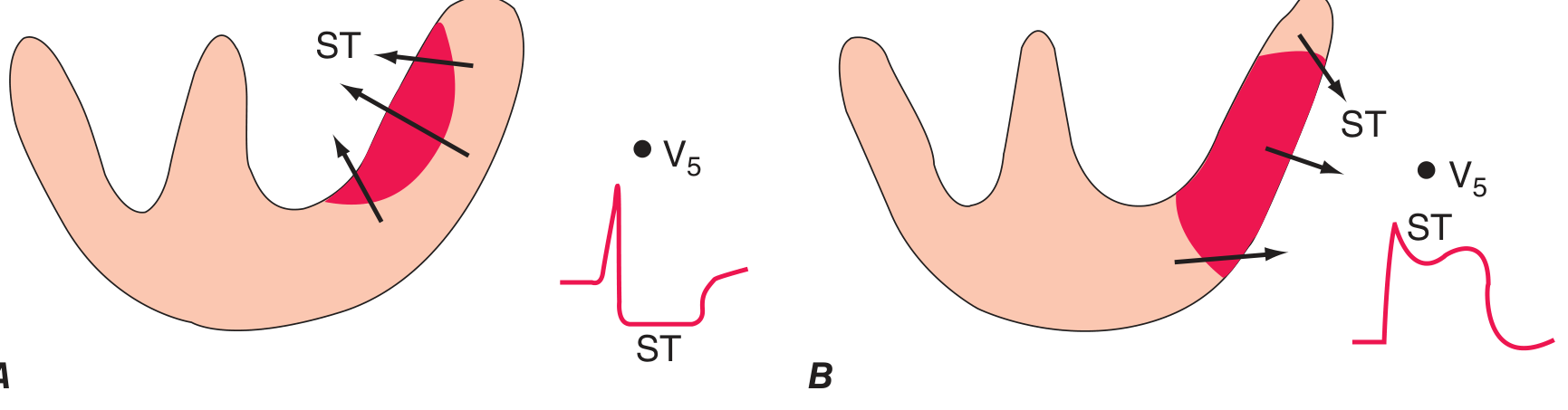
(Harrison's Fig 247-11: A = subendocardial ischemia with ST depression; B = transmural/epicardial injury with ST elevation)
2. Temporal Evolution of ECG Changes in STEMI
The ECG evolves in a predictable sequence after coronary occlusion:
Phase 1 - Hyperacute T Waves (minutes)
- Tall, broad, peaked T waves appear over the ischemic zone
- This is the earliest ECG change, often missed as it is brief
- Due to rapid repolarization from K+ efflux
Phase 2 - ST Elevation (minutes to hours)
- ST segment becomes elevated (convex upward/coved) in leads overlying the infarct
- This is the diagnostic hallmark of STEMI
- Reciprocal ST depression appears in leads opposite the infarct, indicating subendocardial ischemia and predicts larger area of injury, greater severity of CAD, and higher mortality (Tintinalli's)
Phase 3 - Q Wave Formation (hours to days)
- Pathological Q waves develop as necrotic tissue becomes electrically silent
- Q wave is pathological when: width >40 ms (0.04 s) OR depth >25% of the QRS amplitude
- Non-Q-wave infarcts also occur (tend to be less severe but carry high risk of reinfarction)
Phase 4 - T Wave Inversion (hours to days)
- ST segment begins to normalize
- T waves invert symmetrically in the same leads as the prior ST elevation
- Deep T-wave inversions in V1-V4 with or without enzyme elevation suggest severe LAD obstruction ("Wellens T-wave sign")
Phase 5 - Resolution / Chronic Changes (weeks to months)
- ST segments return to baseline
- T waves may normalize or remain inverted
- Q waves may persist permanently as markers of old infarction (though may shrink)
- Failure of R-wave progression in precordial leads can be a late finding of anterior MI
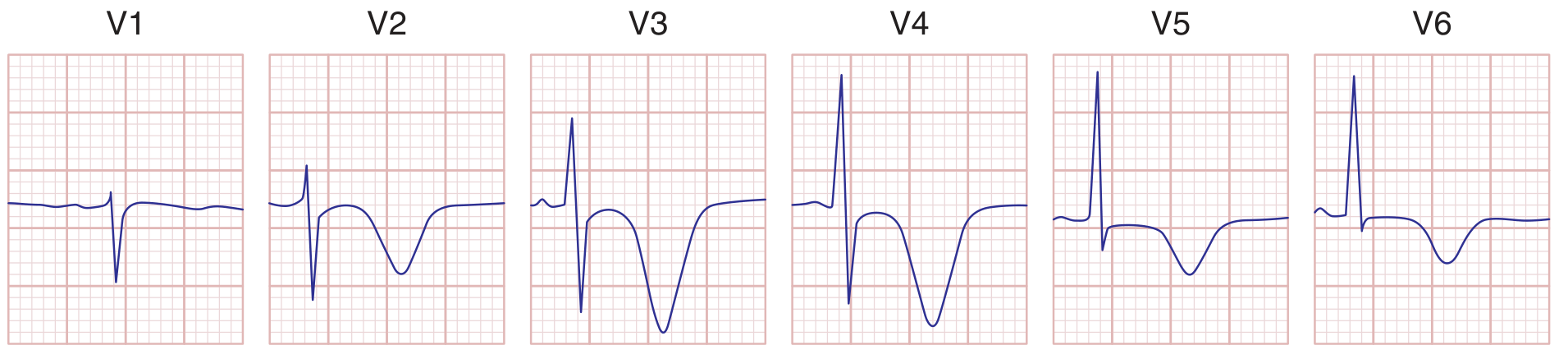
(Harrison's Fig 247-12: Wellens pattern - deep T inversions V1-V6 indicating high-grade LAD stenosis)
3. STEMI Localization by Leads
| Territory | Leads with ST Elevation | Culprit Artery |
|---|---|---|
| Anteroseptal | V1, V2 (±V3) | LAD (proximal/mid) |
| Anterior | V1-V4 | LAD |
| Anterolateral | V1-V6, I, aVL | Proximal LAD |
| Lateral | I, aVL (±V5, V6) | LCx or diagonal branch |
| Inferior | II, III, aVF | RCA (most common) or LCx |
| Inferolateral | II, III, aVF, V5, V6 | RCA or LCx |
| True posterior | Tall R in V1-V2, R/S ≥1; ST elevation in posterior leads V7-V9 | RCA or LCx |
| Right ventricular | II, III, aVF + ST elevation in V3R-V6R | Proximal RCA |
(Tintinalli's Emergency Medicine, Table 49-4)
Culprit Artery Clues (Tintinalli's, Table 49-5):
- ST elevation in III > II + ST depression in I/aVL = RCA occlusion (Sens 90%, Spec 71%)
- ST elevation in V1 or V4R with inferior STEMI = proximal RCA with RV infarction (Spec 100%)
- Inferior STEMI + ST elevation in lateral leads (V5/V6/aVL) with isoelectric/elevated ST in I = LCx occlusion
- ST elevation aVR > V1 = left main or proximal LAD occlusion
4. NSTEMI / Unstable Angina ECG Changes
- ST depression (horizontal or downsloping) in multiple leads
- T-wave inversion (symmetric, deep)
- ECG may be normal in ~25% of NSTEMI cases - diagnosis then depends on troponin elevation
- No pathological Q waves initially
- The key distinction: NSTEMI = elevated biomarkers without STEMI criteria; UA = no biomarker elevation
5. Special ECG Situations
Posterior MI
- No direct ST elevation in standard leads
- Diagnosed by reciprocal changes in V1-V3: ST depression + tall upright R waves + upright T waves
- Confirmed with posterior leads (V7-V9) showing ST elevation >0.5 mm
Right Ventricular MI
- Always occurs with inferior STEMI (proximal RCA occlusion)
- ST elevation in V4R (right-sided lead) is the most sensitive finding
- Clinically important: these patients are preload-dependent - nitrates and diuretics are contraindicated
LBBB and MI
- New LBBB can mask MI (and was formerly treated as STEMI equivalent)
- Sgarbossa criteria help diagnose MI in LBBB:
- Concordant ST elevation ≥1 mm (in leads with positive QRS)
- Concordant ST depression ≥1 mm in V1-V3
- Discordant ST elevation ≥5 mm (excessively discordant)
Wellens Syndrome
- Deep symmetric T-wave inversions in V2-V3 (Type A: biphasic; Type B: deeply inverted)
- Indicates critical proximal LAD stenosis
- ECG changes occur during pain-free period; patient at high risk of anterior STEMI
6. Summary Table
| ECG Change | Timing | Significance |
|---|---|---|
| Hyperacute T waves | Minutes | Earliest sign; often missed |
| ST elevation | Minutes-hours | Transmural injury (STEMI) |
| Reciprocal ST depression | Same time | Larger injury; worse prognosis |
| Q waves | Hours-days | Irreversible necrosis |
| T-wave inversion | Hours-days | Evolving infarction |
| ST normalization | Days-weeks | Scar formation |
| Persistent Q waves | Weeks-permanent | Old MI marker |
Key sources: Harrison's Principles of Internal Medicine 22E (2025), Ch. 247; Tintinalli's Emergency Medicine, Ch. 49; Ganong's Review of Medical Physiology, Ch. 29.
This is a shared conversation. Sign in to Orris to start your own chat.