
Topographic anatomy of the pharynx, peripharyngeal, retropharyngeal, paratonsillar spaces.
Reading File
Finding Sources
Finding Sources
Finding Sources
Reading File
Reading File
Reading File
Reading File
Reading File
Reading File
Reading File
Loading Image
Reading File
I now have comprehensive information from multiple authoritative otolaryngology textbooks. Let me compile a thorough answer.
Topographic Anatomy of the Pharynx and Peripharyngeal Spaces
I. The Pharynx — Overview
The pharynx is a common pathway for air and food, playing a major role in swallowing, speech, and airway protection. It is a fibromuscular tube extending from the base of skull to the inferior border of the cricoid cartilage.
Divisions and Boundaries
| Division | Superior Boundary | Inferior Boundary |
|---|---|---|
| Nasopharynx | Base of skull | Soft palate |
| Oropharynx | Junction of hard and soft palate / circumvallate papillae | Vallecula (plane of hyoid bone) |
| Hypopharynx | Level of hyoid bone (pharyngoepiglottic folds) | Inferior border of cricoid cartilage |
Subunits
Nasopharynx: lateral walls (fossa of Rosenmüller, eustachian tube orifice), vault/roof, posterior wall.
Oropharynx: soft palate and uvula, base of tongue, pharyngoepiglottic and glossoepiglottic folds, palatine arch (tonsillar fossae, palatine tonsils, anterior and posterior pillars), lateral and posterior oropharyngeal walls, valleculae.
Hypopharynx: pyriform sinus (bordered medially by aryepiglottic folds, anteriorly by thyroid cartilage, apex at the level of the cricoid), posterior and lateral pharyngeal walls, postcricoid region (inferior to arytenoids, extending to inferior cricoid margin).
II. Muscular Walls of the Pharynx
Pharyngeal Constrictor Muscles
All three constrictors are innervated by the vagus nerve (CN X) via the pharyngeal plexus. Their function is to narrow the pharyngeal cavity sequentially from top to bottom to propel the food bolus into the esophagus.
| Muscle | Origin | Insertion |
|---|---|---|
| Superior constrictor | Pterygomandibular raphe and adjacent mandible/pterygoid hamulus | Median raphe |
| Middle constrictor | Hyoid bone (greater and lesser cornua) | Median raphe |
| Inferior constrictor | Thyroid and cricoid cartilages | Median raphe |
The lowermost fibers of the inferior constrictor form the upper esophageal sphincter (UES), which is under tonic contraction at rest and relaxes with swallowing.
Soft Palate Muscles
| Muscle | Function | Innervation |
|---|---|---|
| Palatoglossus (anterior pillar) | Approximates palate to tongue; narrows oropharyngeal opening | CN X (pharyngeal plexus) |
| Palatopharyngeus (posterior pillar) | Raises larynx and pharynx; closes oropharyngeal aperture | CN X (pharyngeal plexus) |
| Levator veli palatini | Raises soft palate to contact posterior pharyngeal wall | CN X (pharyngeal plexus) |
| Tensor veli palatini | Pulls palate laterally; gives rigidity; opens eustachian tube | CN V3 (motor) |
| Musculus uvulae | Shortens uvula | CN X (pharyngeal plexus) |
III. Neurovascular Supply of the Pharynx
Motor: CN X via the pharyngeal plexus (all constrictors and most palatal muscles); CN V3 to tensor veli palatini.
Sensory: CN IX (glossopharyngeal) and CN V2 (lesser palatine nerve) to the soft palate and tonsillar region.
Arterial supply (palatine tonsil — five branches):
- Facial artery → tonsillar branch (main supply)
- Facial artery → ascending palatine artery
- Lingual artery → dorsal lingual branches
- Ascending pharyngeal artery
- Maxillary artery → descending palatine → lesser palatine artery
Lymphatic drainage: Upper cervical / jugulodigastric lymph nodes; lateral retropharyngeal nodes.
IV. Waldeyer's Ring
A ring of lymphoid tissue guarding the entrance to the pharynx:
- Adenoids (pharyngeal tonsil) — midline posterior nasopharynx
- Palatine tonsils — between palatoglossal and palatopharyngeal arches
- Lingual tonsils — posterior third of tongue
- Tubal tonsils (Gerlach's tonsil) — posterior to torus tubarius at the eustachian tube opening
- Lateral pharyngeal bands — lymphoid tissue behind posterior pillars
V. Peripharyngeal Fascial Spaces
The deep cervical fascia has three layers — superficial (investing), middle (visceral/buccopharyngeal), and deep (prevertebral) — which create surgically and clinically important compartments around the pharynx.
Fascial Layers of the Retrovisceral Space
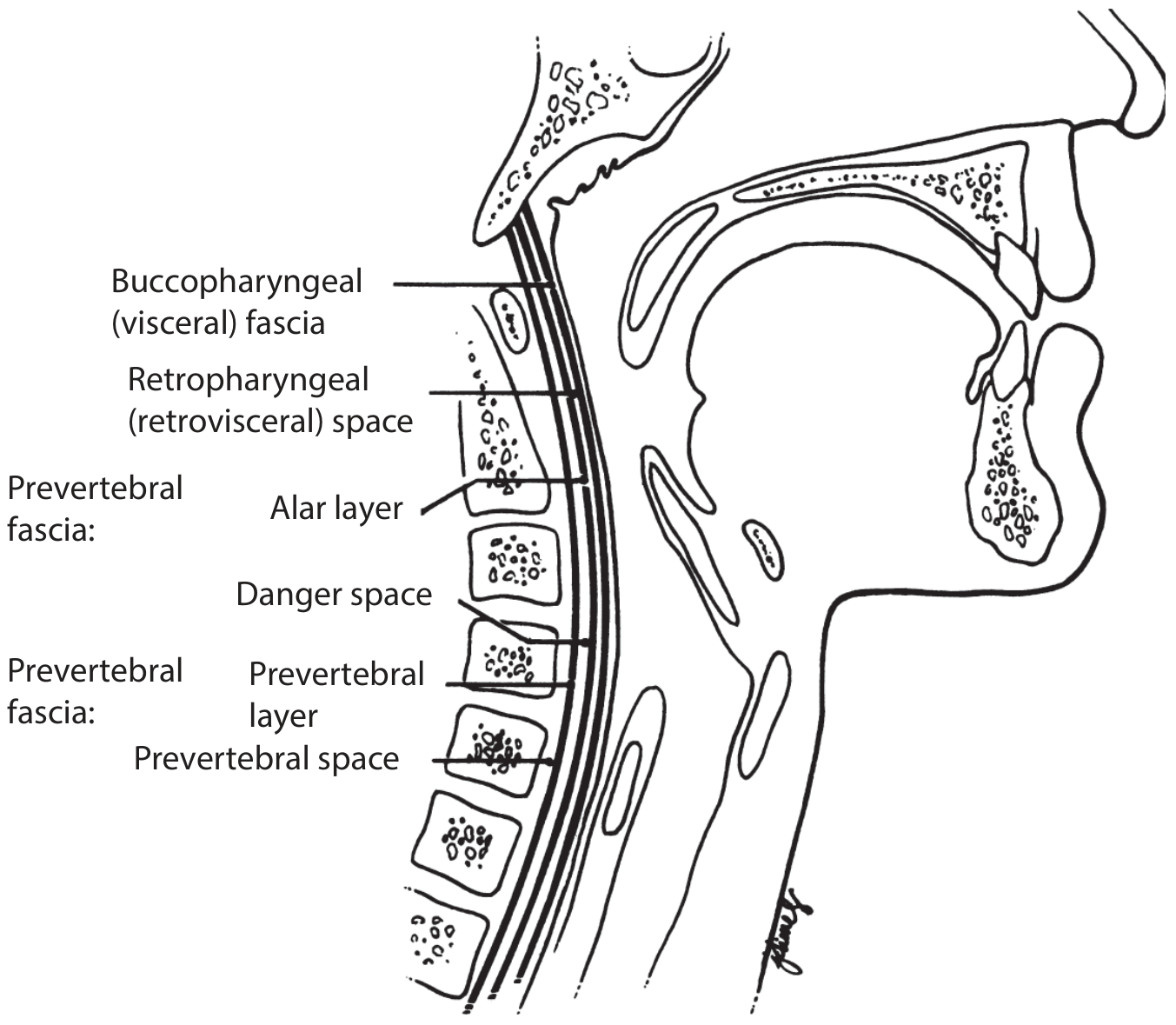
Sagittal view showing the layered arrangement of fascial spaces posterior to the pharynx (K.J. Lee's Essential Otolaryngology)
1. Parapharyngeal Space (PPS)
The PPS is the central anatomic crossroads of the suprahyoid neck — all other deep neck spaces communicate with it.
Boundaries:
- Superior: base of middle cranial fossa
- Inferior: hyoid bone
- Anterior: pterygomandibular raphe
- Posterior: prevertebral fascia
- Medial: pharyngobasilar fascia (superiorly), superior constrictor muscle
- Lateral: deep lobe of parotid gland, mandible, medial pterygoid muscle
The styloid process divides the PPS into two compartments:
| Compartment | Contents |
|---|---|
| Prestyloid (anterior) | Fat, lymph nodes, internal maxillary artery, inferior alveolar/lingual/auriculotemporal nerves, medial & lateral pterygoid muscles, deep lobe of parotid |
| Poststyloid (posterior) | Internal carotid artery, internal jugular vein, sympathetic chain, CN IX, X, XI, XII |
Communicates with: peritonsillar, retropharyngeal, masticator, carotid, and parotid spaces.
2. Retropharyngeal Space (Retrovisceral Space)
Boundaries:
- Superior: base of skull
- Inferior: superior mediastinum, tracheal bifurcation (T4) — where the middle layer of deep cervical fascia fuses with the alar layer
- Anterior: pharynx and esophagus (middle layer / buccopharyngeal fascia)
- Posterior: alar fascia (of the deep/prevertebral layer)
- Medial: midline raphe of the superior constrictor muscle → abscesses in this space are typically unilateral
- Lateral: carotid sheath
Contents:
- Retropharyngeal lymph nodes (Rouvière's nodes — significant in pediatric sinusitis/nasopharyngeal infections)
- Loose connective tissue
Clinical significance: Infection here produces posterior pharyngeal wall bulging, dysphagia, odynophagia, and drooling; can spread inferiorly into the mediastinum via the danger space.
3. Danger Space
Situated between the alar fascia (anteriorly) and the true prevertebral fascia (posteriorly), this is a potential space filled with loose areolar tissue.
Boundaries:
- Superior: base of skull
- Inferior: diaphragm (making mediastinitis a direct risk)
- Anterior: alar fascia
- Posterior: prevertebral fascia
The "danger" refers to the unobstructed pathway from skull base to diaphragm along which infection can spread with devastating speed.
4. Peritonsillar Space (Paratonsillar Space)
Boundaries:
- Medial: capsule of the palatine tonsil
- Lateral: superior constrictor muscle
- The tonsil sits in its fossa between the anterior (palatoglossal) and posterior (palatopharyngeal) pillars
Contents:
- Loose connective tissue
- Tonsillar branches of the lingual, facial, and ascending pharyngeal vessels
Clinical significance: This is the most common site of deep neck infection (peritonsillar abscess). Pus collects between the tonsillar capsule and the superior constrictor, typically in the superior pole. Signs include "hot potato" voice, trismus, uvular deviation to the contralateral side, and unilateral bulging of the soft palate. Communicates directly with the parapharyngeal space.
Summary Table of Key Deep Neck Spaces
| Space | Key Boundaries | Contents | Communicates With |
|---|---|---|---|
| Peritonsillar | Medial: tonsil; Lateral: superior constrictor | Loose CT, tonsillar vessels | Parapharyngeal |
| Parapharyngeal | Sup: skull base; Inf: hyoid; Med: superior constrictor; Lat: deep parotid/medial pterygoid | Fat, lymph nodes, vessels, nerves (pre- and poststyloid) | All other deep neck spaces |
| Retropharyngeal | Sup: skull base; Inf: T4; Ant: buccopharyngeal fascia; Post: alar fascia | Retropharyngeal lymph nodes, loose CT | Parapharyngeal, danger space |
| Danger space | Sup: skull base; Inf: diaphragm; Ant: alar fascia; Post: prevertebral fascia | Loose areolar tissue | Retropharyngeal, mediastinum |
| Prevertebral | Sup: skull base; Inf: coccyx; Ant: prevertebral fascia; Post: vertebral bodies | Prevertebral muscles, spine | Danger space |
Sources:
- K.J. Lee's Essential Otolaryngology, pp. 667–671, 700–706
- Cummings Otolaryngology Head and Neck Surgery, pp. 164–166 (Fascial Spaces of the Suprahyoid Neck)
This is a shared conversation. Sign in to Orris to start your own chat.