
I want mechanism of Glomerulonephritis
Reading File
Now let me search for glomerulonephritis content in parallel across headings and paragraphs:
Finding Sources
Finding Sources
Excellent sources found. Let me now read the most authoritative ones in parallel — Robbins Pathology, Comprehensive Clinical Nephrology, and Smith & Tanagho's Urology:
Reading File
Reading File
Reading File
I now have rich content from Robbins Pathology, Comprehensive Clinical Nephrology, and Smith & Tanagho's Urology. Let me read more of Robbins for the detailed pathogenesis section:
Reading File
Reading File
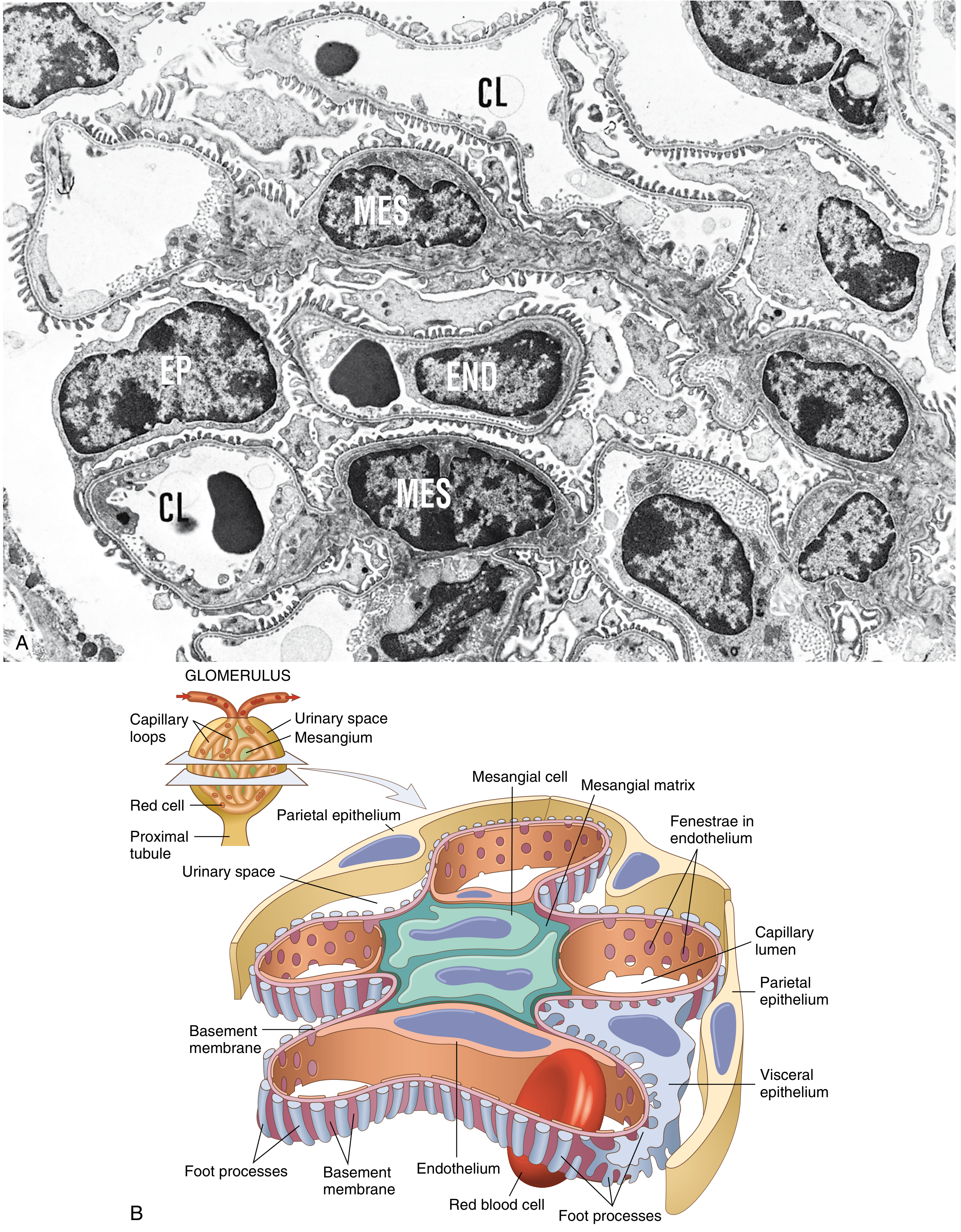
I now have comprehensive content from the textbooks. Let me also fetch the key glomerulus diagram from Robbins for visual clarity:
Loading Image
Glomerulonephritis (GN) is mainly an immune-mediated injury of the glomerulus.
Core mechanism
- Immune trigger
- Infection-related antigens (for example post-streptococcal)
- Autoantigens (for example GBM components, PLA2R)
- Systemic immune disease (for example lupus, IgA disorders)
- ANCA-associated small-vessel vasculitis
- Immune attack in the glomerulus
- Immune complex deposition in glomerular structures:
- Mesangial
- Subendothelial
- Subepithelial
- Or in-situ antibody binding to intrinsic glomerular antigens (for example anti-GBM disease)
- Or pauci-immune injury where circulating ANCAs activate neutrophils and damage capillary walls despite little immune deposition on IF
- Effector pathways of injury
- Complement activation (especially C3 pathways in many forms)
- Leukocyte recruitment (neutrophils, monocytes, macrophages)
- Cytokines, oxidants, proteases, and membrane attack complex-mediated damage
- Podocyte and endothelial injury leading to barrier failure
- Structural consequences in glomerulus
- Increased permeability -> hematuria and proteinuria
- Endocapillary/mesangial hypercellularity
- Capillary wall injury/necrosis
- GBM rupture in severe cases -> fibrin leakage into Bowman space -> crescent formation (rapidly progressive GN)
- Progression to chronic kidney disease
- Ongoing inflammation and nephron loss drive:
- Glomerulosclerosis
- Tubulointerstitial fibrosis
- Proteinuria itself worsens tubular/interstitial injury and accelerates decline in GFR
Mechanistic patterns by GN type (high-yield)
- Immune-complex GN: granular IF pattern; deposits can be mesangial/subendothelial/subepithelial
- Anti-GBM GN: linear IgG along GBM (type II hypersensitivity-like pattern)
- Pauci-immune (ANCA) GN: severe necrotizing crescentic GN with minimal immune deposits on IF
- IgA nephropathy: mesangial IgA immune deposition with complement-mediated inflammation
Simple one-line summary
GN happens when immune mechanisms target the glomerular filtration unit, activate complement and inflammatory cells, damage capillary/GBM/podocyte structures, and lead from acute inflammation to sclerosis and fibrosis if injury persists.
Sources:
- Robbins, Cotran & Kumar Pathologic Basis of Disease, p. 833-839
- Smith and Tanagho's General Urology, 19th Edition, p. 2454-2487
- Comprehensive Clinical Nephrology, 7th Edition, p. 345
This is a shared conversation. Sign in to Orris to start your own chat.