
Latest ACL guide
Reading File
Finding Sources
Finding Sources
The best dedicated ACL section is in Tintinalli's Emergency Medicine. Let me read that, plus the anatomy section and the family medicine knee section in parallel.
Reading File
Reading File
I have rich content from both sources. Let me read the rest of the Tintinalli ACL section (it was truncated) and also check if there's MRI/imaging content.
Reading File
I now have comprehensive content to compile the ACL guide. Here's the complete summary:
ACL (Anterior Cruciate Ligament) — Clinical Guide
Anatomy
The ACL consists of two fiber bundles named by their tibial insertions:
| Bundle | Length | Taut in |
|---|---|---|
| Anteromedial (AM) | ~38 mm | Flexion |
| Posterolateral (PL) | ~20 mm | Extension |
The femoral origin lies in the posterior lateral intercondylar fossa. The AM bundle's origin borders superiorly on the intercondylar line; the PL bundle courses along the bone-cartilage border. Together, the two bundles provide anterior stability and rotational stability through the full arc of knee motion.
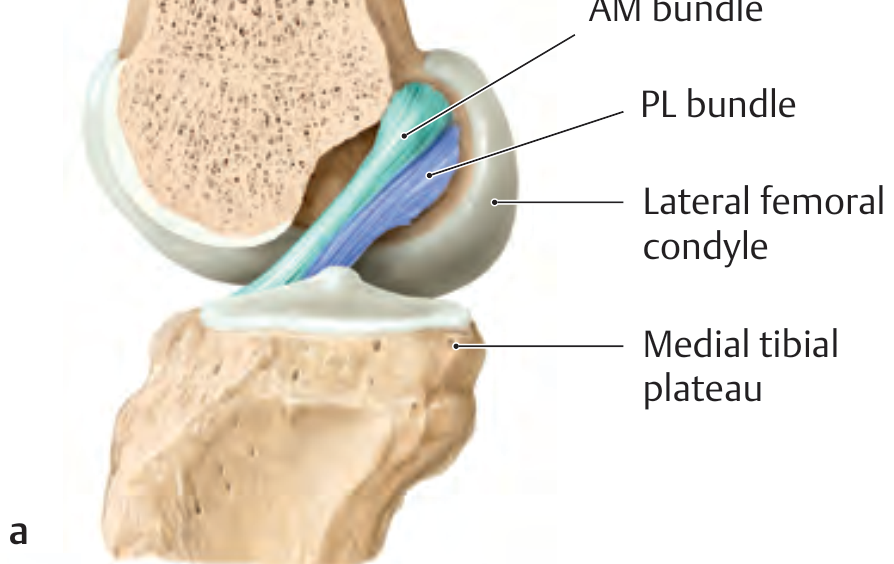
ACL anatomy showing AM and PL bundles and their femoral/tibial footprints — General Anatomy and Musculoskeletal System (THIEME Atlas)
Mechanism of Injury
- Usually noncontact: deceleration, hyperextension, or marked internal rotation of the tibia on the femur
- Classic presentation: audible "pop" (considered pathognomonic), rapid hemarthrosis (swelling within hours), and a sense of instability
- The combination of this mechanism + traumatic effusion is highly suggestive of ACL disruption
Diagnosis
Clinical Tests
| Test | Sensitivity | Specificity | Technique |
|---|---|---|---|
| Lachman test (most sensitive) | 81% | 81% | Knee at 30° flexion; stabilize femur, anteriorly translate tibia at the tibial tubercle level. Positive = anterior displacement or soft end point |
| Anterior drawer test | 38% | 81% | Hip 45° flexion, knee 90° flexion; pull tibia anteriorly. Positive = >6 mm displacement vs. contralateral knee |
| Pivot shift test | 28% | 81% | Knee in full extension; apply valgus + internal rotation, then flex. Positive = sudden audible/palpable clunk of tibial reduction at ~20–30° flexion |
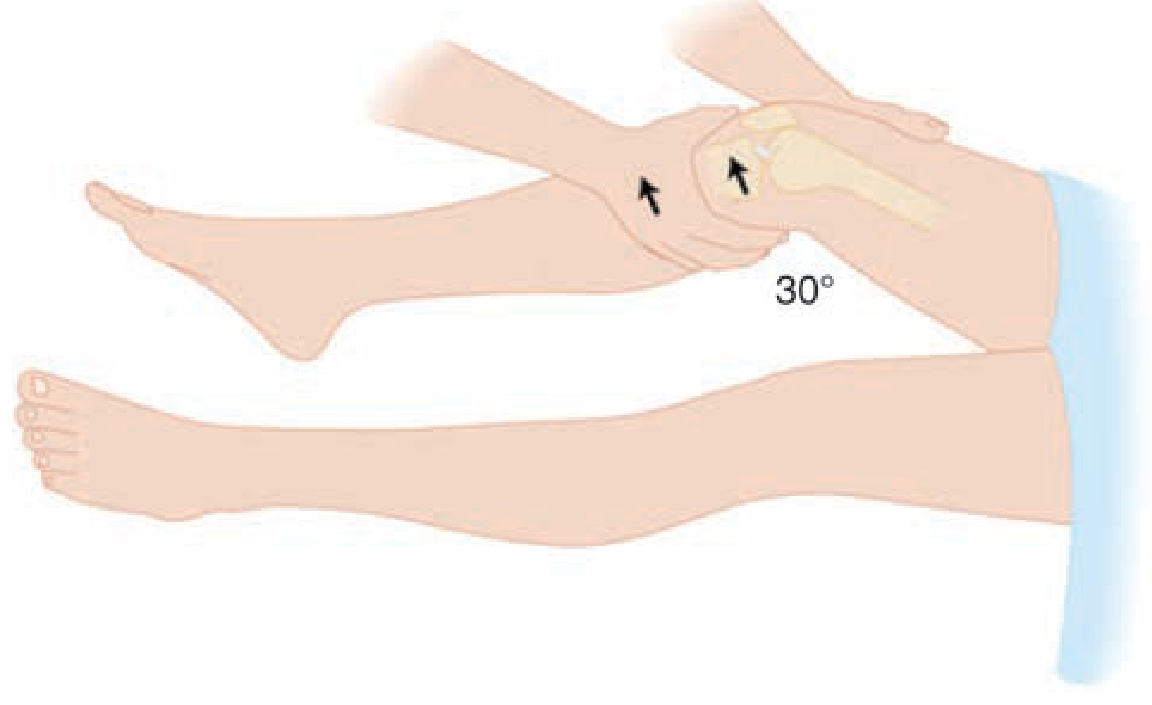

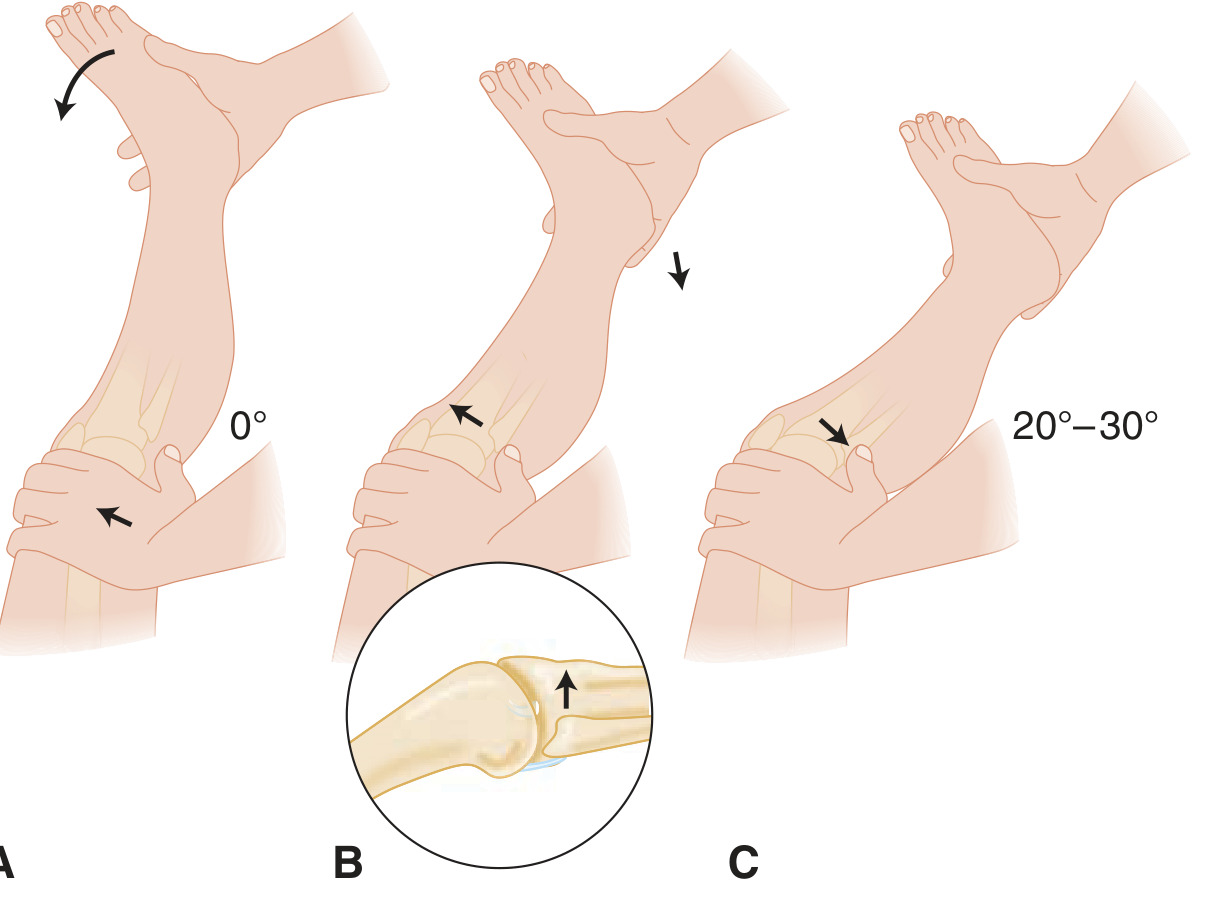
Pearls:
- Anterior drawer can give a false negative (hamstring guarding) or false positive (PCL tear → tibia starts posteriorly subluxed, giving pseudo-anterior displacement)
- Pivot shift is best assessed under anesthesia in the OR
- Lachman is preferred in the ED; it can identify partial tears
Imaging
- Plain radiographs: usually normal; may show a Segond fracture (avulsion of the lateral tibial plateau — a specific marker for ACL tear) or a tibial spine avulsion (pediatric equivalent)
- MRI: gold standard for confirmation; demonstrates ACL fiber discontinuity, altered signal, bone bruising pattern (lateral femoral condyle + posterolateral tibial plateau)
Management
Acute / ED Management
- Ice, compression, elevation; non-weight-bearing with crutches
- Analgesics / NSAIDs
- Knee immobilizer for comfort
- Urgent orthopedic referral — especially if combined ligament injury, locked knee, or neurovascular compromise
Definitive Treatment
| Patient Group | Approach |
|---|---|
| Active/young patients, pivoting sports | ACL reconstruction (patellar tendon or hamstring autograft preferred) |
| Sedentary/elderly or isolated partial tears | Conservative: physiotherapy, bracing, quadriceps strengthening |
| Combined instability (PCL, MCL, posterolateral corner) | Surgical reconstruction, timing individualized |
Surgical note: Replacement grafts face a major challenge — no human-made material fully replicates the ACL's mechanical properties. Reconstruction options include bone-patellar tendon-bone (BTB), hamstring tendon, and allograft.
Associated Injuries (the "Unhappy Triad")
Valgus force + ACL injury commonly involves:
- Medial collateral ligament (MCL) tear
- Medial meniscus tear
Also watch for peroneal nerve injury with lateral-sided instability.
Key Differentials
- PCL tear: posterior drawer positive, sag sign; mechanism is anterior-to-posterior force on tibia (e.g., dashboard injury)
- Meniscal tear: may coexist; McMurray/Thessaly tests positive
- Tibial spine avulsion: radiographic equivalent of ACL rupture in children/adolescents
Sources: Tintinalli's Emergency Medicine: A Comprehensive Study Guide, 9e | General Anatomy and Musculoskeletal System, THIEME Atlas of Anatomy
This is a shared conversation. Sign in to Orris to start your own chat.