
Boundries of orbit
Reading File
The orbit (eye socket) is a bony pyramid-shaped cavity that houses the eyeball and its associated structures. Its boundaries are formed by seven bones.
Searching sources...
Finding Sources
Finding Sources
Finding Sources
Reading File
Reading File
Reading File
Loading Image
Here is a complete breakdown of the boundaries of the orbit, sourced from Gray's Anatomy for Students and K.J. Lee's Essential Otolaryngology.
Boundaries of the Orbit
The orbit is a bilateral, pyramid-shaped bony cavity. Seven bones contribute to its framework: maxilla, zygomatic, frontal, ethmoid, lacrimal, sphenoid, and palatine. The wide base opens anteriorly onto the face; the apex points posteromedially toward the optic foramen.
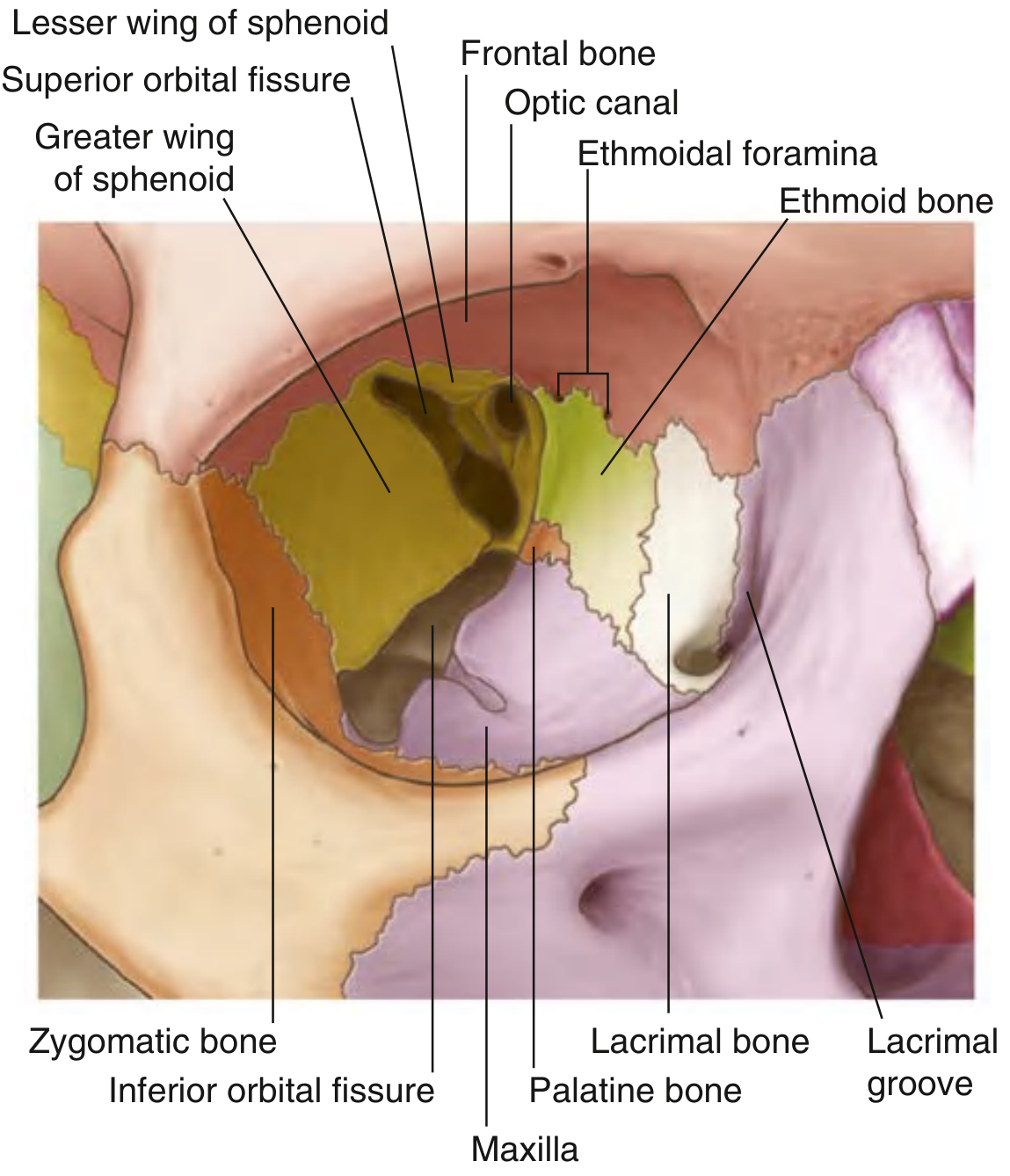
Orbital Rim (Base)
| Side | Bone(s) |
|---|---|
| Superior | Frontal bone |
| Medial | Frontal process of the maxilla |
| Inferior | Zygomatic process of maxilla + zygomatic bone |
| Lateral | Zygomatic bone, frontal process of zygoma, zygomatic process of frontal bone |
Four Walls
1. Roof (Superior Wall)
- Primarily: orbital part of the frontal bone
- Posteriorly: lesser wing of the sphenoid
- Special features:
- Anteromedially: trochlear fovea (for superior oblique muscle pulley)
- Anterolaterally: lacrimal fossa (for lacrimal gland)
- Possible intrusion of the frontal sinus
2. Medial Wall
Formed by four bones (anterior to posterior):
- Frontal process of the maxilla - with anterior lacrimal crest
- Lacrimal bone - with posterior lacrimal crest; together they form the lacrimal groove containing the lacrimal sac
- Orbital plate of ethmoid (lamina papyracea) - the largest contributor; contains ethmoidal cells
- Sphenoid bone (small contribution) - forms part of the medial wall of the optic canal
- At the junction with the roof: anterior and posterior ethmoidal foramina (for ethmoidal nerves and vessels)
3. Floor (Inferior Wall)
Also forms the roof of the maxillary sinus. Formed by:
- Orbital surface of maxilla (primary contributor)
- Zygomatic bone (anterolaterally)
- Orbital process of palatine bone (posteriorly, near junction of maxilla, ethmoid, and sphenoid)
- The inferior orbital fissure runs along the posterior-lateral boundary of the floor
4. Lateral Wall
The thickest and strongest wall. Formed by:
- Zygomatic bone (anterior part)
- Greater wing of the sphenoid (posterior part)
- Between the greater and lesser wings of the sphenoid: superior orbital fissure
Apex
- The apex is the optic canal, formed by the lesser wing of the sphenoid, transmitting the optic nerve (CN II) and ophthalmic artery.
Key Openings in the Orbit
| Opening | Location | Structures Transmitted |
|---|---|---|
| Optic canal | Apex (lesser wing of sphenoid) | CN II, ophthalmic artery |
| Superior orbital fissure | Between roof and lateral wall (lesser + greater wings of sphenoid) | CN III, IV, V1, VI; superior ophthalmic vein; orbital branch of middle meningeal artery |
| Inferior orbital fissure | Floor-lateral wall junction (greater wing of sphenoid, maxilla, palatine) | CN V2 branches (infraorbital + zygomatic nerves), infraorbital artery/vein, ophthalmic vein branch |
| Anterior/posterior ethmoidal foramina | Medial wall (frontoethmoidal suture) | Anterior/posterior ethmoidal nerves and vessels |
Clinical Notes
-
Orbital floor fractures (blowout): Most common type; can trap the inferior oblique muscle causing failure of upward gaze (diplopia on upgaze).
-
Medial wall fractures: Show air in the orbit on X-ray due to continuity with ethmoidal sinuses; patients may feel orbital fullness when blowing the nose.
-
Superior orbital fissure syndrome: Compression causes ophthalmoplegia, ptosis, and fixed dilated pupil (no vision loss).
-
Orbital apex syndrome: Adds CN II involvement, so vision is also impaired.
-
Gray's Anatomy for Students, p. 1067
-
K.J. Lee's Essential Otolaryngology, p. 1132
This is a shared conversation. Sign in to Orris to start your own chat.