
Management of stemi with pt complainting of chest discomfort to ecg changes till stent placement
Reading File
Finding Sources
Finding Sources
Reading File
Finding Sources
Reading File
I now have a comprehensive amount of textbook content to synthesize a detailed STEMI management guide. Let me compile the response.
Loading Image
Here is a comprehensive, step-by-step guide to STEMI management — from the first symptom to stent placement:
STEMI Management: Chest Discomfort → ECG → Stent
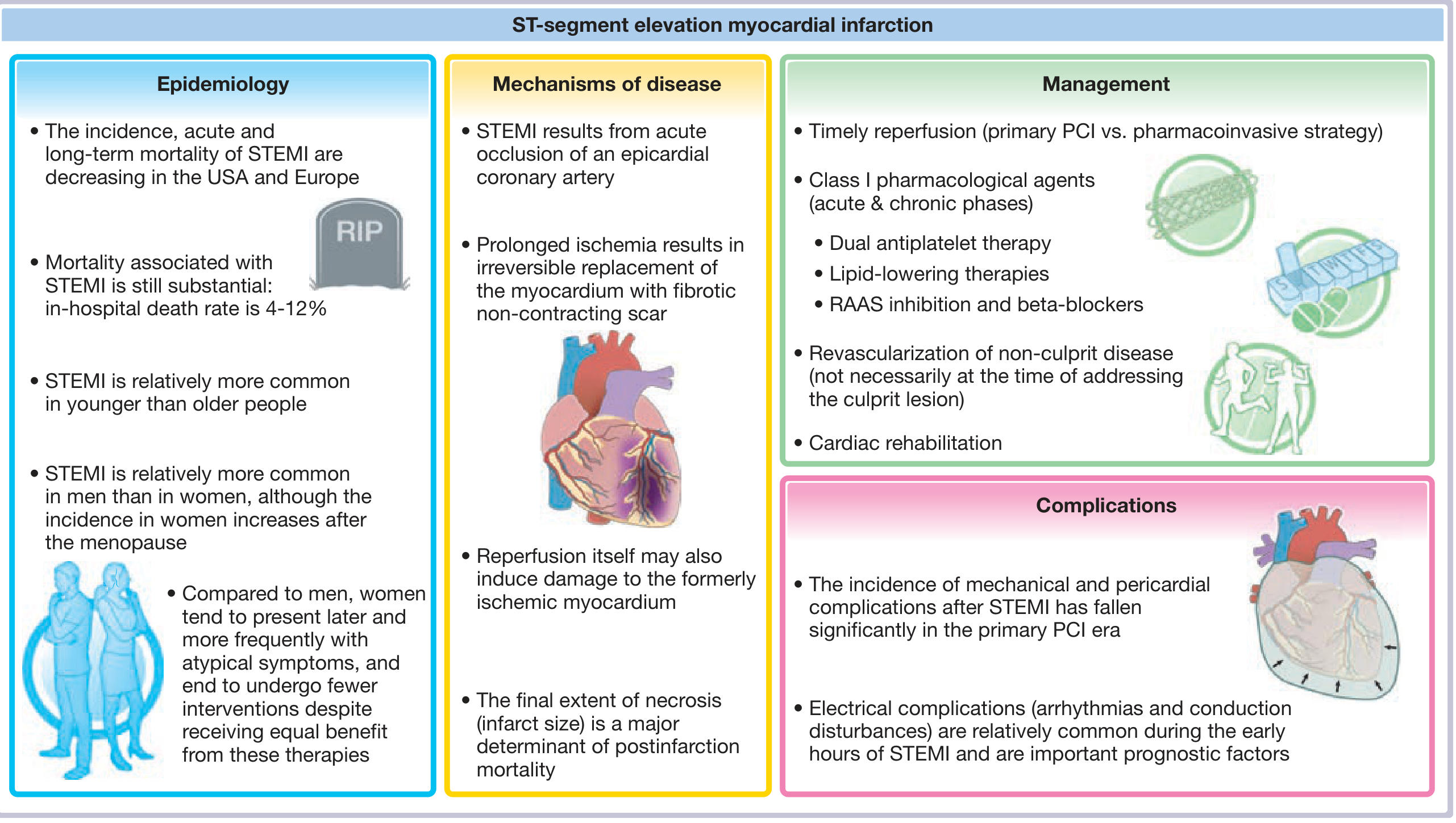
1. Initial Recognition & First Contact
Symptoms: Central/substernal chest discomfort, pressure, radiation to arm/jaw, diaphoresis, dyspnea, nausea.
Immediate Actions (First Medical Contact — FMC):
- 12-lead ECG within 10 minutes of FMC
- Supplemental O₂ only if SpO₂ < 90%
- IV access, continuous cardiac monitoring
- Troponin, CBC, BMP, coagulation panel (don't delay reperfusion for results)
2. ECG Diagnosis of STEMI
ST-elevation criteria for STEMI diagnosis:
- ≥2 contiguous leads: ≥1 mm (≥2 mm in V2–V3 for men, ≥1.5 mm for women)
- New or presumed new LBBB with ischemic symptoms
STEMI diagnosis must be made rapidly — the clock starts at STEMI diagnosis, not hospital arrival.
3. Reperfusion Decision: pPCI vs. Fibrinolysis
The core principle: timely reperfusion reduces in-hospital mortality from ~20% to ~5%.
Primary PCI (pPCI) — Preferred Strategy
| Time Target | Benchmark |
|---|---|
| FMC to wire crossing (reperfusion) | ≤120 minutes |
| Door-to-balloon (in-hospital) | ≤60–90 minutes |
- pPCI is superior to fibrinolysis: reduces death, reinfarction, and stroke
- Requires experienced operator + cath lab available within the time window
- Transradial access preferred (lower bleeding, better outcomes)
- New-generation drug-eluting stents (DES) are standard — lower restenosis and stent thrombosis vs. bare metal stents
"In a large meta-analysis including 23 RCTs, pPCI was better than thrombolytic therapy at reducing death, reinfarction, and stroke in STEMI patients." — Fuster and Hurst's The Heart, 15th Ed.
Fibrinolysis — When pPCI is Not Timely
- Use if pPCI cannot be performed within 120 minutes of STEMI diagnosis
- Administer within 10 minutes of STEMI diagnosis (prehospital if possible)
- Fibrin-specific agents preferred (tenecteplase, alteplase)
- Pharmacoinvasive strategy: after successful fibrinolysis, transfer for angiography within 2–24 hours
- If fibrinolysis fails (no reperfusion at 60 min): rescue PCI immediately
Absolute Contraindications to Fibrinolysis:
- Prior intracranial hemorrhage (any time)
- Ischemic stroke < 6 months
- CNS neoplasm / arteriovenous malformation
- Major trauma/surgery < 3 weeks
- GI bleeding < 1 month
- Known bleeding disorder
- Aortic dissection
4. Antithrombotic Therapy (Acute Phase)
Antiplatelet Therapy
| Drug | Dose | Notes |
|---|---|---|
| Aspirin | 150–300 mg loading, then 75–100 mg/day | Give immediately; chew for rapid absorption |
| Ticagrelor | 180 mg load, then 90 mg BID | Preferred P2Y12 inhibitor |
| Prasugrel | 60 mg load, then 10 mg/day | Alternative; avoid if prior stroke/TIA, age >75, weight <60 kg |
| Clopidogrel | 600 mg load, then 75 mg/day | If ticagrelor/prasugrel unavailable or contraindicated |
Dual antiplatelet therapy (DAPT) — aspirin + P2Y12 inhibitor — is maintained for 12 months post-STEMI.
Anticoagulation
| Drug | Indication |
|---|---|
| Unfractionated heparin (UFH) | Standard during pPCI; weight-based bolus |
| Bivalirudin | Alternative; particularly useful in HIT or high bleeding risk |
| Enoxaparin | Alternative for pharmacoinvasive strategy |
| Fondaparinux | NOT recommended as sole anticoagulant for pPCI |
5. The Catheterization Lab — Culprit Lesion PCI
Procedure Steps:
- Coronary angiography — identify culprit artery (usually the occluded vessel)
- Wire crossing of the occluded segment → this is the reperfusion moment (the "balloon time")
- Thrombus aspiration — selective use only (not routine)
- Stent placement — new-generation DES over culprit lesion
- Post-dilatation to optimize stent apposition
Multivessel Disease
- Culprit-only PCI at the time of primary PCI is the default strategy
- Complete revascularization of non-culprit arteries: performed electively (days to weeks later) in stable patients
- Exception: cardiogenic shock — complete revascularization at index procedure does NOT improve outcomes (culprit-only still preferred per CULPRIT-SHOCK trial)
6. Adjunct Pharmacological Therapy (Acute + Subacute Phase)
| Drug Class | Agent | Indication |
|---|---|---|
| β-Blocker | Metoprolol, carvedilol | Start within 24 h if no signs of HF/low output; reduces arrhythmia, reinfarction |
| ACE inhibitor / ARB | Ramipril, enalapril | All STEMI patients; mandatory if EF <40%, HF, or diabetes |
| Aldosterone antagonist | Eplerenone | If EF <40% + HF or diabetes, no significant renal impairment |
| High-intensity statin | Atorvastatin 40–80 mg, rosuvastatin 20–40 mg | Start immediately; target LDL <55 mg/dL |
| Nitrates | IV nitroglycerin | For ongoing ischemia, HF, hypertension — avoid in hypotension/RV infarct |
| Morphine | Use cautiously | May delay P2Y12 absorption; limit to severe pain/distress |
7. Monitoring Post-PCI
- Continuous telemetry (minimum 24–48 h)
- Echocardiography to assess LV function, wall motion, EF
- Watch for:
- Reperfusion arrhythmias (accelerated idioventricular rhythm, VF — manage accordingly)
- Mechanical complications: free wall rupture, VSD, acute MR (papillary muscle rupture)
- Cardiogenic shock: IABP, Impella, or ECMO as bridge
- Pericarditis (Dressler syndrome at 1–4 weeks)
8. Discharge & Long-Term Care
| Therapy | Duration |
|---|---|
| Aspirin | Lifelong |
| P2Y12 inhibitor (DAPT) | 12 months (standard); may shorten to 3–6 months in high bleeding risk |
| Statin | Lifelong |
| ACE-I / ARB | Lifelong if EF <40% or HF |
| β-Blocker | Lifelong if reduced EF |
| Cardiac rehabilitation | Strongly recommended |
Dual pathway inhibition (aspirin + low-dose rivaroxaban 2.5 mg BID) can be considered beyond 1 year in high ischemic/low bleeding risk patients.
Summary Timeline
Chest discomfort onset
      ↓
First Medical Contact → 12-lead ECG ≤ 10 min
      ↓
STEMI diagnosis → Aspirin + P2Y12 + Anticoagulation
      ↓
pPCI available ≤120 min?
   YES → Primary PCI (wire crossing ≤120 min from diagnosis)
   NO  → Fibrinolysis within 10 min → Transfer for angiography 2–24 h
      ↓
Culprit stent placement (DES)
      ↓
ICU monitoring + adjunct pharmacotherapy
      ↓
Elective complete revascularization (if multivessel disease, stable)
      ↓
Discharge on DAPT + statin + ACE-I + β-blocker
      ↓
Cardiac rehabilitation + long-term follow-up
— Fuster and Hurst's The Heart, 15th Edition, Chapter 18
This is a shared conversation. Sign in to Orris to start your own chat.