
Aids microbiology
I'll read the medical library skill first, then search for AIDS microbiology content.
Reading File
Now let me search the library for AIDS/HIV microbiology content in parallel:
Finding Sources
Finding Sources
I found a dedicated Medical Microbiology textbook. Let me search specifically within it for AIDS content, and also pull from Harrison's which has a major HIV/AIDS section:
Finding Sources
Finding Sources
Excellent! Now let me read the key content from the Medical Microbiology textbook and Jawetz on HIV/AIDS in parallel:
Finding Sources
Reading File
Good content found. Now let me get the HIV structure/replication and pathogenesis sections from Medical Microbiology and Jawetz:
Finding Sources
Reading File
Now let me get the HIV structure/replication and pathogenesis from Jawetz and Sherris, and the Cellular Immunology section:
Finding Sources
Reading File
Excellent content. Let me now read more of the Sherris HIV section (structure, replication cycle, CD4 mechanism) and the Jawetz diagnostic section:
Reading File
Reading File
Now let me get the HIV viral structure details and the Sherris HIV structure section, plus retrieve a key image:
Reading File
Reading File
I now have comprehensive content across multiple authoritative microbiology sources. Let me fetch a key HIV structure/replication image to include:
Loading Image
Finding Sources
I now have comprehensive content from multiple authoritative microbiology textbooks. Let me compile the full, detailed answer.
AIDS Microbiology - A Comprehensive Review
1. Classification and Taxonomy
HIV (Human Immunodeficiency Virus) is the causative agent of AIDS (Acquired Immunodeficiency Syndrome). It belongs to:
- Family: Retroviridae
- Subfamily: Orthoretrovirinae
- Genus: Lentivirus (lenti = "slow" - causes long latency with viremia before disease)
- Types: HIV-1 (worldwide pandemic, major cause of AIDS) and HIV-2 (mainly West Africa, less virulent, slower progression)
Retroviruses are enveloped, icosahedral, single-stranded positive-sense RNA viruses that encode reverse transcriptase (RT) - an RNA-dependent DNA polymerase. This enzyme converts the RNA genome into dsDNA. Discovery of RT by David Baltimore and Howard Temin in 1970 earned them the Nobel Prize. HIV-1 was discovered by Françoise Barré-Sinoussi and Luc Montagnier (Nobel Prize 2008).
- Sherris & Ryan's Medical Microbiology, 8th Ed.
- Jawetz, Melnick & Adelberg's Medical Microbiology, 28th Ed.
2. Viral Structure
HIV-1 is a spherical, enveloped virus ~100-120 nm in diameter with:
| Component | Details |
|---|---|
| Envelope | Lipid bilayer derived from host cell membrane |
| gp120 | Surface glycoprotein - binds CD4 receptor and CCR5/CXCR4 co-receptors |
| gp41 | Transmembrane glycoprotein - mediates fusion of viral envelope with host cell membrane |
| Matrix (p17) | Lines the inner surface of the envelope |
| Capsid (p24) | Cone-shaped core; important diagnostic antigen |
| Nucleocapsid (p7/p9) | Binds RNA genome |
| Genome | 2 identical copies of (+)ssRNA (~9.7 kb); diploid |
| Enzymes (in core) | Reverse transcriptase (RT), Integrase (IN), Protease (PR) |
Genome Organization (gag, pol, env + 6 accessory genes):
- gag - encodes structural proteins (MA, CA, NC)
- pol - encodes enzymes (RT, IN, PR)
- env - encodes envelope glycoproteins (gp160 → cleaved to gp120 + gp41)
- Regulatory: tat, rev
- Accessory: vif, vpr, vpu, nef
3. HIV Replication Cycle
Step-by-Step:
-
Attachment - gp120 binds to CD4 receptor on T-helper cells, macrophages, and dendritic cells. Conformational change allows binding to co-receptor CCR5 (R5 tropism, macrophage-tropic, early infection) or CXCR4 (X4 tropism, T-tropic, late infection).
-
Fusion - gp41 undergoes refolding, mediating fusion of viral and host membranes. The viral core enters the cytoplasm. Fusion inhibitor: enfuvirtide targets this step.
-
Reverse Transcription - RT converts the ssRNA genome → single-stranded cDNA → double-stranded DNA. RT has three enzymatic activities: RNA-dependent DNA polymerase, RNase H (removes RNA template), and DNA-dependent DNA polymerase. NRTIs and NNRTIs target this step.
-
Nuclear Import & Integration - dsDNA forms a preintegration complex (with viral IN and Vpr), enters the nucleus, and integrates into the host chromosome at preferentially actively transcribed regions, forming the provirus. The cell is permanently infected; provirus is replicated as long as the cell divides. Integrase inhibitors (dolutegravir, raltegravir) target this step.
-
Transcription - Host RNA polymerase II transcribes the provirus. LTR sequences contain promoter and enhancer elements. Full-length genomic RNA and spliced mRNAs are produced. Viral protein Tat greatly enhances transcription; Rev regulates nuclear export of unspliced/singly-spliced RNA.
-
Translation - Gag, Gag-Pol polyproteins (from genomic RNA); Env gp160 precursor. Viral protease (PR) cleaves Gag-Pol into MA, CA, NC, RT, IN, and PR. Host protease cleaves gp160 → gp120 + gp41. Protease inhibitors (ritonavir, darunavir, etc.) target this step.
-
Assembly & Budding - New virions assemble at the plasma membrane. Budding occurs; immature virion is released and undergoes maturation via protease cleavage.
Key point: Activation of CD4+ T-lymphocytes greatly increases viral transcription, explaining why antigen stimulation during HIV infection accelerates disease progression.
- Sherris & Ryan's Medical Microbiology, 8th Ed.
4. Pathogenesis
4a. Target Cells
HIV infects cells expressing CD4: CD4+ T-lymphocytes (primary), macrophages, dendritic cells, microglial cells (CNS).
4b. Course of Infection
| Stage | Timeframe | Key Events |
|---|---|---|
| Primary/Acute HIV | 2-4 weeks post-exposure | Intense viral replication, high viremia (within 7-28 days), dissemination to lymphoid tissues; flu/mono-like illness (fever 97%, lymphadenopathy 77%, pharyngitis 73%, rash 70%, myalgias) = Acute Retroviral Syndrome |
| Seroconversion | 3-12 weeks | IgM anti-HIV appears first (2 weeks), then IgG. Viral load drops as immune response activates |
| Clinical Latency (Chronic) | 8-10 years (untreated) | Continued low-level viral replication, slowly declining CD4 count, patient largely asymptomatic. Virus establishes reservoirs in GALT, lymph nodes, resting T-cells, macrophages |
| AIDS | CD4 <200/µL | Severe immunodeficiency; opportunistic infections, malignancies, neurological complications |
4c. CD4 T-Cell Depletion Mechanisms
- Direct cytolysis by viral budding
- Apoptosis triggered by gp120-CD4 crosslinking
- CTL (CD8+) killing of infected cells
- Syncytia formation with gp120-positive cells
- Chronic immune activation and exhaustion
4d. Viral Reservoirs
HIV establishes latent reservoirs in:
- Resting memory CD4+ T-cells (main reservoir)
- Gut-associated lymphoid tissue (GALT)
- CNS macrophages and microglial cells
- Lymph nodes
These reservoirs are impervious to ART and are the major barrier to cure.
5. AIDS Definition (CDC)
AIDS is defined by either:
- CD4+ T-cell count < 200 cells/µL, OR
- Presence of an AIDS-defining condition regardless of CD4 count
- Jawetz, Melnick & Adelberg's Medical Microbiology, 28th Ed.
6. AIDS-Defining Opportunistic Infections
| Category | Organisms/Diseases |
|---|---|
| Protozoal | Toxoplasma gondii (brain abscess), Cryptosporidium (diarrhea), Isospora belli |
| Fungal | Pneumocystis jirovecii pneumonia (PCP - commonest OI), Candida (esophagitis, oral thrush), Cryptococcus neoformans (meningitis), Histoplasma, Coccidioides |
| Bacterial | Mycobacterium avium complex (MAC), M. tuberculosis, Salmonella (recurrent bacteremia) |
| Viral | CMV (retinitis, colitis, esophagitis, pneumonia), HSV (severe mucocutaneous disease), VZV (disseminated), JC virus (PML - progressive multifocal leukoencephalopathy), EBV |
| AIDS-defining Malignancies | Kaposi sarcoma (HHV-8), Primary CNS lymphoma, Burkitt/lymphoblastic lymphoma, Invasive cervical carcinoma |
| Other | HIV encephalopathy (AIDS dementia complex), HIV wasting syndrome (>10% weight loss + >1 month diarrhea/weakness and fever) |
- Medical Microbiology 9e; Jawetz Medical Microbiology
7. Transmission
High viral titers are found in blood and semen. Routes:
- Sexual contact - anal and vaginal (most common globally); oral-genital less efficient. Co-existing STIs (syphilis, gonorrhea, HSV-2) increase risk up to 100-fold.
- Parenteral - IV drug use (needle sharing), blood transfusions, clotting factor concentrates (pre-1985), needle-stick injuries in healthcare workers
- Mother-to-child (vertical) - in utero, intrapartum (most common), breastfeeding
Not transmitted via air, dust, fomites, casual contact - highly susceptible to factors affecting surface tension as an enveloped virus.
8. Laboratory Diagnosis
| Test | Details |
|---|---|
| 4th-generation ELISA (screening) | Detects HIV-1/2 antibodies + p24 antigen; window period ~2-4 weeks |
| Western blot / HIV-1/2 differentiation assay | Confirmatory; requires bands for gp120/gp160, gp41, p24 |
| HIV RNA PCR (viral load) | Earliest marker (~7-28 days); used for monitoring, diagnosis in acute phase, neonates |
| CD4+ T-cell count | Monitors immune status; guides prophylaxis and ART initiation |
| p24 antigen | Detectable in early acute phase before antibodies; declines as anti-p24 rises |
Window period: The time between infection and detectable antibody (3-12 weeks). Early infection is detected by HIV RNA PCR or p24 antigen. The 4th-gen test reduces the window period significantly.
9. Epidemiology
- ~38 million people worldwide living with HIV; 67% in Sub-Saharan Africa
- 1.2 million in the United States
- First recognized in 1981 in the US: unusual Kaposi sarcoma and PCP in men who have sex with men (MSM)
- Epidemic expanded to heterosexuals, hemophiliacs, IV drug users
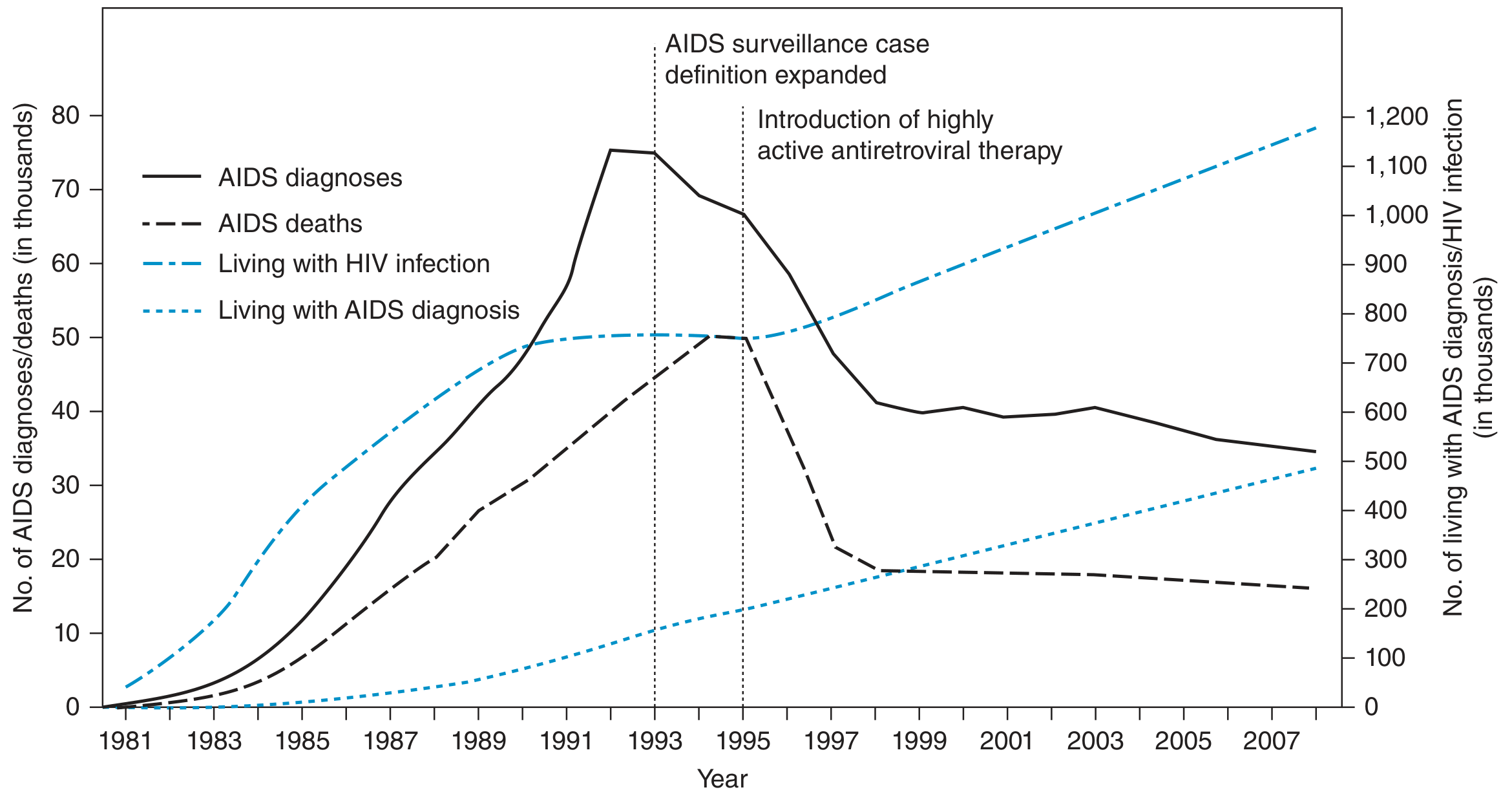
- HAART (1996) dramatically reduced AIDS deaths and morbidity (see graph below)
10. Antiretroviral Therapy (ART)
| Drug Class | Mechanism | Examples |
|---|---|---|
| NRTIs | Nucleoside/nucleotide RT inhibitors; chain terminators | Zidovudine (AZT), Tenofovir, Emtricitabine, Lamivudine, Abacavir |
| NNRTIs | Non-nucleoside RT inhibitors; allosteric binding | Efavirenz, Nevirapine, Rilpivirine, Etravirine |
| Protease Inhibitors (PIs) | Block viral protease; immature virions | Ritonavir, Darunavir, Atazanavir, Saquinavir |
| Integrase Strand Transfer Inhibitors (INSTIs) | Block viral DNA integration | Dolutegravir, Raltegravir |
| Fusion Inhibitors | Block gp41-mediated membrane fusion | Enfuvirtide |
| Entry Inhibitors (CCR5 antagonists) | Block CCR5 co-receptor | Maraviroc |
Current first-line regimen: 2 NRTIs + 1 INSTI (e.g., tenofovir + emtricitabine + dolutegravir in a single tablet).
Goals of ART:
- Reduce viral load to undetectable levels (<50 copies/mL)
- Raise CD4 count
- Prevent opportunistic infections
- Prevent transmission (U = U: Undetectable = Untransmittable)
Key limitations: No cure (viral reservoirs persist), drug resistance if non-adherent, lifelong treatment required.
Prevention of mother-to-child transmission: AZT regimen during pregnancy, labor, and neonatal period reduces transmission from 25-30% → <2%.
PrEP (Pre-Exposure Prophylaxis): Tenofovir-based regimens highly effective at preventing new infections in high-risk individuals.
11. Key Microbiological Features Summary
| Feature | HIV |
|---|---|
| Family | Retroviridae |
| Genus | Lentivirus |
| Genome | (+)ssRNA, diploid |
| Envelope | Yes (lipid bilayer) |
| Key enzymes | RT, Integrase, Protease |
| Key surface proteins | gp120, gp41 |
| Primary receptor | CD4 |
| Co-receptors | CCR5 (R5-tropic), CXCR4 (X4-tropic) |
| Integration | Into host chromosome as provirus |
| Diagnostic antigen | p24 |
| Cytopathic effect | CD4+ T-cell depletion, syncytia |
Sources:
- Sherris & Ryan's Medical Microbiology, 8th Ed.
- Jawetz, Melnick & Adelberg's Medical Microbiology, 28th Ed.
- Medical Microbiology, 9th Ed.
- Harrison's Principles of Internal Medicine, 22nd Ed. (2025)
- Janeway's Immunobiology, 10th Ed.
This is a shared conversation. Sign in to Orris to start your own chat.