
Varicus venous
Reading File
Now I'll search the medical library for varicose veins content in parallel.
Finding Sources
Searching PubMed
"varicose veins" AND treatment
Finding Sources
Good - Bailey and Love's has a dedicated VARICOSE VEINS section. Let me read that and the S Das content in parallel.
Reading File
Reading File
Reading File
Reading File
Reading File
Reading File
Reading File
Reading File
Reading File
Reading File
Reading File
Reading File
Reading File
I now have comprehensive content. Let me also fetch the key clinical image and read the complications/treatment outcomes section.
Reading File
Loading Image
I have a thorough knowledge base now. Let me compile the comprehensive answer.
Varicose Veins
Definition
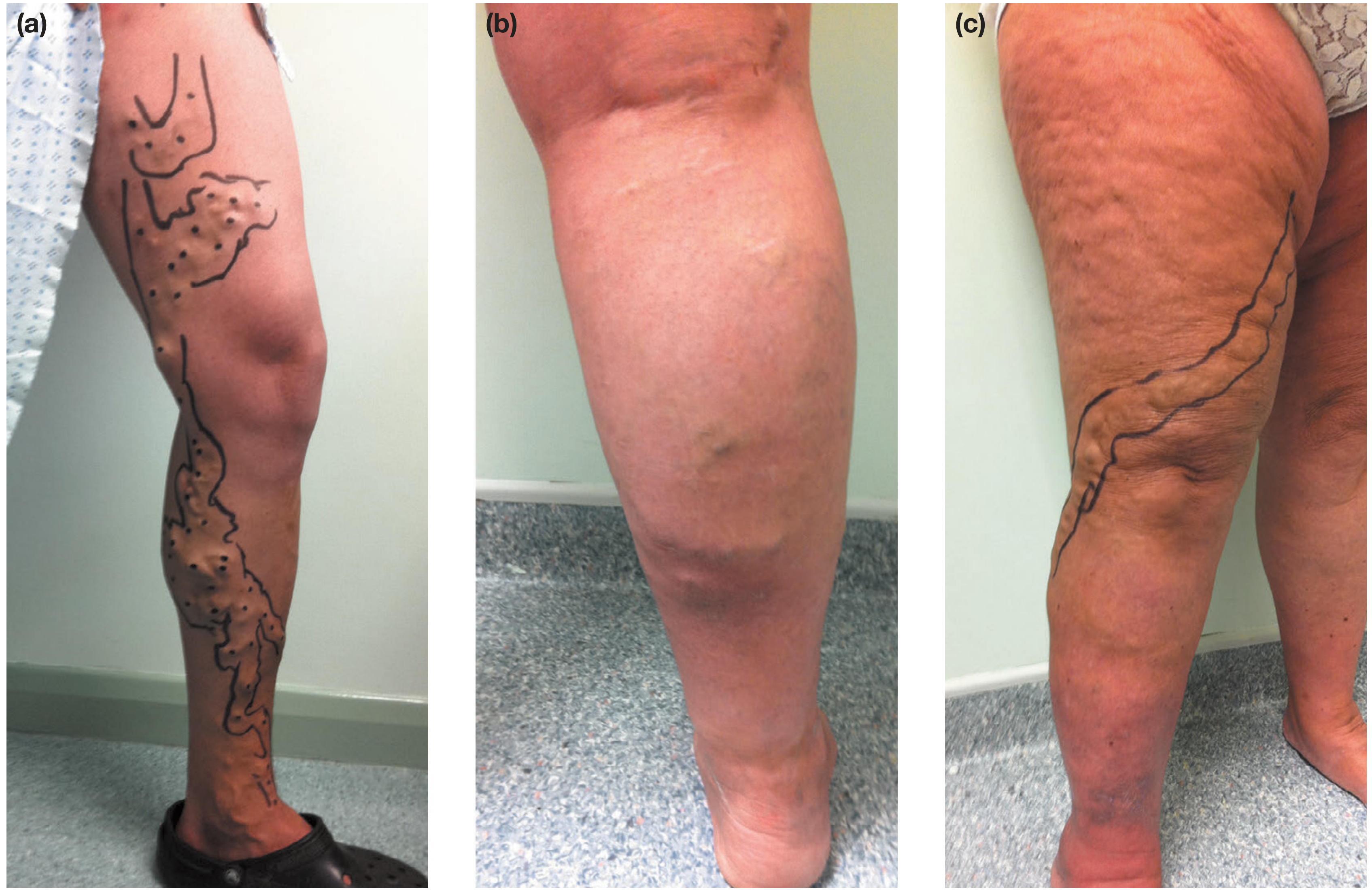
Varicose veins are subcutaneous dilated, tortuous veins 3 mm or more in diameter in the lower limb, defined by the presence of retrograde blood flow (reflux). They are frequently elongated and tortuous with intermittent "blowouts," but may also appear as straight, uniform tubes morphologically.
Pathophysiology
Varicose veins result from venous incompetence - failure of venous valves allowing retrograde flow with gravity. The underlying vein wall changes include:
- Inflammatory cell infiltration and activation
- Dysfunctional smooth muscle cell proliferation
- Collagen deposition and decreased elastin content
- Increased matrix metalloproteinases
- Loss of compliance, dilatation, and elongation (causing tortuosity)
- Secondary valvular dysfunction
These changes are not caused by a primary mechanical valvular failure alone - the mechanism is more complex and can be initiated anywhere in the venous tree. Secondary varicose veins develop in post-thrombotic limbs and in congenital conditions (e.g., Klippel-Trenaunay syndrome, multiple arteriovenous fistulae).
(Bailey and Love's, p. 1049)
Aetiology
- Valve incompetence - the most important factor; may be a sequel of venous thrombosis
- Erect posture - not seen in other animals; occurs in those who stand for prolonged periods (policemen, tram drivers, conductors)
- Pregnancy - progesterone-related smooth muscle relaxation plus uterine compression of pelvic veins
- Obstruction to venous return: abdominal tumours, fibroids, ovarian cysts, abdominal lymphadenopathy, retroperitoneal fibrosis, ascites
- Congenital arteriovenous fistulae - particularly in younger patients
- Hereditary - runs strongly in families
(S. Das, p. 105)
Clinical Features
Epidemiology
- Middle-aged individuals most commonly affected
- Women > men (ratio approximately 10:1)
- Less common in primitive civilisations (Africa, Far East)
Symptoms
- Aching pain in the leg, worst toward the end of the day, relieved by elevation
- Ankle swelling by end of day
- Itching of the skin over the leg
- Night cramps
- Bursting pain on walking (suggests coexisting deep vein thrombosis)
- Varicose ulcer on medial malleolus
Note: Symptoms do not necessarily correlate with the degree of visible varicosity. Asymptomatic varicose veins on one side and severe symptoms with minimal visible veins on the other side are both possible.
Clinical Classification (CEAP)
| Class | Features |
|---|---|
| C0 | No signs of venous disease |
| C1 | Telangiectasia or reticular veins |
| C2 | Varicose veins |
| C3 | Oedema |
| C4a | Pigmentation or eczema |
| C4b | Lipodermatosclerosis (LDS) or atrophie blanche |
| C4c | Corona phlebectatica |
| C5 | Healed venous ulcer |
| C6 | Active venous ulcer |
Classes can be further labelled: s (symptomatic), a (asymptomatic), or r (recurrent).
Aetiological: Ec (congenital), Ep (primary), Es (secondary/post-thrombotic), En (none identified)
Anatomical: As (superficial), Ap (perforator), Ad (deep), An (none)
Pathophysiological: Pr (reflux), Po (obstruction), Pr,o (both), Pn (none)
(Bailey and Love's, p. 1051)
Examination
Inspection
- Note which system is involved - long (great) saphenous or short (small) saphenous, or both
- Great saphenous: trunk on medial side of leg from in front of medial malleolus to saphenous opening in groin
- Small saphenous: trunk from behind lateral malleolus up the posterior calf to popliteal fossa
- Look for skin changes: eczema, pigmentation (haemosiderosis), lipodermatosclerosis, ulceration, scarring
Clinical Tests (Palpation)
| Test | Method | Interpretation |
|---|---|---|
| Brodie-Trendelenburg test | Empty veins in recumbent position; compress SFJ; stand patient up; release compression | Rapid fill from above = SFJ incompetence (positive) |
| Tourniquet test | Tourniquet applied at various levels after vein emptying; patient stands | Identifies level of incompetent perforator |
| Perthes' test | Elastic bandage applied; patient exercises | Crampy pain = deep vein obstruction |
| Modified Perthes' test | Tourniquet at upper thigh; patient walks briskly | Veins shrink = deep veins patent; veins distend = deep veins blocked |
| Schwartz test | Tap varicose vein distally; feel impulse at saphenous opening | Indicates continuous column (absent/incompetent valves) |
| Pratt's test | Esmarch bandage toe to groin; tourniquet at groin; re-apply bandage from groin downward | "Blowouts" at perforator positions |
| Fegan's method | Mark bulges standing; then elevate leg and palpate for fascial defects | Identifies perforator locations |
| Morrissey's test | Ask patient to cough | Cough impulse at saphenous opening = saphena varix |
Complications
- Haemorrhage - may be profuse due to high venous pressure; elevation of the limb is first aid
- Superficial thrombophlebitis (phlebitis) - spontaneous or post-trauma; vein becomes tender and firm, overlying skin red and oedematous, may have pyrexia
- Venous ulceration - typically on the medial malleolus, often associated with underlying deep vein thrombosis; follows lipodermatosclerosis
- Eczema / dermatitis - erythematous, itchy, may progress to blistering
- Lipodermatosclerosis - chronic inflammation and fibrosis resulting in "woody," contracted leg
- Haemosiderosis - brownish skin discoloration around ankle from haemoglobin breakdown
Investigations
Duplex ultrasound is the gold standard investigation. The patient stands for scanning. Key features:
- Reflux defined as retrograde flow lasting ≥ 0.5 seconds in superficial/crural veins
- Reflux in proximal deep veins requires ≥ 1 second
- The SFJ is identified in the groin using transverse view - the "Mickey Mouse sign" (CFV + CFA + GSV)
- Elicited by calf/foot squeeze release, Valsalva, or pneumatic cuff deflation
(Bailey and Love's, p. 1053)
Treatment
1. Conservative
- Compression hosiery (not a curative treatment but reduces symptoms)
- Elevation, weight loss, mobility
2. Endothermal Ablation (First-line for truncal incompetence)
Endovenous Laser Ablation (EVLA)
- Catheter placed under ultrasound guidance to the lowest point of reflux
- Perivenous tumescent anaesthesia administered
- Energy delivery ~60-80 J/cm used; catheter withdrawn during energy delivery
- Post-procedural compression applied
Radiofrequency Ablation (RFA)
- Similar principle using radiofrequency energy instead of laser
- Slightly less painful than EVLA; similar efficacy
3. Non-Thermal, Non-Tumescent Techniques
Ultrasound-Guided Foam Sclerotherapy (UGFS)
- Sclerosing agent (sodium tetradecyl sulphate most common) made into foam via Tessari method (1:3 or 1:4 sclerosant:air ratio, oscillated ~20 times)
- Foam stable for ~2 minutes; injected with leg elevated
- Effective for trunk and tributaries; higher recanalisation rates than thermal ablation
Mechanochemical Ablation (MOCA)
- Spinning wire physically damages endothelium while sclerosant is simultaneously injected
- No tumescent anaesthesia usually required
- Good option for needle-phobic patients; higher long-term recanalisation than endothermal
Endovenous Cyanoacrylate Glue
- Adhesive applied in 0.1 mL increments via catheter; vein compressed to seal lumen
- Minimal procedural pain; no tumescent anaesthesia
- Higher consumable cost; long-term data still emerging
4. Open Surgery (Traditional)
Saphenofemoral Junction (SFJ) Ligation + Great Saphenous Stripping
- Complete dissection of SFJ with flush ligation + stripping of GSV
- Usually under general anaesthesia
- Now superseded by endothermal techniques in most centres; reserved for complex or recurrent cases
Saphenopopliteal Junction (SPJ) Ligation + Small Saphenous Stripping
- Preoperative duplex marking of SPJ highly recommended
- Prone position; risk of sural nerve and popliteal vein injury
Phlebectomy (Ambulatory / Stab)
- Small stab incisions using mosquito forceps or phlebectomy hooks
- Used as adjunct to truncal ablation or as sole treatment for isolated tributary incompetence
(Bailey and Love's, p. 1054-1060)
Summary of Key Points
| Feature | Details |
|---|---|
| Definition | Dilated superficial veins ≥3 mm with reflux |
| Commonest system | Great saphenous vein (medial leg) |
| Key investigation | Duplex ultrasound (standing position) |
| First-line treatment | Endothermal ablation (EVLA or RFA) |
| Complication to fear | Bleeding (high pressure), DVT, venous ulcer |
| Key test | Brodie-Trendelenburg (SFJ incompetence) |
Recent evidence (2024): A network meta-analysis (PMID 38679141) compared polidocanol foam (Varithena) to endovenous thermal ablation, finding similar effectiveness. A meta-analysis (PMID 38316290) comparing RFA vs laser ablation for lower extremity varicose veins found similar outcomes. A systematic review (PMID 39559844) specifically addressed recurrent varicose veins at the saphenofemoral junction. No evidence currently suggests a need to revise the core management principles in the textbooks above.
Sources: Bailey and Love's Short Practice of Surgery 28th Ed., pp. 1049-1060; S. Das Manual on Clinical Surgery 13th Ed., pp. 105-110
Different types of ischemic heart disease
Finding Sources
Finding Sources
Searching PubMed
"ischemic heart disease" AND classification
Excellent - Braunwald's and Robbins' both have dedicated IHD sections. Let me read them in parallel.
Reading File
Reading File
The Robbins section is excellent. Now let me read the Braunwald dedicated IHD section and the Robbins detailed syndromes section in parallel.
Reading File
Reading File
Now let me read the Robbins detailed IHD syndromes section and the Braunwald block 14 which has more clinical detail:
Reading File
Reading File
Reading File
Reading File
I now have comprehensive content from Robbins covering all the IHD types. Let me also quickly check the angina section specifically and grab key images.
Reading File
Loading Image
I now have comprehensive information from both Robbins and Braunwald. Let me compile the full, well-organized answer.
Types of Ischemic Heart Disease (IHD)
Overview
Ischemic heart disease (IHD) is a broad term encompassing several closely related syndromes caused by an imbalance between cardiac blood supply and myocardial oxygen/nutritional demand. In more than 90% of cases, it results from reduced coronary blood flow due to obstructive atherosclerotic vascular disease - hence IHD and coronary artery disease (CAD) are often used synonymously.
IHD is the leading cause of mortality in high-income nations, accounting for approximately 7.5 million deaths worldwide each year.
(Robbins & Kumar Basic Pathology, p. 351)
Pathophysiology - The Two Core Mechanisms
1. Fixed ("Chronic") Atherosclerotic Occlusion
| Degree of Stenosis | Clinical Effect |
|---|---|
| < 70% lumen occlusion | Usually asymptomatic, even with exertion |
| > 70% ("critical stenosis") | Symptoms on exertion → Stable angina |
| ≥ 90% lumen occlusion | Symptoms even at rest → Unstable angina |
Plaques primarily affect: proximal LAD, proximal LCX, and entire RCA length.
2. Acute Plaque Change with Thrombosis / Vasospasm
- Sudden rupture, fissuring, ulceration, or erosion of a partially occlusive plaque exposes thrombogenic material
- Rapid thrombosis follows, causing abrupt complete or near-complete occlusion
- This underlies the three catastrophic ACS presentations: unstable angina, MI, and sudden cardiac death
Vasoconstriction is additionally driven by: adrenergic agonists, platelet products, endothelial dysfunction (loss of NO / excess endothelin), and perivascular inflammatory mediators.
The Four Clinical Syndromes of IHD
1. Angina Pectoris
Ischemia induces pain but is insufficient to cause myocyte death (no infarction). Literally "chest pain," it has three subtypes:
A. Stable Angina (Exertional Angina)
- Caused by fixed high-grade atherosclerotic stenosis (> 70%)
- Pain occurs predictably at certain levels of exertion and is relieved by rest or nitrates
- Imbalance between a fixed maximum coronary supply and increased demand (exercise, emotion)
- ST depression on ECG during episodes
- No myocardial necrosis
B. Vasospastic Angina (Prinzmetal Angina)
- Caused by coronary artery spasm - transient intense vasoconstriction of a coronary vessel
- Often occurs at rest, without obvious precipitant, and can occur even without significant fixed stenosis
- May be due to hyperreactivity of vascular smooth muscle or endothelial dysfunction
- ST elevation (not depression) during episodes - unlike stable angina
- Can be a precursor to MI if spasm is sustained
C. Unstable Angina
- Part of the Acute Coronary Syndrome (ACS) spectrum
- Caused by acute plaque disruption with non-occlusive or transiently occlusive thrombus
- Pain occurs with progressively less exertion, at rest, is more prolonged, or crescendo in pattern
- No troponin elevation (distinguishes it from NSTEMI)
- High short-term risk of progressing to MI
"Unstable angina is the most common initial presentation of ischemic heart disease." (Robbins, p. 352)
2. Myocardial Infarction (MI)
Ischemia is severe or prolonged enough to cause myocardial cell death (necrosis). Accounts for ~800,000 events/year in the USA.
A. STEMI (ST-Elevation MI)
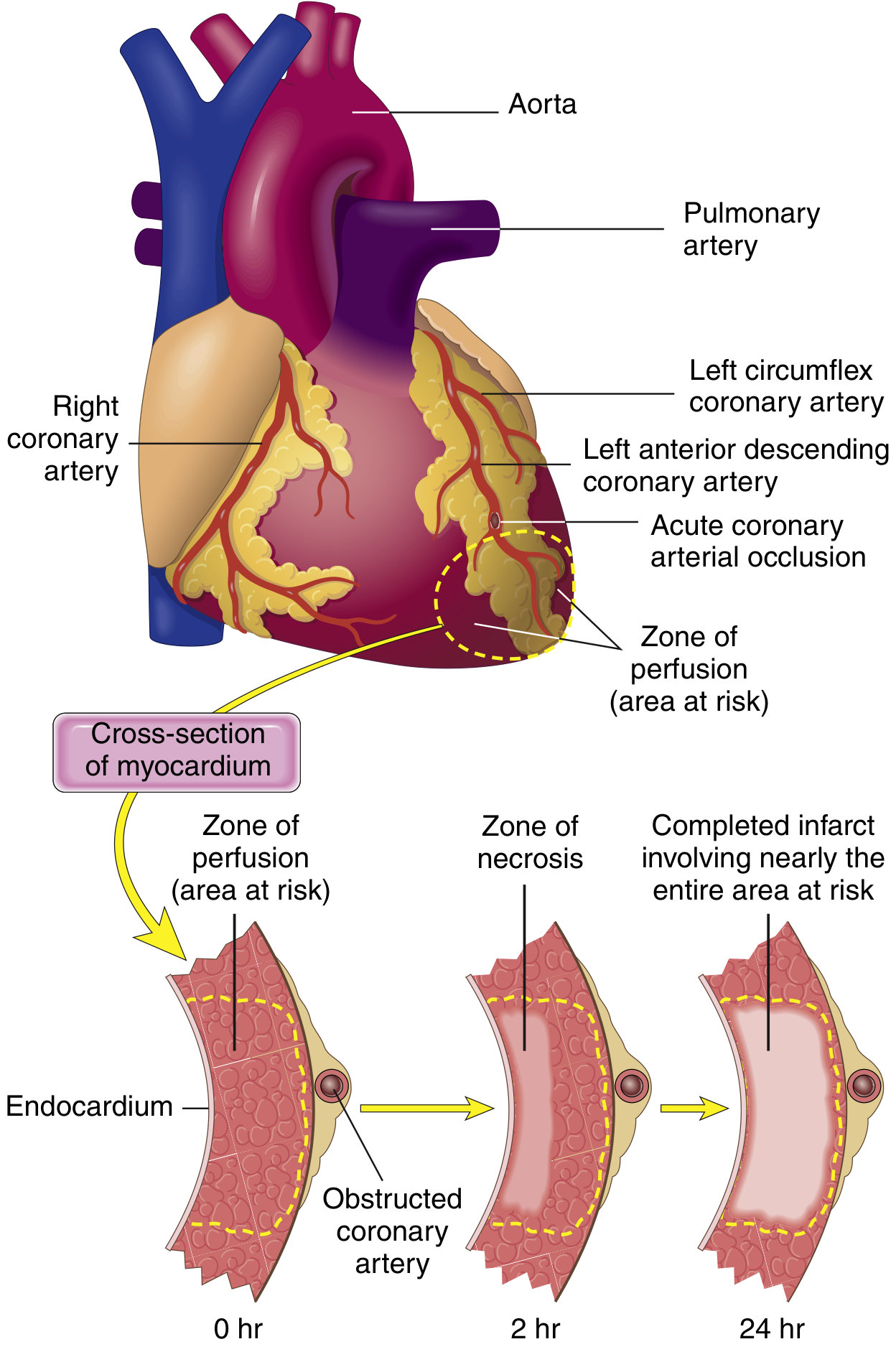
- Results from complete, abrupt occlusion of an epicardial coronary artery
- Causes transmural infarction - full-thickness necrosis of the ventricular wall
- ST elevation on ECG; Q waves develop later
- Treated with emergency reperfusion (primary PCI or thrombolysis)
- Higher in-hospital mortality (~10%)
B. NSTEMI (Non-ST-Elevation MI)
- Coronary thrombus is non-occlusive or transiently occlusive (or spontaneously lysed)
- Causes subendocardial infarction - limited to the inner third of myocardium
- No ST elevation; troponin IS elevated (distinguishes from unstable angina)
- In-hospital mortality ~6%
Coronary artery territory and infarct location:
| Vessel Occluded | Territory Infarcted | % of MIs |
|---|---|---|
| Proximal LAD | Anterior LV wall, anterior 2/3 septum, apex | 40-50% |
| RCA | Right ventricle, posterior/inferior LV | 30-40% |
| LCX | Lateral LV wall | 15-20% |
Patterns of infarction:
- Transmural: Full thickness; due to complete epicardial occlusion + atherosclerosis → STEMI
- Subendocardial: Inner 1/3 of myocardium; due to transient or partial occlusion → NSTEMI; subendocardium is most vulnerable (last to receive blood, highest intramural pressures)
Cardiac Biomarkers after MI:
| Marker | Rise | Peak | Normalization |
|---|---|---|---|
| Myoglobin | 1-4 hrs | 6-8 hrs | 24 hrs |
| CK-MB | 2-4 hrs | 24-48 hrs | ~72 hrs |
| Troponin I/T | 2-4 hrs | 48 hrs | 7-10 days |
Troponins are the preferred biomarker - most sensitive and specific. Elevated troponin allows MI diagnosis long after CK-MB has normalized.
Complications of MI (nearly 3/4 of patients experience at least one):
- Myocardial rupture (1-5% of MIs; peaks 3-7 days post-MI when granulation tissue is maximal):
- Ventricular free wall rupture → fatal hemopericardium/tamponade
- Interventricular septum rupture → VSD (most common type of rupture)
- Papillary muscle rupture → acute severe mitral regurgitation
- Arrhythmias - cause 80-90% of cardiac deaths in IHD setting (ventricular fibrillation)
- Left ventricular failure / cardiogenic shock
- Pericarditis (Dressler syndrome - autoimmune, weeks later)
- LV thrombus → systemic embolism
- Ventricular aneurysm - late complication of scar formation
3. Chronic IHD with Congestive Heart Failure
- Also called ischemic cardiomyopathy
- Results from progressive cardiac decompensation after acute MI or accumulated effect of multiple ischemic insults
- Viable but non-functional myocardium ("hibernating myocardium") contributes to pump failure
- "Stunned myocardium" - reversible non-contractile state after ischemia, before tissue death
- Eventually leads to mechanical pump failure (CHF)
- Prognosis is poor; treated with standard HF therapy + revascularization if viable myocardium present
4. Sudden Cardiac Death (SCD)
- Death within 1 hour of symptom onset, typically due to a lethal arrhythmia (ventricular fibrillation)
- In 80-90% of cases, underlying coronary artery disease is present
- Myocardial ischemia creates electrical instability of ischemic regions → VF
- May be the first manifestation of IHD in up to 20% of patients
- One-third of individuals with STEMIs die out-of-hospital before receiving care
- Survivors require ICD implantation and aggressive risk factor modification
Acute Coronary Syndrome (ACS) - Umbrella Term
The term ACS is applied to the three catastrophic manifestations:
ACS
├── Unstable Angina      (no biomarker rise, no ECG ST elevation)
├── NSTEMI               (biomarker rise, no ST elevation → subendocardial)
└── STEMI                (biomarker rise + ST elevation → transmural)
All three share the same pathophysiological basis: acute plaque disruption with thrombosis.
Summary Table
| Type | Mechanism | Necrosis | ECG | Troponin | Risk |
|---|---|---|---|---|---|
| Stable angina | Fixed stenosis >70% | None | ST depression (during pain) | Normal | Low (predictable) |
| Vasospastic angina | Coronary spasm | None | ST elevation (during pain) | Normal | Low-moderate |
| Unstable angina | Plaque disruption, partial thrombus | None | ST depression/T inversion | Normal | High (imminent MI) |
| NSTEMI | Partial/transient occlusion | Subendocardial | ST depression | Elevated | High |
| STEMI | Complete occlusion | Transmural | ST elevation + Q waves | Elevated | Highest |
| Chronic IHD/CHF | Cumulative ischemia | Diffuse fibrosis | Variable | Variable | High (long-term) |
| Sudden Cardiac Death | VF from ischemia | Variable | VF/VT | N/A | Fatal (unless resuscitated) |
Sources: Robbins & Kumar Basic Pathology, pp. 351-362; Braunwald's Heart Disease 12th Ed.
This is a shared conversation. Sign in to Orris to start your own chat.