
Paraneoplastic syndrome
Reading File
Finding Sources
Searching PubMed
"paraneoplastic syndrome" AND diagnosis
Finding Sources
Reading File
Now let me find the specific paraneoplastic sections in Harrison's and other key references:
Finding Sources
Finding Sources
Reading File
Reading File
Excellent — rich content retrieved. Let me get more from Harrison's on specific PNDs and also pull endocrine/other system syndromes:
Reading File
Reading File
I now have comprehensive content. Let me also fetch the key diagnostic image:
Loading Image
Finding Sources
Reading File
I now have comprehensive material from Harrison's 22E (2025). Let me compile the full, authoritative answer:
Paraneoplastic Syndromes
Paraneoplastic syndromes (PNS) refer to disorders that accompany benign or malignant tumors but are not directly related to mass effects or invasion — they arise from tumor-secreted substances (hormones, cytokines, growth factors) or tumor-triggered immune responses. They affect up to 15% of cancer patients and, critically, precede the cancer diagnosis in ~60–65% of cases, making recognition essential for early tumor detection.
Pathogenesis
Two major mechanisms operate:
1. Ectopic Hormone/Substance Production
Tumor cells (often poorly differentiated or dedifferentiated) express peptide hormones normally produced only by specific endocrine tissues. The resulting hormone excess is:
- Unregulated — defective feedback control (e.g., ACTH from SCLC is not suppressed by dexamethasone in standard doses)
- Aberrantly processed — large, unprocessed precursors (e.g., POMC instead of mature ACTH)
- Driven by epigenetic derepression, translocation, or cellular dedifferentiation
2. Autoimmune/Immune-Mediated (Paraneoplastic Neurologic Disorders)
Tumors ectopically express neural antigens → immune response generated against the tumor cross-reacts with the nervous system. Two mechanistic subtypes:
| Target Antigen Location | Mechanism | Antibody Examples | Response to Treatment |
|---|---|---|---|
| Intracellular | CD4+/CD8+ T-cell cytotoxicity predominates; antibodies cannot access the epitope | Anti-Hu, Anti-Yo, Anti-Ri | Poor — irreversible neuronal loss |
| Cell-surface / synaptic | Antibodies directly alter receptor function/structure | Anti-NMDAR, Anti-AMPAR, Anti-LGI1, Anti-CASPR2 | Better — often reversible |
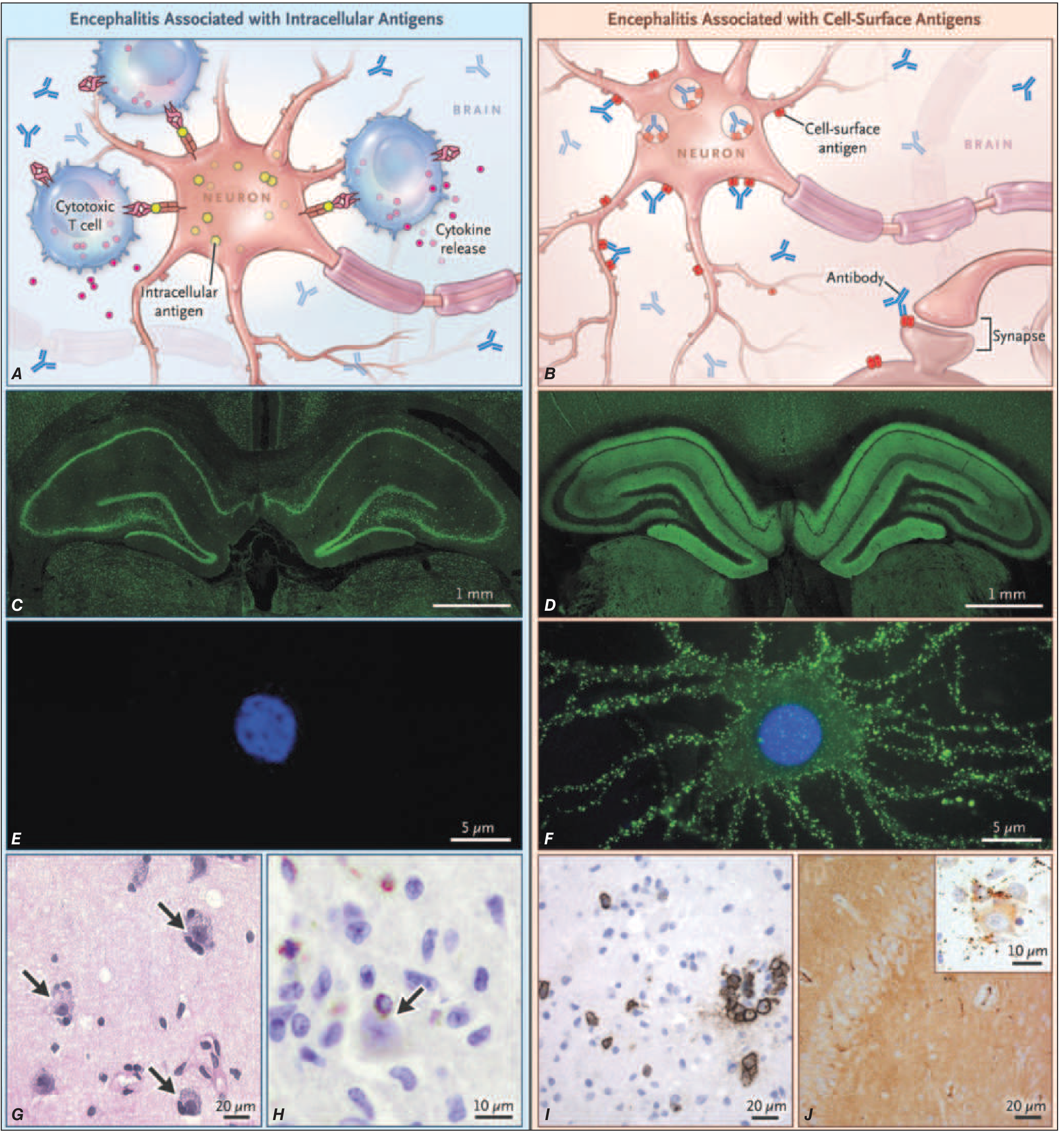
I. Endocrine Paraneoplastic Syndromes
The most common and clinically significant:
Hypercalcemia of Malignancy
- Most common paraneoplastic endocrine syndrome
- Mediator: PTHrP (parathyroid hormone-related protein) → activates PTH receptor
- Tumors: squamous cell carcinoma (lung, head/neck, esophagus), renal cell, breast, bladder
- Also caused by: ectopic 1,25-(OH)₂D (lymphoma), direct bone resorption via cytokines (myeloma), rarely ectopic PTH
Ectopic ACTH Syndrome (Cushing's Syndrome)
- Mediator: ectopic ACTH or CRH production
- Tumors: SCLC (#1), carcinoid tumors, medullary thyroid cancer, pheochromocytoma, pancreatic islet cell tumors
- Key features: rapid onset, profound hypokalemia, muscle wasting, hyperglycemia; classic cushingoid habitus often absent because tumor progression is too fast
- Biochemistry: very high cortisol, high ACTH, no suppression with high-dose dexamethasone
SIADH (Syndrome of Inappropriate ADH)
- Mediator: ectopic vasopressin secretion
- Tumors: SCLC (#1), head/neck squamous cell, primary brain tumors
- Presents: euvolemic hyponatremia, urine osmolality inappropriately high relative to serum
- Treatment: fluid restriction; demeclocycline for long-term control; tumor treatment is definitive
Other Endocrine Syndromes
| Syndrome | Mediator | Tumors |
|---|---|---|
| Non-islet cell hypoglycemia | IGF-2 (large retroperitoneal sarcomas, hepatocellular Ca) or insulin (islet cell) | Sarcomas, HCC, islet cell |
| Gynaecomastia / hCG excess | hCG, estrogens | Testicular germ cell, lung |
| Acromegaly | Ectopic GH or GHRH | Carcinoid, pancreatic islet cell |
| Hyperthyroidism | hCG (TSH-like activity) | Choriocarcinoma, gestational trophoblastic disease |
| Erythrocytosis | Ectopic EPO | RCC, cerebellar hemangioblastoma, uterine fibroids, HCC |
II. Neurologic Paraneoplastic Disorders (PNDs)
Clinically disabling PNDs occur in 0.5–1% of all cancer patients but 2–3% of SCLC/neuroblastoma patients and 30–50% of thymoma patients.
High-Risk Antibodies (>70% probability of underlying cancer)
| Antibody | Syndrome | Tumor |
|---|---|---|
| Anti-Hu (ANNA-1) | Encephalomyelitis, sensory neuronopathy | SCLC |
| Anti-Yo (PCA-1) | Rapidly progressive cerebellar degeneration | Ovary, breast |
| Anti-Ri (ANNA-2) | Cerebellar degeneration, opsoclonus, brainstem encephalitis | Breast, gynecologic, SCLC |
| Anti-CRMP5 (CV2) | Encephalomyelitis, chorea, optic neuritis, peripheral neuropathy | SCLC, thymoma |
| Anti-Tr (DNER) | Rapidly progressive cerebellar degeneration | Hodgkin's lymphoma |
| Anti-Ma2 | Limbic/hypothalamic/brainstem encephalitis | Testicular (young men) |
| Anti-Kelch-like protein 11 | Brainstem encephalitis, ataxia, sensorineural hearing loss | Seminoma, germ cell |
Intermediate-Risk Antibodies (30–70% probability of cancer)
Anti-NMDAR, Anti-AMPAR, Anti-GABA-B-R, Anti-LGI1, Anti-CASPR2
Specific PND Syndromes
Paraneoplastic Cerebellar Degeneration (PCD)
- Subacute onset of dysarthria, limb and gait ataxia, oculomotor dysfunction
- Pathology: severe Purkinje cell loss
- Antibodies: Anti-Yo (breast/ovarian), Anti-Tr (Hodgkin's), Anti-Hu (SCLC)
Paraneoplastic Encephalomyelitis / Limbic Encephalitis
- Limbic: subacute amnesia, personality change, temporal lobe seizures, psychiatric symptoms
- MRI: bilateral medial temporal lobe FLAIR hyperintensity
- Antibodies: Anti-Hu, Anti-Ma2, Anti-LGI1 (SCLC, testicular)
Paraneoplastic Sensory Neuronopathy
- Asymmetric numbness/burning paresthesias, loss of proprioception and vibration (posterior column)
- Anti-Hu (SCLC)
Lambert-Eaton Myasthenic Syndrome (LEMS)
- Proximal lower limb weakness; strength improves with sustained contraction (opposite to myasthenia gravis)
- Antibody: Anti-VGCC (voltage-gated calcium channels); >80% with SCLC also have Anti-SOX1
- EMG: incremental response at high-frequency (>10 Hz) stimulation
- Autonomic features common (dry mouth, erectile dysfunction)
Paraneoplastic Opsoclonus-Myoclonus
- Chaotic conjugate eye movements + myoclonus; in adults usually SCLC or breast (Anti-Ri)
- In children: neuroblastoma (most common cause)
Paraneoplastic Stiff-Person Syndrome
- Progressive rigidity, painful spasms of axial muscles; Anti-amphiphysin or Anti-GAD65
- Tumors: breast cancer (Anti-amphiphysin), SCLC
III. Hematologic Paraneoplastic Syndromes
| Syndrome | Mechanism | Associated Tumors |
|---|---|---|
| Erythrocytosis | Ectopic EPO | RCC, cerebellar hemangioblastoma, HCC |
| Granulocytosis / leukocytosis | Tumor production of G-CSF, GM-CSF, IL-6 | Lung, GI, GU cancers |
| Thrombocytosis | Ectopic thrombopoietin or IL-6 | Various carcinomas |
| Pure red cell aplasia | Autoimmune | Thymoma (#1) |
| Trousseau's syndrome | Hypercoagulability (mucin-secreting adenocarcinomas activate clotting) | Pancreatic, GI, lung adenocarcinoma |
IV. Dermatologic Paraneoplastic Syndromes
| Sign | Features | Tumor |
|---|---|---|
| Acanthosis nigricans | Velvety hyperpigmentation in skin folds | Gastric, GI adenocarcinoma |
| Dermatomyositis | Heliotrope rash, Gottron's papules, proximal myopathy | Lung, ovarian, breast, GI |
| Leser-Trélat sign | Sudden eruption of multiple seborrheic keratoses | GI, lymphoma |
| Paraneoplastic pemphigus | Severe mucocutaneous blistering | Lymphoma (NHL, CLL), thymoma |
| Necrolytic migratory erythema | Migratory, blistering rash in skin folds | Glucagonoma |
| Sweet's syndrome | Tender red plaques + fever + neutrophilia | AML, myelodysplastic syndrome |
V. Rheumatologic & Other
- Hypertrophic osteoarthropathy — periosteal new bone formation, clubbing; lung carcinoma
- Palmar fasciitis/polyarthritis syndrome — rapidly progressive joint contractures; ovarian cancer
- Paraneoplastic glomerulonephritis — membranous nephropathy (solid tumors, especially lung/GI), minimal change disease (lymphoma, NSAID-like)
Diagnosis
The Goldman-Cecil approach to evaluating a suspected PNS:
- Characterize the abnormality; obtain labs and biopsy as needed
- Eliminate common causes first
- If no obvious etiology → consider PNS
- If consistent with a known PNS → screen for occult malignancy (CT chest/abdomen/pelvis, PET-CT, tumor markers, testicular US in young men)
- Antibody panel (serum and CSF for neurologic PNDs)
- Course of the syndrome should parallel tumor course — a hallmark of PNS
Treatment
| Principle | Details |
|---|---|
| Treat the underlying tumor | Definitive treatment; resolution of PNS often follows tumor response |
| Immunosuppression (neurologic PNDs) | High-dose corticosteroids, IVIG, plasmapheresis, rituximab |
| Prognosis | Surface-antigen PNDs (anti-NMDAR, LGI1) respond better than intracellular-antigen PNDs (anti-Hu, anti-Yo) |
| Endocrine syndromes | Symptomatic management (bisphosphonates for hypercalcemia, fluid restriction + tolvaptan for SIADH, metyrapone/ketoconazole for ectopic ACTH) while treating the primary cancer |
Sources: Harrison's Principles of Internal Medicine 22E (2025), Ch. 98–99; Goldman-Cecil Medicine, Ch. 164; Bradley and Daroff's Neurology in Clinical Practice
This is a shared conversation. Sign in to Orris to start your own chat.