
barrack grading of cementing
Reading File
The Barrack grading system classifies the quality of cement mantle in total hip arthroplasty (THA) on postoperative X-rays. There are 4 grades (A-D), with Grade A being the best and Grade D the worst.
Searching sources...
Finding Sources
Finding Sources
Searching the Web
Barrack grading cementing total hip arthroplasty grades A B C D criteria
Good - found the content in Campbell's. Let me read that section and also check for images.
Reading File
I have all the information needed. Let me also fetch the X-ray image from the textbook.
Loading Image
Barrack Grading of Cement Mantle (Total Hip Arthroplasty)
The Barrack et al. (1992) grading system evaluates the quality of the femoral component cement mantle on postoperative radiographs. It was later modified by Mulroy et al. (1995). The system assesses radiolucency at the bone-cement interface.
Grades
| Grade | Description | Radiographic Finding |
|---|---|---|
| A | "White out" | Complete filling of the medullary canal - no radiolucencies. Best possible result. |
| B | Slight radiolucency | Radiolucency at the bone-cement interface involving < 50% of the interface. |
| C | Significant radiolucency | Lucency surrounding 50-99% of the interface, OR any cement mantle defect. |
| D | Worst | Complete lucency on any projection, OR a defect of the mantle at the stem tip. |
Memory Aid
A B C D = Amazing, Bordering, Concerning, Deadly (loosening likely)
Clinical Significance
- Grades A and B - acceptable cement mantles; associated with good long-term fixation
- Grades C and D - associated with significantly increased risk of aseptic loosening (as reported by Malik et al. and Chambers et al.)
- Mulroy et al. specifically noted that a cement mantle < 1 mm thick and defects in the mantle are associated with early loosening
Radiographic Examples (from Barrack et al., 1992)
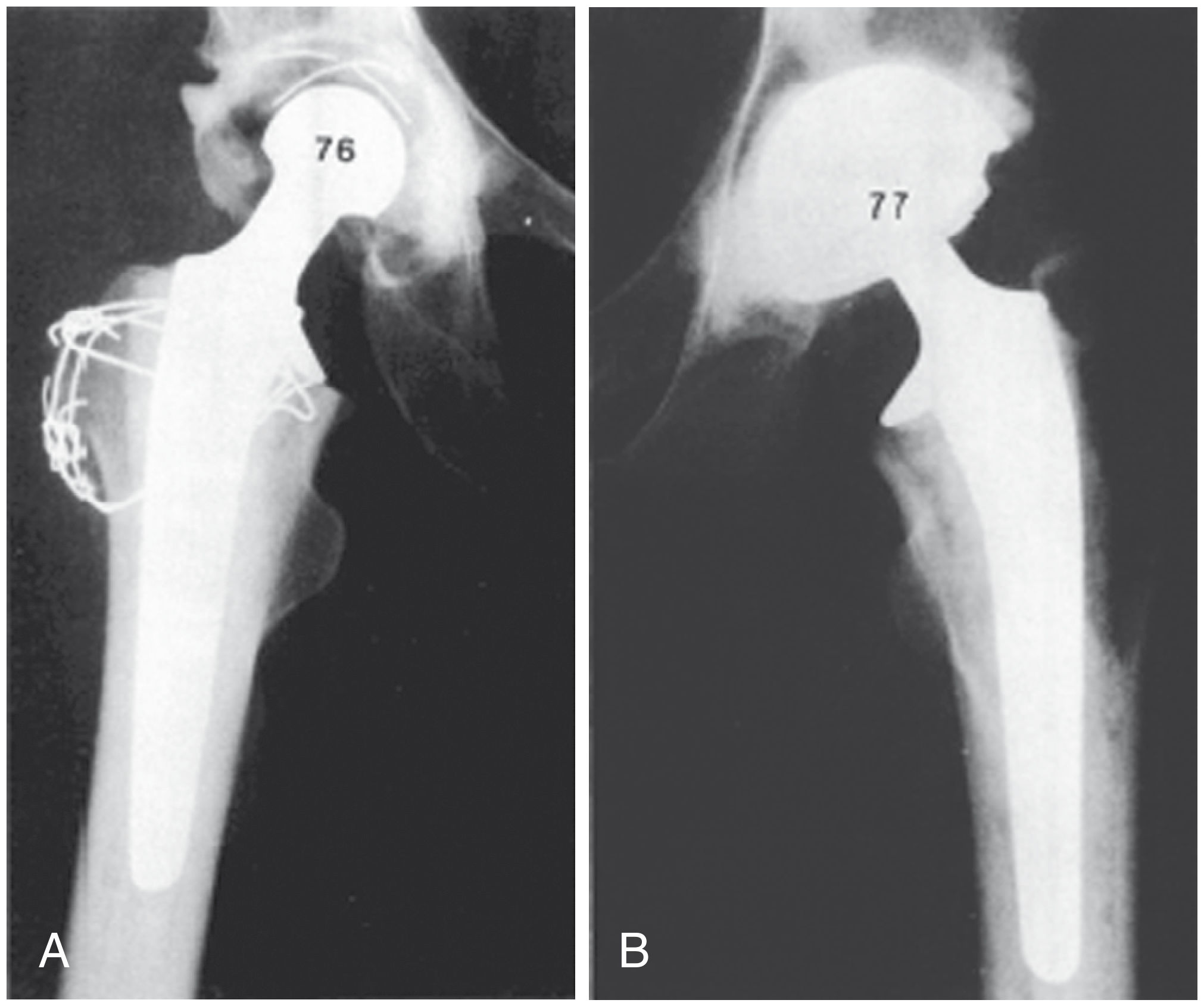
Fig: A = Grade A ("white out", excellent cement distribution). B = Grade B (slight radiolucencies at cement-bone interface).
Common Technical Failures Leading to Poor Grades (C/D)
- Inadequate distal cement plug - stem tip unsupported
- Removal of all trabecular bone, leaving no surface for cement intrusion
- Inadequate cement quantity or laminated bolus
- Failure to pressurize cement - poor penetration into interstices
- Stem motion during cement hardening
- Poor component alignment (not centralized in canal)
- Voids in cement due to poor mixing or injection technique
Source: Campbell's Operative Orthopaedics, 15th Ed. (2026), p. 325 | Original paper: Barrack RL, Mulroy RD, Harris WH. Improved cementing techniques and femoral component loosening - J Bone Joint Surg Br. 1992;74(3):385-389.
This is a shared conversation. Sign in to Orris to start your own chat.