
Pharynx ent according to ent book
Reading File
Searching the ENT textbook for comprehensive information on the pharynx, covering anatomy, physiology, and clinical aspects.
search_medical_text
pharynx anatomy divisions ENT
Bailey and Love's Short Practice of Surgery 28th Edition
Page 795
GradeResponse
GradeResponse
search_medical_text
nasopharynx oropharynx hypopharynx anatomy boundaries muscles
Bailey and Love's Short Practice of Surgery 28th Edition
Page 834
search_medical_image
nasopharynx oropharynx hypopharynx divisions landmarks

Hugging Face pmc clinical VQA raw
Page 0
GradeResponse
GradeResponse
Here is a comprehensive overview of the Pharynx as covered in ENT/surgical textbooks (Bailey & Love's Short Practice of Surgery, 28th Edition):
The Pharynx
Overview
The pharynx is a fibromuscular tube forming the upper part of both the respiratory and digestive passages. It extends from the base of the skull to the level of the 6th cervical vertebra (lower border of the cricoid cartilage), where it becomes continuous with the oesophagus.
(Bailey & Love's, p. 795)
Divisions
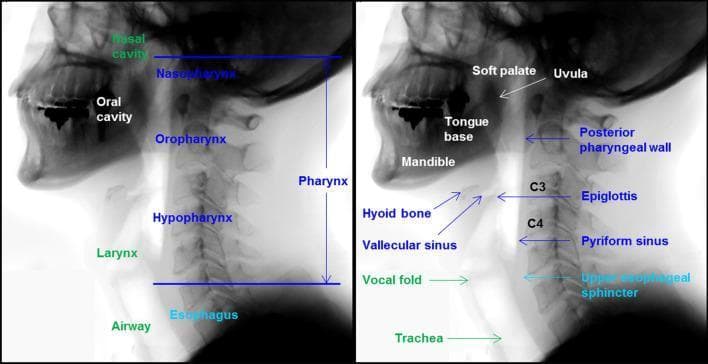
The pharynx is classically divided into three parts:
| Division | Boundaries | Key Structures |
|---|---|---|
| Nasopharynx | Cranial base → horizontal plane of posterior nasal spine (PNS) | Adenoids (pharyngeal tonsil), Eustachian tube openings, choanae |
| Oropharynx | PNS → superior border of epiglottis | Base of tongue, soft palate/uvula, palatine tonsils, posterior pharyngeal wall |
| Hypopharynx (Laryngopharynx) | Superior border of epiglottis → lower border of cricoid (C6) | Piriform fossae, postcricoid region, posterior pharyngeal wall |
Anatomy Diagram
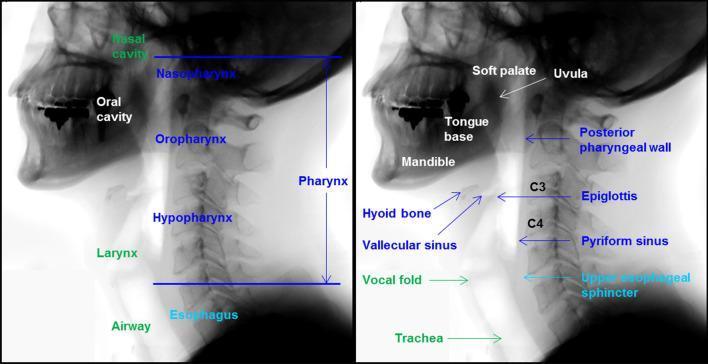
Lateral view showing pharyngeal segments with key landmarks: soft palate, uvula, epiglottis, vallecular sinus, piriform sinus, and upper oesophageal sphincter. Vertebral levels C3–C4 provide spatial orientation.
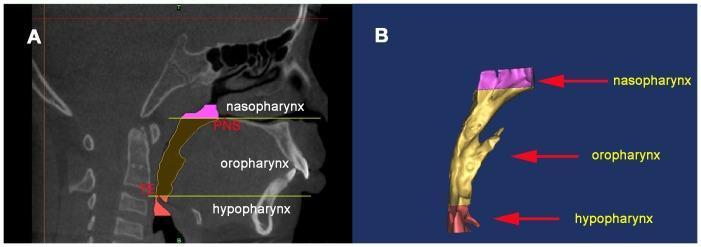
CBCT midsagittal and 3D volumetric reconstruction illustrating the three pharyngeal segments by color. Used in otolaryngology to assess airway volume and morphology.
1. Nasopharynx
- Located behind the nasal cavity, above the soft palate
- Communicates anteriorly with the nasal cavity via the choanae
- Contains the pharyngeal tonsil (adenoids) on its roof and posterior wall
- The Eustachian (auditory) tube opens on each lateral wall, surrounded by the torus tubarius
- The fossa of Rosenmüller (pharyngeal recess) lies posterior to the torus tubarius — an important site for nasopharyngeal carcinoma
2. Oropharynx
- Lies behind the oral cavity, between the soft palate above and the epiglottis below
- Contents include:
- Base of tongue (posterior 1/3, lingual tonsil)
- Soft palate and uvula
- Palatine tonsils in the tonsillar fossae (between palatoglossal and palatopharyngeal arches)
- Posterior pharyngeal wall
- The Waldeyer's ring of lymphoid tissue encircles this region (adenoids + palatine tonsils + lingual tonsil + lateral pharyngeal bands)
3. Hypopharynx (Laryngopharynx)
- Extends from the superior border of the epiglottis to the lower border of the cricoid
- Three sub-sites (important in oncology):
- Piriform fossae (most common site for hypopharyngeal carcinoma)
- Postcricoid region
- Posterior pharyngeal wall
- Anteriorly related to the larynx
- Becomes the oesophagus at C6
Muscles of the Pharynx
Constrictors (outer circular layer):
| Muscle | Origin | Function |
|---|---|---|
| Superior constrictor | Pterygoid hamulus, mandible, tongue | Closes upper pharynx during swallowing |
| Middle constrictor | Hyoid bone | Propels bolus downward |
| Inferior constrictor | Thyroid & cricoid cartilages | Closes lower pharynx; cricopharyngeus = upper oesophageal sphincter |
Longitudinal muscles (inner layer — elevate the pharynx):
- Stylopharyngeus (CN IX)
- Palatopharyngeus
- Salpingopharyngeus
Nerve Supply
| Function | Nerve |
|---|---|
| Motor (all constrictors) | Vagus (CN X) via pharyngeal plexus |
| Motor (stylopharyngeus) | Glossopharyngeal (CN IX) |
| Sensory — nasopharynx | Maxillary branch (CN V2) |
| Sensory — oropharynx | Glossopharyngeal (CN IX) |
| Sensory — hypopharynx | Internal laryngeal branch of vagus (CN X) |
Blood Supply
- Ascending pharyngeal artery (branch of external carotid)
- Ascending palatine and tonsillar branches of facial artery
- Lingual artery (base of tongue)
- Pharyngeal branches of maxillary artery
Venous drainage → pharyngeal venous plexus → internal jugular vein.
Lymphatic Drainage
- Nasopharynx → retropharyngeal nodes → upper deep cervical nodes
- Oropharynx → upper deep cervical (jugulodigastric) nodes
- Hypopharynx → mid/lower deep cervical nodes
Physiology
The pharynx serves dual roles:
- Respiratory — air passage between nasal/oral cavities and larynx/trachea
- Digestive — food/liquid passage; swallowing (deglutition) involves coordinated pharyngeal muscle contraction
- Speech resonance — acts as a resonating chamber
- Eustachian tube function — nasopharynx plays a role in middle ear ventilation
Clinical Relevance
| Condition | Location |
|---|---|
| Adenoid hypertrophy | Nasopharynx |
| Nasopharyngeal carcinoma | Fossa of Rosenmüller, nasopharynx |
| Tonsillitis / peritonsillar abscess | Oropharynx |
| Obstructive sleep apnoea | Oropharynx/soft palate |
| Hypopharyngeal carcinoma | Piriform fossa (most common) |
| Globus pharyngeus | Hypopharynx |
| Pharyngeal pouch (Zenker's diverticulum) | Killian's dehiscence (between inferior constrictor and cricopharyngeus) |
Primary source: Bailey & Love's Short Practice of Surgery, 28th Edition, p. 795 & 834
This is a shared conversation. Sign in to Orris to start your own chat.